
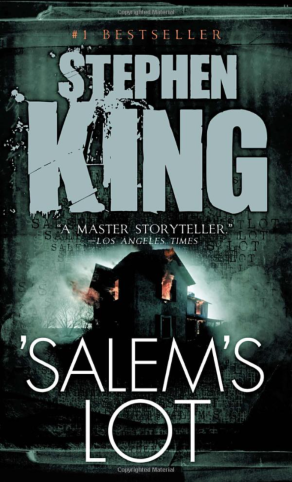
I love Stephen King. I watch his interviews and lectures on YouTube, and I re-read his book, On Writing, once or twice a year, finding it one of the best meditations on the craft around, not to mention a very fine memoir. I follow him on Twitter (er…X), and you should, too (he’s @StephenKing, if you’re interested).
And yet, in one of the stranger ironies of my adult life, I went over twenty years without reading a King novel. Sure, I once devoured books like The Stand and Firestarter in high school, but then I became an English major and, for a multitude of reasons, I stopped.
It wasn’t that King became uncool or anything like that. Even in the rarified world of a university Lit department, he always had a kind of cachet, especially on the MFA side of the hall. Anyone who appreciated good, taut writing and a first-rate imagination had at least a shrugging admiration for King’s stuff. (My writing teacher, Harry Crews, once called him “brilliant.”) Take this passage from ‘Salem’s Lot where the hero, a writer named Ben, meets his love interest:
“I thought I was seeing a ghost.” She held up the book in her lap. He saw fleetingly that “Jerusalem’s Lot Public Library” was stamped on the thickness of pages between covers. The book was Air Dance, his second novel. She showed him the photograph of himself on the back jacket, a photo that was four years old now. The face looked boyish and frighteningly serious—the eyes were black diamonds.
“Of such inconsequential beginnings dynasties are begun,” he said, and although it was a joking throwaway remark, it hung oddly in the air, like prophecy spoken in jest. Behind them, a number of toddlers were splashing happily in the wading pool and a mother was telling Roddy not to push his sister so high. The sister went soaring up on her swing regardless, dress flying, trying for the sky. It was a moment he remembered for years after, as though a special small slice had been cut from the cake of time. If nothing fires between two people, such an instant simply falls back into the general.
How many thousands of current and former MFA students (myself included) wish they could write a passage like that? Note the way King evokes the emotional stakes that have just risen for this character, making what might be, in the hands of a lazy writer, just a functional plot point into a moment of real invention.
Also, regarding King’s literary cred, it didn’t hurt that, by the end of the 1980s, many of his books had already been made into films. Two of them—The Shining by Stanley Kubrick and The Dead Zone by David Cronenberg—became classics. Hell, if Stanley Fucking Kubrick liked the man’s books, there has to be something there. That’s the kind of intellectual gravitas that no self-respecting English nerd can ignore.
Nor did I stop King because I gave up genre fiction entirely. Even into my early twenties, I still read a fair amount of genre fiction—mostly sci-fi and mysteries, by talented writers like William Gibson and Charles Willeford, respectively.
But no King. It took me a long time to realize why. In fact, I didn’t really figure it out until I recently downloaded one of this first classics, ‘Salem’s Lot, onto my Kindle. I was in the mood for something Halloween-worthy, and I remembered my step-mother Eileen’s enthusiastic recommendation of the book when she read it back in 1977. So, I began reading, and I hit the same wall I had run into the last two or three times I attempted to read a King novel—he has so many friggin’ characters.
Yeah, I know. It’s a stupid complaint. I mean, how many characters does Tolstoy throw at you? But it’s not just the sheer number of characters King presents, but the relatively small amount of time he spends on each. Like many genre writers, King likes to focus on one character per section—sometimes several characters in one chapter–using the 3rd Person Point-of-View to render each one with a few deft brushstrokes. Often, the characters are delineated more by their occupation (high school teacher, cop, doctor, handyman, etc.) than by their voice or any particular aspect of their character. Too often, King’s characters fall into three buckets: good-but-clueless people, smart-but-wicked people, and Satanically evil people.
But, for whatever reason, I decided to stick with ‘Salem’s Lot this time. And as I powered through the first few chapters, I began to realize something: King doesn’t care about characters; he cares about communities. With his huge cast of characters, all living and working in the same town, ‘Salem’s Lot began to feel almost Dickensian to me, or perhaps even Sherwood Anderson’s Winesburg, Ohio.
It took me twenty years to realize that my complaints about King’s fiction were not so much intellectual or aesthetic as much as simply a matter of taste—a quirk. It’s not that King doesn’t fill his books with sharp and kinky detail, but rather that those details are easy to miss due to the sheer size of his canvas. And as I continued reading ‘Salem’s Lot (with increasing speed and enthusiasm), I began to see that King’s greatest theme is the same as that of Ray Bradbury’s—the issue of how human community (that is, the town) blunts the imagination and morality of the individual.
With the exception of The Shining—which seems an outlier in King’s body of work—most of his novels take place in small towns. From It to Under the Dome, the town itself becomes a character—a menacing, constricting force. The pressure to conform and ignore that the town exerts always serves the purpose of the ostensible “real” villain, be he a carnivorous alien or a vampire or the Devil himself.
Another, related theme of King’s is how the transition to adulthood itself—and the subsequent entry into the adult community—marks the end of the childlike imagination.
As one character in ‘Salem’s Lot muses:
There was a ruined church along the way, an old Methodist meetinghouse, which reared its shambles at the far end of a frost-heaved and hummocked lawn, and when you walked past the view of its glaring, senseless windows your footsteps became very loud in your ears and whatever you had been whistling died on your lips and you thought about how it must be inside—the overturned pews, the rotting hymnals, the crumbling altar where only mice now kept the sabbath, and you wondered what might be in there besides mice—what madmen, what monsters. Maybe they were peering out at you with yellow reptilian eyes.
And maybe one night watching would not be enough; maybe some night that splintered, crazily hung door would be thrown open, and what you saw standing there would drive you to lunacy at one look. And you couldn’t explain that to your mother and father, who were creatures of the light. No more than you could explain to them how, at the age of three, the spare blanket at the foot of the crib turned into a collection of snakes that lay staring at you with flat and lidless eyes. No child ever conquers those fears, he thought.
That’s why so many of King’s heroes are kids. Nerds. Geeks. Disabled kids. People with Down Syndrome. And it is this compassion for the underdog that makes me like King so much. Ironically, King’s fiction—with its monsters and killer St. Bernard’s and telepathic powers—often reads like great, gritty social realism. In ‘Salem’s Lot, for example, one of the more pathetic characters is named Dud, a hunchback who runs the local dump. When the main vampire in the story confronts Dud, King is able to show just how easily the poor and abused can be seduced by evil (a lesson for the Trump era if ever there was one):
“Well…gettin’ late and all…you really ought to go now, Mister—?”
“But it’s so pleasant, speaking with you,” the old party said, and for the first time he turned his full face to Dud and looked in his eyes. The eyes were wide-set, and still rimmed with the dump’s sullen fire. There was no way you could look away from them, although it wasn’t polite to stare. “You don’t mind if we converse a bit longer, do you?”
“No, I guess not,” Dud said, and his voice sounded far away. Those eyes seemed to be expanding, growing, until they were like dark pits ringed with fire, pits you could fall into and drown in. “Thank you,” he said. “Tell me…does the hump on your back discommode you in your job?”
“No,” Dud said, still feeling far away. He thought faintly: I be buggered if he ain’t hypnotizin’ me. Just like that fella at Topsham Fair…what was his name? Mr Mephisto. He’d put you to sleep and make you do all kinds of comical things—act like a chicken or run around like a dog or tell what happened at the birthday party you had when you were six. He hypnotized ole Reggie Sawyer and Gawd didn’t we laugh…
“Does it perhaps inconvenience you in other ways?”
“No…well…” He looked into the eyes, fascinated.
“Come, come,” the old party’s voice cajoled gently. “We are friends, are we not? Speak to me, tell me.” “Well…girls…you know, girls…”
“Of course,” the old party said soothingly. “The girls laugh at you, do they not? They have no knowing of your manhood. Of your strength.”
“That’s right,” Dud whispered. “They laugh. She laughs.”
“Who is this she?”
“Ruthie Crockett. She…she…” The thought flew away. He let it. It didn’t matter. Nothing mattered except this peace. This cool and complete peace.
“She makes the jokes perhaps? Snickers behind her hand? Nudges her friends when you pass?”
“Yes…”
“But you want her,” the voice insisted. “Is it not so?”
“Oh yes…”
“You shall have her. I am sure of it.” There was something…pleasant about this. Far away he seemed to hear sweet voices singing foul words. Silver chimes…white faces…Ruthie Crockett’s voice. He could almost see her, hands cupping her titties, making them bulge into the V of her cardigan sweater in ripe white half-globes, whispering: Kiss them, Dud…[…] It was like drowning. Drowning in the old man’s red-rimmed eyes.
As the stranger came closer, Dud understood everything and welcomed it, and when the pain came, it was as sweet as silver, as green as still water at dark fathoms.
Good stuff. Check it out.

 Ash Clifton, Writer