Cathy and I have been watching season 4 of Dark Winds on Netflix, and I was thrilled to see the fine German actress Franke Potenta playing the villain. She was Lola in Run Lola Run, one of the coolest films of the 90s. (She was also the love interest in the first Bourne movie.) Nice to see she’s still doing great work.
Run Lola Run was also notable for its amazing, propulsive soundtrack, which perfectly fits the action of the film. (You’ll have to watch it to see what I mean.) I liked the soundtrack so much I bought it–on CD, no less. (Yeah, it’s old. So am I.) And I wrote many line of software code while listening to it. Of course, it’s not really “rock.” It’s techno, or EDM, or whatever they’re calling such music these days.
Whatever it is, it rocks.
Here is the premier track, “Believe,” on which Ms. Potente’s voice can be heard speaking. Enjoy!
Well, the day has arrived. My debut novel, Twice the Trouble, is a Kindle Daily Deal for $1.99 today on Amazon. The offer will stand until 11:59 P.M. tonight, Pacific Standard Time, at which point it will turn into a pumpkin or…something. (Actually, it will just end.)
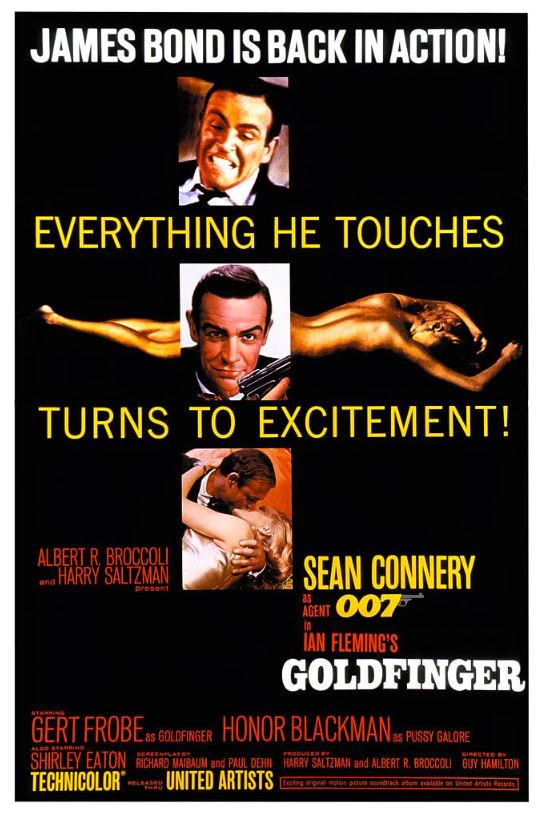
So, to finish my list of Great Movie Countdowns, I’m selecting what many people think is the greatest James Bond movie of all, 1964’s Goldfinger, directed by series veteran Guy Hamilton.
One of the most magical things about James Bond, the character, is that he knows how to do just about everything. He can fight and shoot, of course. But he can also fly a plane, drive a tank, sail a boat, race a motorcycle, surf, and even (as he shows in Goldfinger) play a mean-and-dirty round of golf.
One thing Bond does not know how to do, unfortunately, is disarm an atomic bomb. Which is a problem, because that’s exactly the threat he faces in the climax of Goldfinger. Bond finds himself locked inside the huge, cavernous vault of Fort Knox, surrounded by stacks of gold bars and handcuffed to said atomic bomb, with just a few minutes ticking down on the device’s timer. (This might be the first use of a digital timer in any major motion picture; let me know in the comments if you can think of an earlier one.)
As if this weren’t bad enough, Bond isn’t alone inside the vault. Goldfinger’s chief henchman, Odd Job, is in there too. If Goldfinger is the best Bond movie ever, then Odd Job is the scariest Bond henchman ever. Played by Japanese-American wrestler Harold Sakata, he has such a great, imposing physical presence—a hulking man who seems barely able to hold his own strength in check. When he crushes a golf ball with his bare hands, we, as viewers, really believe he could do it! But what really makes Odd Job scary is his evil little smile. He always seems bemused, enjoying himself, even when he throws a guy off a balcony or throws his steel-brimmed bowler hat into someone’s neck.
In the movie’s climactic countdown (yes, another countdown to nuclear self-destruction), Odd Job seems determined—even happy—to make sure the bomb goes off, despite the obvious fact that it will mean his own death, too. Odd Job, it seems, isn’t afraid of anything except failing in his mission, which makes him that much scarier.
My classics professor in college once said that James Bond is the modern version of Heracles, who, like Bond, loves to fight, drink, and sleep around. Sure enough, the final battle between Bond and Odd Job feels a lot like a Greek myth, with the hero battling a monster—one with some really scary weapons—to the death. And, as in a Greek myth, the contest ends with an example of poetic irony. Odd Job is undone by his own superpower—in this case, his favorite weapon, that lethal, steel-brimmed hat. Bond manages to get hold of it and throws it at him. It misses, alas, and lodges into some steel bars. Instead of just finishing Bond off, though, Odd Job goes to retrieve his beloved hat, at which point Bond slides across the floor and touches a loose power cable to the bars. Current conducts through the bars and through the steel hat, electrocuting the villain. Thus, the monster is defeated by his own magic.
But what about the bomb? Looking inside the device, Bond seems genuinely clueless, for once, bewildered by all the wires and blinky lights. Pathetically, he even tries to stop the machine’s spinning cylinder (which holds, we presume, the cobalt-iodine mixture that makes the bomb “particularly dirty,” in Goldfinger’s words). All to no avail.
Then, with mere seconds left, a man’s gentle hand sweeps in, stops Bond’s frantic groping, and turns the bomb off with the flick of a switch. With the crisis averted, Bond and the man—who looks like a wizened college professor, wearing a brown suit and hat, his face serious yet calm—face each other. A strange look passes between them. A mixture of relief, puzzlement, and awe, the look seems to suggest the entire absurd, insane reality of the Cold War, if not modern existence itself. “How did we get here?” the look seems to say.
Well, it’s just one more day until my book becomes a Kindle Daily Deal on Amazon (the offer starts at midnight tonight, Pacific Standard Time). The next movie on my Great Movie Countdowns list is my favorite B-Movie of all time, John Carpenter’s Escape from New York(EFNY).
EFNY is probably the best example of a classic movie countdown because almost the entire movie is a countdown. War-hero turned bank-robber Snake Plissken has exactly twenty-four hours to find the President of the United States somewhere in the yawning, black hulk of Manhattan, now turned into an open-air prison by the U.S. government. If Snake doesn’t find the POTUS and get him out alive before time runs out, tiny explosives implanted in Snake’s neck will detonate, killing him instantly. Such is the deal made to him by the coldly practical Police Commissioner Bob Hauk (played by Lee Van Cleef in his greatest role since The Good, the Bad, and the Ugly): get the POTUS out alive and you’ll get a pardon. Otherwise, you’re dead.
So, armed to the teeth, Snake infiltrates the island and begins his desperate search. All the while, he keeps checking his special, way-cool digital watch, which looks exactly like a beefed-up version of the first Casio digital watch that me and all my friends had back in the day. The watch doesn’t tell time, of course—it’s a life-clock, counting down the hours, minutes, and seconds until Snake’s neck goes boom.
To make matters worse, there are many people in New York who feel that twenty-four hours is far too long for Snake to live. Chief among them is the Duke of New York, the sinister war-lord who controls the prison, played with great panache by the great musician Isaac Hayes, of “Shaft” fame.
Kurt Russell famously said that Snake is always just trying to live through “the next 60 seconds. Living for exactly that next minute is all there is.” Carpenter’s genius lies in filling every one of those “next minutes” with some new, compelling, and darkly magical moment of mayhem, all of which Snake must overcome in some unexpected and thrilling way.
The final chase scene where Snake and his companions race across the fictional 69th Street Bridge, dodging mines, with The Duke in hot pursuit is a classic. But my favorite moment in the film comes much earlier, when Snake, realizing he has almost no chance of finding the president, gets out his radio, calls Commissioner Hauk, and asks if he can just come out. “I’ll burn you off the wall,” Hauk coldly replies. At which point Snake looks at the radio and says, mostly to himself, “A little human compassion.”
Snake does, in fact, find that little bit of “human compassion” in the course of the movie, when he makes some new friends who help him escape. More importantly, he finds it in himself, too. But that doesn’t stop him from being a bad-ass.
It’s T-Minus two days and counting until my book becomes a Kindle Daily Deal on Amazon (that’s right, on Thursday, August 6). And, to commemorate this, the next movie on my Great Movie Countdowns list is Ridley Scott’s 1979 masterpiece, Alien.
Alien is the greatest sci-fi monster movie ever made. And so it makes sense that it also has the greatest countdown-to-self-destruct sequence of any sci-fi movie ever made. It works because of Ridley Scott’s great direction and Sigourney Weaver’s brilliant performance as Ripley, the ship’s sole survivor, who has started the self-destruct sequence herself. In what is surely one of the most impressive examples of physical acting in Hollywood history, she ducks and weaves through steam-filled corridors, holding a flame-thrower, peeking around each corner to see if the huge, metallic-skinned alien is there.
Sure enough, the alien appears, blocking her way to her shuttle-craft, and she is forced to go ALL the way back to the ship’s control room. When she discovers that she’s too late to stop the self-destruct, she briefly breaks into tears. It’s a heartbreaking moment, one which becomes thrilling when she defiantly yells “You bitch!” at MOTHER, the ship’s AI, and then steels herself to reaching the shuttle, alien or no-alien.
I love how the last 15 minutes of the movie function as a complete contrast to the 105 minutes that came before—that is, the first and second acts of the film, which are mostly filled with moments of silent, creeping horror as the crew tries to find the alien xenomorph (before it finds them). The last act, however, is a brazen, nerve-wracking light- and sound-show, full of strobes, klaxons, hissing steam vents and general mayhem as the good ship Nostromo prepares to blow itself to smithereens. Honestly, I’m not sure the film could be made today in the same way, even with a slew of those “epilepsy-warning” messages at the beginning. It’s that intense. I remember seeing the film in the theater and being battered into my seat.
It’s also the definitive sci-fi-self-destruct sequence, better than all that came before or since. (Yes, even better than the “five-minutes-until-the-Death-Star-blasts-Yavin-to-bits” sequence at the end of Star Wars.) It’s just damned good filmmaking.
As noted by film scholar Eleanor Johnson, it also marks an important moment in American feminism, with Ripley being the first completely compelling female action hero in cinema. She’s not only smart, brave, and strong, she’s honorable. She doesn’t need to blow up the ship; she could just escape on the shuttle-craft. But destroying the ship is the only way to prevent MOTHER from flying it back to Earth on auto-pilot along with its horrifying passenger, the alien. So, Ripley risks her own life to kill the bastard. (Which she does, but not in the expected way.)
The countdown is an obvious dramatic instrument. You might think it was strictly a modern invention—depending, as it does, on a clock ticking—but I think it goes back to at least the 19th Century. Jules Verne’s Around the World in Eighty Days is based around an (extremely long) countdown. And in the Sherlock Holmes stories of the 1890s, Holmes often finds himself racing against the clock, desperate to find some missing treaty or compromising letter that, if not secured in time, will spell certain doom.
As for film, one of the greatest westerns of all time, High Noon, has an obvious, analog countdown, with the camera often showing the town’s clock as it sweeps toward noon. (That’s when a gang of bad guys is expected to arrive on the train and kill the heroic sheriff, Gary Cooper.)
In modern fiction films—and especially genre films like science fiction and spy movies—the digital countdown has become something of a staple. Over the next four days, I’m going to discuss four of my favorites.
For this first installment, I choose what is still one of my favorite sci-fi movies of all time, Robert Wise’s 1971 masterpiece, The Andromeda Strain. The story of what happens when an alien pathogen arrives on Earth via a crash-landed satellite, it is perhaps the first great techno-thriller film, combining science fiction with a tale of a military and political crisis.
When fighter jets are sent to overfly the satellite’s crash site in the Arizona desert, the authorities see that everyone in the nearby town of Piedmont is already dead. They activate a secret “Wildfire” team of scientists, who are grabbed from their homes and flown to a secret, underground biolab that is also (a bit too conveniently) located in the Arizona desert. Most of the drama takes place in the sterile, spaceship-like interior of the lab, where the scientists bring the satellite and isolate the germ. They also bring along the two surviving inhabitants of Piedmont—one, an old, alcoholic man and the other a month-old, helpless infant—who seem mysteriously immune to the alien bug.
The scientists name the bug “Andromeda” and discover, to their horror, that it is a crystalline-based life form with no DNA, which cannot be killed by heat, solvents, or even radiation. Indeed, it laps up X-Rays and uses the energy to mutate at an alarming rate.
As luck would have it, one of these mutations is able to dissolve rubber, which allows Andromeda to escape into the lab’s silo-like core. Naturally, this triggers a countdown to the automatic detonation of a nuclear bomb placed under the lab, intended to sterilize the site before the contamination spreads. Realizing that the bomb’s radiation will not kill Andromeda—it will, rather, cause the germ to flourish, perhaps ending all life on earth—the Wildfire team rushes to cancel the countdown. The only member with this ability is a surgeon, Mark Hall, who has also just solved the riddle of the two unlikely survivors (it has to do with their blood acidity). Hall bravely enters the core and begins the long climb up to the one level where the bomb can be disarmed, using a high-tech key that he has dangling around his neck.
The last five minutes of the movie show Hall desperately trying to avoid the automatic laser guns that guard the core (one of which shoots a hole through his cheek), as well as the nerve gas that the lab’s central computer releases.
Does he make it in time? Does he save the world? You’ll just have to watch the movie…
The idea that horror films might in any way be construed as “pro-feminist” seems counterintuitive to most people. It certainly did to me. After all, women are the preferred victims of horror films, especially the slasher genre in which entire sororities and girls-only sleep-overs are massacred wholesale, often in grisly—and blatantly sexual—methods.
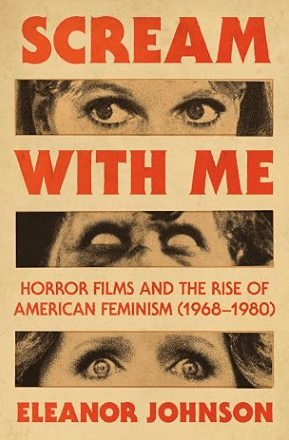
But, as I recently learned, pro-feminist readings of classic horror films are a genuine thing, having a genuine moment. And I was completely convinced of their validity by Eleanor Johnson’s excellent book, Scream With Me: Horror Films and the Rise of American Feminism, 1968-1980. Early in the book, Johnson’s addresses the apparent absurdity of looking for feminist ideas in horror films, going so far as to quote Alfred Hitchcock’s famous formula for an effective thriller: “Torture the women.” Johnson does not minimize the misogyny of classic horror films. Indeed, she goes to great pains to explain that horror films—like any work of art—can often be self-contradictory, sexist on one visceral level but feminist on a deeper, almost subconscious one.
She writes:
[H]orror also has a deep and enduring relationship with American feminism. In fact, American feminism and American horror have been—for more than half a century—allies on issues of domestic abuse, reproductive control, and women’s restricted rights relative to men.
Horror films that focus on violence and persecution of women often do double-duty, serving as a means of getting otherwise conservative or traditionalist viewers to see the plight of women in the first place. More importantly, as Johnson’s title suggests, horror films subconsciously force the viewer to participate in the suffering of women, and thus empathize with their condition.
She writes,
What’s so important about the domestic horror films in this book is that they make viewers—whether or not the viewers are female—carry the fear and vulnerability embodied by the women in the films home with them. They center on a woman’s perspective, making audiences feel wracking physiological and psychological compassion for the women characters who are abused and terrorized. The films, although they showcase women’s suffering, do not simply fetishize that suffering, but rather humanize it, make it palpable, exportable to the viewers’ own minds and bodies. They invite viewers into the lived, embodied experiences of abused women; women barred from power, barred from speaking for themselves, barred from defending themselves; women who weren’t taken seriously by the people from whom they sought aid—doctors, police, lawyers, psychiatrists, husbands, coworkers. These movies took what was going on in American cultural, political, and legal history in the late 1960s and 1970s, and they made those things feelable. They made women’s suffering come alive to viewers who might not otherwise ever have stopped to think about what or how women suffered in the United States, behind closed doors, in the twentieth century. They made that suffering seem like an emergency. And then they made that suffering follow viewers all the way home and nest there.
Johnson goes on to explain her main thesis—namely, that horror films were instrumental in raising public awareness of women’s civil rights issues, and even in changing laws—by focusing on six classic horror films: Rosemary’s Baby, The Exorcist, The Stepford Wives, The Omen, Alien, and The Shining. She examines these films in chronological order, and so it is probably no accident that the oldest, 1968’s Rosemary’s Baby, is also the basis for her most compelling argument.
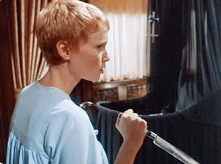
For those who haven’t seen it (i.e., anyone under 40), Rosemary’s Baby is the story of a young couple, Guy and Rosemary Woodhouse, who move into an old, spooky apartment building in Manhattan. They befriend their elderly neighbors, the Castevets, who (it later turns out) run a coven of witches. With the secret cooperation of Guy, the witches drug Rosemary, conjure up Satan, and watch as he rapes the poor woman. Throughout the act, Rosemary is doped up but conscious, hallucinating that she is on a boat, rocking on a rough sea. At moments, though, she becomes lucid, and realizes that she is actually being raped by a huge, hairy creature. “This is no dream,” she yells, in the film’s most horrifying line. “This is really happening.”
The next morning, Guy tells her that he had sex with her while she was asleep. (The scratches on her body, he explains, are due to his “getting a little carried away”). Rosemary is unconvinced but, in true trad-wife fashion, doesn’t make a fuss. When she later becomes pregnant, the Castevets refer her to an old OB-GYN, Dr. Sapirstein, who puts her on a regimen of foul-tasting protein shakes and other noxious concoctions. As the pregnancy progresses, Rosemary finds herself in agonizing pain. Her women friends (whom Guy discourages her from seeing) beg her to find a new doctor, but, again, Rosemary doesn’t make a fuss.
Mia Farrow in “Rosemary’s Baby”
After she finally gives birth at home, the witches take the baby away. Guy tells her it died. But she can hear an infant crying from next door, and the neighbors insist on collecting Rosemary’s milk, which they convinced her to express into glass jars.
At some point, she finds a secret door into the Castevets apartments, only to find them, Dr. Sapirstein, and a bunch of other nattily-dressed devil-worshipers having a party. They are gathered around a cradle in which, of course, Rosemary’s baby lies. The baby himself is never shown. Rather, we only see her horrified reaction when she pulls back the veil and views the hell-spawn. “What’s wrong with his eyes?” she asks. “He has his father’s eyes,” Mr. Castevet replies.
I’ve probably seen Rosemary’s Baby half a dozen times, yet I never put it together that the film is almost a parable about the cruelty of anti-abortion laws. Not until I read Ms. Johnson’s book, that is. As she points out, Rosemary is probably cinema’s most extreme example of a woman forced to complete an unwanted (and very dangerous) pregnancy. One that is, in fact, the result of a rape (by the Devil, no less). As Johnson writes,
By New York State’s own abortion laws in 1968, Rosemary would not have been able to get an abortion on grounds of rape alone. Rape was not justification enough for abortion in 1968 in New York, nor was physical danger, nor psychological harm. Nor, indeed, was the prospect of having a baby born with deformities—which would seem likely when the child’s father is a claw-handed, leather-skinned, goat-eyed demon. The Satanic fetus, whose true range of deformities could only be known after the birth of the child, allegorizes the thousands of thalidomide pregnancies across the United States that women were forced to carry to term, anxiously waiting to see how compromised their babies would be by the drug the women had taken. Like them, Rosemary is going to be forced to carry to term a pregnancy of unknown viability. [Link added]
Of course, it isn’t just a lack of reproductive health rights that causes Rosemary’s ordeal. It’s her lack of freedom in general—financial, educational, and (above all) psychological—that traps her in a private hell. In some ways, her husband, Guy, comes off as even more evil than the Castavets in the way he gaslights and manipulates his wife. And it is this kind of domestic abuse—sometimes physical, always mental—on which Johnson primarily focuses for the rest of the book.
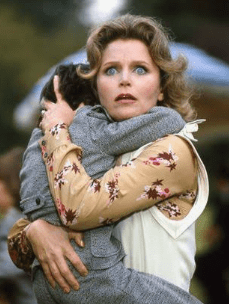
Lee Remick in “The Omen”
In The Omen, for instance, a wealthy man lies to his (much younger) wife, Kathy, when their baby dies at birth. At the urging of a local priest, he takes another baby whose mother has just died and passes him off to Kathy as her own. Naturally, the baby turns out to be the anti-Christ (once again), and the wife suffers mightily (once again), finally being killed by the little bastard and his evil minions. Unlike Guy Woodhouse, the husband in this story is not evil, nor self-serving. He genuinely thinks he’s being kind to his wife in doing the ole baby switch-a-roo, trying to spare her the heartbreak of losing a child. Of course, she has lost a child, and she deserves to know the truth. Moreover, she certainly does not deserve to be tricked into raising the spawn of hell. But her husband, in true patriarchal fashion, does what he sees fit. The result is the same.
I especially enjoyed Johnson’s examination of Stanley Kubrick’s The Shining, which she presents as an apotheosis of the domestic-abuse horror genre. I have always felt that Shelley Duvall’s fine, selfless performance as the tormented wife, Wendy, was the most underappreciated (and even mocked) aspect of the film. Indeed, she is the center of the movie, without which it would have no meaning.
Also, of all the films’ hapless heroines, Wendy’s plight is the most isolating and claustrophobic. As Johnson writes,
Rosemary can’t easily get away from the coven, but she can go see her doctors and, on occasion, her friends. Chris [in The Exorcist] is in thrall to the demon every bit as much as Regan is, but she still manages to go out to see doctors and priests. Joanna has quite a bit of freedom of movement, until the end of Stepford Wives; same with Kathy from The Omen. Ellen Ripley [in Alien] is every bit as imprisoned as Wendy Torrance, but her imprisonment feels incidental because she’s trapped on a floating domestic space, and everyone else is trapped right along with her. Wendy’s entrapment feels obvious, manifest, total, unbreachable. She’s trapped by the hotel; by [her husband] Jack; by the weather; by the distance to any other person or place, to any kind of shelter. The horror of The Shining isn’t ultimately the ghosts in the hotel. It’s Jack and his total imprisonment of Wendy. And, as viewers, we are trapped with her.
Shelley Duvall in “The Shining”
Indeed.
Scream with Me is a hell of a book. Check it out…!
No self-respecting cinephile could live with themselves if they failed to mark the passing of a great movie star like Sam Neill. Yes, Neill was a movie star. He seldom played the lead in big-budget films—Jurassic Park was a lucky exception, and even that film was more of an ensemble piece—yet whenever he was on-screen, it was impossible to take your eyes off him. And that inexplicable quality, more than anything, is what defines a movie star.
I say inexplicable, because no one can really define it. Yes, it has something to do with good looks, and Neill was definitely handsome. (Early in his career, he was an outright heartthrob in his native New Zealand.) Intelligence, too, often has something to do with star-power, and Neill was certainly, obviously smart. And charming, albeit in a reserved, unassuming way.
But there are lots of other good-looking, smart, and charming actors who never achieve the status of movie star. Neill did. How did he do it? I’m not sure. If I had to assign Neill one of my 15 Hollywood archetypes, I guess he would fit best in the Noble Everyman slot. But he was almost too handsome for that category. Really, he was almost his own archetype—that of the quiet, capable, professional man.
These terms certainly describe the first role I saw him in, which made me a fan—that of the titular superspy in Reilly, Ace of Spies. A 12-part miniseries shown on the Masterpiece Theater program in America, it told the story of the dapper, aristocratic, and amoral Sidney Reilly, a Russian-born secret agent who works for the British Empire circa 1910. With his deceptively soft, incisive voice and penetrating intellect, Neill was perfect for the role, and it made him a star.
Throughout his subsequent film career, he played many other resourceful, smart, but quiet characters, often in supporting roles. He played naval officers (Dead Calm, The Hunt for Red October), scientists (Jurassic Park, The Dish), and, of course, spies (Reilly, Ace of Spies, Plenty).
Whatever he played, though, he always exuded a kind of affable, open, benign quality that viewers instinctively warmed to.
Incredibly, forty years have passed since David Lynch’s masterpiece, Blue Velvet, was released to theaters. Actually, “released” isn’t quite the right word; it detonated, hitting the cultural consciousness with the force of an H-bomb. Although not a huge commercial hit compared to other films that came out that year (including such juggernauts as Top Gun, Crocodile Dundee, and Aliens), Blue Velvet quickly became the most talked about, joked about, and debated about movie in America, at least among the literati.
This was especially true of the English- and Film-major nerd set of which I was a member. I was, in fact, roughly the same age as Jeffrey Beaumont (Kyle MacLachlan), the film’s young protagonist, who comes home from college to Lumberton, N.C. He is visiting his hospitalized father (who suffers a stroke in the film’s famously surrealistic opening sequence), and soon finds himself wandering around town, adrift. One afternoon, he finds a severed human ear, which he takes to the local police department and hands over to a good-natured detective. “That’s an ear all right,” the man says, in one of many moments of 1950s camp dialog. Thus begins the dark mystery that propels this very, very dark film.
Again, “dark” isn’t quite the right word. For the movie is as concerned with light as much as darkness. Jeffrey soon finds himself drawn to two very different women—Sandy (Laura Dern), the blond-haired, sweet daughter of the detective; and Dorothy (Isabella Rossellini), the sultry femme fatale who might have something to do with the severed ear. He experiences a life-altering, mind-blowing moment with each of them, in turn. With Sandy, he glimpses a bit of transcendent, romantic bliss when they first dance together at a party, to the angelic voice of July Cruz on the soundtrack. With Dorothy, he witnesses her violation at the hands of a psychotic drug-lord, Frank, who has sexually enslaved her.
That latter scene, which comes at the end of Act I, is one of the most powerful and perverse in the history of cinema. Even today, in our porn-saturated culture, many people find it shocking. And they should. It’s meant to shock. But it’s also meant to question. To ask the viewer: why is evil so seductive? Why is it so powerful?
Or, as Jeffrey asks Sandy, “Why are there men like Frank?” He might just as well have asked: Do all of us have a sadistic streak like Frank (and maybe Dorothy)? Do all of us have a masochistic streak like Dorothy (and maybe Frank)?
For me, this questioning aspect is what separates art from pornography, even when the line is blurred, as it very much is in Blue Velvet. Val Kilmer, who was in consideration for the role of Jeffrey, dismissed the script as “pornography.” He might have been right about that script, but he was wrong about the final product. Blue Velvet is art. In fact, it’s high art. There is something sublime about it. Something that transcends ordinary definitions and categories. It seems to exist on a higher plane of existence.
Looking back on the film, another aspect I find amazing about it is the sheer number of careers it launched—or, in many cases, rejuvenated. MacLachlan and Dern became movie stars almost overnight. (Yeah, MacLachlan had been in Dune, but the movie bombed). Rossellini went from being a model and cosmetics spokesperson to an acclaimed, A-list actress. Veteran actor Dean Stockwell made an instant comeback based on his one, over-the-top scene in the movie, vamping and lip-synching Roy Orbison’s “In Dreams” (which the film also re-popularized). And 1960s counter-culture hero Dennis Hopper—whose performance as Frank was so electrifying that he was nominated for Golden Globe—found his career jumpstarted. He went on to star in many films throughout the 1990s, and also to direct a couple.
But the biggest winner of Blue Velvet was, of course, Lynch himself. He went from being that cool-but-weird art film director (who had somehow made both Dune and also Eraserhead) to a Bonafide cultural phenomenon. A phenomenon would reach its apex a few years later in 1990, when Lynch had both the hippest TV show on air (Twin Peaks) and the hippest movie in theaters (Wild at Heart).
Despite all those later successes (and a few failures, too; he was such a great artist that even his “failures” were pretty damned good), Lynch would never top Blue Velvet. Sure, he came close a few times, especially with his phantasmagoric Hollywood tale, Mulholland Drive in 2001, but he never quite equaled it.
And that’s okay. Blue Velvet remains his masterpiece, not to mention one of my favorite films of all time.
So, if you live near a theater that sometimes shows re-releases of classic films, keep your eye it. It’s a great film, and everyone should get a chance to see it on the big screen (as I did, lo those forty years ago).
A couple of weeks ago I reposted an old essay of mine called The Anti-Heroes of American Cinema: A Tribute. Ever since then, I’ve been thinking that there is a counterpart to the anti-hero—the anti-villain. Whereas anti-heroes often display characters that seem to contradict the classical definition of a hero, such as occasional selfishness, comical cowardice, and foolishness, anti-villains often run counter to the classical definition of a villain. That is, they can be courageous, charming, and even noble (albeit in a misguided fashion).
Ironically, it is classic literature itself, I think, that gives the first, prototypical anti-villain: Hector, the Trojan prince who flummoxes the Greeks in The Ilyad. Hector is, in many ways, more compelling and even sympathetic than the nominal “hero” of the work, Achilles, who spends most of his time sulking in his tent. Hector, whose moniker is “the breaker of horses,” is determined to defend his country from the invading Greeks, which makes him far more relatable than the glory-hound Achilles. He is also shown to be a devoted family man, gentle to his wife and infant child, as well as being a loving son and older brother.
In the same way, the very best films of American cinema often have a great “villain” who is actually more of an “anti-villain.” In John McTiernan’s Die Hard, for instance, Alan Rickman gave a career-making performance as the hissable Hans Gruber. Hans isn’t just smart. He’s resourceful, courageous, and disciplined. When he accidentally gets cornered by John, he fakes a brilliant American accent that we can understand how someone would fall for it.
But what really makes Hans such a compelling character is that, in some ways, Hans seems to be struggling almost as much as the hero, John McClane. We sense that Hans really needs this heist to work. That, despite all his bravado and (yes) cruelty, he’s really just a guy trying to make his mark while there is still time. “You’re just a common thief,” Holly says to him, to which he replies, “I am an exceptional thief.” And we have to agree. He is exceptional.
More importantly, he feels like a fully rounded, three-dimensional character. Yeah, he’s still the bad guy, with wicked and even evil motives, but he is still compelling, likeable, and real. Much of this depth, of course, comes from the brilliant script by Jeb Stuart and Steven E. de Souza, but is it mainly due to Rickman’s refusal to play the character as a trope, the dimestore villain. As Rickman explained in an early interview: “I’m not playing ‘the villain’. I’m just playing somebody who wants certain things in life—who’s made certain choices—and goes after them.”
To take another great film from the 1980s, Oliver Stone’s Wall Street presented us with one of the great anti-villains of all time, Gordon Gekko, as brilliantly played by Michael Douglas in an Oscar-winning performance. Gekko is whip-smart, ruthless, and willing to play for table-stakes when the circumstances call for it. He also has a bit of an inferiority complex, as he reveals in an early scene when he and the film’s young hero, Bud Fox, play squash. Bud compliments Gekko on the luxury of his health club, to which Gekko responds, “Yeah, not bad for a City College boy. I bought my way in, now all these Ivy league schmucks are sucking my kneecaps.”
Of course, this kind of admission on Gekko’s part—that he comes from humble beginnings, and that he harbors a huge amount of resentment against the American aristocracy—serves to make him more compelling, not less. In other words, he becomes an anti-villain. We can understand how the movie’s young protagonist, Bud Fox, would be in awe of the man’s talent and grit. It’s only later in the film, when Bud figures out the man’s true, reptilian character, that he turns on Gekko and reclaims some of his dignity.
Come to think of it, Oliver Stone’s other great movie from the 80s, Platoon, also has a great anti-villain, who also tempts the movie’s young hero toward the dark side. In Platoon, it is the ruthless Sergeant Barnes (brilliantly played by Tom Berringer in a career-highpoint). Barnes is surely the most capable and lethal soldier in his platoon, displaying enormous courage and self-control in battle. He seems to genuinely care about the well-being of his troops (up to a point) and to harbor an authentic (if perverse) form of patriotism. Unfortunately, he is also a bit of a fascist, set on revenge against the Vietnamese people (both the Viet Cong and the villagers who sometimes aid them). We sense the depth of the trauma he has suffered from his previous war experience (manifested in a symbolic wound, the disfigurement of his face).
An earlier Vietnam movie, Francis Ford Coppola’s Apocalypse Now, presents us with another great anti-villain, the mad Colonel Kurtz (played by Marlon Brando). As we learn from the film’s (anti-)hero, Willard, Kurtz is a former war-hero, a West Point grad whose patriotism and courage led him to achieve high rank at a young age. But then, deep in the existential maw of Vietnam, he suffered a psychic that led him to go rogue, becoming a renegade war-lard in Cambodia, waging his own horrific, private version of the war.
It’s not surprising that Vietnam was such a great source of cinematic anti-heroes (and anti-villains), considering the way moral lines became so blurred in the long, horrific conflict. In the same way, modern military conflicts in the Twenty-First Century also generate their share of vexed, morally complex characters. In fact, one the greatest anti-villains of all time appeared in Dennis Villeneuve’s 2015 thriller, Sicario. In that film, the nominal hero, a young police officer named Kate Macer (Emily Blunt) finds herself entangled in a covert, CIA-run military operation against a Mexican drug cartel. One of the CIA operatives, Alejandro (Benecio del Toro), becomes a kind of demented mentor to her, showing her how to survive in the morally-inverted universe of the U.S. War or Drugs.
Alejandro is such an effective villain because neither the viewer nor Kate realize he is a villain until late in Act III, when we discover that Alejandro is, in fact, an assassin—the “hitman” of the film’s title—whose mission is to kill the cartel’s leader, Fausto Alarcón. The entire plot is then revealed to be an elaborate scheme to secretly insert Alejandro into Mexico, where he breaks into Alarcón’s house and kills him—along with his wife and children—while the family is having dinner.
It’s a shocking moment, one that might sink any other film. But Villeneuve and the screenwriter, Taylor Sheridan (later of Yellowstone fame), have prepared us for it by fully fleshing-out Alejandro’s character to the point that we can understand—almost—his actions. Throughout the movie, he is presented to us unfailingly cheerful yet lethal, fearless yet controlled, protective yet ruthless. We also learn that Alarcón brutally murdered his daughter in the past, which goes a long way to explain his wrath.
Most importantly, in the climactic scene in which Alejandro first sneaks into Alarcón’s house, he is spotted by a kitchen maid. Instead of killing her, though, he lets her go, knowing she won’t warn anybody about his presence. In this way, the film subtly suggests that Alejandro doesn’t necessarily kill the wife and kids out of wrath. Rather, he has to make the assassination look like an inter-cartel hit, so he has to be as brutal as required—but no more so—to maintain that fiction.
It’s a great movie, and it also presages what I’ve seen as growing development in American action cinema. Namely, the blurring together of anti-heros and anti-villains, to the point where they are not only indistinguishable from each other, but they inhabit the same (main) character. What is Walter White of Breaking Bad if not an agglomeration of anti-villain/anti-hero? Or Frank Lucas in American Gangster? Or John Wick?
It’s almost as if Hollywood has entered some kind of time-warp and looped back to the gritty, neo-noir films of the early 1970s. Movies with dark, morally ambiguous protagonists like Point Blank, Charley Varrick, The Mechanic, and even Super Fly. That Vietnam-era when the American cinema goer became more hardened, more cynical toward government and law enforcement and Capitalism and…well…just about everything.