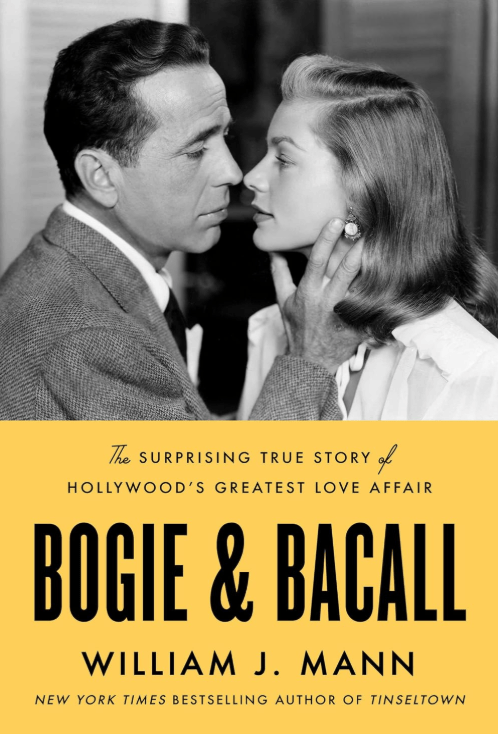
So many good books have already been written about Hollywood legend Humphrey Bogart that even a biographer as talented as William J. Mann must have felt the need to find a new twist. A new gimmick. And with Bogie and Bacall: The Surprising True Story of Hollywood’s Greatest Love Affair, Mann found one—a combined biography of Bogart and his famous wife, Lauren Bacall. It makes sense. After all, in the last years of his life, Bogie found himself as half of the first great celebrity couple. Long before Bennifer or The Beckhams or even Taylor/Burton, Bogie-and-Bacall entranced the public with both their movies and their marriage, never mind the fact that the public image of their relationship was largely fabricated by studio hacks.
It wasn’t all fabricated, though. Yes, Bogart and Bacall spent much of their marriage living somewhat separate lives, as one might expect in a pairing where one partner is so much older (and hard-bitten). They often travelled separately, for extended periods. Bogart continued a intermittent affair with his long-time mistress, and Bacall had an intense (and possibly physical) relationship with Frank Sinatra, to whom she was briefly engaged after Bogart’s death. Yet, by all accounts, the love and respect between the world’s most famous couple was genuine and deep. So deep, in fact, that Bogart actually cut down on the booze, at least for a time, after Bacall got sick of him coming home plastered (when he came home at all).
Indeed, in Mann’s telling, the story feels very much like a redemption tale for Bogart. This is especially true since most of the book is devoted to his life story. I would estimate a 70/30 split between words devoted to Bogie and Bacall, respectively—an imbalance that makes sense for a number of reasons. For one, Bogart’s biography began twenty-five years before Bacall’s. And by the time their romance first kindled in 1944 (and the Bogie-and-Bacall legend thus began), Bogart had been a movie star for over a decade and had already made his two greatest films, The Maltese Falcon and Casablanca, establishing him as the most important film actor of his (or perhaps any) generation.
So, it’s perhaps inevitable that most of Mann’s book would be devoted to his life story. And, as Mann reveals, most of that story was taken up by his Bogart’s two obsessions—acting and booze. The two pursuits were related, of course; Bogart’s damaged psychological state (he had a sterile, lonely childhood) informed his acting even as it fueled his drinking. A deeply intelligent man, Bogart honed his artistry to a level unseen previously in cinema—he could play heroes and villains with equal prolixity—yet his intellect caused him to hate most of the Hollywood people he met, including himself.
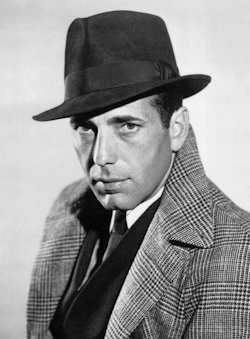
Beginning in his youth, Bogart was known for getting drunk and punching other guys in the face. He took the habit with him to Hollywood, where he struggled for years under the thumb of studio system, grinding out B- and C-grade melodramas for the ruthless Jack Warner. And even as his star began to rise (his breakout role was that of a mesmerizingly evil villain in 1936’s The Petrified Forest, much like Javier Bardem’s in No Country for Old Men), his drinking only intensified.
As often happens with alcoholics, Bogart soon married someone who could match him drink-for-drink. Mayo Methot was a highly regarded actress who starred in many films throughout the 1930s. She was beautiful, intelligent, and deeply troubled. After marrying Bogart, she essentially gave up her already waning film career, and the disappointment and frustration of married life drove her to drink even more. And fight. Humphrey and Mayo soon became known as “The Battling Bogarts” in the tabloid press for their frequent, public rows. One of the most notable of these came while they were on a U.S.O. tour in Italy, entertaining troops fresh off the battlefields of World War II.
[The] Battling Bogarts made at least one appearance. After practically “distilling themselves” drinking with a group of paratroopers, the couple squabbled and Mayo locked her husband out of their room. As Bogie attempted to break in, he was apprehended by a colonel, whom he told to go to hell. As a guest of the army, he was called to account. “I didn’t mean to insult the uniform,” he said during a hearing. Looking at the colonel, he said, “I only meant to insult you.”
Despite their conflicts, Bogart doggedly remained married to Methot. Until, of course, he met a nineteen-year-old beauty named Betty Joan Perske, who went by the stage name Lauren Bacall.
One the most compelling aspects of Mann’s book is the almost unbelievable contrast between Bogart’s long, grueling rise to fame over almost two decades and Bacall’s overnight success. Bacall was doing a bit of acting and modelling work in New York when her photograph was spotted by Nancy Keith, wife of legendary actor Howard Hawks. Keith convinced her husband to give her a call. As if that development weren’t serendipitous enough for the young actress, Hawks’s secretary misunderstood his instructions and sent Bacall a plane ticket to Hollywood for a screen test. After meeting Bacall in person, Hawks was so taken by her beauty, intelligence, and poise that he immediately signed her to a seven-year contract. For her first picture, To Have and Have Not, she had a small part, intended to only give her one or two short scenes with the lead, Humphrey Bogart.
There is a scene in Homer’s Odyssey washes ashore on the island of Phaeacia. Naked and starving, he is discovered the virginal princess Nausicaa, who takes pity on him and saves him. I have heard the moment of their meeting described by one professor as “absolute innocence (Nausicaa) meeting absolute experience (Odysseus).” After all, by this point in the story, Odysseus has been at war for ten years, lost at sea for another seven, survived numerous monsters, witnessed the death of all his men, been held as a captive sex-slave by two powerful women (Circe and Calypso), and even made a short trip to hell (well, Hades).
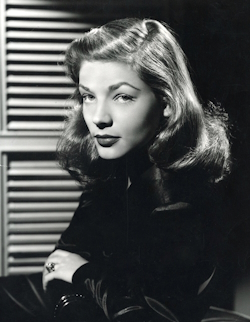
I thought of all this as I read Mann’s account of the romance that quickly blossomed between the teenaged ingenue Bacall and the forty-five-year-old, world-weary, thrice-married, hard-drinking Bogart. But while Bacall might have been something of a princess (in Hollywood terms, at least), she was not a total innocent. As Mann recounts, she had been single-minded and ruthless in her pursuit of acting career, attending the American Academy of Dramatic Arts in New York (where she had a crush on one of her classmates, a young Kirk Douglas). After graduating, she endeared herself to various directors, producers, and writers until she finally got a few breaks, appearing in at least two high-profile productions. And though, according to Mann, she never succumbed to the casting couch, she had no qualms about flirting with older, powerful men to get ahead.
This series of flirtations culminated with Hawks himself, who took Bacall under his wing, sculpting her image and even teaching her how to lower her naturally high-pitched voice. (Yes, Bacall’s famously low, sexy, husky voice, immortalized in an erotic moment in To Have and Have Not, was as fake as Bogart’s toupees.)
Yes, Hawks was clearly grooming her for an eventual affair (perhaps even a marriage), and when he realized that she had become infatuated with Bogart, he was livid. However, to his credit, Hawks cared more about making a good movie than about bedding Bacall. Watching the dailies, he took note of the obvious, crackling chemistry between Bogie and Bacall, and he had the script revised to expand her part, giving them more screen time together. Hawks also featured Bacall heavily in all of the film’s publicity.
In less than a year, Bogart had divorced Methot and married Bacall. Taking over from Hawks, Bogart became Bacall’s mentor as well as her husband, instilling in her his passion for acting at a deep, psychological level years before The Method was even a thing.
Bogie remained her acting teacher. Once, after watching Betty rehearse a scene in which she opened a door, he told her, “You walked out there like a model.” She took his advice and changed her stride. “You must always realize you have come from someplace,” Bogie went on. “What were you doing before? Were you filing your nails? Were you writing a letter?” Every scene must convey an attitude. “That is a very important part of acting, and I never forgot it,” Betty later said.
As I said above, their marriage was initially rocky but soon settled into a mellow, happy rhythm. They lived somewhat separate lives, but were united in their love of acting and also their political causes. (Bogart was what we would now call a liberal, so much so that he was—like so many liberals today—accused of being a communist; Bacall, for her part, was so involved in Democratic politics that she nearly had an affair with Adlai Stevenson.) They also had two children.
Then, after over a decade, the marriage ended when Bogart died of throat cancer. Bacall was, of course, still a young woman (in her thirties), and the last third of Mann’s book covers the rest of her long and surprisingly illustrious life. For while it is clear that Bacall was neither as good an actor as her late husband nor as powerful a cultural influence, she was still pretty damned cool. Having moved back to New York after her leading roles in Hollywood began to dry up, she went on to a long and distinguished career as a stage actress, eventually winning two Tony Awards. She also did the occasional character bit in films, most notably her Oscar-nominated performance in 1996’s The Mirror Has Two Faces.
That’s another reason I really liked this book. Bacall’s life serves as a kind of bridge between the old Hollywood of Bogart’s day and the New Hollywood of the 1970s, when I got into films as a kid, and then into the modern era. She spanned three worlds, at least, and did so with enormous charm.