Cathy and I have been watching season 4 of Dark Winds on Netflix, and I was thrilled to see the fine German actress Franke Potenta playing the villain. She was Lola in Run Lola Run, one of the coolest films of the 90s. (She was also the love interest in the first Bourne movie.) Nice to see she’s still doing great work.
Run Lola Run was also notable for its amazing, propulsive soundtrack, which perfectly fits the action of the film. (You’ll have to watch it to see what I mean.) I liked the soundtrack so much I bought it–on CD, no less. (Yeah, it’s old. So am I.) And I wrote many line of software code while listening to it. Of course, it’s not really “rock.” It’s techno, or EDM, or whatever they’re calling such music these days.
Whatever it is, it rocks.
Here is the premier track, “Believe,” on which Ms. Potente’s voice can be heard speaking. Enjoy!
Well, the day has arrived. My debut novel, Twice the Trouble, is a Kindle Daily Deal for $1.99 today on Amazon. The offer will stand until 11:59 P.M. tonight, Pacific Standard Time, at which point it will turn into a pumpkin or…something. (Actually, it will just end.)
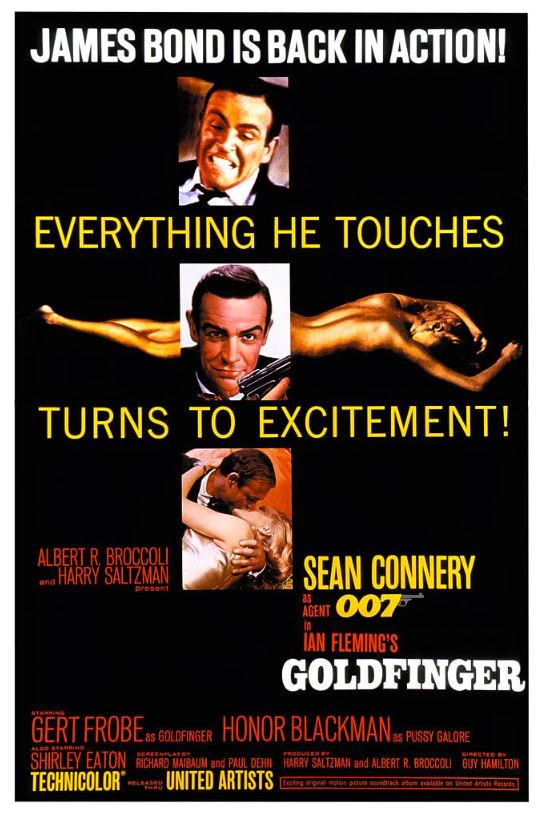
So, to finish my list of Great Movie Countdowns, I’m selecting what many people think is the greatest James Bond movie of all, 1964’s Goldfinger, directed by series veteran Guy Hamilton.
One of the most magical things about James Bond, the character, is that he knows how to do just about everything. He can fight and shoot, of course. But he can also fly a plane, drive a tank, sail a boat, race a motorcycle, surf, and even (as he shows in Goldfinger) play a mean-and-dirty round of golf.
One thing Bond does not know how to do, unfortunately, is disarm an atomic bomb. Which is a problem, because that’s exactly the threat he faces in the climax of Goldfinger. Bond finds himself locked inside the huge, cavernous vault of Fort Knox, surrounded by stacks of gold bars and handcuffed to said atomic bomb, with just a few minutes ticking down on the device’s timer. (This might be the first use of a digital timer in any major motion picture; let me know in the comments if you can think of an earlier one.)
As if this weren’t bad enough, Bond isn’t alone inside the vault. Goldfinger’s chief henchman, Odd Job, is in there too. If Goldfinger is the best Bond movie ever, then Odd Job is the scariest Bond henchman ever. Played by Japanese-American wrestler Harold Sakata, he has such a great, imposing physical presence—a hulking man who seems barely able to hold his own strength in check. When he crushes a golf ball with his bare hands, we, as viewers, really believe he could do it! But what really makes Odd Job scary is his evil little smile. He always seems bemused, enjoying himself, even when he throws a guy off a balcony or throws his steel-brimmed bowler hat into someone’s neck.
In the movie’s climactic countdown (yes, another countdown to nuclear self-destruction), Odd Job seems determined—even happy—to make sure the bomb goes off, despite the obvious fact that it will mean his own death, too. Odd Job, it seems, isn’t afraid of anything except failing in his mission, which makes him that much scarier.
My classics professor in college once said that James Bond is the modern version of Heracles, who, like Bond, loves to fight, drink, and sleep around. Sure enough, the final battle between Bond and Odd Job feels a lot like a Greek myth, with the hero battling a monster—one with some really scary weapons—to the death. And, as in a Greek myth, the contest ends with an example of poetic irony. Odd Job is undone by his own superpower—in this case, his favorite weapon, that lethal, steel-brimmed hat. Bond manages to get hold of it and throws it at him. It misses, alas, and lodges into some steel bars. Instead of just finishing Bond off, though, Odd Job goes to retrieve his beloved hat, at which point Bond slides across the floor and touches a loose power cable to the bars. Current conducts through the bars and through the steel hat, electrocuting the villain. Thus, the monster is defeated by his own magic.
But what about the bomb? Looking inside the device, Bond seems genuinely clueless, for once, bewildered by all the wires and blinky lights. Pathetically, he even tries to stop the machine’s spinning cylinder (which holds, we presume, the cobalt-iodine mixture that makes the bomb “particularly dirty,” in Goldfinger’s words). All to no avail.
Then, with mere seconds left, a man’s gentle hand sweeps in, stops Bond’s frantic groping, and turns the bomb off with the flick of a switch. With the crisis averted, Bond and the man—who looks like a wizened college professor, wearing a brown suit and hat, his face serious yet calm—face each other. A strange look passes between them. A mixture of relief, puzzlement, and awe, the look seems to suggest the entire absurd, insane reality of the Cold War, if not modern existence itself. “How did we get here?” the look seems to say.
Well, it’s just one more day until my book becomes a Kindle Daily Deal on Amazon (the offer starts at midnight tonight, Pacific Standard Time). The next movie on my Great Movie Countdowns list is my favorite B-Movie of all time, John Carpenter’s Escape from New York(EFNY).
EFNY is probably the best example of a classic movie countdown because almost the entire movie is a countdown. War-hero turned bank-robber Snake Plissken has exactly twenty-four hours to find the President of the United States somewhere in the yawning, black hulk of Manhattan, now turned into an open-air prison by the U.S. government. If Snake doesn’t find the POTUS and get him out alive before time runs out, tiny explosives implanted in Snake’s neck will detonate, killing him instantly. Such is the deal made to him by the coldly practical Police Commissioner Bob Hauk (played by Lee Van Cleef in his greatest role since The Good, the Bad, and the Ugly): get the POTUS out alive and you’ll get a pardon. Otherwise, you’re dead.
So, armed to the teeth, Snake infiltrates the island and begins his desperate search. All the while, he keeps checking his special, way-cool digital watch, which looks exactly like a beefed-up version of the first Casio digital watch that me and all my friends had back in the day. The watch doesn’t tell time, of course—it’s a life-clock, counting down the hours, minutes, and seconds until Snake’s neck goes boom.
To make matters worse, there are many people in New York who feel that twenty-four hours is far too long for Snake to live. Chief among them is the Duke of New York, the sinister war-lord who controls the prison, played with great panache by the great musician Isaac Hayes, of “Shaft” fame.
Kurt Russell famously said that Snake is always just trying to live through “the next 60 seconds. Living for exactly that next minute is all there is.” Carpenter’s genius lies in filling every one of those “next minutes” with some new, compelling, and darkly magical moment of mayhem, all of which Snake must overcome in some unexpected and thrilling way.
The final chase scene where Snake and his companions race across the fictional 69th Street Bridge, dodging mines, with The Duke in hot pursuit is a classic. But my favorite moment in the film comes much earlier, when Snake, realizing he has almost no chance of finding the president, gets out his radio, calls Commissioner Hauk, and asks if he can just come out. “I’ll burn you off the wall,” Hauk coldly replies. At which point Snake looks at the radio and says, mostly to himself, “A little human compassion.”
Snake does, in fact, find that little bit of “human compassion” in the course of the movie, when he makes some new friends who help him escape. More importantly, he finds it in himself, too. But that doesn’t stop him from being a bad-ass.
It’s T-Minus two days and counting until my book becomes a Kindle Daily Deal on Amazon (that’s right, on Thursday, August 6). And, to commemorate this, the next movie on my Great Movie Countdowns list is Ridley Scott’s 1979 masterpiece, Alien.
Alien is the greatest sci-fi monster movie ever made. And so it makes sense that it also has the greatest countdown-to-self-destruct sequence of any sci-fi movie ever made. It works because of Ridley Scott’s great direction and Sigourney Weaver’s brilliant performance as Ripley, the ship’s sole survivor, who has started the self-destruct sequence herself. In what is surely one of the most impressive examples of physical acting in Hollywood history, she ducks and weaves through steam-filled corridors, holding a flame-thrower, peeking around each corner to see if the huge, metallic-skinned alien is there.
Sure enough, the alien appears, blocking her way to her shuttle-craft, and she is forced to go ALL the way back to the ship’s control room. When she discovers that she’s too late to stop the self-destruct, she briefly breaks into tears. It’s a heartbreaking moment, one which becomes thrilling when she defiantly yells “You bitch!” at MOTHER, the ship’s AI, and then steels herself to reaching the shuttle, alien or no-alien.
I love how the last 15 minutes of the movie function as a complete contrast to the 105 minutes that came before—that is, the first and second acts of the film, which are mostly filled with moments of silent, creeping horror as the crew tries to find the alien xenomorph (before it finds them). The last act, however, is a brazen, nerve-wracking light- and sound-show, full of strobes, klaxons, hissing steam vents and general mayhem as the good ship Nostromo prepares to blow itself to smithereens. Honestly, I’m not sure the film could be made today in the same way, even with a slew of those “epilepsy-warning” messages at the beginning. It’s that intense. I remember seeing the film in the theater and being battered into my seat.
It’s also the definitive sci-fi-self-destruct sequence, better than all that came before or since. (Yes, even better than the “five-minutes-until-the-Death-Star-blasts-Yavin-to-bits” sequence at the end of Star Wars.) It’s just damned good filmmaking.
As noted by film scholar Eleanor Johnson, it also marks an important moment in American feminism, with Ripley being the first completely compelling female action hero in cinema. She’s not only smart, brave, and strong, she’s honorable. She doesn’t need to blow up the ship; she could just escape on the shuttle-craft. But destroying the ship is the only way to prevent MOTHER from flying it back to Earth on auto-pilot along with its horrifying passenger, the alien. So, Ripley risks her own life to kill the bastard. (Which she does, but not in the expected way.)
A couple of weeks ago I reposted an old essay of mine called The Anti-Heroes of American Cinema: A Tribute. Ever since then, I’ve been thinking that there is a counterpart to the anti-hero—the anti-villain. Whereas anti-heroes often display characters that seem to contradict the classical definition of a hero, such as occasional selfishness, comical cowardice, and foolishness, anti-villains often run counter to the classical definition of a villain. That is, they can be courageous, charming, and even noble (albeit in a misguided fashion).
Ironically, it is classic literature itself, I think, that gives the first, prototypical anti-villain: Hector, the Trojan prince who flummoxes the Greeks in The Ilyad. Hector is, in many ways, more compelling and even sympathetic than the nominal “hero” of the work, Achilles, who spends most of his time sulking in his tent. Hector, whose moniker is “the breaker of horses,” is determined to defend his country from the invading Greeks, which makes him far more relatable than the glory-hound Achilles. He is also shown to be a devoted family man, gentle to his wife and infant child, as well as being a loving son and older brother.
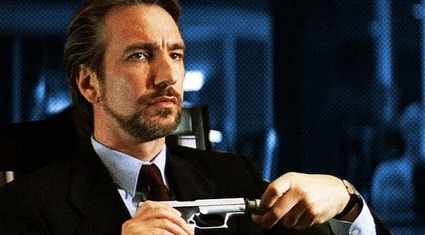
In the same way, the very best films of American cinema often have a great “villain” who is actually more of an “anti-villain.” In John McTiernan’s Die Hard, for instance, Alan Rickman gave a career-making performance as the hissable Hans Gruber. Hans isn’t just smart. He’s resourceful, courageous, and disciplined. When he accidentally gets cornered by John, he fakes a brilliant American accent that we can understand how someone would fall for it.
But what really makes Hans such a compelling character is that, in some ways, Hans seems to be struggling almost as much as the hero, John McClane. We sense that Hans really needs this heist to work. That, despite all his bravado and (yes) cruelty, he’s really just a guy trying to make his mark while there is still time. “You’re just a common thief,” Holly says to him, to which he replies, “I am an exceptional thief.” And we have to agree. He is exceptional.
More importantly, he feels like a fully rounded, three-dimensional character. Yeah, he’s still the bad guy, with wicked and even evil motives, but he is still compelling, likeable, and real. Much of this depth, of course, comes from the brilliant script by Jeb Stuart and Steven E. de Souza, but is it mainly due to Rickman’s refusal to play the character as a trope, the dimestore villain. As Rickman explained in an early interview: “I’m not playing ‘the villain’. I’m just playing somebody who wants certain things in life—who’s made certain choices—and goes after them.”
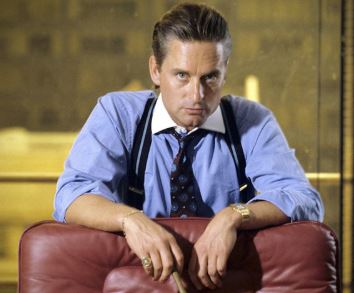
To take another great film from the 1980s, Oliver Stone’s Wall Street presented us with one of the great anti-villains of all time, Gordon Gekko, as brilliantly played by Michael Douglas in an Oscar-winning performance. Gekko is whip-smart, ruthless, and willing to play for table-stakes when the circumstances call for it. He also has a bit of an inferiority complex, as he reveals in an early scene when he and the film’s young hero, Bud Fox, play squash. Bud compliments Gekko on the luxury of his health club, to which Gekko responds, “Yeah, not bad for a City College boy. I bought my way in, now all these Ivy league schmucks are sucking my kneecaps.”
Of course, this kind of admission on Gekko’s part—that he comes from humble beginnings, and that he harbors a huge amount of resentment against the American aristocracy—serves to make him more compelling, not less. In other words, he becomes an anti-villain. We can understand how the movie’s young protagonist, Bud Fox, would be in awe of the man’s talent and grit. It’s only later in the film, when Bud figures out the man’s true, reptilian character, that he turns on Gekko and reclaims some of his dignity.
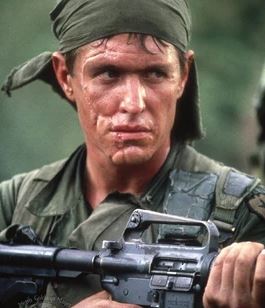
Come to think of it, Oliver Stone’s other great movie from the 80s, Platoon, also has a great anti-villain, who also tempts the movie’s young hero toward the dark side. In Platoon, it is the ruthless Sergeant Barnes (brilliantly played by Tom Berringer in a career-highpoint). Barnes is surely the most capable and lethal soldier in his platoon, displaying enormous courage and self-control in battle. He seems to genuinely care about the well-being of his troops (up to a point) and to harbor an authentic (if perverse) form of patriotism. Unfortunately, he is also a bit of a fascist, set on revenge against the Vietnamese people (both the Viet Cong and the villagers who sometimes aid them). We sense the depth of the trauma he has suffered from his previous war experience (manifested in a symbolic wound, the disfigurement of his face).
An earlier Vietnam movie, Francis Ford Coppola’s Apocalypse Now, presents us with another great anti-villain, the mad Colonel Kurtz (played by Marlon Brando). As we learn from the film’s (anti-)hero, Willard, Kurtz is a former war-hero, a West Point grad whose patriotism and courage led him to achieve high rank at a young age. But then, deep in the existential maw of Vietnam, he suffered a psychic that led him to go rogue, becoming a renegade war-lard in Cambodia, waging his own horrific, private version of the war.
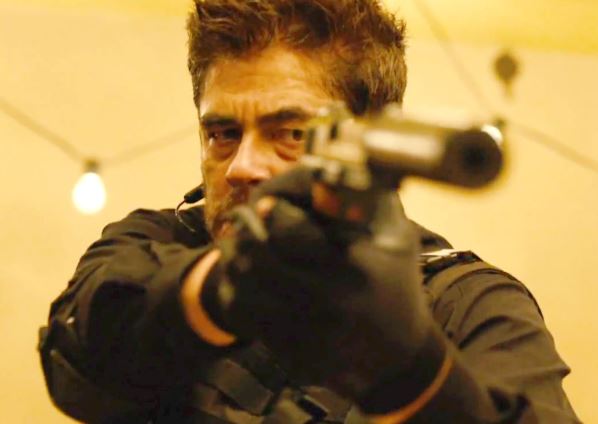
It’s not surprising that Vietnam was such a great source of cinematic anti-heroes (and anti-villains), considering the way moral lines became so blurred in the long, horrific conflict. In the same way, modern military conflicts in the Twenty-First Century also generate their share of vexed, morally complex characters. In fact, one the greatest anti-villains of all time appeared in Dennis Villeneuve’s 2015 thriller, Sicario. In that film, the nominal hero, a young police officer named Kate Macer (Emily Blunt) finds herself entangled in a covert, CIA-run military operation against a Mexican drug cartel. One of the CIA operatives, Alejandro (Benecio del Toro), becomes a kind of demented mentor to her, showing her how to survive in the morally-inverted universe of the U.S. War or Drugs.
Alejandro is such an effective villain because neither the viewer nor Kate realize he is a villain until late in Act III, when we discover that Alejandro is, in fact, an assassin—the “hitman” of the film’s title—whose mission is to kill the cartel’s leader, Fausto Alarcón. The entire plot is then revealed to be an elaborate scheme to secretly insert Alejandro into Mexico, where he breaks into Alarcón’s house and kills him—along with his wife and children—while the family is having dinner.
It’s a shocking moment, one that might sink any other film. But Villeneuve and the screenwriter, Taylor Sheridan (later of Yellowstone fame), have prepared us for it by fully fleshing-out Alejandro’s character to the point that we can understand—almost—his actions. Throughout the movie, he is presented to us unfailingly cheerful yet lethal, fearless yet controlled, protective yet ruthless. We also learn that Alarcón brutally murdered his daughter in the past, which goes a long way to explain his wrath.
Most importantly, in the climactic scene in which Alejandro first sneaks into Alarcón’s house, he is spotted by a kitchen maid. Instead of killing her, though, he lets her go, knowing she won’t warn anybody about his presence. In this way, the film subtly suggests that Alejandro doesn’t necessarily kill the wife and kids out of wrath. Rather, he has to make the assassination look like an inter-cartel hit, so he has to be as brutal as required—but no more so—to maintain that fiction.
It’s a great movie, and it also presages what I’ve seen as growing development in American action cinema. Namely, the blurring together of anti-heros and anti-villains, to the point where they are not only indistinguishable from each other, but they inhabit the same (main) character. What is Walter White of Breaking Bad if not an agglomeration of anti-villain/anti-hero? Or Frank Lucas in American Gangster? Or John Wick?
It’s almost as if Hollywood has entered some kind of time-warp and looped back to the gritty, neo-noir films of the early 1970s. Movies with dark, morally ambiguous protagonists like Point Blank, Charley Varrick, The Mechanic, and even Super Fly. That Vietnam-era when the American cinema goer became more hardened, more cynical toward government and law enforcement and Capitalism and…well…just about everything.