I’ve read many fine coming-of-age novels in my time, but never one about a 62-year-old protagonist. Yet, in Under the Wave at Waimea, that is exactly what Paul Theroux delivers. And it’s a thing of beauty.
Joe Sharkey is a champion big wave surfer in Hawaii. Past his prime but still a hero to younger surfers, Sharkey lives off corporate sponsorships in a beautiful beach-side house, spending his free time on the water and hanging out with his much younger girlfriend, Olive. He lives pretty much as he always has: in the moment.
But his life turns dark when he accidentally hits and kills a homeless man on the road. Sharkey initially dismisses the incident (the man was “just a homeless guy,” after all, biking in the rain). But Sharkey soon finds himself cursed by mysterious maladies and a sudden, inexplicable fear of the water, culminating in a moment when he almost drowns while surfing on of his trademark big-waves.
Fortunately, he is rescued—both physically and spiritually—by Olive, who senses that Sharkey’s misfortunes can only be turned around if he performs some kind of penance. This takes the form of a search for the homeless man’s identity. They discover that his name was Max Mulgrave, a one-time Silicon Valley millionaire who somehow found his way to Hawaii and ended up living in a tent. In exploring Max’s life-story—which turns out to have many parallels to Sharkey’s own—Sharkey must confront some of the darker aspects of his own past, and the fraught trajectory of his future.
Theroux is one of those writers whose style always inspires me to try to improve my own. I’ve written before about how much I admire his novels, and this one is no exception. Endlessly smart and brutally honest, Under the Wave at Waimea is both a brilliant character study as well as a fine whodunit (in the best, psychological sense). Check it out.
Attention all book nerds!!! My great friend Margaret Luongo and I have made another book talk video, in which we reveal the various books we’ve each been reading instead of David Copperfield. Enjoy!
Once again, I’ve been too slammed to finish a new blog entry, so I’m re-running an oldie-but-goodie (I hope). Enjoy…!!!!
A few months ago, I wrote a post about M. R. Carey’s excellent sci-fi novel, The Girl with All the Gifts. I recounted how incredibly impressed I was by the way Carey took an exhausted genre—the zombie apocalypse story—and found a way to make it fresh and vital.
As luck would have it, the next novel I chose to read was William Gibson’s latest book, The Peripheral. I tore through it over the course of a weekend, and at some point, it occurred to me how similar the book is—in spirit, if not content—to Carey’s. Gibson, after all, faced a similar challenge to Carey in that his preferred genre, the cyberpunk novel, was also played out, in large part due to his (Gibson’s) own amazing success. His iconic works like Mona Lisa Overdrive and Burning Chrome helped define the cyberpunk aesthetic, that weirdly prescient vision of a future divided between poor street people and the ultra-rich. It was Gibson who coined the term cyberspace, and, by the end of the 1990s, the cyberpunk vibe had permeated not only popular fiction but movies (Blade Runner, The Matrix) and anime (Akira).
Now, in 2019, reality itself seems to have caught up with Gibson’s work. We live in a world where the vast bulk of humanity is virtually impoverished and uneducated. These teeming masses distract themselves with 3D games and social media (literal cyberspace) while a few fantastically rich individuals build spaceships and private islands for themselves. We live in a world where teenaged soldiers kill people via satellite-controlled drones on the other side of the planet, and where rogue Chinese scientists make designer babies.
How’s a poor science fiction writer supposed to keep up?
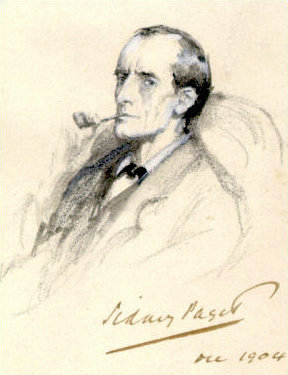
Whenever I am feeling stressed out in the evening, I re-read something old, familiar, and soothing. For me, that is often the Sherlock Holmes stories. I read a story here, a story there, and pretty soon I’ve worked my way through the entire collection. Again.
On each iteration, though, I discover something new. Recently, I re-read Doyle’s 1904 story, “The Adventure of Charles Augustus Milverton.” It’s one of the lesser known of the Sherlock tales, which is ironic because it’s also one of the best. Part of the reason for its obscurity is due, I suspect, to its boring title (more of a “label” than an actual title). I mean, if you had a choice between reading a story called “The Adventure of Charles Augustus Milverton” or “The Hound of the Baskervilles,” which would you pick?
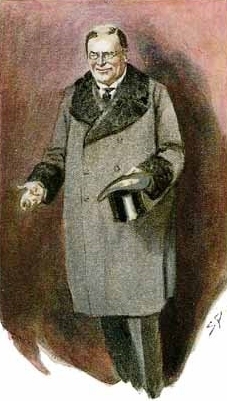
Anyway, I really admire this story, for a number of reasons. Its titular character, Milverton, is a As for Milverton, we learn that he is a master blackmailer, who funds his lavish lifestyle by obtaining compromising letters (what we would now call kompromat) written by rich, aristocratic ladies. He buys the letters from treacherous servants in the ladies’ households, then uses them to extort ruinous sums from the lady in question, often pouncing right before her wedding to some duke or count or whatever. Holmes explains all this to his friend Watson in 221-B Baker Street as they wait for titular villain to stop by. (Milverton’s latest target, an unnamed rich lady, has hired Holmes to get her letters back.)
It’s a very similar premise to another of Doyle’s great stories, “A Scandal in Bohemia,” which I wrote a post about some years ago entitled “Sherlock Holmes was a Fixer”. As in that prior story, Holmes serves as more of a trouble-shooter than a traditional detective here, using his intellect and knowledge of the underworld to sort out a client’s problems. More importantly, in both stories Holmes finds himself compelled to break the law in order to get his client out of trouble. In “The Adventure of Charles Augustus Milverton,” he disguises himself as a working-class tradesman in order to infiltrate Milverton’s household. As Holmes explains to Watson after the fact:
“You would not call me a marrying man, Watson?”
“No, indeed!”
“You’ll be interested to hear that I’m engaged.”
“My dear fellow! I congrat——”
“To Milverton’s housemaid.”
“Good heavens, Holmes!”
“I wanted information, Watson.”
“Surely you have gone too far?”
“It was a most necessary step. I am a plumber with a rising business, Escott, by name. I have walked out with her each evening, and I have talked with her. Good heavens, those talks! However, I have got all I wanted. I know Milverton’s house as I know the palm of my hand.”
“But the girl, Holmes?”
He shrugged his shoulders. “You can’t help it, my dear Watson. You must play your cards as best you can when such a stake is on the table. However, I rejoice to say that I have a hated rival, who will certainly cut me out the instant that my back is turned. What a splendid night it is!”
I love that line, “You can’t help it, my dear Watson.” It seems to encapsulate the great theme of the noir and hard-boiled detective fiction that would emerge later in America. Namely, how do you fight evil effectively without becoming evil yourself? The answer, of course, is that you can’t. Not completely. As the morally expedient Sam Spade says to his similarly disapproving secretary in The Maltese Falcon, “That’s just the way it is, dear.”
Speaking of The Maltese Falcon, I would bet that Dashiell Hammett read (and re-read) “The Adventure of Charles Augustus Milverton.” The villain of Hammett’s novel, Gutman (played so with such risible gusto by Sydney Greenstreet in the 1941 film version), seems like a direct descendent of Doyle’s Milverton. As Doyle describes him,
Charles Augustus Milverton was a man of fifty, with a large, intellectual head, a round, plump, hairless face, a perpetual frozen smile, and two keen gray eyes, which gleamed brightly from behind broad, gold-rimmed glasses. There was something of Mr. Pickwick’s benevolence in his appearance, marred only by the insincerity of the fixed smile and by the hard glitter of those restless and penetrating eyes. His voice was as smooth and suave as his countenance, as he advanced with a plump little hand extended, murmuring his regret for having missed us at his first visit. Holmes disregarded the outstretched hand and looked at him with a face of granite. Milverton’s smile broadened, he shrugged his shoulders, removed his overcoat, folded it with great deliberation over the back of a chair, and then took a seat.
Now look at Hammett’s introduction of Gutman…
The fat man was flabbily fat with bulbous pink cheeks and lips and chins and neck, with a great soft egg of a belly that was all his torso, and pendant cones for arms and legs. As he advanced to meet Spade all his bulbs rose and shook and fell separately with each step, in the manner of clustered soap-bubbles not yet released from the pipe through which they had been blown. His eyes, made small by fat puffs around them, were dark and sleek. Dark ringlets thinly covered his broad scalp. He wore a black cutaway coat, black vest, black satin Ascot tie holding a pinkish pearl, striped grey worsted trousers, and patent-leather shoes.
Note how both villains are presented as soft, one way or another. That is, both are overweight, (Milverton is just “plump” while Gutman is “flabbily fat”), their girth symbolizing not only their greed but their apparent harmlessness. Which makes them all the more dangerous, of course. People underestimate them. They want people to underestimate them. In the same way, both are impeccably mannered and well dressed, with a bit of the dandy about them. The only really threatening thing about them, on the surface, is their compelling eyes (Milverton’s are “hard,” “keen” and penetrating; Gutman’s are “dark and sleek”).
Yet both are formidable opponents, both physically and intellectually. Milverton, for his part, moves “quick as a rat” when Holmes and Watson try to use physical force against him, drawing a revolver to defend himself. He is so capable, in fact, that Holmes resorts to simple robbery in hope of retrieving the kompromat. After seducing Milverton’s hapless maid, he explains how he plans to break into the man’s library and crack his safe.
As in all noir fiction, Holmes’s corruption is contagious. It spreads. Watson insists on coming along on the caper, and soon finds himself enjoying it. As he relates,
My first feeling of fear had passed away, and I thrilled now with a keener zest than I had ever enjoyed when we were the defenders of the law instead of its defiers. The high object of our mission, the consciousness that it was unselfish and chivalrous, the villainous character of our opponent, all added to the sporting interest of the adventure.
Naturally, the operation goes pear-shaped. After breaking into Milverton’s library, Milverton returns to the room and they are forced to hide behind a tapestry. They listen, helpless, as the man conducts a clandestine, midnight meeting with an unknown woman, one whom he assumes to be another disgruntled maid but who is actually one of his former victims. The lady shoots him dead, then flees. Holmes, having already cracked Milverton’s, tosses all the letters into the fire, after which he and Watson do a runner, barely escaping the dead man’s enraged house staff.
With the main plot essentially over, the story still has a couple of surprises in the last pages. Indeed, there is a bit of transgressive humor near the end, when Holmes and Watson are visited the next morning by Inspector Lestrade, of Scotland Yard, seeking their help in a puzzling new case that has arisen overnight—namely, the burgling and murder of one Thomas Milverton! As Lestrade reports, there were two criminals involved in the matter.
“Criminals?” said Holmes. “Plural?”
“Yes, there were two of them. They were as nearly as possible captured red-handed. We have their footmarks, we have their description, it’s ten to one that we trace them. The first fellow was a bit too active, but the second was caught by the under-gardener, and only got away after a struggle. He was a middle-sized, strongly built man—square jaw, thick neck, moustache, a mask over his eyes.”
“That’s rather vague,” said Sherlock Holmes. “My, it might be a description of Watson!”
“It’s true,” said the inspector, with amusement. “It might be a description of Watson.”
This wonderful black comedy is, of course, another way the story pre-sages noir fiction. Holmes, like Sam Spade or Philip Marlowe, takes gleeful delight in outwitting the cops, even though he has no real animus towards them. In some ways, Holmes is a prototype of those later detectives. Like them, he is an island unto himself, obeying the law when possible but otherwise following his own, internal, moral code, no matter where it might lead.
It’s a very modern, almost existentialist version of Holmes, one that is seldom seen in the pop-cultural depictions of him.
(Author’s Note: I’ve been a bit busy lately, so I’m reposting this essay about one of my favorite modern novels. Enjoy…!)
Even though I fancy myself a literary fiction writer (even when I’m writing detective or sci-fi novels), I don’t read that much literary fiction. I read a ton when I was young, especially in college, and lately I’ve found it difficult to find novels that don’t seem derivative or poorly imagined or just downright silly. And for those rare books I do find engaging, I often arrive at them in circuitous ways.
Take Kaui Hart Hemmings’ celebrated novel, The Descendants. Like a lot of books I read, it became known to me from a movie adaptation, although, strangely enough, I didn’t actually see the movie. I was on a flight to Europe some years ago, on an older model jet that still had drop-down movie screen, and the in-flight movie was The Descendants. I didn’t pay for the earphones, but even as a silent film it looked interesting, with George Clooney skulking about some lush tropical landscape that I somehow knew was Hawaii. I looked the movie up on Imdb.com and found that it was based on a novel, so I looked that up. It was a debut novel and looked the kind of book I might like: a literary story, told from a single point-of-view, with relatively few characters, a vivid setting, a compressed time-span, and an intriguing premise.
So, I checked it out on Overdrive. And, man, was I lucky I did.
Author’s Note: I’ve be rereading Saint Jack by Paul Theroux this spring. Again. Every time I read it, I feel like my own writing improves. Maybe it’s my imagination.
Anyway, I thought I’d repost this essay about it. Enjoy…!
Novice writers sometimes ask about the difference between “literary” fiction and “commercial” fiction, and so-called learned people often answer something like this: “Commercial fiction is about plot; literary fiction is about character.”
But what any real student of literary fiction knows is that all novels—all good novels, at least—have a plot. That is, they have a story with a beginning, a middle, and an end, and some element of that story compels the protagonist (and, thus, the reader) through each phase. A short story without a plot isn’t a short story; it’s a poem. And a novel without a plot is a very long poem, the only real difference being a lack of fixed line-breaks.
No, what people really mean when they talk about literary fiction being “plotless” is that the plot, while discernable, is usually internal in nature. This lies in direct opposition to popular novels. Plots of popular novels are often extrinsic, with threats and goals that are externalized and easy to understand. Plots of literary fiction are intrinsic, private to the hidden thoughts, fears, and desires of the main character. Or, put another way, literary fiction often makes use of a plot that revolves around a symbol—something crucial to the hero for reasons that even they might not understand.
Horror and suspense novels have the most obvious and extrinsic plots: Escape the Monster; Kill the Monster; Get the Girl (or Boy); Live to Tell About It. The degree to which the writer of such fiction can make the internal life of the hero relevant to this plot might define the quality of the work, its “literary merit,” but it is by no mean an essential aspect of the genre itself.
Great horror novelists like Stephen King can blur the line between genre and literary fiction almost to undetectability, as in King’s most famous and widely admired novel, The Shining. While ostensibly a ghost story, King elevates his novel by rendering the psychological make-up of his main character, Jack, in vivid and poignant detail. Early in the book, the reader learns that Jack is a failed writer and recovering alcoholic—conditions that combine to make him uniquely susceptible to the seductions of evil emanating from the villainous hotel. But only later do we learn that Jack is also an adult victim of child abuse, a “key” to his psychic make-up that makes the second half of the novel all the more tragic.
In this way, King confirms what Flannery O’Connor said about fiction: “A story always involves, in a dramatic way, the mystery of personality.” She also said that every novel is, in a sense, a whodunnit, if only the psychological sense. The whodunnit of The Shining is Jack’s abusive, alcoholic father.
Of course, the best literary fiction writers can blur the line, too, from the opposite direction. I’ve written before of my love of Robert Stone’s Dog Soldiers, which won the National Book Award in 1973. The story of two world-weary young men who conspire to smuggle a kilo of pure heroin from Viet Nam back to the States, the novel could easily be mistaken for a crime thriller. It’s only the way Stone is able to make the heroin a symbol for both of the men, especially the tragic main character, Ray Hicks, that allows him to wind a deeply affecting literary novel around the spine of that frantic and violent tale.
I’ve been thinking about all this plot business recently, even since I read a very fine novel called Saint Jack by Paul Theroux. Most people classify Theroux as a travel writer—his book The Great Railway Bizarre is often cited as a masterpiece of travel literature—but I know him primarily as a fiction writer, one of the best of the past fifty years. I had admired his books Kowloon Tong and Hotel Honolulu, but for some reason I never read Saint Jack, one of his earlier novels, despite my having been intrigued by it since I was in high school, when I saw Peter Bogdanovich’s wry and mysterious movie adaption starring Ben Gazarra. Part of my failure to actually read the book probably had to do with its relative obscurity; I could never find a copy even in my favorite used book stores. But one of the great boons of the digital era is that the back-catalogues of countless writers are now available, and Saint Jack somehow popped up in my Kindle recommendations for a whopping two bucks! Woo-hoo!
And, man, was that two bucks well spent! Saint Jack presents the reader with one of the most colorful and endearing low-life characters in the history of literature. American ex-pat Jack Flowers is a part-time shipping supplier and full-time pimp working the streets of Singapore. Middle-aged and mildly alcoholic, Jack’s seedy character is redeemed, somewhat, by the kindness with which he treats his affable young prostitutes (his “girls”) and also the hypocritical men (the “fellers”) who seek their services. At least, Jack hopes he is redeemed, fancying himself as a man of importance, a protector to the feckless, lustful, and greedy souls haunting the streets of the city. Cooling his heels in a hotel lobby as he waits for a girl to finish her session with a “feller,” Jack often indulges in…
[t]hat momentary daydream which flits into every reflective man’s mind and makes him say his name with a tide, Sir or President or His Highness—everyone does it sometimes: the clerk wants a kingship, it’s only natural—this dubbing was a feature of my every waking moment. I wasn’t kidding; even the most rational soul has at least one moment of pleasurable reflection when he hears a small voice addressing him as Your Radiance. I had a litany which began Sir Jack, President Flowers, King John, and so forth. And why stop at king? Saint Jack! It was my yearning, though success is nasty and spoils you, the successful say, and only failures listen, who know nastiness without the winch of money. If the rich were correct, I reasoned, what choice had they made? Really, was disappointment virtue and comfort vice and poverty like the medicine that was good because it stung? The President of the United States, in a sense the king of the world, said he had the loneliest job on earth; where did that leave a feller like me?
Unhappy and adrift, Jack’s only ambition is to somehow strike it rich, though he has no plan for doing so. He once dreamed of opening the classiest whore-house in Singapore, a goal that, we learn, was briefly realized in previous years (with tragic consequences). At the point of the novel’s opening, he seems to have stagnated, both financially and spiritually. Then, a stranger enters his life. Leigh, a British accountant hired by Jack’s boss, is of roughly the same age and disposition as Jack, but his life has taken an opposite path. Completely conventional and straightlaced, Leigh nonetheless takes a liking to Jack, even as he finds himself slightly horrified by the details of the man’s street-wise existence. Jack, for his part, sees Leigh as a kindred spirit, a decent “feller,” albeit one who would never hire one of his “girls”. More importantly, Jack is disturbed by Leigh’s disapproval of him, although he struggles to understand why.
Of course, the reader knows why: Leigh is a symbol. He’s a mirror in which Jack sees himself—or, rather, some better version of himself that might have been. In Leigh, all of Jack’s moral failings are revealed.
In this way, his appearance serves as the instigating action of the novel, the beginnings of the plot in which Jack will be forced to explore his own life history. A more generic kind of novel might have proceeded with a burgeoning friendship between the two men, Jack and Leigh, in which the former would find enrichment and even escape from his louche existence. But in Theroux’s capable hands, the story takes an unexpected turn when, barely one-third into the novel, Leigh dies suddenly from a heart attack while drinking in Jack’s favorite “club,” surrounded by boozy British ex-Pats (whom Jack loathes even as he craves their approval).
I previously alluded to O’Connor’s theory that every good novel is a kind of whodunnit, and Saint Jack is a wonderful case in point. It falls to Jack to call Leigh’s wife and tell her of the man’s passing, and also to arrange the funeral, which Theroux renders as predictably absurd and yet surprisingly moving. At this point, the story becomes a huge, Mobius-loop of a flashback in which we learn much about Jack’s past, including the reason he finds himself in Singapore (he’s a fugitive fleeing drug charges in the States) as well as his brief and glorious stint as a whore-house proprietor. Jack pours all his artistic and self-aggrandizing impulses into this joint, an opulent mini-resort which he grandly bestows with the name Dunroamin—a moniker which vaguely evokes an English estate as well as being a homophone for Jack’s yearning for permanence, a true home. (He’s “done roamin’”; get it?). He also pours in all his money, and for a time Dunroamin is successful. But its very success contains the seeds of Dunroamin’s destruction, as it soon attracts the ire of the local Triads, whose henchmen kidnap Jack and tattoo his arms with Chinese curses. Upon his release, Jack finds Dunroamin burned to the ground, his hopes for a better future having gone up with it.
As it turns out, Jack’s days as a house-pimp are not entirely over. He gets a visit from an old acquaintance named Schuck, a CIA spook who once ran a government-subsidized “hotel” with Jack providing R&R to battle-crazed Vietnam soldiers. If the operation of this hotel represented an even deeper moral failing for Jack than his previous ones, Schuck soon tempts Jack all the way into the abyss, hiring him to film a troublesome American general trysting with a prostitute. Whether or not Jack will go through with the plan is the climax of the novel (and one which I will not reveal here).
Saint Jack is a classic novel by one of our most underrated literary writers. Check it out…
Last year, I wrote a post about a fine non-fiction book called Paperbacks from Hell: The Twisted History of ‘70s and ‘80s Horror Fiction. I enjoyed the book primarily for the way the author, Grady Hendrix, mixes his obvious love of old, pulpy horror novels with an enormous amount of mockery and snark. Basically, he makes fun of the trends that ran through horror fiction back in the day, as well their emphasis on over-the-top gore and hilariously silly plots.
As I read the book, though, I noticed Hendrix mention one writer whom he does not mock: Michael McDowell. Rather, Hendrix uncharacteristically bestows a bit of praise on this particular novelist, which made me curious as to why I had never heard of the dude.
As it turns out, most people haven’t heard of McDowell, even though he was a very respected paperback fiction writer (Stephen King called him one of the best) as well as a successful screenwriter (he wrote the screenplays for Beetlejuice and The Nightmare before Christmas, as well as a lot of TV shows). I, especially, should have heard of McDowell considering he was, like me, a Southern writer—from the Gulf Coast of Alabama, not far from where I spent my summers in Pass Christian, Mississippi. He was also a writer who tried to blend a literary sensibility with an appreciation of genre narrative, which is an achievement which I admire.
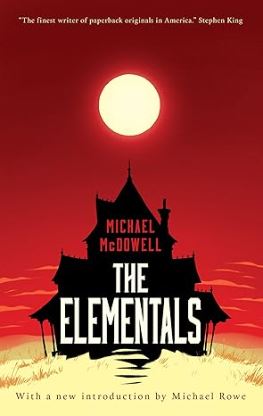
McDowell died in 1999, a latter casualty of the AIDS epidemic in America, just a few years before reliable HIV treatments came into common use. In the years since, his reputation seems to have grown, steadily if slowly, to the point where he is now considered a forgotten master. I was surprised to find an e-book edition of his most famous novel, The Elementals, on my local library’s Overdrive site, and I immediately checked it out and tore into it.
It’s definitely worth the read. Set in Alabama, it tells the story of a two wealthy, intermarried families: the Savages, with matriarch Marian and her adult son, Dauphin; and the McCrays, with matriarch Big Barbara and her adult children, Luker (who has a thirteen-year-old daughter, India) and Leigh (who is married to Dauphin Savage). At the start of the book, Marian has just died and the rest of the blended family is attending her funeral:
In the middle of a desolate Wednesday afternoon in the last sweltering days of May, a handful of mourners were gathered in the church dedicated to St. Jude Thaddeus in Mobile, Alabama. The air conditioning in the small sanctuary sometimes covered the noise of traffic at the intersection outside, but occasionally it did not, and the strident honking of an automobile horn would sound above the organ music like a mutilated stop. The space was dim, damply cool, and stank of refrigerated flowers. Two dozen enormous and very expensive arrangements had been set in converging lines behind the altar. A massive blanket of silver roses lay draped across the light-blue casket, and there were petals scattered over the white satin interior. In the coffin was the body of a woman no more than fifty-five. Her features were squarish and set; the lines that ran from the corners of her mouth to her jaw were deep-plowed. Marian Savage had not been overtaken happily.
Even for a funeral, it’s a very dreary and ominous affair. Yet it gets worse when, at one pre-arranged moment, Dauphin rises and stabs a ritual knife into his dead mother’s chest. Yeah, it’s that kind of book. The fact that McDowell can pull it off and still maintain a high-level of physical and emotional realism—not to mention vivid, sharp writing, as in the passage above—is a testament to his mastery.
The book gets even weirder after the funeral, when the family retreats to their ancestral vacation spot, a tiny barrier island called Beldame, taking with them their Black maid, the long-suffering (and very smart) Odessa. We soon learn that there are three houses on Beldame, yet the family occupies only two of them, leaving the third abandoned. (You can probably guess the reason why, but it has something to do with the house’s intermittent habit of…well…eating people.)
Michael McDowell
As the sand-dunes slowly encroach and bury it, the empty house attracts the curiosity of the young and intrepid India McCray, who ventures inside and sees something impossible yet real. And terrifying.
Of course, The Elementals isn’t just a generic ghost story, nor a generic Southern Gothic novel. The characters are vividly drawn, sympathetic, and believable. Their conversation is fraught with age-old tensions and resentments, yet it’s often very funny in a Curb Your Enthusiasm kind of way. And the characters of India and Odessa are especially well-realized. Linked by their intelligence and, as McDowell implies, some kind of psychic power reminiscent of The Shining, each comes off as a kind of hero in their battle against the evil hiding (rather obviously) in House #3.
The Elementals is a literary horror novel, meaning that it bridges the gap between genre story-telling and development of realistic characters. The book really comes to life (forgive the pun) in the chapters about India as well as of the adult male characters, Luker and Dauphin, both of whom struggle—in true Southern fashion—with the dark legacy of the past and especially surround their own family. Self-indulgent, smothering matriarchs like the recently deceased Marian are, in particular, a source of psychological revulsion. Indeed, they are central to the main theme of the novel, which I will not spoil here.
There is also a good amount of subtle criticism about the racial divide that existed at the time (and now) in the deep south. Odessa, the Black maid, is the only character who does any real work in the book, busy doing the cooking and cleaning for the affluent Whites, just as she has done (we are told) for thirty years. And, of course, Odessa is not only smarter than most of the family members (except, perhaps, for India) she is the only one who knows what the hell is going on in House #3, using her power of second-sight as well as (it is implied) a familial knowledge of voodoo.
Yes, as many reviewers on Reddit have observed, Odessa is an instance of the Magical Negro Trope, of the sort that genre writers, both Southern and not, have abused for a century. This trope is, of course, a literary stereotype, and like any stereotype it can be harmful if taken too far and left unexamined. But if Odessa is a Magical Negro, she is a very world-weary and snarky example, with both courage and brains. I simply loved her character. Sue me.
In fact, I loved the whole book, which feels a bit like a mash-up of Tennessee Williams and Stephen King. Check it out. It deserves some attention. Better late than never.
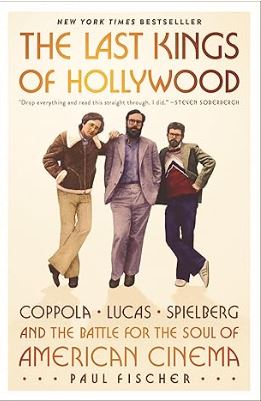
I’ve been reading an excellent non-fiction book by Paul Fischer called The Last Kings of Hollywood: Coppola, Lucas, Spielberg—and the Battle for the Soul of American Cinema. It’s very similar to another great book I read recently (and subsequently wrote a post about), Don’t Stop: Why We Still Love Fleetwood Mac’s “Rumours,” in that both books document the history of struggling artists—film directors, in the former, and rock stars, in the latter—who hit the Big Time. Inevitably, they each also tell the story of a bohemian sub-culture of the 1970s, when people lived hand-to-mouth in the canyons of Southern California, occupying cheap, hardscrabble houses and doing menial jobs while they developed their artistic skills. They also did a lot of drugs (mostly cocaine, booze, and marijuana) while having lots of sex with multiple partners. Fischer’s book, in particular, tells the great story of aspiring actress Margo Kidder, whose rented, A-frame house was frequented by young film makers, actors, musicians, and other arty-types, all attracted by Kidder’s good-natured wit, excellent cooking, and general hospitality. And by her beauty, of course. As Fischer relates, Kidder once joked that if she had bothered to write a memoir of that halcyon time, she would’ve entitled it I Fucked Everybody.
Such artistic, bohemian scenes are as old as…well, 19th Century Paris, when the term “bohemianism” came into use. Apparently, it first referred to the Romani people of Paris, who lived a nomadic existence doing odd-jobs and performing various services (most legal, some not) for local people. In French, they were called bohémiens, because they were thought (mistakenly) to have migrated to France from the Kingdom of Bohemia. Bohemian soon came to describe anyone who, by choice, lived an unconventional life on the edges of society, doing as they pleased. Often, these were artists (painters, writers, musicians) who refused to pursue a normal career, but it also included the moneyed, free-spirited offspring of rich people, who went “slumming” with those same artists.
As I was reading the Wikipedia page on bohemianism, I discovered that such bohemian subcultures are often examples of a precariat. Precariat (I learned) is a mashup of precarious and proletariat, the latter being Karl Marx’s term for the working class. (“Proles” as they are called in George Orwell’s 1984.) People in a precariat are usually just as poor but also lack even the job security of the traditional industrial class, going from low-paying job to low-paying job, with no guarantee of when they’ll land their next position (or be able to pay the rent).
The term (I also learned) is particularly apt today, being often used to describe our modern world of Uber drivers, digital freelancers, and other non-traditional workers. As I read about all this, I thought of a book I posted about some years ago called Nowtopia: How Pirate Programmers, Outlaw Bicyclists, and Vacant Lot Gardeners Are Inventing the Future Today! by Chris Carlston. Written at the dawn of the so-called gig economy, Carlston describes how, rather than dreading the precariousness of modern capitalism, some people have embraced it. By working temporary gigs, such people—whom Carlson calls Nowtopians—have managed to preserve the time and freedom to pursue their true passions like art, or education, or community service, or whatever. He writes:
What we see in the Nowtopian movement is not a fight for workers emancipation within the capitalist division of labor…. Instead we see people responding to the overwork and emptiness of a bifurcated life that is imposed in the precarious marketplace. They seek emancipation from being merely workers. To a growing minority of people, the endless treadmill of consumerism and overwork is something they are working to escape. Thus, for many people time is more important than money. Access to goods has been the major incentive for compliance with the dictatorship of the economy. But in pockets here and there, the allure of hollow material wealth, and with it the discipline imposed by economic life, is breaking down.
Looking back on these words now, they seem a bit naïve. The longings of a utopian dream. They hardly seem describe our current gig economy, which, instead of new bohemian class, seems little more than a last-ditch means of survival for those who can not find good, decent-paying jobs (with benefits). As wealth and power become more concentrated in the hands of a few (usually male) oligarchs, fewer people have the freedom to do anything, no less pursue art. They’re too busy working, looking for jobs, looking for housing, or generally getting by.
In fact, rather than a utopia, our precariat seems more like the dystopia of which William Gibson foretold in his early, cyberpunk novels. Worlds in which most people on earth are underemployed, rootless, and in constant danger, while a tiny middle-class manages everything for an even tinier upper-class. The heroes of such novels are usually young, smart people who resist in the only way they can—by entering an underworld of artists, hackers, thieves, and gangsters who make their living off the rich.
Does this mean that we, as modern Americans, are headed for a world in which the precariat is, essentially, everyone? I think so, yeah. After all, isn’t that the fantasy of every oligarch—to rule over a vast sea of unpaid serfs with no autonomy to control their own lives? A limitless, self-perpetuating underclass, with no agency to defend themselves from the predatory impulses of the ultra-rich, impulses are, ultimately, sadistic in nature.
Despite a youth in which I read literally hundreds of sci-fi novels, I somehow missed the works of Clifford D. Simak. I would blame the fact that Simak wrote his best books long before I was born, in the Golden Age of Science Fiction, but I managed to read other giants from that period like Isaac Asimov and Robert Heinlein. No, I think I missed Simak simply because, well, he wasn’t as popular as those guys. In fact, he became known as one of the founders of Pastoral Science Fiction, a sub-genre in which the stories are set in rural or other off-beat settings. (Sounds sexy, huh?)
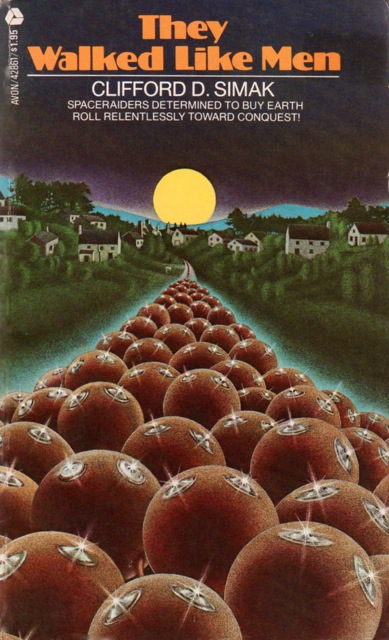
So, you can imagine my surprise when I read Simaks 1964 novel They Walked Like Men. I stumbled upon the book on my local library’s web site. It was a modern copy (see the excellent 1979 cover below by Jan Esteves), and I figured that if my librarians like it enough to buy an e-book copy, it must be worth a shot. So, I checked it out. And I loved it. It’s one of the strangest, edgiest sci-fi novels I read in a long time. Imagine an alien invasion narrative, set in the early 1960s, in which the major plot point is…real estate.
Sounds funky, right? The protagonist, Parker, is a hard-drinking, noirish newspaper man who stumbles upon a plot by mysterious strangers to buy all the real estate in town. Naturally, the strangers turn out to be aliens whose actual shape is something like a bowling ball, but who can simulate almost any form—kind of like the T-1000 in Terminator 2, with equally gruesome results. Parker makes it his mission to get to the bottom of the murderous aliens’ plan, whose true motive turns out to be even stranger than I suspected.
Honestly, I can’t believe no one has adapted this book into a movie. It reads like The Maltese Falcon meets Twin Peaks meets The Invasion of the Body Snatchers. I could someone like Jordan Peele coming in and making this into a really cool, eldritch thriller.
In the meantime, we have the book! Check it out…
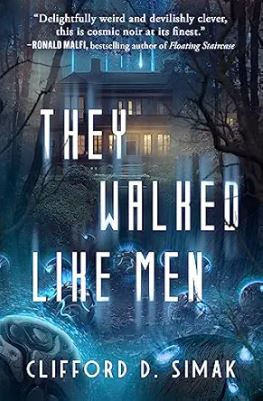
Here is the cover from the latest printing, which I also really like…
I finally moved out of my parents’ house when I was twenty-two, when I embarked on a cross-country move to Tucson, Arizona. I had enrolled in an M.F.A. program at the university there, and I arrived knowing not a single, living soul. Once I found a place to live and acquired a U-of-A ID card, I spent my evenings going to the small, student gym in the basement of the football stadium, where I and a few other lonely souls (all dudes) worked out until the lights went off.
I vividly remember my first night at that gym. There were radio speakers in the ceiling tuned to the local F.M. rock station. That night, as it happened to be running an hour-long special devoted entirely to one rock album: Fleetwood Mac’s Rumours. The show included a few tracks off the album along with interviews with Lindsey Buckingham, Stevie Nicks, and Christine McVie. (For some reason, Mick Fleetwood and John McVie were left out.)
By this time, Rumours had already achieved legendary status of the sort afforded very few pop-music albums. (Sgt. Pepper’s Lonely Hearts Club Band is perhaps the only other.) Today, many years after that first night in Tucson, the album’s popularity and reputation has not diminished. If anything, it has increased. It’s gone from being a recognized artistic masterpiece to a timeless cultural colossus. As each new generation of music fans and musicians have discovered Rumours, an entire legendarium has been constructed around it.
Entire books have been devoted to the months-long, tortuous period in 1977 when the album was recorded. Two of the band’s members, John and Christine McVie, were in the midst of an ugly divorce. Two other members, Stevie Nicks and Lindsey Buckingham, were in the midst of an ugly breakup. And the remaining member, drummer and band leader Mick Fleetwood, was on the verge of breaking up with his famous wife, Jenny Boyd. The five members alternated between screaming obscenities at each other and slipping into effortless, soulful harmonies, all while drinking heavily and vacuuming titanic amounts of cocaine up their collective nose.
At one point late in the process, the album’s producer, Ken Caillat, was horrified to discover that the master recording tapes were literally flaking-out. They had been re-run through the mixing machines so many times that the metal-oxide strip was coming loose from the plastic, threatening to lose all the work he and the band had done. A technician from the manufacturer was flown in to manually transfer the recording onto a new tape before disaster struck.
In short, the fact that Rumours was made at all seems like something of a miracle.