
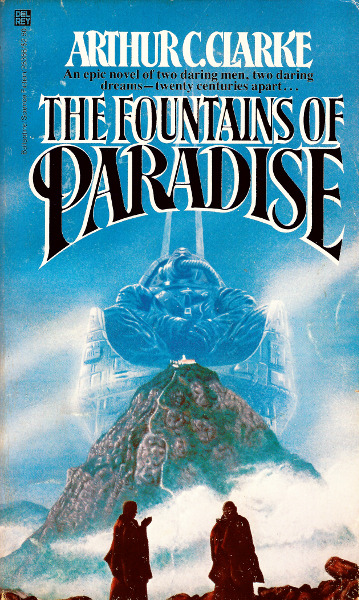
Classic Sci-Fi Book Cover: “The Fountains of Paradise”

I’m no expert on the subject, but when I think of The History of Science Fiction, I imagine it in three big chunks. First came the “Golden Age” of the 1920s and 1930s, when pulp magazines like Astounding and Amazing Stories became enormously popular. Second was the era during and after World War II, when the so-called “Big Three” superstar authors—Issac Asimov, Robert Heinlein, and Authur C. Clarke—emerged. Then came science fiction’s “New Wave,” when literary writers like Philip K. Dick, Ursula K. Le Guin, Harlan Ellison, Samuel R. Delany, and J. G. Ballard transformed the genre.

Over my reading lifetime, I have mostly explored this third era—the New Wave—mainly because, frankly, it’s the only one where you can find some genuinely great novels. But in middle school and high school, I read some of the post-WWII writers, too, especially Clarke. I read Childhood’s End, 2001: A Space Odyssey, Earthlight, and Rendezvous with Rama. I loved all of them, particularly Childhood’s End, which is probably his best book.

Clarke was, by far, my favorite of the Big Three, even though he was far from a great writer. (Heinlein was probably the best, from a stylistic sense, but I disliked his books for other reasons.) Almost invariably, Clarke’s characters fall into a two-dimensional, generic type—the stalwart (male) hero, the honorable scientist, the devoted wife, the curious child, etc. etc.—but he was such a good story teller that no one cared. Essentially, his books are like extended Astounding magazine short stories, beginning with a fascinating, nerdy premise and weaving a cerebral-yet-exciting adventure tale around it.

I read one of his later novels, The Fountains of Paradise, when I was in college and enjoyed it immensely. Set in the near-future, it focuses on a stalwart scientist-hero—a civil engineer, in this case, named Vannevar Morgan—who is determined to build the world’s first space elevator, a literal railway to the stars. He needs to build it somewhere on the earth’s equator and chooses a mountain on the fictional island of Taprobane (a thinly veiled Sri Lanka, which was Clarke’s home for the latter half of his life). Naturally, he immediately faces challenges, beginning with the intractable head-monk of a Buddhist monastery that happens to be smack in the middle of the site Morgan has chosen. The rest of the story follows Morgan’s struggle to build the elevator. Technical problems abound, and several mini-crisis intrude on the elevator’s progress.

One element that The Fountains of Paradise stand-out from the rest of his novels is a clever narrative trick he pulls off. The 21st Century story Morgan is interwoven with a 5th Century tale of a local monarch, King Kalidasa, who tried to build a heaven-like palace on the exact same mountain top. The parallels between the two men are obvious but interesting—each is driven, almost to the point of madness, to see his dream come to reality. But while Kalidasa is a ruthless dictator who amputates the hands off his craftsmen after they finish their task (so they can never reproduce the work for another king), Morgan is a deeply moral, modern, scientific visionary whose goal is the betterment of humanity. He also cares about his workers. In the books final act, an accident occurs that requires Morgan to risk his own life to get oxygen to the workers who are stranded high-up on the elevator’s monofilament cable. It’s a great sequence. (I won’t spoil the ending, of course.)

I really like this cover (by veteran illustrator Terry Oakes) from the 1979 Del Rey edition. I like the juxtaposition of the monks in the foreground with the ghost of King Kalidasa hovering over the mountain (albeit in a high-tech reincarnation, wearing a pressure suit) and the space-elevator cable shooting up into the sky. It’s a crazy cover, in some ways, but it captures the clever dichotomy of the book.
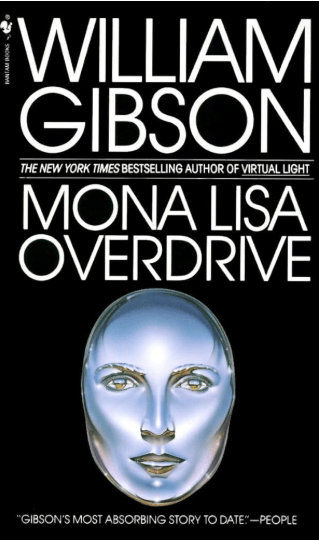
What I’m Reading: “Mona Lisa Overdrive”

The great sci-fi writer Clifford D. Simak was known for writing novels and short stories with off-beat main characters. Often, his protagonists were cynical, working-class stiffs (often with a drinking problem) who stuck to their own, private, moral code, often at great cost to themselves. One of Simak’s editors once groused that all of his stories were about “losers.”

“I like losers,” Simak replied.

I just read this quote the other day, and I immediately thought of William Gibson’s books—specifically, Mona Lisa Overdrive. I first read MLO back in the early 1990s, just a few years after its publication, and I thought it was great. I never really thought of reading it again, but for some reason—perhaps because I’ve been a bit down, of late—I recently checked-out the book and re-read it. And I’m really glad I did. One of the foundational works of the cyberpunk sub-genre (along with Gibson’s Burning Chrome, Neuromancer, Count Zero, and other books), it still holds up, both as a work of speculative fiction as well as just a damned good, vividly imagined, human story. 

A lot of people heap praise on Gibson’s novel—and on the Cyberpunk genre in general—because of their ideas, the thematic questions they ask about how humanity can relate in an age of overwhelming, dehumanizing technology. And what are the brutalizing effects of the ever-increasing disparity between the high-tech haves and the lower-tech have nots? Et cetera et cetera

Myself, I like Gibson’s characters. Often, they are losers, of the sort Simak wrote about. Little people eking-out an existence on the fringes of society. MLO is no exception. The last of Gibson’s Sprawl trilogy, after Neuromancer and Count Zero, it’s set on a near-ish future Earth where mega-corporations, trillionaires, and criminal cartels have replaced all governments, and most of humanity muddles along in a rat-race of late-stage capitalism. The plot is a complicated skein of four interlocking narratives, each centered on a different character: Mona, a teenaged prostitute; Kumiko, the tween-aged daughter of a Yakuza boss; Angie, a beautiful young star of virtual reality films (“simstims”); and Slick Henry, an artist who sculpts robots and suffers from government-inflicted memory loss. I find it interesting that, of these four characters, two are children (Mona is sixteen), one is addicted to drugs, and one is brain-damaged. Additionally, two of them (Mona and Slick Henry) are poor, while the other two “rich” characters (Angie and Kumiko) are virtual prisoners of their wealth and position, separated from any real friendships or human connection. 

Most notably, none of them have real families. Mona is an orphan; Kumiko’s mother died under mysterious circumstances, and her father is an aloof cypher.

In short, all of Gibson’s view-point characters are underdogs, one way or another. The closest he has ever come to a real, kick-ass hero is in one of his best supporting characters, Molly Millions, the cybernetically enhanced mercenary who figures so prominently throughout the Sprawl trilogy (not to mention Gibson’s landmark short-story “Johnny Mneumonic”, which first appeared in Omni Magazine in 1981; yeah, I read it fresh off the newsstand). And even Molly is more of an anti-hero, selling her services to the highest bidder, yet always displaying a basic, inner decency and compassion.

It is Molly, in fact, who becomes the physical catalyst that eventually brings the four narrative threads of the plot together in the MLO’s final chapters. I don’t want to spoil it completely, but the story involves a plot to kidnap Angie (the simstim star, whom Mona strongly resembles; hint, hint) and prevent her from reuniting with her boyfriend, Bobby Newmark, whose body lies comatose in Slick Henry’s art studio while his mind is busy in cyberspace. Kumiko, too, finds herself caught up in this plot, if only tangentially.

Having just re-read the book for the first time in thirty-odd years, I find myself liking it even more now than I did back then. I am awestruck by how deft Gibson’s prose is (he is surely one of America’s most underrated writers), as well as how quickly the story sucks the reader in. Almost every pop-novel out there these days is written from multiple, shifting points-of-view, but very, very few manage to draw their individual characters so vividly, or keep the reader as invested in the plight of each. 

And, yeah, Gibson’s ideas are really, really cool. My favorite revelation in the book is when Slick Henry’s friend, Gentry, figures out that the L.F., the device attached to Bobby’s skull, is really an aleph, referencing the 1945 short story by Jorge Luis Borges. (If you read enough cyberpunk novels—or urban fantasy novels, for that matter—you’re going to run into Borges eventually.)

To sum up, Mona Lisa Overdrive is one of my favorite novels, sci-fi or otherwise. Check it out…

What I’m Reading: Middlemarch

As some dedicated readers of this blog might know, my friend Margaret Luongo and I posted a pair of videos discussing George Eliot’s classic novel Middlemarch to our “Read A Classic Novel…Together!” channel on YouTube. Ever since then, I’ve been meaning to take the time to write a post about it, mainly because it had such a big impact on me. I mean, lots of books have achieved the classic moniker and yet don’t hold up to modern scrutiny. But Middlemarch does. In fact, it’s one of those titanic works of literature that you almost can’t get your head around. It has so many sides and so many aspects, such that it attains a kind of sublime quality. Like Shakespeare’s works, Middlemarch is a different experience for everyone who reads it.

When I say titanic, I mean it literally. Middlemarch is a big book–eight hundred pages in most editions–following the lives of six major and at least a dozen minor characters in the fictional, provincial town called Middlemarch. The story is set in the 1830s, but Eliot wrote the book in the 1870s, when the world had already been vastly changed by the industrial revolution in England. And so, the book has a little bit of a “lost world” feel to it. One can sense that Eliot (whose real name was Mary Ann Evans) is writing about the social and economic environment that is already a thing of the past. However, absolutely nothing about the book feels the least bit sentimental or nostalgic. Quite the contrary. Eliot was a great writer whose blazing intelligence seems to illuminate every page of this very long book. And everything she describes feels as true and relevant today as when she wrote it.

Continue reading “What I’m Reading: Middlemarch”