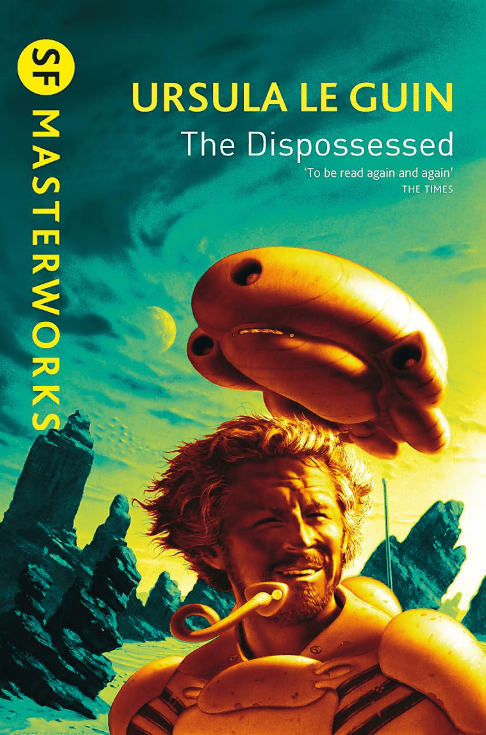
This installment of my ongoing Classic Sci-Fi Book Covers series is another “modern classic,” dating back only to 1999. But I still really like it. The book itself, Ursula K. Le Guin’s The Dispossessed, is quite a bit older, having been published in 1974 when it won the trifecta of sci-fi literary awards—the Hugo, the Locus, and the Nebula. And, yes, it is a classic.
A couple of years ago, Margaret Luongo and I made a couple of YouTube videos about it. I had never read it before, and I really enjoyed it. Indeed, it is now one of my favorite sci-fi books of all time, despite the fact that its premise sounds a bit like an episode of Star Trek. Two diametrically opposed civilizations exist on two adjacent worlds—Urras, a lush, earth-like planet, and Anarres, Urras’s barren, desert moon. While opulent, decadent Urras is run by rival capitalist/fascistic governments, the poor folk of Anarres eke out their existence in a vaguely socialist, anarchistic system. Everybody is free, but poor.
Le Guin’s third-person narrative is told from the point of view of Shevek, a genius physicist from Anarres. Stricken by wanderlust and curiosity, he decides to break an age-old taboo and travel to Urras, whose oligarchic rulers are happy to receive him, hoping to gain his scientific secrets. Half of the story follows his journey to Urras and his subsequent struggle to understand its violent, Machiavellian culture; the other half is told in flashback, revealing his past on Anarres—where he faced a very different set of struggles.
On one level, the book is a great political novel about competing cultures and economic systems. On a much more personal level, it’s a fine coming-of-age story, showing how Shevek gradually becomes disillusioned with the egalitarian but stifling culture of Anarres and thus decides to explore Urras. There, he is disillusioned again, albeit in a much more horrifying, violent way. All the while, Shevek tries to maintain his relationship with another scientist on Anarres, a woman named Takver, with whom he falls in love and has a daughter.
I won’t spoil the ending, but like Le Guin’s other great novel, The Left Hand of Darkness (which is set in the same fictional universe), the plot eventually thickens into that of a taut thriller, with Shevek on the run from his “hosts” on Urras as he flees to a rival state that seems more humane and progressive.
I like this cover by Chris Moore because, while it was done in the early days of the digital age, it still feels like a painting, although an almost photo-realistic one. It features a sun-burned Shevek on Anarres, wearing something that looks very much like a Fremen still-suit from Frank Herbert’s Dune—which makes sense because Anarres is almost as brutal a world as Arrakis. Also, I like how the cover depicts Shevek as a kind of grizzled-yet-optimistic adventurer, ready to explore his neighboring world.
The idea that horror films might in any way be construed as “pro-feminist” seems counterintuitive to most people. It certainly did to me. After all, women are the preferred victims of horror films, especially the slasher genre in which entire sororities and girls-only sleep-overs are massacred wholesale, often in grisly—and blatantly sexual—methods.
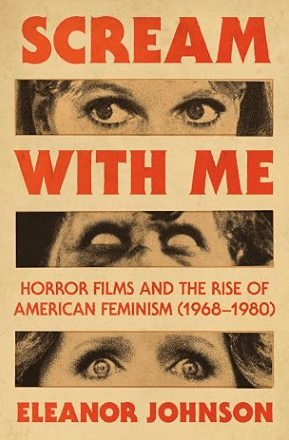
But, as I recently learned, pro-feminist readings of classic horror films are a genuine thing, having a genuine moment. And I was completely convinced of their validity by Eleanor Johnson’s excellent book, Scream With Me: Horror Films and the Rise of American Feminism, 1968-1980. Early in the book, Johnson’s addresses the apparent absurdity of looking for feminist ideas in horror films, going so far as to quote Alfred Hitchcock’s famous formula for an effective thriller: “Torture the women.” Johnson does not minimize the misogyny of classic horror films. Indeed, she goes to great pains to explain that horror films—like any work of art—can often be self-contradictory, sexist on one visceral level but feminist on a deeper, almost subconscious one.
She writes:
[H]orror also has a deep and enduring relationship with American feminism. In fact, American feminism and American horror have been—for more than half a century—allies on issues of domestic abuse, reproductive control, and women’s restricted rights relative to men.
Horror films that focus on violence and persecution of women often do double-duty, serving as a means of getting otherwise conservative or traditionalist viewers to see the plight of women in the first place. More importantly, as Johnson’s title suggests, horror films subconsciously force the viewer to participate in the suffering of women, and thus empathize with their condition.
She writes,
What’s so important about the domestic horror films in this book is that they make viewers—whether or not the viewers are female—carry the fear and vulnerability embodied by the women in the films home with them. They center on a woman’s perspective, making audiences feel wracking physiological and psychological compassion for the women characters who are abused and terrorized. The films, although they showcase women’s suffering, do not simply fetishize that suffering, but rather humanize it, make it palpable, exportable to the viewers’ own minds and bodies. They invite viewers into the lived, embodied experiences of abused women; women barred from power, barred from speaking for themselves, barred from defending themselves; women who weren’t taken seriously by the people from whom they sought aid—doctors, police, lawyers, psychiatrists, husbands, coworkers. These movies took what was going on in American cultural, political, and legal history in the late 1960s and 1970s, and they made those things feelable. They made women’s suffering come alive to viewers who might not otherwise ever have stopped to think about what or how women suffered in the United States, behind closed doors, in the twentieth century. They made that suffering seem like an emergency. And then they made that suffering follow viewers all the way home and nest there.
Johnson goes on to explain her main thesis—namely, that horror films were instrumental in raising public awareness of women’s civil rights issues, and even in changing laws—by focusing on six classic horror films: Rosemary’s Baby, The Exorcist, The Stepford Wives, The Omen, Alien, and The Shining. She examines these films in chronological order, and so it is probably no accident that the oldest, 1968’s Rosemary’s Baby, is also the basis for her most compelling argument.
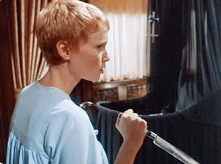
For those who haven’t seen it (i.e., anyone under 40), Rosemary’s Baby is the story of a young couple, Guy and Rosemary Woodhouse, who move into an old, spooky apartment building in Manhattan. They befriend their elderly neighbors, the Castevets, who (it later turns out) run a coven of witches. With the secret cooperation of Guy, the witches drug Rosemary, conjure up Satan, and watch as he rapes the poor woman. Throughout the act, Rosemary is doped up but conscious, hallucinating that she is on a boat, rocking on a rough sea. At moments, though, she becomes lucid, and realizes that she is actually being raped by a huge, hairy creature. “This is no dream,” she yells, in the film’s most horrifying line. “This is really happening.”
The next morning, Guy tells her that he had sex with her while she was asleep. (The scratches on her body, he explains, are due to his “getting a little carried away”). Rosemary is unconvinced but, in true trad-wife fashion, doesn’t make a fuss. When she later becomes pregnant, the Castevets refer her to an old OB-GYN, Dr. Sapirstein, who puts her on a regimen of foul-tasting protein shakes and other noxious concoctions. As the pregnancy progresses, Rosemary finds herself in agonizing pain. Her women friends (whom Guy discourages her from seeing) beg her to find a new doctor, but, again, Rosemary doesn’t make a fuss.
Mia Farrow in “Rosemary’s Baby”
After she finally gives birth at home, the witches take the baby away. Guy tells her it died. But she can hear an infant crying from next door, and the neighbors insist on collecting Rosemary’s milk, which they convinced her to express into glass jars.
At some point, she finds a secret door into the Castevets apartments, only to find them, Dr. Sapirstein, and a bunch of other nattily-dressed devil-worshipers having a party. They are gathered around a cradle in which, of course, Rosemary’s baby lies. The baby himself is never shown. Rather, we only see her horrified reaction when she pulls back the veil and views the hell-spawn. “What’s wrong with his eyes?” she asks. “He has his father’s eyes,” Mr. Castevet replies.
I’ve probably seen Rosemary’s Baby half a dozen times, yet I never put it together that the film is almost a parable about the cruelty of anti-abortion laws. Not until I read Ms. Johnson’s book, that is. As she points out, Rosemary is probably cinema’s most extreme example of a woman forced to complete an unwanted (and very dangerous) pregnancy. One that is, in fact, the result of a rape (by the Devil, no less). As Johnson writes,
By New York State’s own abortion laws in 1968, Rosemary would not have been able to get an abortion on grounds of rape alone. Rape was not justification enough for abortion in 1968 in New York, nor was physical danger, nor psychological harm. Nor, indeed, was the prospect of having a baby born with deformities—which would seem likely when the child’s father is a claw-handed, leather-skinned, goat-eyed demon. The Satanic fetus, whose true range of deformities could only be known after the birth of the child, allegorizes the thousands of thalidomide pregnancies across the United States that women were forced to carry to term, anxiously waiting to see how compromised their babies would be by the drug the women had taken. Like them, Rosemary is going to be forced to carry to term a pregnancy of unknown viability. [Link added]
Of course, it isn’t just a lack of reproductive health rights that causes Rosemary’s ordeal. It’s her lack of freedom in general—financial, educational, and (above all) psychological—that traps her in a private hell. In some ways, her husband, Guy, comes off as even more evil than the Castavets in the way he gaslights and manipulates his wife. And it is this kind of domestic abuse—sometimes physical, always mental—on which Johnson primarily focuses for the rest of the book.
Lee Remick in “The Omen”
In The Omen, for instance, a wealthy man lies to his (much younger) wife, Kathy, when their baby dies at birth. At the urging of a local priest, he takes another baby whose mother has just died and passes him off to Kathy as her own. Naturally, the baby turns out to be the anti-Christ (once again), and the wife suffers mightily (once again), finally being killed by the little bastard and his evil minions. Unlike Guy Woodhouse, the husband in this story is not evil, nor self-serving. He genuinely thinks he’s being kind to his wife in doing the ole baby switch-a-roo, trying to spare her the heartbreak of losing a child. Of course, she has lost a child, and she deserves to know the truth. Moreover, she certainly does not deserve to be tricked into raising the spawn of hell. But her husband, in true patriarchal fashion, does what he sees fit. The result is the same.
I especially enjoyed Johnson’s examination of Stanley Kubrick’s The Shining, which she presents as an apotheosis of the domestic-abuse horror genre. I have always felt that Shelley Duvall’s fine, selfless performance as the tormented wife, Wendy, was the most underappreciated (and even mocked) aspect of the film. Indeed, she is the center of the movie, without which it would have no meaning.
Also, of all the films’ hapless heroines, Wendy’s plight is the most isolating and claustrophobic. As Johnson writes,
Rosemary can’t easily get away from the coven, but she can go see her doctors and, on occasion, her friends. Chris [in The Exorcist] is in thrall to the demon every bit as much as Regan is, but she still manages to go out to see doctors and priests. Joanna has quite a bit of freedom of movement, until the end of Stepford Wives; same with Kathy from The Omen. Ellen Ripley [in Alien] is every bit as imprisoned as Wendy Torrance, but her imprisonment feels incidental because she’s trapped on a floating domestic space, and everyone else is trapped right along with her. Wendy’s entrapment feels obvious, manifest, total, unbreachable. She’s trapped by the hotel; by [her husband] Jack; by the weather; by the distance to any other person or place, to any kind of shelter. The horror of The Shining isn’t ultimately the ghosts in the hotel. It’s Jack and his total imprisonment of Wendy. And, as viewers, we are trapped with her.
Shelley Duvall in “The Shining”
Indeed.
Scream with Me is a hell of a book. Check it out…!
(Author’s Note: I’ve been a bit busy lately, so I’m reposting this essay about one of my favorite modern novels. Enjoy…!)
Even though I fancy myself a literary fiction writer (even when I’m writing detective or sci-fi novels), I don’t read that much literary fiction. I read a ton when I was young, especially in college, and lately I’ve found it difficult to find novels that don’t seem derivative or poorly imagined or just downright silly. And for those rare books I do find engaging, I often arrive at them in circuitous ways.
Take Kaui Hart Hemmings’ celebrated novel, The Descendants. Like a lot of books I read, it became known to me from a movie adaptation, although, strangely enough, I didn’t actually see the movie. I was on a flight to Europe some years ago, on an older model jet that still had drop-down movie screen, and the in-flight movie was The Descendants. I didn’t pay for the earphones, but even as a silent film it looked interesting, with George Clooney skulking about some lush tropical landscape that I somehow knew was Hawaii. I looked the movie up on Imdb.com and found that it was based on a novel, so I looked that up. It was a debut novel and looked the kind of book I might like: a literary story, told from a single point-of-view, with relatively few characters, a vivid setting, a compressed time-span, and an intriguing premise.
So, I checked it out on Overdrive. And, man, was I lucky I did.
Author’s Note: I’ve be rereading Saint Jack by Paul Theroux this spring. Again. Every time I read it, I feel like my own writing improves. Maybe it’s my imagination.
Anyway, I thought I’d repost this essay about it. Enjoy…!
Novice writers sometimes ask about the difference between “literary” fiction and “commercial” fiction, and so-called learned people often answer something like this: “Commercial fiction is about plot; literary fiction is about character.”
But what any real student of literary fiction knows is that all novels—all good novels, at least—have a plot. That is, they have a story with a beginning, a middle, and an end, and some element of that story compels the protagonist (and, thus, the reader) through each phase. A short story without a plot isn’t a short story; it’s a poem. And a novel without a plot is a very long poem, the only real difference being a lack of fixed line-breaks.
No, what people really mean when they talk about literary fiction being “plotless” is that the plot, while discernable, is usually internal in nature. This lies in direct opposition to popular novels. Plots of popular novels are often extrinsic, with threats and goals that are externalized and easy to understand. Plots of literary fiction are intrinsic, private to the hidden thoughts, fears, and desires of the main character. Or, put another way, literary fiction often makes use of a plot that revolves around a symbol—something crucial to the hero for reasons that even they might not understand.
Horror and suspense novels have the most obvious and extrinsic plots: Escape the Monster; Kill the Monster; Get the Girl (or Boy); Live to Tell About It. The degree to which the writer of such fiction can make the internal life of the hero relevant to this plot might define the quality of the work, its “literary merit,” but it is by no mean an essential aspect of the genre itself.
Great horror novelists like Stephen King can blur the line between genre and literary fiction almost to undetectability, as in King’s most famous and widely admired novel, The Shining. While ostensibly a ghost story, King elevates his novel by rendering the psychological make-up of his main character, Jack, in vivid and poignant detail. Early in the book, the reader learns that Jack is a failed writer and recovering alcoholic—conditions that combine to make him uniquely susceptible to the seductions of evil emanating from the villainous hotel. But only later do we learn that Jack is also an adult victim of child abuse, a “key” to his psychic make-up that makes the second half of the novel all the more tragic.
In this way, King confirms what Flannery O’Connor said about fiction: “A story always involves, in a dramatic way, the mystery of personality.” She also said that every novel is, in a sense, a whodunnit, if only the psychological sense. The whodunnit of The Shining is Jack’s abusive, alcoholic father.
Of course, the best literary fiction writers can blur the line, too, from the opposite direction. I’ve written before of my love of Robert Stone’s Dog Soldiers, which won the National Book Award in 1973. The story of two world-weary young men who conspire to smuggle a kilo of pure heroin from Viet Nam back to the States, the novel could easily be mistaken for a crime thriller. It’s only the way Stone is able to make the heroin a symbol for both of the men, especially the tragic main character, Ray Hicks, that allows him to wind a deeply affecting literary novel around the spine of that frantic and violent tale.
I’ve been thinking about all this plot business recently, even since I read a very fine novel called Saint Jack by Paul Theroux. Most people classify Theroux as a travel writer—his book The Great Railway Bizarre is often cited as a masterpiece of travel literature—but I know him primarily as a fiction writer, one of the best of the past fifty years. I had admired his books Kowloon Tong and Hotel Honolulu, but for some reason I never read Saint Jack, one of his earlier novels, despite my having been intrigued by it since I was in high school, when I saw Peter Bogdanovich’s wry and mysterious movie adaption starring Ben Gazarra. Part of my failure to actually read the book probably had to do with its relative obscurity; I could never find a copy even in my favorite used book stores. But one of the great boons of the digital era is that the back-catalogues of countless writers are now available, and Saint Jack somehow popped up in my Kindle recommendations for a whopping two bucks! Woo-hoo!
And, man, was that two bucks well spent! Saint Jack presents the reader with one of the most colorful and endearing low-life characters in the history of literature. American ex-pat Jack Flowers is a part-time shipping supplier and full-time pimp working the streets of Singapore. Middle-aged and mildly alcoholic, Jack’s seedy character is redeemed, somewhat, by the kindness with which he treats his affable young prostitutes (his “girls”) and also the hypocritical men (the “fellers”) who seek their services. At least, Jack hopes he is redeemed, fancying himself as a man of importance, a protector to the feckless, lustful, and greedy souls haunting the streets of the city. Cooling his heels in a hotel lobby as he waits for a girl to finish her session with a “feller,” Jack often indulges in…
[t]hat momentary daydream which flits into every reflective man’s mind and makes him say his name with a tide, Sir or President or His Highness—everyone does it sometimes: the clerk wants a kingship, it’s only natural—this dubbing was a feature of my every waking moment. I wasn’t kidding; even the most rational soul has at least one moment of pleasurable reflection when he hears a small voice addressing him as Your Radiance. I had a litany which began Sir Jack, President Flowers, King John, and so forth. And why stop at king? Saint Jack! It was my yearning, though success is nasty and spoils you, the successful say, and only failures listen, who know nastiness without the winch of money. If the rich were correct, I reasoned, what choice had they made? Really, was disappointment virtue and comfort vice and poverty like the medicine that was good because it stung? The President of the United States, in a sense the king of the world, said he had the loneliest job on earth; where did that leave a feller like me?
Unhappy and adrift, Jack’s only ambition is to somehow strike it rich, though he has no plan for doing so. He once dreamed of opening the classiest whore-house in Singapore, a goal that, we learn, was briefly realized in previous years (with tragic consequences). At the point of the novel’s opening, he seems to have stagnated, both financially and spiritually. Then, a stranger enters his life. Leigh, a British accountant hired by Jack’s boss, is of roughly the same age and disposition as Jack, but his life has taken an opposite path. Completely conventional and straightlaced, Leigh nonetheless takes a liking to Jack, even as he finds himself slightly horrified by the details of the man’s street-wise existence. Jack, for his part, sees Leigh as a kindred spirit, a decent “feller,” albeit one who would never hire one of his “girls”. More importantly, Jack is disturbed by Leigh’s disapproval of him, although he struggles to understand why.
Of course, the reader knows why: Leigh is a symbol. He’s a mirror in which Jack sees himself—or, rather, some better version of himself that might have been. In Leigh, all of Jack’s moral failings are revealed.
In this way, his appearance serves as the instigating action of the novel, the beginnings of the plot in which Jack will be forced to explore his own life history. A more generic kind of novel might have proceeded with a burgeoning friendship between the two men, Jack and Leigh, in which the former would find enrichment and even escape from his louche existence. But in Theroux’s capable hands, the story takes an unexpected turn when, barely one-third into the novel, Leigh dies suddenly from a heart attack while drinking in Jack’s favorite “club,” surrounded by boozy British ex-Pats (whom Jack loathes even as he craves their approval).
I previously alluded to O’Connor’s theory that every good novel is a kind of whodunnit, and Saint Jack is a wonderful case in point. It falls to Jack to call Leigh’s wife and tell her of the man’s passing, and also to arrange the funeral, which Theroux renders as predictably absurd and yet surprisingly moving. At this point, the story becomes a huge, Mobius-loop of a flashback in which we learn much about Jack’s past, including the reason he finds himself in Singapore (he’s a fugitive fleeing drug charges in the States) as well as his brief and glorious stint as a whore-house proprietor. Jack pours all his artistic and self-aggrandizing impulses into this joint, an opulent mini-resort which he grandly bestows with the name Dunroamin—a moniker which vaguely evokes an English estate as well as being a homophone for Jack’s yearning for permanence, a true home. (He’s “done roamin’”; get it?). He also pours in all his money, and for a time Dunroamin is successful. But its very success contains the seeds of Dunroamin’s destruction, as it soon attracts the ire of the local Triads, whose henchmen kidnap Jack and tattoo his arms with Chinese curses. Upon his release, Jack finds Dunroamin burned to the ground, his hopes for a better future having gone up with it.
As it turns out, Jack’s days as a house-pimp are not entirely over. He gets a visit from an old acquaintance named Schuck, a CIA spook who once ran a government-subsidized “hotel” with Jack providing R&R to battle-crazed Vietnam soldiers. If the operation of this hotel represented an even deeper moral failing for Jack than his previous ones, Schuck soon tempts Jack all the way into the abyss, hiring him to film a troublesome American general trysting with a prostitute. Whether or not Jack will go through with the plan is the climax of the novel (and one which I will not reveal here).
Saint Jack is a classic novel by one of our most underrated literary writers. Check it out…
I’m no expert on the subject, but when I think of The History of Science Fiction, I imagine it in three big chunks. First came the “Golden Age” of the 1920s and 1930s, when pulp magazines like Astounding and Amazing Stories became enormously popular. Second was the era during and after World War II, when the so-called “Big Three” superstar authors—Issac Asimov, Robert Heinlein, and Authur C. Clarke—emerged. Then came science fiction’s “New Wave,” when literary writers like Philip K. Dick, Ursula K. Le Guin, Harlan Ellison, Samuel R. Delany, and J. G. Ballard transformed the genre.
Over my reading lifetime, I have mostly explored this third era—the New Wave—mainly because, frankly, it’s the only one where you can find some genuinely great novels. But in middle school and high school, I read some of the post-WWII writers, too, especially Clarke. I read Childhood’s End, 2001: A Space Odyssey, Earthlight, and Rendezvous with Rama. I loved all of them, particularly Childhood’s End, which is probably his best book.
Clarke was, by far, my favorite of the Big Three, even though he was far from a great writer. (Heinlein was probably the best, from a stylistic sense, but I disliked his books for other reasons.) Almost invariably, Clarke’s characters fall into a two-dimensional, generic type—the stalwart (male) hero, the honorable scientist, the devoted wife, the curious child, etc. etc.—but he was such a good story teller that no one cared. Essentially, his books are like extended Astounding magazine short stories, beginning with a fascinating, nerdy premise and weaving a cerebral-yet-exciting adventure tale around it.
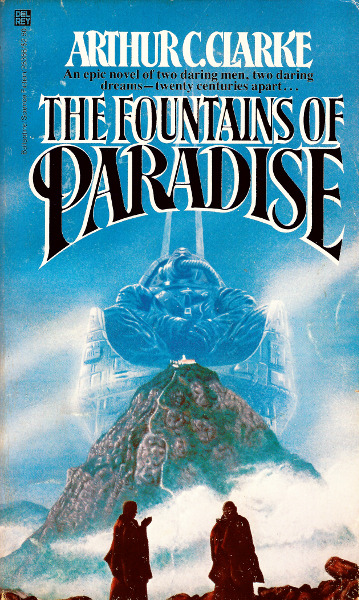
I read one of his later novels, The Fountains of Paradise, when I was in college and enjoyed it immensely. Set in the near-future, it focuses on a stalwart scientist-hero—a civil engineer, in this case, named Vannevar Morgan—who is determined to build the world’s first space elevator, a literal railway to the stars. He needs to build it somewhere on the earth’s equator and chooses a mountain on the fictional island of Taprobane (a thinly veiled Sri Lanka, which was Clarke’s home for the latter half of his life). Naturally, he immediately faces challenges, beginning with the intractable head-monk of a Buddhist monastery that happens to be smack in the middle of the site Morgan has chosen. The rest of the story follows Morgan’s struggle to build the elevator. Technical problems abound, and several mini-crisis intrude on the elevator’s progress.
One element that The Fountains of Paradise stand-out from the rest of his novels is a clever narrative trick he pulls off. The 21st Century story Morgan is interwoven with a 5th Century tale of a local monarch, King Kalidasa, who tried to build a heaven-like palace on the exact same mountain top. The parallels between the two men are obvious but interesting—each is driven, almost to the point of madness, to see his dream come to reality. But while Kalidasa is a ruthless dictator who amputates the hands off his craftsmen after they finish their task (so they can never reproduce the work for another king), Morgan is a deeply moral, modern, scientific visionary whose goal is the betterment of humanity. He also cares about his workers. In the books final act, an accident occurs that requires Morgan to risk his own life to get oxygen to the workers who are stranded high-up on the elevator’s monofilament cable. It’s a great sequence. (I won’t spoil the ending, of course.)
I really like this cover (by veteran illustrator Terry Oakes) from the 1979 Del Rey edition. I like the juxtaposition of the monks in the foreground with the ghost of King Kalidasa hovering over the mountain (albeit in a high-tech reincarnation, wearing a pressure suit) and the space-elevator cable shooting up into the sky. It’s a crazy cover, in some ways, but it captures the clever dichotomy of the book.
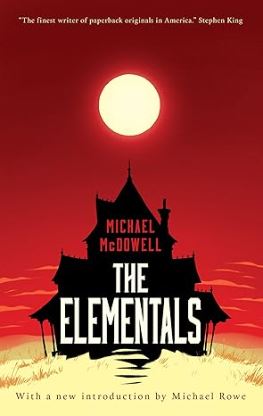
Last year, I wrote a post about a fine non-fiction book called Paperbacks from Hell: The Twisted History of ‘70s and ‘80s Horror Fiction. I enjoyed the book primarily for the way the author, Grady Hendrix, mixes his obvious love of old, pulpy horror novels with an enormous amount of mockery and snark. Basically, he makes fun of the trends that ran through horror fiction back in the day, as well their emphasis on over-the-top gore and hilariously silly plots.
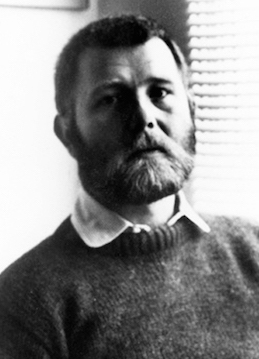
As I read the book, though, I noticed Hendrix mention one writer whom he does not mock: Michael McDowell. Rather, Hendrix uncharacteristically bestows a bit of praise on this particular novelist, which made me curious as to why I had never heard of the dude.
As it turns out, most people haven’t heard of McDowell, even though he was a very respected paperback fiction writer (Stephen King called him one of the best) as well as a successful screenwriter (he wrote the screenplays for Beetlejuice and The Nightmare before Christmas, as well as a lot of TV shows). I, especially, should have heard of McDowell considering he was, like me, a Southern writer—from the Gulf Coast of Alabama, not far from where I spent my summers in Pass Christian, Mississippi. He was also a writer who tried to blend a literary sensibility with an appreciation of genre narrative, which is an achievement which I admire.
McDowell died in 1999, a latter casualty of the AIDS epidemic in America, just a few years before reliable HIV treatments came into common use. In the years since, his reputation seems to have grown, steadily if slowly, to the point where he is now considered a forgotten master. I was surprised to find an e-book edition of his most famous novel, The Elementals, on my local library’s Overdrive site, and I immediately checked it out and tore into it.
It’s definitely worth the read. Set in Alabama, it tells the story of a two wealthy, intermarried families: the Savages, with matriarch Marian and her adult son, Dauphin; and the McCrays, with matriarch Big Barbara and her adult children, Luker (who has a thirteen-year-old daughter, India) and Leigh (who is married to Dauphin Savage). At the start of the book, Marian has just died and the rest of the blended family is attending her funeral:
In the middle of a desolate Wednesday afternoon in the last sweltering days of May, a handful of mourners were gathered in the church dedicated to St. Jude Thaddeus in Mobile, Alabama. The air conditioning in the small sanctuary sometimes covered the noise of traffic at the intersection outside, but occasionally it did not, and the strident honking of an automobile horn would sound above the organ music like a mutilated stop. The space was dim, damply cool, and stank of refrigerated flowers. Two dozen enormous and very expensive arrangements had been set in converging lines behind the altar. A massive blanket of silver roses lay draped across the light-blue casket, and there were petals scattered over the white satin interior. In the coffin was the body of a woman no more than fifty-five. Her features were squarish and set; the lines that ran from the corners of her mouth to her jaw were deep-plowed. Marian Savage had not been overtaken happily.
Even for a funeral, it’s a very dreary and ominous affair. Yet it gets worse when, at one pre-arranged moment, Dauphin rises and stabs a ritual knife into his dead mother’s chest. Yeah, it’s that kind of book. The fact that McDowell can pull it off and still maintain a high-level of physical and emotional realism—not to mention vivid, sharp writing, as in the passage above—is a testament to his mastery.
The book gets even weirder after the funeral, when the family retreats to their ancestral vacation spot, a tiny barrier island called Beldame, taking with them their Black maid, the long-suffering (and very smart) Odessa. We soon learn that there are three houses on Beldame, yet the family occupies only two of them, leaving the third abandoned. (You can probably guess the reason why, but it has something to do with the house’s intermittent habit of…well…eating people.)
Michael McDowell
As the sand-dunes slowly encroach and bury it, the empty house attracts the curiosity of the young and intrepid India McCray, who ventures inside and sees something impossible yet real. And terrifying.
Of course, The Elementals isn’t just a generic ghost story, nor a generic Southern Gothic novel. The characters are vividly drawn, sympathetic, and believable. Their conversation is fraught with age-old tensions and resentments, yet it’s often very funny in a Curb Your Enthusiasm kind of way. And the characters of India and Odessa are especially well-realized. Linked by their intelligence and, as McDowell implies, some kind of psychic power reminiscent of The Shining, each comes off as a kind of hero in their battle against the evil hiding (rather obviously) in House #3.
The Elementals is a literary horror novel, meaning that it bridges the gap between genre story-telling and development of realistic characters. The book really comes to life (forgive the pun) in the chapters about India as well as of the adult male characters, Luker and Dauphin, both of whom struggle—in true Southern fashion—with the dark legacy of the past and especially surround their own family. Self-indulgent, smothering matriarchs like the recently deceased Marian are, in particular, a source of psychological revulsion. Indeed, they are central to the main theme of the novel, which I will not spoil here.
There is also a good amount of subtle criticism about the racial divide that existed at the time (and now) in the deep south. Odessa, the Black maid, is the only character who does any real work in the book, busy doing the cooking and cleaning for the affluent Whites, just as she has done (we are told) for thirty years. And, of course, Odessa is not only smarter than most of the family members (except, perhaps, for India) she is the only one who knows what the hell is going on in House #3, using her power of second-sight as well as (it is implied) a familial knowledge of voodoo.
Yes, as many reviewers on Reddit have observed, Odessa is an instance of the Magical Negro Trope, of the sort that genre writers, both Southern and not, have abused for a century. This trope is, of course, a literary stereotype, and like any stereotype it can be harmful if taken too far and left unexamined. But if Odessa is a Magical Negro, she is a very world-weary and snarky example, with both courage and brains. I simply loved her character. Sue me.
In fact, I loved the whole book, which feels a bit like a mash-up of Tennessee Williams and Stephen King. Check it out. It deserves some attention. Better late than never.
The great sci-fi writer Clifford D. Simak was known for writing novels and short stories with off-beat main characters. Often, his protagonists were cynical, working-class stiffs (often with a drinking problem) who stuck to their own, private, moral code, often at great cost to themselves. One of Simak’s editors once groused that all of his stories were about “losers.”
“I like losers,” Simak replied.
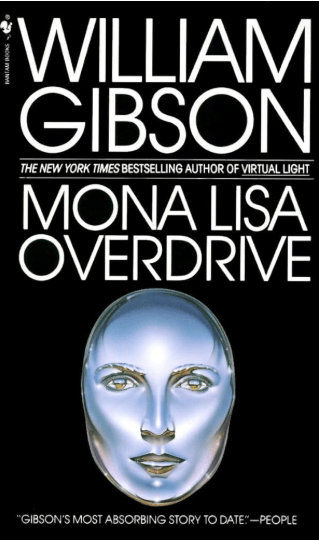
I just read this quote the other day, and I immediately thought of William Gibson’s books—specifically, Mona Lisa Overdrive. I first read MLO back in the early 1990s, just a few years after its publication, and I thought it was great. I never really thought of reading it again, but for some reason—perhaps because I’ve been a bit down, of late—I recently checked-out the book and re-read it. And I’m really glad I did. One of the foundational works of the cyberpunk sub-genre (along with Gibson’s Burning Chrome, Neuromancer, Count Zero, and other books), it still holds up, both as a work of speculative fiction as well as just a damned good, vividly imagined, human story.
A lot of people heap praise on Gibson’s novel—and on the Cyberpunk genre in general—because of their ideas, the thematic questions they ask about how humanity can relate in an age of overwhelming, dehumanizing technology. And what are the brutalizing effects of the ever-increasing disparity between the high-tech haves and the lower-tech have nots? Et cetera et cetera.
Myself, I like Gibson’s characters. Often, they are losers, of the sort Simak wrote about. Little people eking-out an existence on the fringes of society. MLO is no exception. The last of Gibson’s Sprawl trilogy, after Neuromancer and Count Zero, it’s set on a near-ish future Earth where mega-corporations, trillionaires, and criminal cartels have replaced all governments, and most of humanity muddles along in a rat-race of late-stage capitalism. The plot is a complicated skein of four interlocking narratives, each centered on a different character: Mona, a teenaged prostitute; Kumiko, the tween-aged daughter of a Yakuza boss; Angie, a beautiful young star of virtual reality films (“simstims”); and Slick Henry, an artist who sculpts robots and suffers from government-inflicted memory loss. I find it interesting that, of these four characters, two are children (Mona is sixteen), one is addicted to drugs, and one is brain-damaged. Additionally, two of them (Mona and Slick Henry) are poor, while the other two “rich” characters (Angie and Kumiko) are virtual prisoners of their wealth and position, separated from any real friendships or human connection.
Most notably, none of them have real families. Mona is an orphan; Kumiko’s mother died under mysterious circumstances, and her father is an aloof cypher.
In short, all of Gibson’s view-point characters are underdogs, one way or another. The closest he has ever come to a real, kick-ass hero is in one of his best supporting characters, Molly Millions, the cybernetically enhanced mercenary who figures so prominently throughout the Sprawl trilogy (not to mention Gibson’s landmark short-story “Johnny Mneumonic”, which first appeared in Omni Magazine in 1981; yeah, I read it fresh off the newsstand). And even Molly is more of an anti-hero, selling her services to the highest bidder, yet always displaying a basic, inner decency and compassion.
It is Molly, in fact, who becomes the physical catalyst that eventually brings the four narrative threads of the plot together in the MLO’s final chapters. I don’t want to spoil it completely, but the story involves a plot to kidnap Angie (the simstim star, whom Mona strongly resembles; hint, hint) and prevent her from reuniting with her boyfriend, Bobby Newmark, whose body lies comatose in Slick Henry’s art studio while his mind is busy in cyberspace. Kumiko, too, finds herself caught up in this plot, if only tangentially.
Having just re-read the book for the first time in thirty-odd years, I find myself liking it even more now than I did back then. I am awestruck by how deft Gibson’s prose is (he is surely one of America’s most underrated writers), as well as how quickly the story sucks the reader in. Almost every pop-novel out there these days is written from multiple, shifting points-of-view, but very, very few manage to draw their individual characters so vividly, or keep the reader as invested in the plight of each.
And, yeah, Gibson’s ideas are really, really cool. My favorite revelation in the book is when Slick Henry’s friend, Gentry, figures out that the L.F., the device attached to Bobby’s skull, is really an aleph, referencing the 1945 short story by Jorge Luis Borges. (If you read enough cyberpunk novels—or urban fantasy novels, for that matter—you’re going to run into Borges eventually.)
To sum up, Mona Lisa Overdrive is one of my favorite novels, sci-fi or otherwise. Check it out…
(…or, Why I Leave My Christmas Lights Up Till January 5th)
Author’s Note: I wrote this post some years ago. I am reposting it now because Christmas.
I’m a big fan of the Brother Cadfael novels by Edith Pargeter. Brother Cadfael is a medieval monk who has two areas of expertise: botany (plant-based medicine) and solving crimes. Ever since I began reading the Cadfael series about twenty years ago, I’ve been fascinated by the richness and detail of Catholic dogma. Like all monks, Brother Cadfael observes the canonical hours that strictly divide the entire day into a schedule of prayer sessions (for which he is always late). And I also became interested in the various holy days that he and his fellow monks observe.
Perhaps that’s the reason I refuse to consider Christmas over on December 26. Rather, I prefer to stick to the original church concept of Christmastide, which begins on Christmas Day and extends all the way to Twelfth Night on January 5 (better known as Three Kings Day in the Latin community).
Twelfth Night, of course, marks the Day of the Epiphany when the Christ-child was perceived by the wise men as a divine being. The wise men are, themselves, a subject of fascination for me. Their story—which is barely mentioned in the bible—has become embellished over the centuries by various Catholic fanboys. According to current tradition, there were three of them, and they were in fact kings from various parts of the orient: Balthasar of Arabia, Melchior of Persia, and Caspar of India. In some versions, their various ages are given as 20, 40, and 60, representing the three phases of a person’s life (youth, middle-age, and old-age).
So, if you’re still hung over from Christmas Day (I’m speaking metaphorically, although I did have a bit of whiskey in my eggnog), take heart. Christmas might be over, but Christmastide goes on and on. As it should. Those medievals had a much better sense of how to celebrate, from which we, as harried, stressed-out, modern Westerners have much to learn.
And whether you’re a Christian or a lapsed-Christian or just a secular person who respects the Christ figure and observes the holiday solely from a sense of tradition, why not extend the holiday a bit, even past New Year’s Day? Leave your Christmas lights up. Give another present or two to your loved ones. Have another feast.
I know, I know. This cover is a bit out-there. Not every sci-fi book cover, after all, has a spaceship hovering in a night sky over a plus-size female model in a metal bikini, go-go boots, and mail headdress. (But I kind of wish they did.)
Even so, this cover for Babel-17 by Samuel R. Delany is a bonafide classic by the great Spanish illustrator Vicente Segrelles, who has created a ton of great covers throughout his long and brilliant career. It was done for a series of Delany’s novels that were re-released by Bantam in the 1980s, all of which had great, subtle, off-beat covers.
Now, I’ve read a lot of snark about this cover on various chat-boards. Younger guys, especially, find it hilariously bad (and perhaps a lot of girls, too). I think this is because the woman depicted is not the usual, skinny, spandex-clad sci-fi babe. Personally, that’s one reason I like her. I think she’s mysterious, regal, and (yes) sexy.
More importantly, she captures the essence of the novel’s main character, Rydra Wong, who is not only the captain of a spaceship but also a master linguist. When government operatives seek her help in cracking an enemy, alien code called Babel-17, she discovers that it is not just a code—it’s an entire language. She promptly sets-off on a space-adventure to decipher the language, a quest that leads her into a war zone on the edge of the galaxy.
One of the things I love about Babel-17 is the way Delany, even way back in 1966, managed to push a message of tolerance and multi-culturalism. Wong’s spaceship is crewed by a rag-tag group of mercenaries, some of whom are not only transsexual but transhuman, opting for synthetically altered bodies that make them resemble wild animals or fairy tale creatures, and so on. Moreover, Wong’s desire to find the source of Babel-17—and, thus, better understand the aliens who are attacking humanity—suggests a deeper response to the usual fear and xenophobia that was so endemic in America at the time (and is again now, alas).
Babel-17 a classic sci-novel with a classic cover. Check it out…
Harry Harrison’s Deathworld trilogy kept me sane during one long-ago summer when I was bored and lonely. As I recall, my father gave it to me, having bought it in an airport bookshop after a long trip. (Yes, he was a good dad.)
Harrison is most famous for his Stainless Steel Rat series, but I liked these books better. As in all of Harrison’s work, the Deathworld stories center around a trickster anti-hero—in this case, Jason dinAlt, a smart, conniving rogue who is also telepathic. (He uses his E.S.P. to cheat at cards and thus travels from casino-to-casino, and planet-to-planet, having adventures but never a real job.)
Looking back on it, I would bet that this cover by illustrator David Egge, depicting dinAlt in futuristic battle gear, had a lot to do with further popularizing the military science fiction sub-genre, of which Robert Heinlein’s Starship Troopers is the best-known example. (Current examples are too numerous to name.) In fact, the Deathworld books are not military sci-fi. The characters dress like soldiers because they live on a very dangerous planet named Pyrrus (as in pyrrhic; get it?) where every living thing from plants to animals is lethal to humans. Indeed, the entire ecosystem of Pyrrus seems determined to kill all the human colonists, for reasons that dinAlt will try to discover using his telepathic powers as well as his finely honed survival skills.
The Deathworld books are just fun, well-plotted, fast-paced adventure stories, reminiscent of science fiction’s Golden Age—albeit with a bit more wit attached to them than the average sci-fi fair. Moreover, Harrison should be lauded for the series’ strong ecological message (well hidden, at first, but definitely in there), which was usual at the time, especially in “guy’s” books.