
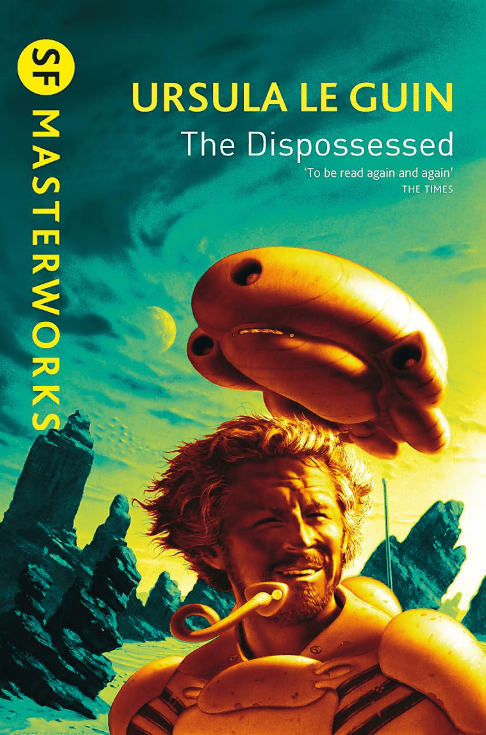
This installment of my ongoing Classic Sci-Fi Book Covers series is another “modern classic,” dating back only to 1999. But I still really like it. The book itself, Ursula K. Le Guin’s The Dispossessed, is quite a bit older, having been published in 1974 when it won the trifecta of sci-fi literary awards—the Hugo, the Locus, and the Nebula. And, yes, it is a classic.
A couple of years ago, Margaret Luongo and I made a couple of YouTube videos about it. I had never read it before, and I really enjoyed it. Indeed, it is now one of my favorite sci-fi books of all time, despite the fact that its premise sounds a bit like an episode of Star Trek. Two diametrically opposed civilizations exist on two adjacent worlds—Urras, a lush, earth-like planet, and Anarres, Urras’s barren, desert moon. While opulent, decadent Urras is run by rival capitalist/fascistic governments, the poor folk of Anarres eke out their existence in a vaguely socialist, anarchistic system. Everybody is free, but poor.
Le Guin’s third-person narrative is told from the point of view of Shevek, a genius physicist from Anarres. Stricken by wanderlust and curiosity, he decides to break an age-old taboo and travel to Urras, whose oligarchic rulers are happy to receive him, hoping to gain his scientific secrets. Half of the story follows his journey to Urras and his subsequent struggle to understand its violent, Machiavellian culture; the other half is told in flashback, revealing his past on Anarres—where he faced a very different set of struggles.
On one level, the book is a great political novel about competing cultures and economic systems. On a much more personal level, it’s a fine coming-of-age story, showing how Shevek gradually becomes disillusioned with the egalitarian but stifling culture of Anarres and thus decides to explore Urras. There, he is disillusioned again, albeit in a much more horrifying, violent way. All the while, Shevek tries to maintain his relationship with another scientist on Anarres, a woman named Takver, with whom he falls in love and has a daughter.
I won’t spoil the ending, but like Le Guin’s other great novel, The Left Hand of Darkness (which is set in the same fictional universe), the plot eventually thickens into that of a taut thriller, with Shevek on the run from his “hosts” on Urras as he flees to a rival state that seems more humane and progressive.
I like this cover by Chris Moore because, while it was done in the early days of the digital age, it still feels like a painting, although an almost photo-realistic one. It features a sun-burned Shevek on Anarres, wearing something that looks very much like a Fremen still-suit from Frank Herbert’s Dune—which makes sense because Anarres is almost as brutal a world as Arrakis. Also, I like how the cover depicts Shevek as a kind of grizzled-yet-optimistic adventurer, ready to explore his neighboring world.


