Classic Sci-Fi Book Cover: “The Demolished Man”

As usual, I was on Wikipedia the other night, looking up one of my favorite rock songs of all time—“Deacon Blues” by Steely Dan. There, I was surprised to learn that the first line of the song, “[t]hese are days of the expanding man,” is a reference to a classic sci-fi novel, Alfred Bester’s The Demolished Man. Donald Fagan apparently said,

The concept of the “expanding man” that opens the song may have been inspired by Alfred Bester’s The Demolished Man. Walter [Becker] and I were major sci-fi fans. The guy in the song imagines himself ascending to the levels of evolution, “expanding” his mind, his spiritual possibilities, and his options in life.

Finding this unexpected reference to Bester’s novel was yet another moment of that Synchronicity for Bookworms phenomomenon that I write about so often, mainly because I had been considering to a post on a great cover I had found for the book. And here it is!

I read The Demolished Man in my late twenties and found it a really bizarre yet engrossing sci-fi novel, one that seems to straddle two eras, “Golden Age” (1940s-50s) sci-fi—with its Buck Rogers’ style future and tropes—and New Wave (1960s-70s) sci-fi—with its trippy, subversive themes and immoral main character. (Roger Silverberg’s The Man in the Maze, which I posted about recently, is very similar in this respect.)

Bester’s novel asks this intriguing question: How does one commit murder in a world where all the police have E.S.P. and can literally read your mind? Yeah, it’s a very, very similar idea to Philip K. Dick’s The Minority Report, which was published three years later. In Bester’s book, people with telepathic abilities—“espers,” who come in ability levels 1, 2, and 3—form a kind of privileged Mandarin caste on 24th Century Earth. They run much of the government and law enforcement with apparent competence, benevolence, and integrity. They may only marry and have children within their own esper class, and they prefer their own company. Most importantly, they can suss out crimes, either before they happen (usually) or afterward (always).

So, what’s a brilliant, daring, sociopathic billionaire like Ben Reich to do when his mind tends toward homicide? The target of his animus is an older business rival, Craye D’Courtney, whom Reich despises with a passion bordering on obsession. Reich devises a cunning plan to kill D’Courtney at a swingin’ dinner party they are both scheduled to attend, and he hires the services of a rare corrupt esper to run interference. Reich also—in one of the book’s cleverest plot devices—pays a corporate jingle-writer to play him the most annoying, brain-embedding ear-worm she has. Reich knows that he won’t be able to get the jingle out of his head, which will temporarily flummox any espers who might try to scan him.

After Reich does the deed at the party, an esper police detective, Lincoln Powell, shows up to investigate. Using a mixture of his esper abilities as well as good old-fashioned intuition, Powell immediately realizes that Reich is guilty of the murder but can’t prove it thanks to the layers of interference that Reich has devised. The rest of the book is like a futuristic episode of Columbo as Powell pursues Reich across the solar system, trying to trap him and reveal his guilt.

If Powell does manage to catch him and prosecute him successfully, Reich faces neither prison nor execution but a fate far worse—“demolition,” the process whereby espers mentally strip a person of their memories and personality so that they might be “rehabilitated” as a productive, normal (non-evil, non-insane) member of society.

In this way, The Demolished Man becomes a very suspenseful inverted detective novel, with the reader breathlessly following Powell and wondering how—or whether—he will catch Reich. I also found myself rooting for the wicked, rebellious anti-hero Reich, which was clearly Bester’s intention. The last half of the book has some genuinely surprising and cool plot twists, and it’s very entertaining overall—especially if you can get past Bester’s very 1950s, conservative, often misogynistic sensibilities (which are very similar, alas, to Robert Heinlein’s).

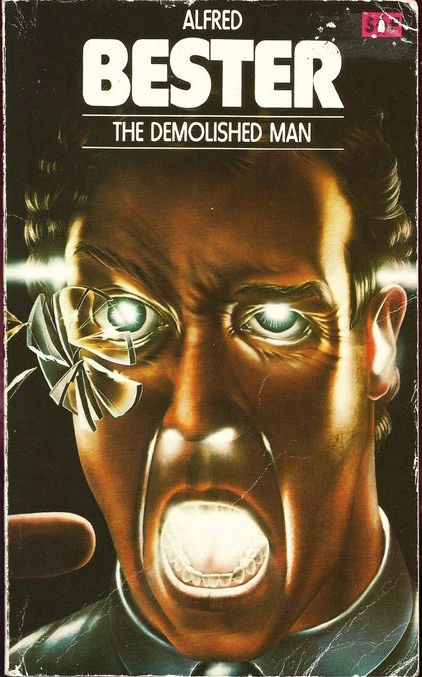
I really like this 1979 cover by Adrian Chesterman because it evokes the sense of horror (of demolition, presumably, but also of insanity, self-discovery, and other dark things) that pervades the book.

It’s also just really, really trippy.

Classic Sci-Fi Book Cover: “Damnation Alley”

For this latest entry in my Classic Sci-Fi Book Covers series, I’ve chosen a fairly recent (2004) edition of Roger Zelazny’s Damnation Alley. The book is a great, sci-fi action yarn about a post-WWIII America in which most of the heartland is scarred by nuclear radiation. Gale-force winds above 500 feet prevent any kind of air travel between the coasts, where the few remaining cities struggle to survive. When an epidemic breaks-out in Boston, officials in Southern California offer a tough criminal, Hell Tanner, a pardon if he will lead a convoy through Damnation Alley, a cross-continental route that bypasses the worst radiation spots. The rest of the story is a kind of post-apocalyptic Iditarod, complete with bandits, micro-hurricanes, and grotesque mutants (both human and animal), all of which Tanner must survive in order to deliver a vaccine.

If you grew up in the 1970s, you might remember the really cheesy (but fun) B-movie that was adapted from it (starring George Peppard, no less!). But even if you’re younger than that, the outlaw-turned-hero plot might seem familiar, mainly because it’s been ripped-off so many times in movies, from Mad Max: The Road Warrior to Escape from New York to Pitch Black

Speaking of movies, Zelazny himself was probably inspired by numerous Westerns from the 1950s and 60s that used the same story. (I’m thinking of The Magnificent Seven, 3:10 to Yuma, and even The Searchers). All such tales focus on a criminal whose ruthlessness and brutality cause him to be ostracized from civilization under normal circumstances, but whose strength and cunning become indispensable in a crisis. 

The idea, of course, goes back further still. Greek and Hindu epics like The Iliad and The Mahabarahta are full of instances of big, nasty warriors who must face a seemingly insurmountable gauntlet of enemies (warriors, monsters, demi-gods, etc.) and defeat them all to achieve some seemingly unattainable boon. In the process, the hero delivers his people from danger and (usually) achieves some kind of moral rehabilitation, if only after his death. 

But there are a couple of key differences between modern tales like Damnation Alley and The Illiad. In ancient literature, the warrior’s violent tendencies are not a minus; they’re a plus. Paleolithic civilizations valued and glorified violent aggression even more than we do, probably because they faced real, existential threats much more often. Also, in ancient myths, it’s usually the hero himself who, seeking glory, embarks on the challenge of his own free-will. In stories like Damnation Alley, the hero (really more of an anti-hero) is compelled by others to take part in the saga. In the end, he might fight some deeper, non-selfish part of himself—or not. It all depends on the worldview of the author.

I really like this cover (by renowned comic book artist Dennis Callero) because it highlights the book’s anti-hero—Hell Tanner—in all his badass glory. He looks like a Hell’s Angel because, according to the story, he is a Hell’s Angel (back before the world got nuked). Now, instead of a Harley, he rides a tank-like vehicle called a Landmaster, bristling with weaponry, which is shown in the background. I also like the greenish glow (of radiation, presumably) coming from the edge of the picture. 

Most of all, I admire how the cover, which was probably done using some kind of digital tool, still looks like an oil painting from old days of 1960s and 70s sci-fi illustration. It’s realistic, but not photo-realistic. It looks like…art.

Classic Sci-Fi Book Cover: “The Man in the Maze”

Once again, I have the great library district of Alachua County to thank for my latest classic sci-fi book cover post. I was browsing through the library’s website, looking at their most recent e-book purchases, when I stumbled upon this oldie by famed sci-fi author Robert Silverberg. I don’t know how exactly, but I never read Silverberg before. I had heard of him, of course. I knew that he was a famous sci-fi author (he’s actually still with us, at 91, as of this writing), often lumped in with the New Wave that emerged in the 1960s. 

Having read one book by him now, I must say that he feels more like a Golden Age writer to me. The Man in the Maze, after all, has not one but two brilliant, highly educated yet macho heroes (ala Heinlein) who live in a Buck-Rogers-style galactic civilization of the future (ala Asimov), where they are very successful with the hot babes of many, far-flung planets. 

Still, this book has a lot more character depth and thematic complexity then the average sci-fi tale, then or now. In fact, it’s clever as hell. I mean, how many other sci-fi works are based on an ancient Greek play? Specifically, this one is a retelling of Sophocles’ drama Philoctetes, in which the titular hero, a great archer and warrior of the Achaeans, is wounded early in the Trojan war. His wound is of a supernatural origin—literally a curse from the Gods—and will not heal. It also stinks to high-heaven, so much so that the other Achaean Greeks dump him on an island called Lemnos, where he stews in his own self-pity and growing hatred of all humankind.

Silverberg cleverly transposes the tail to a far-future civilization, where interplanetary diplomat Dick Muller is similarly afflicted after completing a mission to a newly discovered planet, Beta Hydri IV. During his visit, the Beta Hydrians bestow upon him the “gift” of telepathy. Unfortunately, the kind they give him only works one way, outward. When he returns to human-occupied space, he is horrified to learn that his innermost and darkest thoughts, fears, and impulses are constantly transmitted to those around, to the point that people literally run away. 

Basically, he stinks. In despair, he exiles himself to a bizarre planet (called Lemnos, naturally) which was abandoned millions of years earlier by a highly intelligent but now extinct race. All that remains of their civilization is a huge, diabolical maze, filled with automated traps and snares that kill virtually everyone who goes into it. Except Mueller, that is, who finds his way to the center and takes up residence there.

All this occurs before the main action of the novel, when, as in the original Sophocles drama, Muller’s old friends soon realize that they desperately need the forsaken man to save them from a new crisis. In the play, the Achaeans learn via prophecy that only Philoctetes, with his awesome archery skills, can secure the final victory over Troy. In the novel, Muller’s old friend, Charles Boardman (the guy who sent him to Beta Hydri IV) seeks his help in dealing with yet another alien civilization, this one threatening to enslave all humanity.

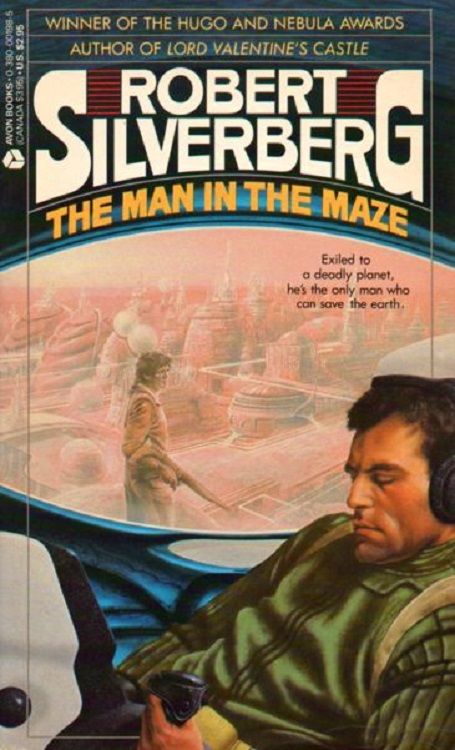
I really like this cover from the 1987 Avon edition because it feels like a great, archetype 1980s cover. Done by master illustrator Jim Burns, it has the photorealistic, industrial style that was typical of that era, the age before digital art was even a dream. (It feels a lot like a Syd Mead work actually.) It’s also got a strangely muted scene, with a rugged-looking man—Charles Boardman, presumably—sitting in the cockpit of a starship while a younger comrade—Ned Rawlins, presumably, whom Boardman convinces to venture into the maze and befriend Muller, in hopes of gulling him into coming with them back to civilization. And behind Rawlins, of course, is the insane, sci-fi maze of Lemnos.

It’s a really fun book. Kind of a precursor to The Hunger Games and The Maze Runner and lots of other, later yarns. Check it out…

Classic Sci-Fi Book Cover: “The Fountains of Paradise”

I’m no expert on the subject, but when I think of The History of Science Fiction, I imagine it in three big chunks. First came the “Golden Age” of the 1920s and 1930s, when pulp magazines like Astounding and Amazing Stories became enormously popular. Second was the era during and after World War II, when the so-called “Big Three” superstar authors—Issac Asimov, Robert Heinlein, and Authur C. Clarke—emerged. Then came science fiction’s “New Wave,” when literary writers like Philip K. Dick, Ursula K. Le Guin, Harlan Ellison, Samuel R. Delany, and J. G. Ballard transformed the genre.

Over my reading lifetime, I have mostly explored this third era—the New Wave—mainly because, frankly, it’s the only one where you can find some genuinely great novels. But in middle school and high school, I read some of the post-WWII writers, too, especially Clarke. I read Childhood’s End, 2001: A Space Odyssey, Earthlight, and Rendezvous with Rama. I loved all of them, particularly Childhood’s End, which is probably his best book.

Clarke was, by far, my favorite of the Big Three, even though he was far from a great writer. (Heinlein was probably the best, from a stylistic sense, but I disliked his books for other reasons.) Almost invariably, Clarke’s characters fall into a two-dimensional, generic type—the stalwart (male) hero, the honorable scientist, the devoted wife, the curious child, etc. etc.—but he was such a good story teller that no one cared. Essentially, his books are like extended Astounding magazine short stories, beginning with a fascinating, nerdy premise and weaving a cerebral-yet-exciting adventure tale around it.

I read one of his later novels, The Fountains of Paradise, when I was in college and enjoyed it immensely. Set in the near-future, it focuses on a stalwart scientist-hero—a civil engineer, in this case, named Vannevar Morgan—who is determined to build the world’s first space elevator, a literal railway to the stars. He needs to build it somewhere on the earth’s equator and chooses a mountain on the fictional island of Taprobane (a thinly veiled Sri Lanka, which was Clarke’s home for the latter half of his life). Naturally, he immediately faces challenges, beginning with the intractable head-monk of a Buddhist monastery that happens to be smack in the middle of the site Morgan has chosen. The rest of the story follows Morgan’s struggle to build the elevator. Technical problems abound, and several mini-crisis intrude on the elevator’s progress.

One element that The Fountains of Paradise stand-out from the rest of his novels is a clever narrative trick he pulls off. The 21st Century story Morgan is interwoven with a 5th Century tale of a local monarch, King Kalidasa, who tried to build a heaven-like palace on the exact same mountain top. The parallels between the two men are obvious but interesting—each is driven, almost to the point of madness, to see his dream come to reality. But while Kalidasa is a ruthless dictator who amputates the hands off his craftsmen after they finish their task (so they can never reproduce the work for another king), Morgan is a deeply moral, modern, scientific visionary whose goal is the betterment of humanity. He also cares about his workers. In the books final act, an accident occurs that requires Morgan to risk his own life to get oxygen to the workers who are stranded high-up on the elevator’s monofilament cable. It’s a great sequence. (I won’t spoil the ending, of course.)

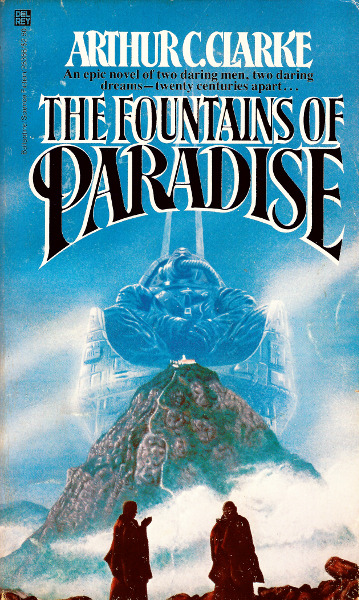
I really like this cover (by veteran illustrator Terry Oakes) from the 1979 Del Rey edition. I like the juxtaposition of the monks in the foreground with the ghost of King Kalidasa hovering over the mountain (albeit in a high-tech reincarnation, wearing a pressure suit) and the space-elevator cable shooting up into the sky. It’s a crazy cover, in some ways, but it captures the clever dichotomy of the book.

Classic Sci-Fi Book Cover: “They Walked Like Men”

Despite a youth in which I read literally hundreds of sci-fi novels, I somehow missed the works of Clifford D. Simak. I would blame the fact that Simak wrote his best books long before I was born, in the Golden Age of Science Fiction, but I managed to read other giants from that period like Isaac Asimov and Robert Heinlein. No, I think I missed Simak simply because, well, he wasn’t as popular as those guys. In fact, he became known as one of the founders of Pastoral Science Fiction, a sub-genre in which the stories are set in rural or other off-beat settings. (Sounds sexy, huh?)

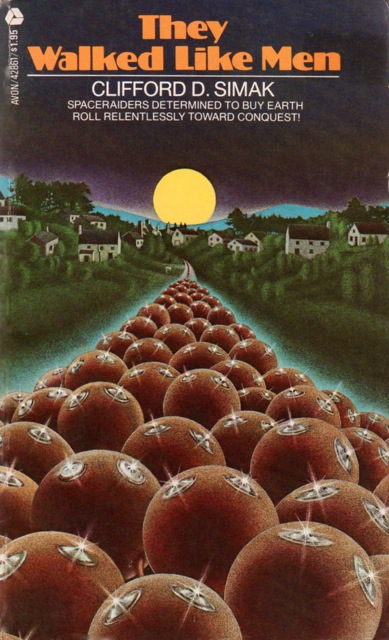
So, you can imagine my surprise when I read Simaks 1964 novel They Walked Like Men. I stumbled upon the book on my local library’s web site. It was a modern copy (see the excellent 1979 cover below by Jan Esteves), and I figured that if my librarians like it enough to buy an e-book copy, it must be worth a shot. So, I checked it out. And I loved it. It’s one of the strangest, edgiest sci-fi novels I read in a long time. Imagine an alien invasion narrative, set in the early 1960s, in which the major plot point is…real estate. 

Sounds funky, right? The protagonist, Parker, is a hard-drinking, noirish newspaper man who stumbles upon a plot by mysterious strangers to buy all the real estate in town. Naturally, the strangers turn out to be aliens whose actual shape is something like a bowling ball, but who can simulate almost any form—kind of like the T-1000 in Terminator 2, with equally gruesome results. Parker makes it his mission to get to the bottom of the murderous aliens’ plan, whose true motive turns out to be even stranger than I suspected.

Honestly, I can’t believe no one has adapted this book into a movie. It reads like The Maltese Falcon meets Twin Peaks meets The Invasion of the Body Snatchers. I could someone like Jordan Peele coming in and making this into a really cool, eldritch thriller.

In the meantime, we have the book! Check it out…

Here is the cover from the latest printing, which I also really like…

Classic Sci-Fi Book Cover: “The Martian Chronicles” (Again)

Bantam’s 1977 Edition of “The Martian Chronicles”

This 1977 cover for Ray Bradbury’s The Martian Chronicles is probably an off-beat choice for my Classic Sci-Fi Book Covers series. After all, it’s a pen-and-ink illustration, which is a very unusual choice for sci-fi art.

Unusual, that is, unless you’re the great Ian Miller, who does most of his work in pencil or pen. Miller did a lot of Bradbury covers in the 1970s and 80s, and I love every single one of them. They have a weird, surreal, almost cubist quality that evokes the sense of mystery and magic that the best sci-fi novels create.

Here is another great cover by Miller.

And here is a link to his website.

Classic Sci-Fi Book Cover: “Babel-17”

I know, I know. This cover is a bit out-there. Not every sci-fi book cover, after all, has a spaceship hovering in a night sky over a plus-size female model in a metal bikini, go-go boots, and mail headdress. (But I kind of wish they did.)

Even so, this cover for Babel-17 by Samuel R. Delany is a bonafide classic by the great Spanish illustrator Vicente Segrelles, who has created a ton of great covers throughout his long and brilliant career. It was done for a series of Delany’s novels that were re-released by Bantam in the 1980s, all of which had great, subtle, off-beat covers.

Now, I’ve read a lot of snark about this cover on various chat-boards. Younger guys, especially, find it hilariously bad (and perhaps a lot of girls, too). I think this is because the woman depicted is not the usual, skinny, spandex-clad sci-fi babe. Personally, that’s one reason I like her. I think she’s mysterious, regal, and (yes) sexy.

More importantly, she captures the essence of the novel’s main character, Rydra Wong, who is not only the captain of a spaceship but also a master linguist. When government operatives seek her help in cracking an enemy, alien code called Babel-17, she discovers that it is not just a code—it’s an entire language. She promptly sets-off on a space-adventure to decipher the language, a quest that leads her into a war zone on the edge of the galaxy.

One of the things I love about Babel-17 is the way Delany, even way back in 1966, managed to push a message of tolerance and multi-culturalism. Wong’s spaceship is crewed by a rag-tag group of mercenaries, some of whom are not only transsexual but transhuman, opting for synthetically altered bodies that make them resemble wild animals or fairy tale creatures, and so on. Moreover, Wong’s desire to find the source of Babel-17—and, thus, better understand the aliens who are attacking humanity—suggests a deeper response to the usual fear and xenophobia that was so endemic in America at the time (and is again now, alas).

Babel-17 a classic sci-novel with a classic cover. Check it out…

Classic Sci-Fi Book Cover: “A Clockwork Orange”

The most important novel in the dystopian science fiction sub-genre is George Orwell’s 1984. The second most important is Anthony Burgess’s A Clockwork Orange. I would go so far to argue that Burgess’s book has, in some ways, been even more influential and culturally significant than Orwell’s, especially for those generations that grew up in the 1970s and later. 

It was in 1971 that Stanley Kubrick adapted the book into a landmark film, which was how I first discovered the novel. By the time I was a teenager, in the early 80s, Kubrick’s movie had taken on cult status—almost as much as 2001: A Space Odyssey. My friends and I all loved the movie. And I, being a particularly bookish kid, decided to check the novel out, too.

The secret to A Clockwork Orange’s success, topping that of almost all other dystopian novels, is that it has a great, exciting twist. Its protagonist, a fifteen-year-old delinquent named Alex, seems more like a villain than a hero. He is, after all, a thug, a thief, a gang-member, a rapist, a drug user, and a lover of all things violent (“ultraviolence,” as he and his gang friends call it). Yet, in comparison to the oppressive, authoritarian, end-stage-Capitalist society in which he lives, he is a kind of hero. Against that iron-grey backdrop, his better, human qualities come to the fore—his intelligence, his ferocious courage, and his absolute dedication to personal pleasure, the state-be-damned.

This twist is one of the greatest, central ironies in modern literature, and it’s the reason teenage boys (and probably a few girls, too) continue to find themselves drawn to the book, just as they have been for sixty years. Conversely, this is also the reason that social conservatives have hated the book for just as long. In fact, as I recently learned from openculture.com, A Clockwork Orange was the most banned book of the 2024-25 school year

I have no doubt that Burgess would have been very, very proud.

Kubrick’s film version was so powerful that it influenced the cover-design for most subsequent editions of the book. Many of these covers were thinly-veiled riffs on the movie poster or on Malcolm McDowell’s brilliant performance, wearing his singularly perverse, false-eyelash. I really like this cover from 1995 by Robert Longo because it bucked that trend and did something new. 

Also, I think it really captures the madness of the book—the ferocity of Alex’s character as he rages against the machine. Yes, he’s an evil character, but that’s sort of the point of the whole book. Alex has a God-given right to be evil, if that’s his choice. Evil is an implied, but not a  necessary, product of his free will, and he fights valiantly against being “programmed” by the cold authority figures of the story.

Just like most teenagers. Even the ones that aren’t psychopaths.

Classic Sci-Fi Book Cover: “The Deathworld Trilogy”

Cover art by David Egge

Harry Harrison’s Deathworld trilogy kept me sane during one long-ago summer when I was bored and lonely. As I recall, my father gave it to me, having bought it in an airport bookshop after a long trip. (Yes, he was a good dad.) 

Harrison is most famous for his Stainless Steel Rat series, but I liked these books better. As in all of Harrison’s work, the Deathworld stories center around a trickster anti-hero—in this case, Jason dinAlt, a smart, conniving rogue who is also telepathic. (He uses his E.S.P. to cheat at cards and thus travels from casino-to-casino, and planet-to-planet, having adventures but never a real job.) 

Looking back on it, I would bet that this cover by illustrator David Egge, depicting dinAlt in futuristic battle gear, had a lot to do with further popularizing the military science fiction sub-genre, of which Robert Heinlein’s Starship Troopers is the best-known example. (Current examples are too numerous to name.) In fact, the Deathworld books are not military sci-fi. The characters dress like soldiers because they live on a very dangerous planet named Pyrrus (as in pyrrhic; get it?) where every living thing from plants to animals is lethal to humans. Indeed, the entire ecosystem of Pyrrus seems determined to kill all the human colonists, for reasons that dinAlt will try to discover using his telepathic powers as well as his finely honed survival skills.

The Deathworld books are just fun, well-plotted, fast-paced adventure stories, reminiscent of science fiction’s Golden Age—albeit with a bit more wit attached to them than the average sci-fi fair. Moreover, Harrison should be lauded for the series’ strong ecological message (well hidden, at first, but definitely in there), which was usual at the time, especially in “guy’s” books. 

Check them out…

Classic Sci-Fi Book Cover: “The Early Asimov – Volume 1”

Ever since I started this series, I’ve been meaning to write a post about Chris Foss. For a sci-fi nerd growing up in the 1970s and ’80s, it was impossible not to see and be familiar with Foss’s artwork. After all, he illustrated more than 1,000 book covers during his long and celebrated career. His style is so distinct and memorable that one can recognize it on a bookshelf (or a computer screen) from twenty yards away. 

I remember seeing some of his sci-fi book covers back in the 1970s and being struck by their originality and vividness. He specialized in images depicting spaceships or futuristic craft, which he rendered with a strange, industrial-style realism that was new and striking. In particular, his spaceships look like real, constructed things with visible welds and spanners and plates, often painted in bright, almost nautical color schemes. He also likes to depict smoke. Or mist. Or dust. Something to give the otherwise static vacuum of space some drama and sense of motion. 

His work was so good, in fact, that no one seemed to care whether the depicted image had anything to do with the plot of the book itself. Often, it did not. But that didn’t matter. The cover always said two things: science fiction and drama. And that was enough. It was plenty. 

While I was doing a bit of research for this post, I was delighted to learn that Mr. Foss is still alive and still working. You can see more of his artwork on his website, which I encourage everyone to visit.