Gainesville has a famous bar called The Salty Dog Saloon, across the street from the University of Florida and just two blocks away from Ben Hill Griffin Stadium. Back in the 1990s, I spent many an evening at The Salty Dog, shooting pool, drinking beer, and inhaling so much second-hand smoke that, as I soon discovered, I could smoke an entire cigarette without coughing, even though I had never officially taken up the habit.
The Salty Dog also had a great jukebox (maybe it still does). And, this being the height of the grunge era, my friends and I played a lot of Nirvana, Soundgarden, and Pearl Jam. Somehow, a joke started among us that the next Godzilla movie should be set in Seattle, where the great kaiju would be battled (and, no doubt, defeated) by the likes of Chris Cornell, Eddie Vedder, and Kurt Cobain.
It was a dumb joke, but it struck a chord. These guys were the superheroes of rock, cultural warriors that always seemed brilliant, dedicated, and brave. So, in 1993, when two of three, Vedder and Cornell, teamed up to form a super-group called Temple of the Dog, we should have been ecstatic. It was like Batman and Superman joining forces to fight evil (if not Godzilla).
In fact, the band—which was formed by Cornell as a kind of tribute to his late friend and lead singer of Mother Love Bone, Andrew Wood—made very little impact on us. Except for one song: “Hunger Strike.” For a few weeks, it was the practically the only thing on the radio (yes, we still listened to radio in those days). An unlikely duet between Cornell and Vedder, it shows off the vocal strengths of both men, whose voices complement each other in kind of harmonic unity not often heard in alt-rock (and especially not in grunge). I love how Cornell’s magnificent tenor soars high above Vedder’s mournful baritone, which seems to anchor it.
Somehow, through the alchemy of art, the song becomes less of a dirge than a jubilant cry of defiance.
The great sci-fi writer Clifford D. Simak was known for writing novels and short stories with off-beat main characters. Often, his protagonists were cynical, working-class stiffs (often with a drinking problem) who stuck to their own, private, moral code, often at great cost to themselves. One of Simak’s editors once groused that all of his stories were about “losers.”
“I like losers,” Simak replied.
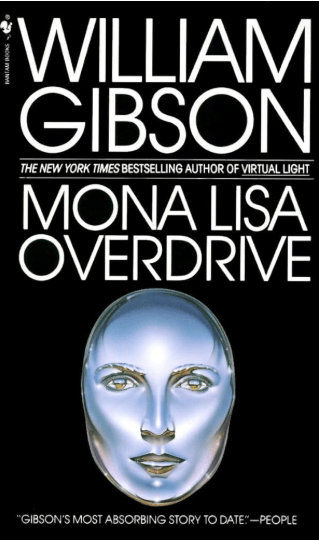
I just read this quote the other day, and I immediately thought of William Gibson’s books—specifically, Mona Lisa Overdrive. I first read MLO back in the early 1990s, just a few years after its publication, and I thought it was great. I never really thought of reading it again, but for some reason—perhaps because I’ve been a bit down, of late—I recently checked-out the book and re-read it. And I’m really glad I did. One of the foundational works of the cyberpunk sub-genre (along with Gibson’s Burning Chrome, Neuromancer, Count Zero, and other books), it still holds up, both as a work of speculative fiction as well as just a damned good, vividly imagined, human story.
A lot of people heap praise on Gibson’s novel—and on the Cyberpunk genre in general—because of their ideas, the thematic questions they ask about how humanity can relate in an age of overwhelming, dehumanizing technology. And what are the brutalizing effects of the ever-increasing disparity between the high-tech haves and the lower-tech have nots? Et cetera et cetera.
Myself, I like Gibson’s characters. Often, they are losers, of the sort Simak wrote about. Little people eking-out an existence on the fringes of society. MLO is no exception. The last of Gibson’s Sprawl trilogy, after Neuromancer and Count Zero, it’s set on a near-ish future Earth where mega-corporations, trillionaires, and criminal cartels have replaced all governments, and most of humanity muddles along in a rat-race of late-stage capitalism. The plot is a complicated skein of four interlocking narratives, each centered on a different character: Mona, a teenaged prostitute; Kumiko, the tween-aged daughter of a Yakuza boss; Angie, a beautiful young star of virtual reality films (“simstims”); and Slick Henry, an artist who sculpts robots and suffers from government-inflicted memory loss. I find it interesting that, of these four characters, two are children (Mona is sixteen), one is addicted to drugs, and one is brain-damaged. Additionally, two of them (Mona and Slick Henry) are poor, while the other two “rich” characters (Angie and Kumiko) are virtual prisoners of their wealth and position, separated from any real friendships or human connection.
Most notably, none of them have real families. Mona is an orphan; Kumiko’s mother died under mysterious circumstances, and her father is an aloof cypher.
In short, all of Gibson’s view-point characters are underdogs, one way or another. The closest he has ever come to a real, kick-ass hero is in one of his best supporting characters, Molly Millions, the cybernetically enhanced mercenary who figures so prominently throughout the Sprawl trilogy (not to mention Gibson’s landmark short-story “Johnny Mneumonic”, which first appeared in Omni Magazine in 1981; yeah, I read it fresh off the newsstand). And even Molly is more of an anti-hero, selling her services to the highest bidder, yet always displaying a basic, inner decency and compassion.
It is Molly, in fact, who becomes the physical catalyst that eventually brings the four narrative threads of the plot together in the MLO’s final chapters. I don’t want to spoil it completely, but the story involves a plot to kidnap Angie (the simstim star, whom Mona strongly resembles; hint, hint) and prevent her from reuniting with her boyfriend, Bobby Newmark, whose body lies comatose in Slick Henry’s art studio while his mind is busy in cyberspace. Kumiko, too, finds herself caught up in this plot, if only tangentially.
Having just re-read the book for the first time in thirty-odd years, I find myself liking it even more now than I did back then. I am awestruck by how deft Gibson’s prose is (he is surely one of America’s most underrated writers), as well as how quickly the story sucks the reader in. Almost every pop-novel out there these days is written from multiple, shifting points-of-view, but very, very few manage to draw their individual characters so vividly, or keep the reader as invested in the plight of each.
And, yeah, Gibson’s ideas are really, really cool. My favorite revelation in the book is when Slick Henry’s friend, Gentry, figures out that the L.F., the device attached to Bobby’s skull, is really an aleph, referencing the 1945 short story by Jorge Luis Borges. (If you read enough cyberpunk novels—or urban fantasy novels, for that matter—you’re going to run into Borges eventually.)
To sum up, Mona Lisa Overdrive is one of my favorite novels, sci-fi or otherwise. Check it out…
Recently I was chatting with a friend of mine, and at some point in the course of the conversation I told her about one of my favorite thriller novels of the last twenty years. It was Winter’s Bone by Daniel Woodrell, who sadly passed away in November. I described the plot to my friend, explaining how it’s about a 16-year-old girl, Ree Dolly, who lives in the Ozark mountains, raising her two little brothers. When her meth-dealing father goes missing, Ree faces the prospect of the bank foreclosing on the family mortgage, which would leave them all homeless (in addition to crushingly poor). To prevent this, Ree goes alone on a quest to find her father—or, at least, to find his body (she suspects he’s dead) so that she can get the money from his life insurance policy. This quest leads her into the mountain-shack domain of the local drug lord.
As I told all this to my friend, her expression became doubtful.
“Sounds dark,” she said.
I was taken aback, momentarily, and not just because my enthusiasm for Woodrell’s book failed to penetrate her skepticism. I was taken aback because I did not, in fact, have a good reply to her complaint. Yes, Winter’s Boneis a dark novel. Very dark. About as dark as you can get in a realistic, literary work. However, my enjoyment of the book is not dark. In fact, I remember the light-hearted, almost giddy thrill I felt while reading it—feverishly, tearing through it in a couple of days. It was the sensation that Vladimir Nabokov called a “kindling of the spine,” which one gets when reading a truly fine book.
What I found myself unable to communicate to my friend is the simple fact that I loved Winter’s Bone, even though its subject matter sounds like the stuff of an awful, depressing PBS documentary. How is this possible? Why do people like me sometimes read, and love, “dark” novels. More to the point, why do we read “heavy” novels in general—novels about tough subjects, adult circumstances, and big, real-life, consequential choices?
Why don’t we only read fun, predictable, pop-novels of the sort that dominate the best seller lists (not to mention the top 100 slots on GoodReads)?
I often think of something the late, great film critic Roger Ebert once said: “Happy movies don’t make you happy, and sad movies don’t make you sad. Good movies make you happy, and bad movies make you sad.”
Daniel Woodrell – MPR News
Such a simple statement, and yet so profound! It applies equally well to novels. Good novels make you happy, and bad novels make you sad (or, at least, bored). Ultimately, though, Ebert’s aphorism is insufficient to answer my friend’s reaction. What does “good” mean in a movie, or a novel? For that matter, what does “happy” mean? Neither word seems easily definable, in this circumstance.
Happiness, in the grand sense, is not the sensation one gets from a book like Winter’s Bone. As thrilling and, yes, entertaining as it is, it does not induce true happiness. Rather, what it grants the reader is a sense of being transported—of movement, into the mind and world of the main character. That is, for each one- or two-hours session of reading the book, one becomes Ree Dolly. Take this opening paragraph:
Ree Dolly stood at break of day on her cold front steps and smelled coming flurries and saw meat. Meat hung from trees across the creek. The carcasses hung pale of flesh with a fatty gleam from low limbs of saplings in the side yards. Three halt haggard houses formed a kneeling rank on the far creekside and each had two or more skinned torsos dangling by rope from sagged limbs, venison left to the weather for two nights and three days so the early blossoming of decay might round the flavor, sweeten that meat to the bone.
What most people misunderstand about books like Winter’s Bone is that they are not merely well written. Yes, good writing is a necessary—but not sufficient—quality of a successful literary novel. What is also required, though, is this shift in psychic awareness. In the paragraph above, we feel Ree’s sense of life—her desperation, her determination to survive in the most severe physical circumstances. We, as readers, are right there with her, standing on the snow, freezing our butts off, wondering how we’re going to survive the winter.
In a later passage, we also get a sense of Ree’s love and compassion for her two little brothers:
Sonny and Harold were eighteen months apart in age. They nearly always went about shoulder to shoulder, running side by side and turning this way or veering that way at the same sudden instant, without a word, moving about in a spooky, instinctive tandem, like scampering quotation marks. Sonny, the older boy, was ten, seed from a brute, strong, hostile, and direct. His hair was the color of a fallen oak leaf, his fists made hard young knots, and he’d become a scrapper at school. Harold trailed Sonny and tried to do as he did, but lacked the same sort of punishing spirit and muscle and often came home in need of fixing, bruised or sprained or humiliated.
The great novelist Martin Amis once related Vladimir Nabokov’s belief that the reader should not identify with the character in a novel; rather, they should identify with the author. But I’ve never believed it. Yes, a good book does impart the wisdom of the author (this especially true in a masterpiece like George Eliot’s Middlemarch), as well as the benefit of their wit and depth of feeling. But that’s not the main reason people read novels. Rather, it is identification with the protagonist. And it’s not just that we identify with the main character; we must sympathize with them. We must participate in their struggle.
Even a rat-bastard character like Nabokov’s own Humbert Humbert—the most famous pedophile in literary history—could not keep our attention as readers if we did not, on some level, see ourselves in him. We must like him, if only a little. Feel sorry for him, even. Yes, he commits dreadful acts, but he does so, we sense, in a mistaken pursuit of happiness (that, what he believes is happiness, as he equates it to his sexual possession for Delores Haze). He is, in other words, a very wicked man but not a truly evil one.
Ree Dolly, of course, is neither wicked nor evil. She is, in fact, a completely valiant and admirable character. But that’s not the point. The relative morality or immorality of the main character is almost irrelevant. The only real requirement of a successful novel is that, through the art and skill and sympathy of the author, we are able to pierce the membrane of our own egos and enter that of the character. And, in doing so, we inevitably reflect upon our own, personal, real-life struggles. To paraphrase something I once heard Harry Crews say, it is a psychological truism that, in thinking about and judging a character in a novel, we inevitably come to think about and judge ourselves.
Right about now, you might be thinking of the Ancient Greek concept of carthasis, which refers to that paradoxical feeling of renewal one gets after watching a great, tragic play like Oedipus Rex or Othello. It is the sense of having participated in the plight of the tragic hero and come out the other side, as if reborn. And this idea certainly applies to literary novels. But what I am talking about is even deeper, more elemental, than catharsis. Rather, it has something to do with what Joseph Campbell described as “the rapture of being alive.” The rapture can, and in some ways must, transcend what we normally think of as decency or even morality. It goes deeper. It gets as who—and what—we really are, as beings that exist on both a physical and a spiritual plane.
So, I guess the title of this essay is a trick question. I don’t know why we read heavy, challenging novels. I don’t know why we enjoy them, and even need them. And I doubt anyone else really knows, either.
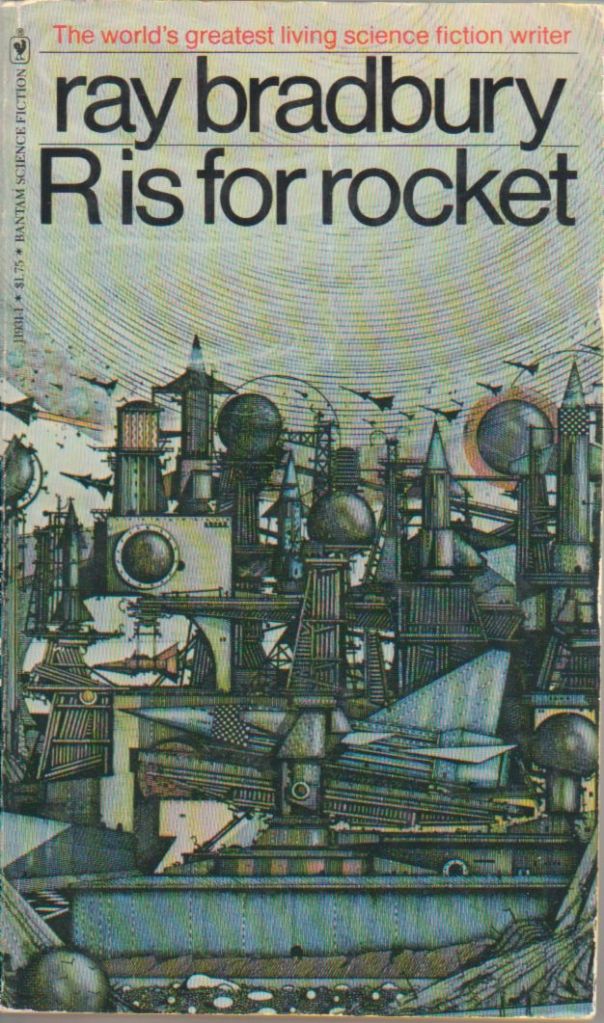
This 1977 cover for Ray Bradbury’s The Martian Chronicles is probably an off-beat choice for my Classic Sci-Fi Book Covers series. After all, it’s a pen-and-ink illustration, which is a very unusual choice for sci-fi art.
Unusual, that is, unless you’re the great Ian Miller, who does most of his work in pencil or pen. Miller did a lot of Bradbury covers in the 1970s and 80s, and I love every single one of them. They have a weird, surreal, almost cubist quality that evokes the sense of mystery and magic that the best sci-fi novels create.
Everything you need to know about alt-rock in the 1980s can be learned from listening to four bands: The Smiths, Echo & the Bunnymen, Siouxsie and the Banshees, and The Cure. I’ve featured all of these bands except The Cure, so it’s about time, especially considering that they were, in some ways, the most innovative and versatile of the four.
Most people know the song “Just Like Heaven“, and they should because it’s a masterpiece. But I love this song, too, because it’s so strange and powerful. With Robert Smith singing on the edge of his vocal range, his voice breaking and whinging like the embodiment of every teenage neurosis you can think of, “Why Can’t I Be You?” is the ultimate song about Nerd Love.
It’s also a great dance song. (Yes, a danceable goth-rock song. Who knew?) And the horn section is epic. (A goth-rock song with horns? Yes, again!)
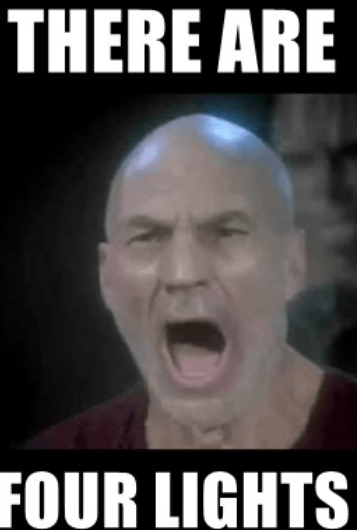
It is almost a law of nature that if you scroll through Twitter for long enough, you will run across a Star Trek meme. And, if you keep scrolling, you will eventually run into a “There are four lights!” meme.
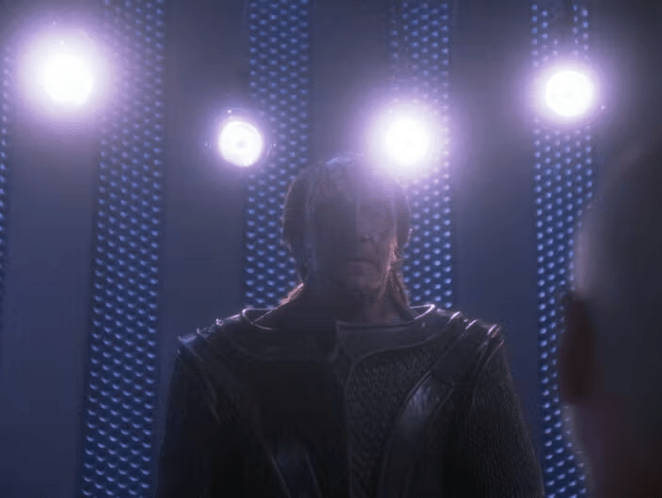
These memes are, of course, a reference to one of the most famous episodes of Star Trek: The Next Generation. Entitled “Chain of Command,” it depicts the ordeal that Captain Picard must endure at the hands of a Cardassian interrogator named Gul Madred. It is one of the most famous (infamous?) episodes because of its brutal depiction of torture and humiliation, up to and including the truly shocking moment when Picard is hung naked by his wrists (thus cinematically immortalizing Patrick Stewart’s impressively muscular British arse). Despite the disturbing subject—or, perhaps, because of it—the episode has become one of the most beloved and acclaimed of the entire series.
I, for one, believe that “Chain of Command” deserves every iota of the praise it has received. It’s brilliantly acted, of course, by Stewart and his former Shakespearean colleague David Warner, who was one of the greatest actors of his generation. And it tackles a dreadful but important subject—the nature of political torture. Screenwriter Frank Abatemarco conducted research into the impact and nature of such torture as reported by Amnesty International, and the episode seems completely believable, not to mention chilling. It dissects the psychology of the victim but also of the torturer, with Warner brilliantly conveying how Madred, an intelligent man and, apparently, a loving father, is nonetheless able to rationalize his activities by dehumanizing his victim.
If one trawls the many Reddit threads and other chat-board threads that have been devoted to the episode, one learns that many of its fans—especially those former English majors, like myself—were quick to seize on its central homage to George Orwell’s 1984. Specifically, it echoes the climactic scenes in 1984 when Winston Smith is tortured by O’Brien, a man whom Winston believes to be a friend and fellow-revolutionary but who turns out to be a commander of the Thought Police.
As every Star Trek nerd knows, of course, the most direct parallel between 1984 and “Chain of Command” comes in the episode’s climax, when Madred shines four lights on the wall and asks Picard how many lights he sees. When Picard answers, truthfully, “four,” Madred shocks him.
In 1984, O’Brien lays Winston out on an electronic torture-rack and says to him,
“Do you remember,” he went on, “writing in your diary, ‘Freedom is the freedom to say that two plus two make four?”
“Yes,” said Winston.
O’Brien held up his left hand, its back toward Winston, with the thumb hidden and the four fingers extended.
“How many fingers am I holding up, Winston?”
“Four.”
“And if the Party says that it is not four but five—then how many?”
“Four.”
The word ended in a gasp of pain.
The torment continues, with Winston replying “five” and “three” and anything else he can think of to stop the pain. At which point O’Brien pauses the interrogation and says, “Sometimes, Winston. Sometimes they are five. Sometimes they are three. Sometimes they are all of them at once. You must try harder. It is not easy to become sane.”
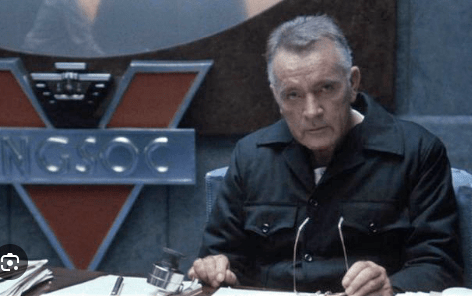
Richard Burton as O’Brien in 1984
It’s this portion of 1984 that, to me, establishes O’Brien as the supreme villain of world literature. He is also its greatest nihilist. He seems to have no illusions about the purpose of Big Brother’s totalitarian rule—namely, for the rulers to partake of the ultimate sadistic pleasure in endlessly tormenting their subjects, forever. He blithely explains to Winston how the state will soon make things even worse for the common people, including modifying human anatomy so that people cannot even have orgasms. When O’Brien also suggests that the state might increase the pace of life so that people go senile at thirty, Winston pleads:
“Somehow you will fail. Something will defeat you. Life will defeat you.”
“We control life, Winston, at all its levels. You are imagining that there is something called human nature which will be outraged by what we do and will turn against us. But we create human nature. Men are infinitely malleable.”
Many dudes on Reddit have observed, correctly, that the scene with Picard and Madred are about mind control, and how strong people must fight to resist it. But the greater issue comes in the last scene of “Chain of Command,” after Picard has been freed and is safely back on the Enterprise. There, washed and fed, he meets with Counselor Troy and explains the worst part of his ordeal—namely that, in the delirium of his agony, he actually saw “five lights,” as he was commanded to do by Madred.
In other words, despite his great intellect and courage, Picard’s body began to alter his perceptions. He became, in O’Brien’s words, “infinitely malleable.”
In 1984, Winston experiences the same horrific revelation.
And he did see them, for a fleeting instant, before the scenery of his mind changed. He saw five fingers, and there was no deformity. Then everything was normal again, and the old fear, the hatred, and the bewilderment came crowding back again. But there had been a moment—he did not know how long, thirty seconds, perhaps—of luminous certainty, when each new suggestion of O’Brien’s had filled up a patch of emptiness and become absolute truth, and when two and two could have been three as easily as five, if that were what was needed. It had faded out before O’Brien had dropped his hand; but though he could not recapture it, he could remember it, as one remembers a vivid experience at some remote period of one’s life when one was in effect a different person.
I have written before about how the greatest themes in literature are best posed as questions. The question here is, “Is there really some indominable spirit in us that can’t be crushed and mastered by force and torture?” Or, put another way, “Are human beings really infinitely malleable, to the point that they can’t even trust their own senses?”
To many—and especially to those who adhere to a philosophy of materialism—this might seem a banal question. Their answer would certainly be: Of course, people are infinitely malleable; human beings are the product of their sensations, and if those sensations can be completely controlled (through drugs or torture or propaganda), then those beings can be complete controlled, too.
If this is true, I fear that the future of humanity is hopeless. We will, eventually, devolve into some kind of hive-mind existence (yes, rather like the Borg in Star Trek), which, even if it isn’t quite as hellish as the nightmare-state that O’Brien creates for the proles of 1984, would still be devoid of individuality or any authentic human experience.
Fortunately, I don’t believe it is true. For one thing, as a practical matter, I don’t believe that a ruling class whose only motivation is sadistic sexual pleasure could sustain itself. It’s too destructive, and its members would inevitably turn on each other. And even if they didn’t, they would die out, unable to create and nurture the most basic form of life—children. In other words, Big Brother can only destroy. It cannot create.
On a more philosophical note, I do believe that there is a “something called human nature,” as O’Brien puts it, that will inevitably rebel against tyranny. All the hero stories of world mythology reflect this, as do our own, modern mythologies. Like, for instance, Star Trek. Clearly, in the imagined universe of the twenty-fourth century, civilization has not devolved into some kind of soul-destroying dystopia. Quite the opposite. The Federation represents civilizations response to the ever-present threat of oppression, in all its forms, from fascist militarism (the Klingons), xenophobic isolationism (the Romulans), to full-on, cybernetic collectivism (the Borg). The Federation beats them all.
So, what is the Federation’s secret? Probably a lot of things. But, for my money, it’s that the Federation is a pluralistic society, open to all races, ideas, and voices.
Back in college, I studied the great Russian literary critic M. M. Bakhtin, who saw the greatest innovation in art as the novel. The novel represents a quantum leap in art because it is the greatest example of what Bakhtin called dialogism—the interplay of voices and perceptions from which our shared experience of consciousness emerges. This impulse toward dialogism—dialogue—is always set in opposition to the evil but omnipresent forces of monologism, which strive to establish a singular, monolithic truth on humanity and thus control it.
Big Brother’s IngSoc party might be the most monologic literary creation ever imagined by a writer (Orwell). Conversely, the Federation might be the most dialogic, combining not only an endless multiple of voices and point-of-view but actual sentient species from all over the galaxy, united by there shared…humanity? For lack of a better word, yes.
Let’s hope Star Trek’s vision of the future is the one that plays out.
Have you ever noticed that, at any given time, the tech bros and sci-fi nerds of the world are obsessed with one current, real-world technology. Right now, it’s AI. A few years ago, it was cryptocurrency. The topic itself changes over time, but whatever it is, they can’t stop talking about it.
I’m a bit of a nerd myself, but I must confess that I was never much intrigued by cryptocurrency, and I am only mildly interested in AI. Rather, my technological obsession is the same as it was when I was in high school: controlled fusion energy, a.k.a. fusion.
Fusion was a staple of almost every sci-fi book of the 1970s and ‘80s in which space travel or future civilization was described. Heck, even Star Trek’s U.S.S. Enterprise uses fusion to power its impulse engines. That’s why nerds of a certain age were so bewitched by the idea, and we still are.
But the idea itself isn’t science fiction—at least, not for much longer.
Fusion’s potential as the ultimate, clean power source has been understood since the 1940s. The required fuel is ubiquitous (basically water), the radioactive waste negligible (much lower volume and shorter-lived than fission waste), the risk of a meltdown non-existent (uncontrolled fusion reactions don’t ramp-up; they snuff-out), and the maximum power potential unlimited (fusion literally powers the stars).
The very idea of a world powered by clean, cheap fusion energy is enough to make a nerd’s eyes twinkle. (Well, this nerd, anyway.) No more oil wars. Fossil fuels would be worthless. We could use all the extra power for next-gen construction, manufacturing, water desalination, enhanced food production, and on and on and on. Best of all, we could start actively removing all the CO2 that we’ve been pumping into the earth’s atmosphere for 300 years.
Of course, a good bit of that power windfall will probably go to AI data centers, whose appetite for energy seems insatiable. And growing. Whatever your feelings are regarding the AI revolution, it is going to be one of the most important, disruptive, and consequential developments of human history, second only to the invention of the digital computer.
We’ll need fusion to power it.
So, I find it pleasingly ironic that AI might turn out to play a role in the mastery of fusion energy itself. I learned of this from an article on the World Economic Forum’s website, entitled “How AI will help get fusion from the lab to the grid by the 2030s”. To grasp the gist of the article, however, one should first understand how incredibly, maddeningly, ridiculously difficult controlled fusion is.
Fusion works by pressing atoms (of hydrogen, usually) together at enormous pressure—so enormous that it can overcome the mutual repulsion of these atoms and cause them to fuse and form a bigger atom (helium), while “sweating” a photon or two in the process.
This photon sweat is the bounty of the fusion energy, and it’s YUGE. Unfortunately, the process of squeezing a hydrogen plasma into a tight enough space for a long enough period of time at millions of degrees Celsius, without it leaking out the side or, worse, squirting off into the walls of your reactor and melting everything, is damned hard. You remember those prank spring snakes that pop out of a can when you open a lid? Imagine cramming a billion of those snakes into a can the size of a thimble and you’ll have some idea of the challenge.
Taming a fusion plasma is so hard, in fact, that it well be one of those hyper-intensive tasks mere human beings—with our leaden reflexes, sluggishly throwing switches and pushing buttons—might not be able to manage.
For an analogy, I often think of the F-117 Nighthawk, the first true “stealth” bomber produced back in the 1980s. The Nighthawk didn’t look like a regular airplane because it wasn’t a regular airplane. Rather, the distinctive, saw-tooth pattern of its wings and fuselage, which was the essence of its radar-evading design, made it look ungainly. And, indeed, it was ungainly, so much so that no human pilot could fly it unaided. Instead, an on-board computer was required to make constant corrections, microsecond by microsecond, to keep the plane in the air and on target.
Controlling a nuclear plasma is, I suspect, a lot like flying a stealth-bomber; constant corrections are needed to keep the fluid stable. And they need to happen much faster than a human being can comprehend, no less attend to.
Enter AI.
As we all should know by now, you can teach an AI how to do almost anything—including (we hope) how to maintain a fusion plasma. As the article I mentioned above explains, a partnership has been created between the private company Commonwealth Fusion Systems (CFS) and AI research company Google DeepMind to do just that. One of the more notable achievements of this partnership so far is the creation of a fusion plasma simulator called TORAX, which could be used to train an AI.
Of course, I have no idea if this partnership will turn out to be fruitful. For that matter, I have no idea if we will ever, truly, crack the fusion code once and for all. But I think we will. And I’m not alone. As one expert, Jean Paul Allain, states in the article, “Fusion is real, near and ready for coordinated action.” In other words, fusion might soon be a real thing. For this reason, capitalists have caught the fusion bug and are funding dozens, if not hundreds, of related start-ups, including CFS.
In some ways, this fusion mania is reminiscent of the very earliest days of aviation (way earlier than the Nighthawk). Back in 1908 or so, there were literally hundreds of amateur aviators in Europe, desperately trying to master the trick of powered flight. Many of these enthusiasts were smart, self-funded, and brave. But their craft were not much better than cannonballs with wings, unable to turn or steer, or even stay in the air for very long. Sure, they had all heard rumors of a possible breakthrough that might have been achieved by those bicycle-shop boys, the Wright brothers, over in the U.S., but no one knew exactly what had happened. And they certainly hadn’t seen the proof.
At an exhibition in Le Mans, France, Wilbur flew his and Orville’s latest model over the famous racecourse, remaining in-flight for a full one minute and 45 seconds. More important than the duration, though, was the fact that he could steer the airplane, demonstrating banked turns, climbs, and dives.
Three years later, he flew a newer model over the same racecourse for 31 minutes and 25 seconds.
The world had changed.
The same kind of progression is now happening in fusion. In 2024, Korea’s KSTAR tokamak sustained plasma for 102 seconds. In February of 2025, the WEST in France sustained a plasma for 22 minutes. Each year or so, the record gets longer, and the plasma becomes more stable. And all this is happening before the ITER mega-reactor has even come on-line (as it is expected to do this year).
One of these days, fusion is going to take off and never land.
(…or, Why I Leave My Christmas Lights Up Till January 5th)
Author’s Note: I wrote this post some years ago. I am reposting it now because Christmas.
I’m a big fan of the Brother Cadfael novels by Edith Pargeter. Brother Cadfael is a medieval monk who has two areas of expertise: botany (plant-based medicine) and solving crimes. Ever since I began reading the Cadfael series about twenty years ago, I’ve been fascinated by the richness and detail of Catholic dogma. Like all monks, Brother Cadfael observes the canonical hours that strictly divide the entire day into a schedule of prayer sessions (for which he is always late). And I also became interested in the various holy days that he and his fellow monks observe.
Perhaps that’s the reason I refuse to consider Christmas over on December 26. Rather, I prefer to stick to the original church concept of Christmastide, which begins on Christmas Day and extends all the way to Twelfth Night on January 5 (better known as Three Kings Day in the Latin community).
Twelfth Night, of course, marks the Day of the Epiphany when the Christ-child was perceived by the wise men as a divine being. The wise men are, themselves, a subject of fascination for me. Their story—which is barely mentioned in the bible—has become embellished over the centuries by various Catholic fanboys. According to current tradition, there were three of them, and they were in fact kings from various parts of the orient: Balthasar of Arabia, Melchior of Persia, and Caspar of India. In some versions, their various ages are given as 20, 40, and 60, representing the three phases of a person’s life (youth, middle-age, and old-age).
So, if you’re still hung over from Christmas Day (I’m speaking metaphorically, although I did have a bit of whiskey in my eggnog), take heart. Christmas might be over, but Christmastide goes on and on. As it should. Those medievals had a much better sense of how to celebrate, from which we, as harried, stressed-out, modern Westerners have much to learn.
And whether you’re a Christian or a lapsed-Christian or just a secular person who respects the Christ figure and observes the holiday solely from a sense of tradition, why not extend the holiday a bit, even past New Year’s Day? Leave your Christmas lights up. Give another present or two to your loved ones. Have another feast.
The brilliant singer and musician Chris Rea has passed away. I remember when I first heard this song (my favorite of his). I was in grad school in Tucson, Arizona and had a summer job teaching English at Pima Community College. I was driving there one day in July when the temperature hit 117. My little car started to overheat so I turned off the A/C, rolled the windows down, and hoped for the best. Then this song came on. It had such a great groove to it that I almost forgot my miserable circumstances. Almost.
It was also so very, very appropriate. Still is, even in winter.









 Ash Clifton, Writer