
Great Movie Countdowns – Part 001: “Goldfinger”

Well, the day has arrived. My debut novel, Twice the Trouble, is a Kindle Daily Deal for $1.99 today on Amazon. The offer will stand until 11:59 P.M. tonight, Pacific Standard Time, at which point it will turn into a pumpkin or…something. (Actually, it will just end.)
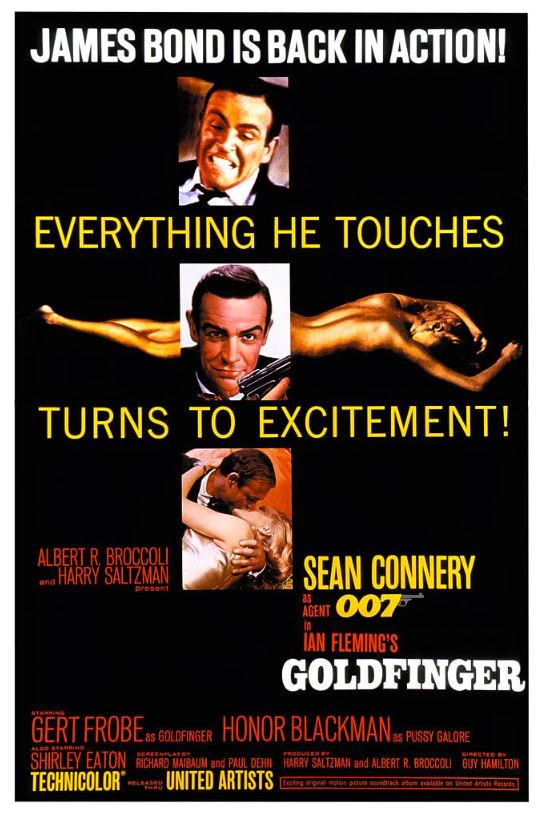
So, to finish my list of Great Movie Countdowns, I’m selecting what many people think is the greatest James Bond movie of all, 1964’s Goldfinger, directed by series veteran Guy Hamilton.

One of the most magical things about James Bond, the character, is that he knows how to do just about everything. He can fight and shoot, of course. But he can also fly a plane, drive a tank, sail a boat, race a motorcycle, surf, and even (as he shows in Goldfinger) play a mean-and-dirty round of golf.

One thing Bond does not know how to do, unfortunately, is disarm an atomic bomb. Which is a problem, because that’s exactly the threat he faces in the climax of Goldfinger. Bond finds himself locked inside the huge, cavernous vault of Fort Knox, surrounded by stacks of gold bars and handcuffed to said atomic bomb, with just a few minutes ticking down on the device’s timer. (This might be the first use of a digital timer in any major motion picture; let me know in the comments if you can think of an earlier one.)

As if this weren’t bad enough, Bond isn’t alone inside the vault. Goldfinger’s chief henchman, Odd Job, is in there too. If Goldfinger is the best Bond movie ever, then Odd Job is the scariest Bond henchman ever. Played by Japanese-American wrestler Harold Sakata, he has such a great, imposing physical presence—a hulking man who seems barely able to hold his own strength in check. When he crushes a golf ball with his bare hands, we, as viewers, really believe he could do it! But what really makes Odd Job scary is his evil little smile. He always seems bemused, enjoying himself, even when he throws a guy off a balcony or throws his steel-brimmed bowler hat into someone’s neck.

In the movie’s climactic countdown (yes, another countdown to nuclear self-destruction), Odd Job seems determined—even happy—to make sure the bomb goes off, despite the obvious fact that it will mean his own death, too. Odd Job, it seems, isn’t afraid of anything except failing in his mission, which makes him that much scarier.

My classics professor in college once said that James Bond is the modern version of Heracles, who, like Bond, loves to fight, drink, and sleep around. Sure enough, the final battle between Bond and Odd Job feels a lot like a Greek myth, with the hero battling a monster—one with some really scary weapons—to the death. And, as in a Greek myth, the contest ends with an example of poetic irony. Odd Job is undone by his own superpower—in this case, his favorite weapon, that lethal, steel-brimmed hat.  Bond manages to get hold of it and throws it at him. It misses, alas, and lodges into some steel bars. Instead of just finishing Bond off, though, Odd Job goes to retrieve his beloved hat, at which point Bond slides across the floor and touches a loose power cable to the bars. Current conducts through the bars and through the steel hat, electrocuting the villain. Thus, the monster is defeated by his own magic.

But what about the bomb? Looking inside the device, Bond seems genuinely clueless, for once, bewildered by all the wires and blinky lights. Pathetically, he even tries to stop the machine’s spinning cylinder (which holds, we presume, the cobalt-iodine mixture that makes the bomb “particularly dirty,” in Goldfinger’s words). All to no avail.

Then, with mere seconds left, a man’s gentle hand sweeps in, stops Bond’s frantic groping, and turns the bomb off with the flick of a switch. With the crisis averted, Bond and the man—who looks like a wizened college professor, wearing a brown suit and hat, his face serious yet calm—face each other. A strange look passes between them. A mixture of relief, puzzlement, and awe, the look seems to suggest the entire absurd, insane reality of the Cold War, if not modern existence itself. “How did we get here?” the look seems to say.

How, indeed.

Great Movie Countdowns – Part 002: “Escape from New York”

Well, it’s just one more day until my book becomes a Kindle Daily Deal on Amazon (the offer starts at midnight tonight, Pacific Standard Time). The next movie on my Great Movie Countdowns list is my favorite B-Movie of all time, John Carpenter’s Escape from New York (EFNY).

EFNY is probably the best example of a classic movie countdown because almost the entire movie is a countdown. War-hero turned bank-robber Snake Plissken has exactly twenty-four hours to find the President of the United States somewhere in the yawning, black hulk of Manhattan, now turned into an open-air prison by the U.S. government. If Snake doesn’t find the POTUS and get him out alive before time runs out, tiny explosives implanted in Snake’s neck will detonate, killing him instantly. Such is the deal made to him by the coldly practical Police Commissioner Bob Hauk (played by Lee Van Cleef in his greatest role since The Good, the Bad, and the Ugly): get the POTUS out alive and you’ll get a pardon. Otherwise, you’re dead.  

So, armed to the teeth, Snake infiltrates the island and begins his desperate search. All the while, he keeps checking his special, way-cool digital watch, which looks exactly like a beefed-up version of the first Casio digital watch that me and all my friends had back in the day. The watch doesn’t tell time, of course—it’s a life-clock, counting down the hours, minutes, and seconds until Snake’s neck goes boom.

To make matters worse, there are many people in New York who feel that twenty-four hours is far too long for Snake to live. Chief among them is the Duke of New York, the sinister war-lord who controls the prison, played with great panache by the great musician Isaac Hayes, of “Shaft” fame.

Kurt Russell famously said that Snake is always just trying to live through “the next 60 seconds. Living for exactly that next minute is all there is.” Carpenter’s genius lies in filling every one of those “next minutes” with some new, compelling, and darkly magical moment of mayhem, all of which Snake must overcome in some unexpected and thrilling way.

The final chase scene where Snake and his companions race across the fictional 69th Street Bridge, dodging mines, with The Duke in hot pursuit is a classic. But my favorite moment in the film comes much earlier, when Snake, realizing he has almost no chance of finding the president, gets out his radio, calls Commissioner Hauk, and asks if he can just come out. “I’ll burn you off the wall,” Hauk coldly replies. At which point Snake looks at the radio and says, mostly to himself, “A little human compassion.”

Snake does, in fact, find that little bit of “human compassion” in the course of the movie, when he makes some new friends who help him escape. More importantly, he finds it in himself, too. But that doesn’t stop him from being a bad-ass.

Great Movie Countdowns – Part 003: “Alien”

It’s T-Minus two days and counting until my book becomes a Kindle Daily Deal on Amazon (that’s right, on Thursday, August 6). And, to commemorate this, the next movie on my Great Movie Countdowns list is Ridley Scott’s 1979 masterpiece, Alien

Alien is the greatest sci-fi monster movie ever made. And so it makes sense that it also has the greatest countdown-to-self-destruct sequence of any sci-fi movie ever made. It works because of Ridley Scott’s great direction and Sigourney Weaver’s brilliant performance as Ripley, the ship’s sole survivor, who has started the self-destruct sequence herself. In what is surely one of the most impressive examples of physical acting in Hollywood history, she ducks and weaves through steam-filled corridors, holding a flame-thrower, peeking around each corner to see if the huge, metallic-skinned alien is there. 

Sure enough, the alien appears, blocking her way to her shuttle-craft, and she is forced to go ALL the way back to the ship’s control room. When she discovers that she’s too late to stop the self-destruct, she briefly breaks into tears. It’s a heartbreaking moment, one which becomes thrilling when she defiantly yells “You bitch!” at MOTHER, the ship’s AI, and then steels herself to reaching the shuttle, alien or no-alien.

I love how the last 15 minutes of the movie function as a complete contrast to the 105 minutes that came before—that is, the first and second acts of the film, which are mostly filled with moments of silent, creeping horror as the crew tries to find the alien xenomorph (before it finds them). The last act, however, is a brazen, nerve-wracking light- and sound-show, full of strobes, klaxons, hissing steam vents and general mayhem as the good ship Nostromo prepares to blow itself to smithereens. Honestly, I’m not sure the film could be made today in the same way, even with a slew of those “epilepsy-warning” messages at the beginning. It’s that intense. I remember seeing the film in the theater and being battered into my seat. 

It’s also the definitive sci-fi-self-destruct sequence, better than all that came before or since. (Yes, even better than the “five-minutes-until-the-Death-Star-blasts-Yavin-to-bits” sequence at the end of Star Wars.) It’s just damned good filmmaking.

As noted by film scholar Eleanor Johnson, it also marks an important moment in American feminism, with Ripley being the first completely compelling female action hero in cinema. She’s not only smart, brave, and strong, she’s honorable. She doesn’t need to blow up the ship; she could just escape on the shuttle-craft. But destroying the ship is the only way to prevent MOTHER from flying it back to Earth on auto-pilot along with its horrifying passenger, the alien. So, Ripley risks her own life to kill the bastard. (Which she does, but not in the expected way.)

Pretty freakin cool.

Great Movie Countdowns – Part 004: “The Andromeda Strain”

It’s just three days until my first book becomes a Kindle Daily Deal. And so, I thought I would count down the days with…a LIST OF COUNTDOWNS.

That is, the Best Countdowns in Cinema.

The countdown is an obvious dramatic instrument. You might think it was strictly a modern invention—depending, as it does, on a clock ticking—but I think it goes back to at least the 19th Century. Jules Verne’s Around the World in Eighty Days is based around an (extremely long) countdown. And in the Sherlock Holmes stories of the 1890s, Holmes often finds himself racing against the clock, desperate to find some missing treaty or compromising letter that, if not secured in time, will spell certain doom.

As for film, one of the greatest westerns of all time, High Noon, has an obvious, analog countdown, with the camera often showing the town’s clock as it sweeps toward noon. (That’s when a gang of bad guys is expected to arrive on the train and kill the heroic sheriff, Gary Cooper.)

In modern fiction films—and especially genre films like science fiction and spy movies—the digital countdown has become something of a staple. Over the next four days, I’m going to discuss four of my favorites.

For this first installment, I choose what is still one of my favorite sci-fi movies of all time, Robert Wise’s 1971 masterpiece, The Andromeda Strain. The story of what happens when an alien pathogen arrives on Earth via a crash-landed satellite, it is perhaps the first great techno-thriller film, combining science fiction with a tale of a military and political crisis.

 When fighter jets are sent to overfly the satellite’s crash site in the Arizona desert, the authorities see that everyone in the nearby town of Piedmont is already dead. They activate a secret “Wildfire” team of scientists, who are grabbed from their homes and flown to a secret, underground biolab that is also (a bit too conveniently) located in the Arizona desert. Most of the drama takes place in the sterile, spaceship-like interior of the lab, where the scientists bring the satellite and isolate the germ. They also bring along the two surviving inhabitants of Piedmont—one, an old, alcoholic man and the other a month-old, helpless infant—who seem mysteriously immune to the alien bug.

The scientists name the bug “Andromeda” and discover, to their horror, that it is a crystalline-based life form with no DNA, which cannot be killed by heat, solvents, or even radiation. Indeed, it laps up X-Rays and uses the energy to mutate at an alarming rate.

As luck would have it, one of these mutations is able to dissolve rubber, which allows Andromeda to escape into the lab’s silo-like core. Naturally, this triggers a countdown to the automatic detonation of a nuclear bomb placed under the lab, intended to sterilize the site before the contamination spreads. Realizing that the bomb’s radiation will not kill Andromeda—it will, rather, cause the germ to flourish, perhaps ending all life on earth—the Wildfire team rushes to cancel the countdown. The only member with this ability is a surgeon, Mark Hall, who has also just solved the riddle of the two unlikely survivors (it has to do with their blood acidity). Hall bravely enters the core and begins the long climb up to the one level where the bomb can be disarmed, using a high-tech key that he has dangling around his neck.

The last five minutes of the movie show Hall desperately trying to avoid the automatic laser guns that guard the core (one of which shoots a hole through his cheek), as well as the nerve gas that the lab’s central computer releases.

Does he make it in time? Does he save the world? You’ll just have to watch the movie…