
** SPOILERS BELOW**
(Disclaimer: This essay is about a film by the director Roman Polanski, who, as of this writing, is a fugitive from justice in the United States on rape charges involving a minor. I have no opinion regarding Mr. Polanski as a person. This essay merely concerns the film as a work of art.)
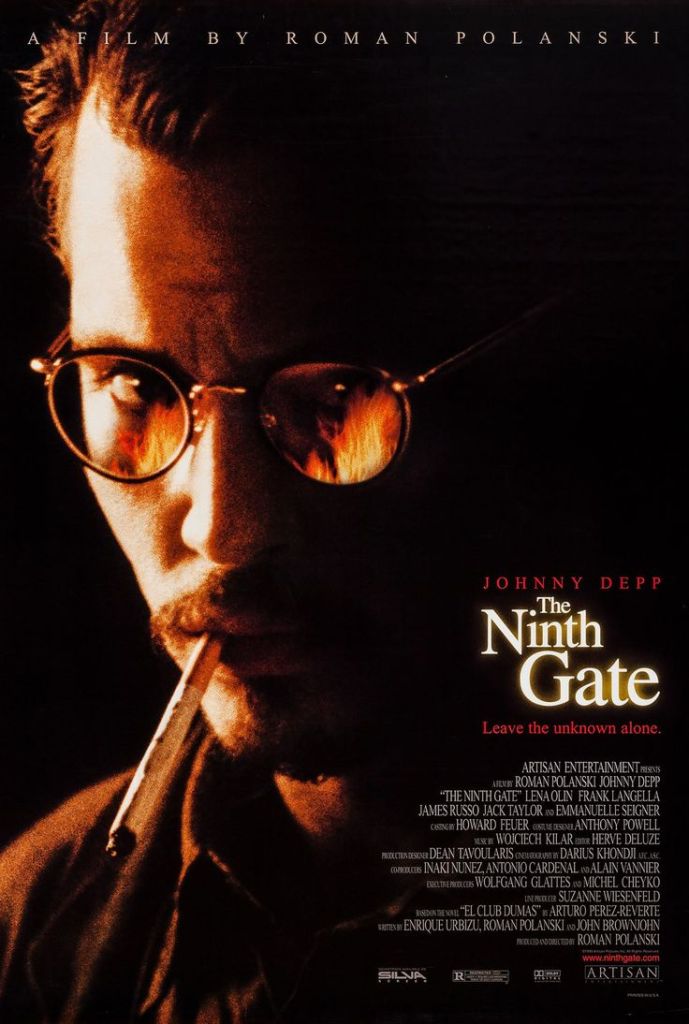
Well, it’s October, and I’m officially starting to my annual marathon of horror movies that I watch in my spare time. This week, I re-watched Roman Polanski’s 1999 flick, The Ninth Gate, starring Johnny Depp in his pre-Jack Sparrow era. I first saw the film on DVD about a year after it came out, and I liked it. Now, after my second viewing, my feelings are slightly different: I really like it. In fact, I think it’s one of my favorite horror movies of all time.
This might seem surprising to some film buffs. After all, the movie has gotten a lot of hate in the quarter-century since it came out. As of this writing, it has a 44% “Fresh” rating (i.e. “Rotten”) on Rotten Tomatoes, and it hasn’t fared much better on IMDB. I am always surprised and depressed when something I really like gets such a bad rap. Such a disconnect makes a person question their taste, if not their sanity. Am I crazy, or is everyone else?
I should be used to this. Many, many of my favorite films—starting with Blade Runner in 1982—were commercial and critical flops when they came out, only to achieve cult status later on. Judging by the number of YouTube videos that are now devoted to “explaining” The Ninth Gate, I would guess that it, too, has now become a cult film.
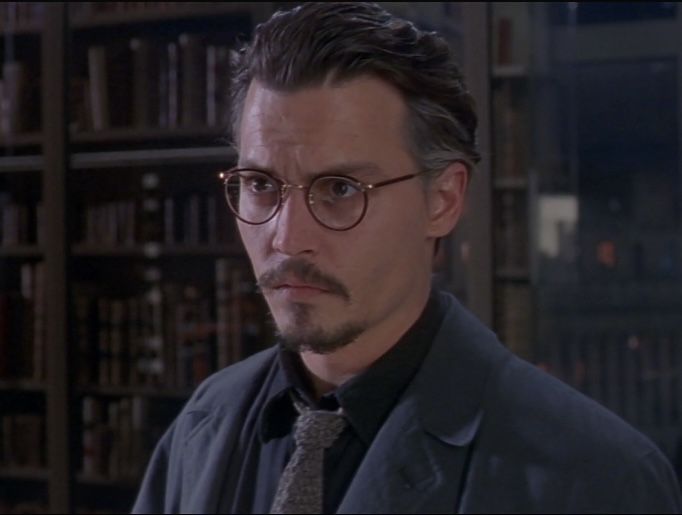
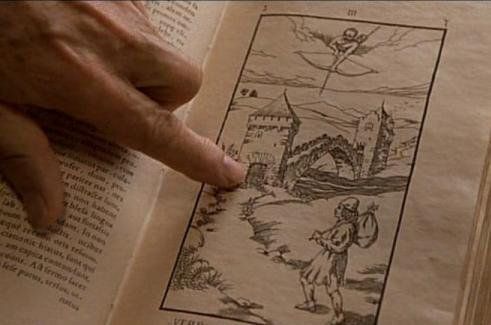
Which is a good thing, because more people should see it. The story follows a chain-smoking, world-weary book dealer, Dean Corso (Johnny Depp), who is hired by a billionaire collector, Balkan (Frank Langella), to verify the authenticity of a 17th-century book of the occult, The Nine Gates of the Kingdom of Shadows. The book has nine engravings in it (which look a lot like the images on ancient Tarot cards), which some believe to be encoded with secret information that can conjure up Satan. Apparently, two other versions of the book exist, each held in a separate private collection, and Balkan wants Corso to compare those versions to his.
Corso flies to Europe to begin his investigation, prowling down shadowy, medieval streets in various ancient cities. The movie thus becomes a kind of noir detective movie, with Depp doing an impressive job as the hard-boiled detective, inching his way deeper and deeper into a dark secret. As with any hard-boiled detective yarn, he soon encounters two beautiful women—Liana Telfer (the radiant Lena Olin), a rich femme fatale who once owned a copy of the book, and a mysterious, dangerous-looking blond girl who looks dresses like a European backpacker, without the backpack. This girl, played by the stunning Emmanuelle Seigner (star of Polanski’s earlier film, Frantic), becomes an even bigger enigma than the one Corso is pursuing. Corso dubs her “Green Eyes,” and she seems to be following him, appearing out of nowhere at various times on his quest, often protecting him (she knows kung fu) from various henchmen that intent on stealing his copy of the book—and probably killing him in the process.
As one would expect, Corso’s search turns nasty, with everyone he questions ending up dead in some grisly and perhaps supernatural fashion ala The Omen. He learns that the engravings in each of the books are slightly different from each other, with some being signed LCF for Lucifer. He deduces that these altered versions hold the key to a Satanic ritual, and, indeed, the trail eventually leads him to a coven of rich devil worshipers who seek to use the book to conjure up old Scratch himself.
If it all sounds like horror-movie hokum, it is. In fact, The Ninth Gate reminded me of many great B-movies from the 1960s and 70s like The Witches, Eye of the Devil, The Dunwich Horror, and, yes, The Omen. These are all creepy, supernatural horror movies that are best viewed late at night on TV with the lights off, the viewer munching popcorn and wondering what Satanic will be revealed next. I love how Polanski was able to replicate the B-movie appeal of those old movies in what is, obviously, an A-movie like The Ninth Gate, with movie stars (Depp, Olin, Langella), high production values, gorgeous cinematography, exotic locations, and one of the most ethereal, haunting scores ever written, composed by Wojciech Kilar. At heart, it’s still a schlocky old horror thriller, with ancient tomes, black-robed witches, castles, and bloody murders. Somehow, Polanski celebrates all those familiar tropes even as he ever so lightly mocks them.

Yet, at the same time, the movie is a damned good psychological thriller. For one thing, the acting is uniformly great. 1999 found Depp at the height of his appeal both physically and artistically. Polanski was reluctant to cast him, apparently, because Corso is supposed to be 40-something, whereas Depp was 34 at the time. But even with his hair sprayed conspicuously gray at the temples (to suggest encroaching middle age, obviously), Depp is completely convincing as the corrupt but strangely honorable Corso. This is a man for whom the adjective “cynical” doesn’t suffice. He’s selfish, hedonistic, and completely jaded—a man who thinks he can no longer be shocked by anything. And so, his accelerating sense of horror at the mysteries he soon uncovers is, somehow, all the more believable. He is soon forced to take account for his actions, even as his quest leads him into dangers that any sensible person would shun. In every scene of violence, horror, or sex (sometimes all three at once), Depp sells it wholeheartedly. It’s one of his best performances.
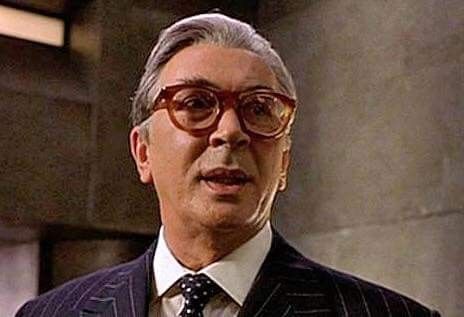
As for the supporting cast, Langella is at his absolute best as the elegant yet creepily sinister Balkan, whose character represents what some now call “the Epstein class.” That is, a fabulously rich guy who is evil AF. With his velvety voice and understated delivery, Langella steals every scene he’s in—including one where he’s not even on-screen. Late in the film’s second act, Corso discovers that Balkan’s copy of the book has been stolen from his (Corso’s) hotel room, and when he calls Balkan to deliver the bad news, the scene is truly terrifying. I could almost do an entire essay on how Langella—completely unseen, mind you—delivers one of the most chilling monologues in film history. It’s great stuff.
Lena Olin is also great. She made a career of playing sophisticated, seductive women (see Paul Mazurski’s great movie, Enemies: A Love Story) and she really shines in this one. In the role of Liana, a supposedly grieving widow who turns out to be a devil-worshipper herself, she is by turns demure, wanton, and vicious. And always bewitching (forgive the pun).
Yet, in some ways, the real casting triumph of the film is that of Emmanuelle Seigner. To cast his “Green Eyes,” Polanski didn’t have to look very far—like, across the bed. Yes, Seigner was (and remains) his real-life wife. And while casting a family member in a film is often a recipe for disaster for directors, Seigner is perfect in the role. She has perhaps a hundred words of dialogue, so her performance is, in effect, almost like that of a silent movie. Which is perfect, because she doesn’t need words. With her almost brutal, Gallic features and (yes) her mesmerizing green eyes, Seigner hypnotizes Corso every time she looks at him, not to mention the viewer. And with her bemused smile and unflappable demeanor, she exudes power and confidence, anticipating the great female superheroes like Black Widow and the Scarlet Witch that would begin to populate the Marvel MCU a decade later. When Green Eyes kicks a bad guy’s ass, we believe she could really do it.
Her smile also hints at hidden knowledge. Throughout the film, she clearly knows a lot more about what’s going on than Corso does. Which leads to one of the great topics of discussion about the film, to which dozens of blog posts and YouTube videos have been devoted: Who is she? An avenging angel? The Whore of Babylon? The devil himself (er…herself)?
And that question leads, inevitably, to the even greater one about the movie’s ending, which has been controversial since the film’s release. Why does Corso go back to the castle, and why does it erupt in blazing white light? Is it a fulfillment of the Latin phrase that Corso himself quotes earlier in the film, “nunc scio tenebris lux,” translated as “now I know light from darkness”? Does it suggest that, at last, Corso had released Lucifer (whose name literally means, “bringer of light”)?
For whatever reason, the ending works for me. I like the fact that Polanski doesn’t try to spell it out (whatever “it” is), or, even worse, CGI-bomb the final scenes with some computer-generated images of Satan emerging from hell. It’s just a fade-to-white. Cool.
If you haven’t seen The Ninth Gate (and if I haven’t completely spoiled it by now), you should check it out. It’s one of the most underrated movies of the past fifty years. It’s also a great pick for Halloween.

