
**SPOILERS**
For a time in the 1950s and 60s, Hollywood legend Charlton Heston was best known for his leading roles in Biblical epics—namely, The Ten Commandments and Ben Hur. But for nerdy kids who grew up in the 1970s and 80s, he was the uncontested king of B-Movie sci-fi, having appeared in three of the coolest, most nerd-tastic sci-fi flicks ever made: 1968’s Planet of the Apes, 1971’s The Omega Man, and 1973’s Soylent Green.
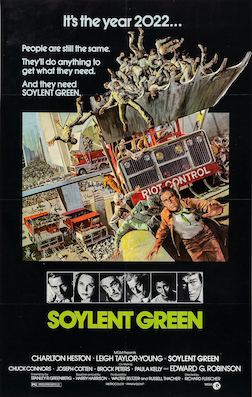
Of this trifecta, the only one that hasn’t gotten a remake (or two, or six) is Soylent Green, a snub that seems especially unfair considering the film is, in many ways, the best. Certainly the most prescient. Set in the near-future of 2022 (50 years after the film’s release), it imagines a dystopian world where overpopulation, global warming, wealth inequality, and environmental destruction have turned even America into a third-world hellscape of poverty and crime. New York City has a population of 40 million, whose threadbare, unwashed masses live in stairwells, under highways, or on the street. Fresh fruit and vegetables are luxury items that only the city’s richest citizens—safely ensconced in heavily guarded, high-rise apartment buildings—can afford. Life is cheap, and basic human rights (especially women’s rights) have been abolished. Many beautiful women serve as “furniture”—i.e., live-in mistresses that come with those same high-rise apartments, to be enjoyed by their rich, male occupants.
Crazy, huh? So far-fetched! I mean, the U.S.A. could never end up like that! Not unless a few crazy billionaires stole all the money, installed right-wing puppets in the government, and pillaged the planet’s resources, all while poisoning the atmosphere in the process.
And that could never happen, right? RIGHT?
I state that the film was highly prescient even though many critics, then and now, have condemned it as being a silly, alarmist fever-dream of the environmental left. Specifically, many considered its vision of an over-populated earth to be an artifact of Paul Erhlich’s 1968 non-fiction book The Population Bomb, which predicted a Malthusian nightmare of famine and poverty.
Clearly, Erhlich’s book was incorrect. Earth’s population is expected to stabilize at 10 billion in the 2080s and then begin to decline. Yet, while the movie might have gotten that one particular detail wrong, its overall vision seems all too plausible. After all, we now have cities around the world bulging with immigrants, many of whom are fleeing the consequences of global warming (which the movie does accurately predict). The rise of the far-right in America under Donald Trump was based, primarily, on popular fears of such an apocalyptic immigration surge overwhelming the U.S. The same kind of thing is happening in Europe.
And Soylent Green’s depiction of a civilization ravaged by end-stage capitalism seems dead-n, too, especially in a time when Elon Musk can buy elections and, on a whim, cause the starvation of 700,000 people in Africa.
But what really makes Soylent Green a classic is, of course, its premise. Like 1992’s The Crying Game, Soylent Green was marketed as a movie with a shocking “secret” (one that most people already knew going into the theater but wanted to see revealed anyway). In keeping with this “secret,” the film is structured like a noir detective mystery. Soylent Green begins with a murder. A rich executive named Simonson sits in his luxurious apartment and watches as an assassin breaks in. Instead of running or calling the police, Simonson merely greets the assassin and waits to die.
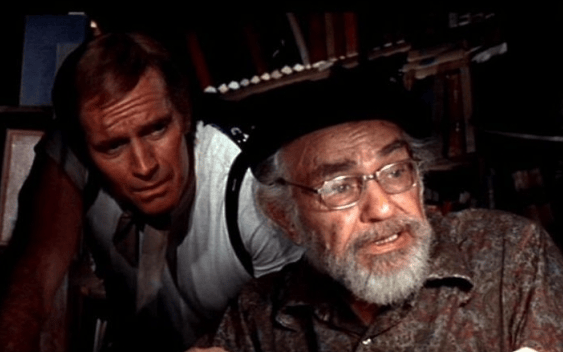
Afterward, NYPD homicide detective Robert Thorn comes to investigate, interviewing Simonson’s bodyguard (Western-movie veteran Chuck Connors in a great, villainous turn) as well as his “furniture,” the beautiful Shirl (Leigh Taylor-Young), all the while looting various goodies from Simonson’s apartment. Thorn takes the stolen goods (soap, fruit, vegetables, etc.) home to share with his roommate and research assistant Roth (Edward G. Robinson in his last role). Apparently, all senior police officers have such an assistant—called a “Book”—and Roth soon helps Thorn untangle the mystery.

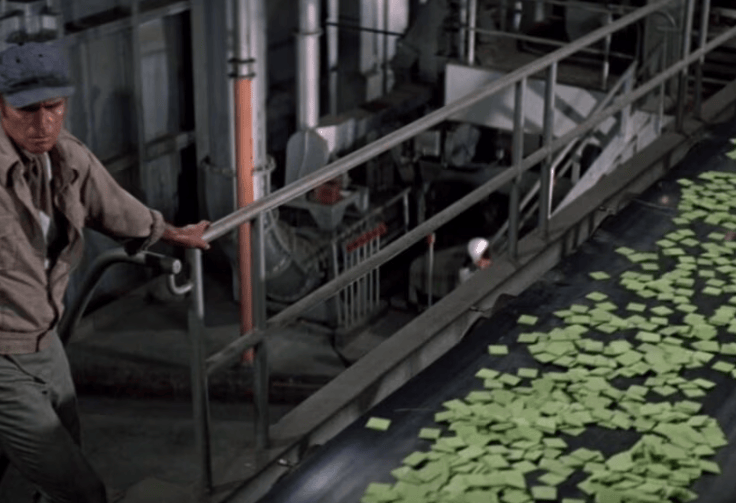
The trail leads inexorably to the Soylent Corporation, on whose board Simonson served. The corporation manufactures the only reliable food sources left in America, factory-processed crackers that come in different colors: Soylent Red, Soylent Blue, Soylent Yellow, and (the newest, tastiest product), Soylent Green. Supposedly, the crackers are made out of sea plankton, and they are a staple of everyone’s diet (including Thorn’s).
Even so, supplies are limited, and food riots often break out at the distribution points. One of the film’s most memorable scenes centers around one such riot, in which the police deploy huge shovel-trucks to come and scoop up the rioters to take them away to who-knows-where. All cops are activated during such riots, so Thorn is helping-out when he is attacked by the same assassin who killed Simonson. Thorn narrowly escapes when the assassin is crushed by a scooper-shovel.
Knowing he is hot on the trail of something big, Thorn doggedly pursues the mystery, even as he begins a blissful affair with Shirl. Meanwhile, Roth is doing his own digging. He soon discovers the “secret” of the movie—a revelation so devastating that he goes to a public euthanasia center to be injected with a fatal drug. Thorn reaches him in his last moments, and Roth whispers the secret into Thorn’s ear. The viewer doesn’t hear what he says, but we know from Thorn’s expression that it must be something really, really horrible.
Indeed, it is. After Roth dies, Thorn stows away on the garbage truck that collects the centers’ corpses. The truck takes the bodies to—guess where—the main factory of the Soylent Corporation. There, Thorn witnesses the cadavers being dumped into vats and then processed into Soylent Green!
Thus is the secret of the film revealed: cannibalism, on an industrial scale.
Throughout the history of literature from Swift’s “A Modest Proposal” to Cormac McCarthy’s The Road to Thomas Harris’s The Silence of the Lambs, cannibalism has always represented the ultimate evil. The final breakdown of civilization. I suspect this is because cannibalism—in Western cultures, at least—is the only taboo on a level with incest and matricide. Even more importantly, it suggests a failed society. Afterall, culture that eats its own is doomed.

Yes, even in our jaded culture, the concept of cannibalism still manages to horrify us. That’s why the last line of the movie—though often parodied—still packs something of a punch. After Thorn makes his gruesome discovery, he is pursued by Soylent agents. During the chase, he is punched, stabbed, bludgeoned, and shot. Thorn survives, however, and as medics take him away on a stretcher, he reaches one bloody hand into the air and yells, “Soylent Green is people!”
People. Not “human flesh.” Not “corpses.” People. Human beings, who have been reduced to abjection—an industrial product, churned out of a factory. And that’s the real secret horror of the movie. In the future, unless things get a lot better and fast, we might all be reduced to Soylent Green, or something very much like it. Food for the proles, who serve the rich and wait to die.
Soylent Green is a very dated movie—it often looks and feels rather like a 1970s TV show—but it’s still a fine one. Luckily for us, a new 4K Bluray version has been released by Arrow Video. Check it out.


