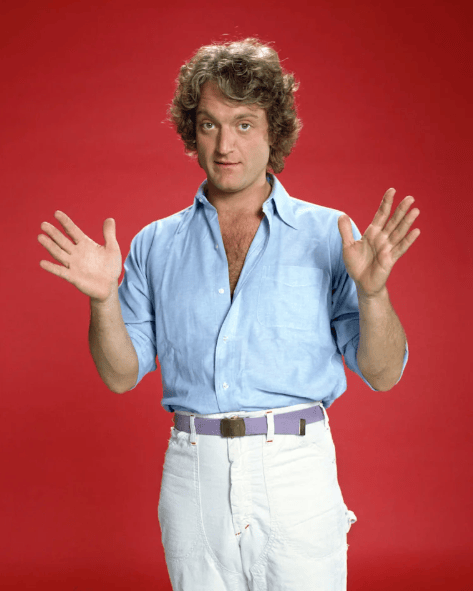
Earlier this month, America lost one of its funniest and most versatile character actors, Garrit Graham. He was one of those actors whom everyone recognized instantly, but no one ever knew his name. Rather, he was “that guy who played X in Z,” where X is one of your favorite characters in one of your favorite (Z) movies—often a cult movie like Phantom of the Paradise.
For me, that favorite role/movie was in one of Robert Zemeckis’s early films, 1980s Used Cars. I should really devote an entire post to that movie, surely one of the best B-comedy flix ever made, with humor on a level of Mel Brooks and the Marx Brothers. And Graham one was the elements that made it so damned funny. As Jeff, the nerdy-yet-hip sidekick to Kurt Russell’s fast-talking main character, he both abets and reigns in the antics. Jeff is a mensch, nearly crippled by his own neurosis, yet smart and kind of sexy, too. Best of all, he becomes a hero at the end of the film. (He also participated in one the riskiest practical stunts I’ve ever seen, in which he is almost run over by a hurtling muscle-car.)
Sadly, Graham never achieved the kind of fame he deserved, not the secondary kind of fame that some great character actors enjoy. With a little luck, he might have filled the same kind of niche in the 1980s as Steve Buscemi would in the 1990s. Instead, Graham worked steadily in small, one-off parts in film and on TV. (He appeared twice in the Star Trek universe, playing different aliens.)
He was also something of a renaissance man, having co-written one song for the Grateful Dead and penned teleplays for TV.
The world is a little less interesting without him in it.
Like a lot of Southern boys with a literary bent, I absolutely love New York City. Ever since I went there in the early 1990s to visit a girlfriend (herself a native New Yorker), I have been entranced by the place, a feeling which only deepened after I got a remote job with a Manhattan consulting firm and got to make frequent trips there for business. (That’s the best way to see The City—when someone else is paying for it.)
Ever since then, it’s often occurred to me that NYC is still Hollywood’s most beloved city, too, with L.A. coming in a distant (and often more loathed than loved) second. This is probably due to the fact that NYC is still the cultural and artistic center of the nation, as well as the place where many young actors and directors get their start, still.
Of course, many great films show the dark side of New York. Too many to mention, in fact, but the list includes Rosemary’s Baby, Seven, Taxi Driver, The Warriors, Bad Lieutenant, and on and on. However, I want to focus on films that show it in a favorable light. That is, movies where The City is almost a main character, and a great one at that.
Here is a list of my top ten favorites. Note that I am including all five boroughs in my criteria, although Manhattan is, as usual, the stand-out.
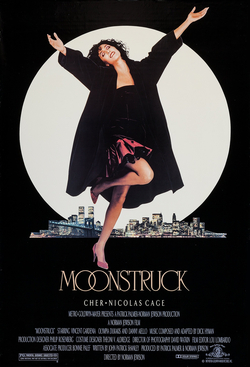
Moonstruck
Moonstruck is the greatest romantic comedy film ever made. And so, it makes perfect sense that it takes place in New York City, which is our most romantic city. That is, it has the most character, the most mystery, and the most beauty. Like a lot of the films on this list, it takes place in one of the boroughs—Brooklyn, in this case, with its great Italian-American culture. Never has that city-within-a-city, with its family-owned shops, brownstones, and restaurants, seemed so magical. Like “moonlight in a martini,” as one character says. (He’s speaking of a woman, but close enough.)
Throughout the film, the towers of Manhattan loom in the distance like a fairy-tale kingdom, to which the heroine, Loretta Castorini (Cher), finally ventures with her new unlikely “prince,” Ronny (Nicholas Cage in one of his definitive roles) when he takes her to the opera.
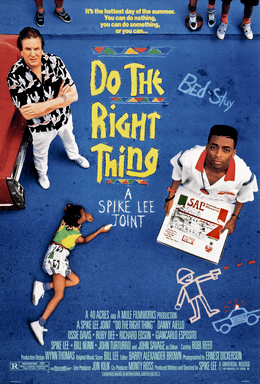
Do the Right Thing
Spike Lee’s masterpiece from 1989 is not only one of the best movies ever made, it is also one of the very few to depict life in a predominantly black urban community (except crime thrillers full of drug dealers and prostitutes). Set in the legendary Bed-Stuy neighborhood of Brooklyn, it follows the lives of several people who live and work there, including Mookie (Spike Lee), a pizza-delivery man, his sister Jade (Joie Lee), and his boss, Sal (Danny Aiello). The story takes place on a single, hot summer day when tensions—racial, economic, familial, and sexual—all reach a boiling point. It’s a great film with a great soundtrack, to which artists as diverse as Public Enemy and Teddy Riley contributed. With its combination of propulsive music, kinetic cinematography, and excellent, all-in performances by the stars, Do the Right Thing captures the energy and spirit of working-class New York better than any other film. More importantly, it’s one of the first hit movies to focus on the African-American community of New York, which gets a lot more attention than the Italian-American or Irish-American or Any-Other-American community.
Basically, it’s just a great movie.
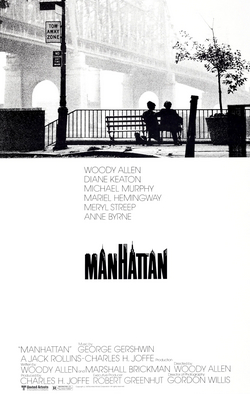
Manhattan
What list of great New York movies could be complete without at least one entry from The City’s most iconic director, Woody Allen? (Okay, he’s probably tied with Martin Scorsese; see below). Manhattan is Allen’s lyrical cinematic ode to the borough, shot in sumptuous black-and-white and featuring the music of George Gershwin (whose work, apparently, inspired the film). It tells the story of Isaac (Allen), a middle-aged TV comedy writer who is dating a beautiful, brilliant seventeen-year-old, Stacy (Mariel Hemingway). Their relationship might seem ridiculous (even he finds it so), but he’s happy. At least, he thinks he is, until his life is upended by a woman his own age, Mary (Diane Keaton). Mary is Isaac’s equal in intellect, spirit, and sheer neurotic energy, and he finds himself smitten with her. Unfortunately, she is currently the mistress of his best friend, Yale (Michael Murphy), who seems to take her affections for granted.
Like most of Allen’s early classics, Manhattan is an almost Dickensian satire of highly-paid, arty New Yorkers, with their hilarious pretensions and absurdly tortured relationships. Isaac laughs at them almost as much as he laughs at himself. But it’s clear that he (like Allen) loves them, too. Especially Mary. She essentially functions as a stand-in for Manhattan (the city) itself—complex, gorgeous, and endlessly changeable.
Arthur
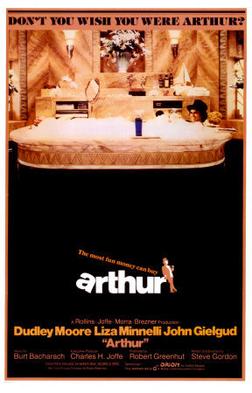
Steven Gordon’s 1981 rom-com Arthur is not a great film, but it is a very, very good one. Not only did it make Dudley Moore a Hollywood movie star (he had already been famous in the U.K. for decades), it revitalized the careers of Shakespearean actor John Gielgud and music-legend Liza Minelli. More importantly, the film brilliantly evokes the magic of Manhattan, as seen through the eyes of rich, alcoholic, and extremely lovable playboy, Arthur Bach.
Arthur (Moore) is a brilliantly witty, talented, and rich man. He is also a congenial drunk. He spends his days enjoying bubble baths in a huge, gilded tub set in the center of his penthouse apartment, sipping martinis made for him by his long-suffering butler, Hobson (Gielgud). Then, he spends his nights wining-and-dining streetwalkers whom he picks up on 8th Avenue.
In the hands of a lesser actor, Arthur might well have come off as a pathetic—even repulsive—character. But Moore was able to infuse him with so much charm and humor that it’s impossible not to like him. Crucially, Moore also imbues him with his (Moore’s) own wounded and vulnerable qualities. While Arthur has been psychologically crippled by his domineering and sadistic father, Moore was a chronically shy person who grew up with a myriad of physical disabilities (including a clubfoot). And Arthur, like Moore himself, was enchanting in his apparent childishness combined with a rapier wit.
In short, Arthur is a glittering, New York City archetype: the charming drunk who makes good in the end. And the movie’s title song, “Arthur’s Theme (Best That You Can Do),” is also a classic.
After Hours
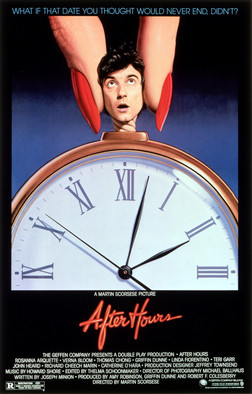
Martin Scorsese is known for a lot of things, but comedy isn’t one of them. Yet his 1985 film, After Hours is one of the funniest movies about NYC ever made. It follows the nightmarish adventure of a likeable, unassuming nebbish, Paul (Griffin Dunne), who works in a Manhattan office as a “word processor.” One day, he ventures to SoHo in pursuit of a beautiful young woman, Marcy (Roseanna Arquette), whom he has met at a café earlier. Things go pear-shaped when Paul loses all his money en route to Marcy’s apartment. When he finally gets there, he meets her equally beautiful—but also dangerous and possibly insane—roommate, Kiki (Linda Fiorentino), a sculptress who dabbles in S&M. Thus begins a Dantesque—and very funny—descent into the bowels of lower Manhattan, with its odd cast of avant garde artists, deranged cabbies, bar hoppers, burglars, and general freaks. Anyone who’s ever lost their wallet on the wrong side of NYC will instantly relate to this film, which celebrates The City’s weirdness as much as it mocks it.
Dinner Rush
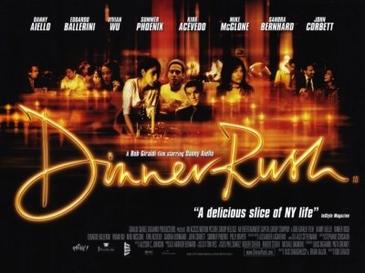
What list of great NYC movies would be complete without at least one film about the restaurant scene? My favorite is a little indie production from 2000, Dinner Rush. Directed by Bob Giraldi, the plot focuses on a single night in the lives of the people who run a posh TriBeCa restaurant. The joint is owned by Louis (Danny Aiello), an avuncular bookie and former mafioso, whose son, Udo, is the brilliant but pretentious head chef. Udo refuses to cook the traditional Italian meals that Louis loves, so the sous-chef, Duncan (Kirk Acevedo), secretly prepares them for him. Duncan is a working-class kid with a bad gambling habit, and Louis obviously thinks of him as a kind of second, “better” son. Duncan and Udo seem to hate each other, but they help each other when the going gets rough.
Intrigues abound among the restaurant staff as well as the diverse array of patrons who show up, including an art gallery owner (and his starving artists), a food critic, two young hoods, a pretty office girl, and a charming, mysterious Wall Street broker whose significance isn’t revealed until the end of the movie. (I won’t spoil it; you’ll have to watch the movie.)
Working Girl
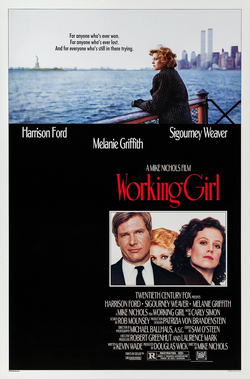
In many ways, Working Girl is the best movie on this list, with its tale of a hive-haired, Staten Island girl, Tess (Melanie Griffith), with the intelligence and audacity to take a shot at success in the cutthroat business world of New York.
Specifically, Tess dreams of becoming an executive in the big Manhattan M&A firm where she works as a secretary. That is, she dreams of becoming her boss, Katharine (Sigourney Weaver in one of her best roles), a tough-as-nails business operative. Katharine, whose blue-blood background is as upscale as Tess’s is trashy, seems nice at first, and even promises to mentor Tess on her way up the corporate ladder. But when Tess discovers that Katharine has secretly stolen one of Tess’s business ideas and fobbed it off as her own, she decides to beat Katherine and the whole, male-dominated business world at their own game.
I love this movie because not only is it one of the best romantic comedies ever made, it also asks many questions about the nature of the American dream: is it real? Is it corrupt? What does a girl have to do (really) to achieve it?
Fame
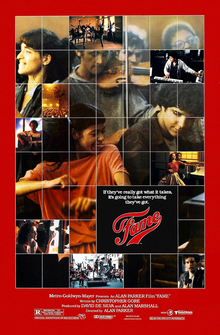
Alan Parker’s 1980 film Fame is an underrated film about the experiences of “gifted kids” who attend New York’s High School for the Performing Arts. As with any coming-of-age tale, the main characters—who each focus on dance, acting, or music—discover a lot about themselves as people, and also about what it takes to succeed in the arts. That is, how to achieve real fame.
The young actors are all first-rate, including Gene Anthony Ray, who had never acted before. A young Irene Cara is a stand-out. All-in-all, Fame is a great study of that most celebrated aspect of New York City: its music, theater, and dance culture. Basically, it’s about the bush-league for Broadway.
Men in Black
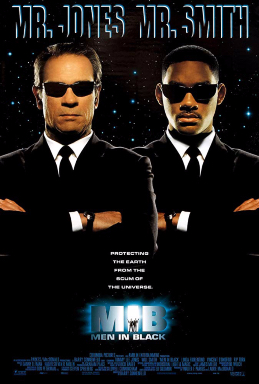
At one point in Barry Sonnenfeld’s classic summer movie, Men in Black, one of the main characters, veteran MIB agent K (Tommy Lee Jones) tells his young trainee that the MIB headquarters are “Just like Casablanca. Only no Nazis.” But this is not quite right. A much more apt description would be Ellis Island, where immigrants from all over the world (galaxy, in this case) come to gain entry to our civilization.
You don’t have to be an English lit major to glean that Men in Black is all about immigration and the diversity that immigration brings. The film opens with the MIB men disrupting an NIS raid of a truck near the Mexican border. (K mocks the way the NIS men treat the “dangerous aliens”—i.e., Mexican immigrants.) Later, the new MIB recruit, J (Will Smith), routinely mistakes weird-looking (but human) people on the streets of New York for extraterrestrials.
The point of the movie is that, well, we’re all people. (Except for those evil bugs, of course.) And diversity is a good thing—a miraculous thing—which is another reason NYC is the coolest city in the universe.
Ghostbusters
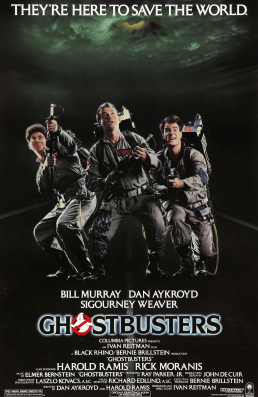
One of my favorite scenes in Ivan Reitman’s Ghostbusters is the one in which the demon-possessed accountant Louis Tully (Rick Moranis) wanders the streets of Central Park West. He encounters a horse-drawn carriage driver and warns the man (and his horse) about the imminent coming of Gozer, the God of Destruction. After Louis staggers off, the driver thinks for a moment and says to himself, “What an asshole.”
To me, this moment reveals the message of the entire movie—that New Yorkers are the toughest, most unflappable people on earth. They can handle anything, so long as they stick together.
While purportedly a horror-comedy, Ghostbusters is mainly one long celebration of that New York attitude, especially as demonstrated by Peter Venkman, the quick-thinking, bullshit-spewing, totally selfish guy who leads the Ghostbuster team. Venkman is one of the great anti-heroes of American cinema. He thinks he’s just looking out for himself—until the shit hits the fan and he has to step up to protect his friends and his city.
Another great example is the old rich guy in the lobby of the building where the heroes catch Slimer. When Venkman, clad in full nuclear-powered GB gear, tries to hold the elevator for the man, the old guy merely puffs on his cigar and deadpans, “I’ll wait.”
Having once been an art student (well, a creative-writing student; close enough), I know from experience that the quickest way to start an argument among a bunch of art majors is to ask them what the definition of “real” art is. Similarly, the best way to start an argument among a bunch of cinephiles is to ask them what “real” cinema is.
That is essentially what the great director Martin Scorsese did in 2019 when he suggested that Marvel superhero movies (in their zenith, at the time) were “not cinema”. He stated:
Honestly, the closest I can think of them, as well made as they are, with actors doing the best they can under the circumstances, is theme parks. It isn’t the cinema of human beings trying to convey emotional, psychological experiences to another human being.
Scorsese thus not only managed to make himself sound like a bit of a snob—not to mention a grumpy old man—but to also start an internet flame-war that continues to this day.
Ultimately, though, the whole affair was a tempest-in-a-teapot. Of course the Marvel films are “real” cinema. That is, they are fabulously well-crafted motion pictures that, at their best, have an emotional and even a physical impact on their viewers. They also (again, at their best) make important philosophical and political points.
However, they are a different kind of cinema than what Scorsese works in. In other words, what we’re really talking about her is the difference between literary cinema and popular (that is, genre-based) cinema.
This is the same distinction one must make between literary fiction and genre fiction. The purest and simplest definition of genre fiction is that, for the most part, the reader knows what they’re gonna get. A mystery is going to have a murderer and a sleuth. A horror story is going to have a monster and hero/heroine fighting it. A rom-com is going to have two people who should get together romantically but just can’t, for some reason, until the very end. And a superhero movie is going to have, well, a superhero with some kind of superpowers who is fighting some equally superlative evil.
The devil, of course, is in the details. We consume genre cinema for the same reason we consume genre literature—because we want to see how they pull it off. “They” in the case of cinema, being the director and the writer and the actors. How do they change-up the old formula, make it interesting and somehow new?
That is how genres evolve and adapt to new time periods and new zeitgeists. Daniel Craig’s interpretation of James Bond was different from Sean Connery’s or Roger Moore’s—it was more brutal, more bloodthirsty, and yet somehow more vulnerable, too. Just like us, the American film-viewing public.
In the same way, Marvel superhero movies are different from superhero movies of the 1970s (think Superman) or the 1980s. The characters are more believable, as well as being more complex and even vulnerable. I am, again, thinking of the very best Marvel movies: the first Ironman starring Robert Downey Jr. and Captain America: The Winter Soldier. This latter film, which came out in 2014 (yes, it’s been that long), is probably the best film of the entire series. And, yes, it is “real” cinema.
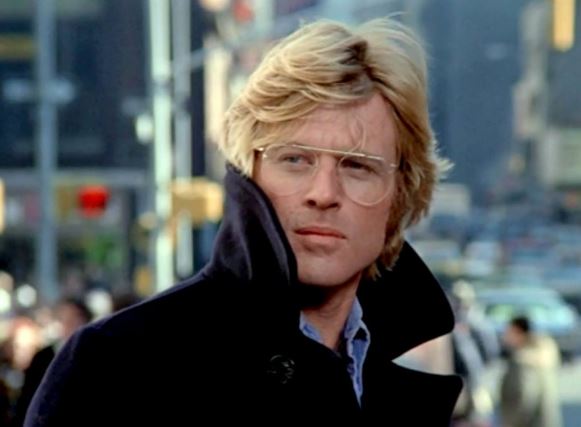
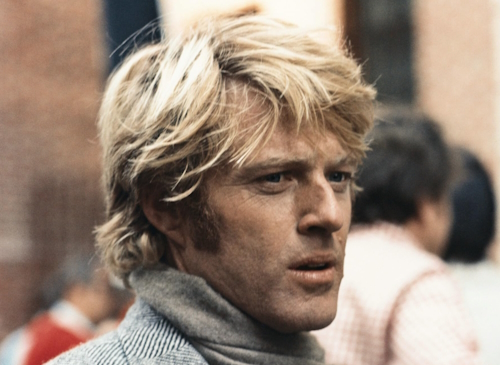
Robert Redford in “Three Days of the Condor”
In fact, as very few people have realized, The Winter Soldier is almost a remake of a 1975 film that most film snobs would agree is “real” cinema: Three Days of the Condor.
The only obvious similarity is that both films feature Robert Redford. In Condor, Redford plays a brilliant but very bookish CIA analyst named Turner who works in a New York City branch office. One day, he comes back from lunch to find everyone in the office dead, murdered by professional assassins. Turner goes on the run. Unsure of who he can trust, he kidnaps an unsuspecting, beautiful woman (Faye Dunnaway) and hides in her apartment. From there, he gradually figures out that the assassins who killed his work-mates were sent by a rogue faction inside the CIA itself. Apparently, Turner’s branch had stumbled upon a secret plot by the faction to invade the Middle East and capture all the oil fields (how very far-fetched, right?). Turner eventually confronts the leader of the faction, as well the head assassin, a Zen-Master-like Frenchman named Joubert (played with brilliant, icy effectiveness by Max von Sydow).
On the surface, Condor might seem like a very different film from The Winter Soldier. But the closer you look, the more The Winter Soldier seems almost like a remix of the earlier film. That is, it has all the same elements. The good-guy-betrayed-by-his-government figure is Steve Rogers (a.k.a. Captain America) who, like Turner in Condor, discovers a vast conspiracy within U.S. intelligence (S.H.I.E.L.D, in this case, rather than the CIA). Like Turner, Rogers finds himself on the run with a beautiful woman (Natasha Romanoff/Black Widow). He confronts the leader of the conspiracy (played by none other than Robert Redford himself). And of course he confronts the lead assassin, Barnes, who (like Joubert in Condor) turns out to be far more complicated than he appears.
Even some of the individual scenes in The Winter Soldier are eerily reminiscent of those in Condor. Take the now famous elevator sequence, which is not only the best in the film but one of the best in the entire MCU series. On his way out of the high-tech and vaguely fascistic H.Q. of S.H.I.E.L.D., Rogers steps into an elevator and rides down. As the elevator stops at successive floors, more and more men step on, each menacing but seemingly disinterested. The scene works so well because everyone can relate to it, to that sense of unease we all fell when forced into close proximity with strangers. We begin to wonder: what if some of these people were evil. They could hurt us—maybe even kill us—before we could react. And yet, despite this unease, we do nothing because we have no real evidence of evil intent. We’re playing a social role. And that’s just what Rogers—a good-natured man if ever there was one, willing to give anyone the benefit of the doubt—does.
Robert Redford in “The Winter Soldier”
I love the moment when Rogers notices sweat streaming down the face of one of the men next to him. He knows—as we, the viewers, know—that this is really, really bad. But there is nothing he can do about it…yet. It’s still in the future. Alfred Hitchcock couldn’t have done it any better. Nor, for that matter, could Sidney Pollack, who has an almost identical scene in Condor, in which the hapless Turner finds himself in an elevator with Joubert, the master assassin. Each man knows that the other man knows who he really is, but neither can take any action…yet.
Ever since I read Mark Crispin Miller’s landmark essay “Hollywood: The Ad” many years ago, I’ve been fascinated the way in which the tropes and elements of an early “classic” movie can end up rearranged and transformed in a later pop film. Miller gives the example of 2001: A Space Odyssey (1968) and Star Wars (1977). If you look closely, many of the components of the former get transmogrified in the latter. The apes of 2001 become the loyal Wookie Chewbacca. The cold, robotic voice of HAL the computer becomes that of C3PO the droid. The white, sterile interiors of the spaceship Discovery become the stark, sterile halls of the Death Star. And so on and so forth.
Martin Scorsese
That’s just what has happened here, with Condor and The Winter Solider. They’re practically the same movie, but shaken up by time and changing purposes. That is, The Winter Soldier is every inch a pop film, with the full intention of stimulating the audience with all the action and explosions and kung-fu fights that we’ve come to expect from a Hollywood blockbuster. But, on some level, the kernel of Condor is still there. The Winter Soldier is also a story about evil, rapacious men seizing control of government, and also the creeping power of America’s military-industrial complex. It’s also about the dehumanization the soldiers like Rogers and Barnes undergo as pawns in the hands of callous leaders and ruthless institutions.
In short, despite all its roller-coaster-ride thrills and spectacle, The Winter Solider is a “real” movie.
No self-respecting cinephile could live with themselves if they failed to mark the passing of a great movie star like Sam Neill. Yes, Neill was a movie star. He seldom played the lead in big-budget films—Jurassic Park was a lucky exception, and even that film was more of an ensemble piece—yet whenever he was on-screen, it was impossible to take your eyes off him. And that inexplicable quality, more than anything, is what defines a movie star.
I say inexplicable, because no one can really define it. Yes, it has something to do with good looks, and Neill was definitely handsome. (Early in his career, he was an outright heartthrob in his native New Zealand.) Intelligence, too, often has something to do with star-power, and Neill was certainly, obviously smart. And charming, albeit in a reserved, unassuming way.
But there are lots of other good-looking, smart, and charming actors who never achieve the status of movie star. Neill did. How did he do it? I’m not sure. If I had to assign Neill one of my 15 Hollywood archetypes, I guess he would fit best in the Noble Everyman slot. But he was almost too handsome for that category. Really, he was almost his own archetype—that of the quiet, capable, professional man.
These terms certainly describe the first role I saw him in, which made me a fan—that of the titular superspy in Reilly, Ace of Spies. A 12-part miniseries shown on the Masterpiece Theater program in America, it told the story of the dapper, aristocratic, and amoral Sidney Reilly, a Russian-born secret agent who works for the British Empire circa 1910. With his deceptively soft, incisive voice and penetrating intellect, Neill was perfect for the role, and it made him a star.
Throughout his subsequent film career, he played many other resourceful, smart, but quiet characters, often in supporting roles. He played naval officers (Dead Calm, The Hunt for Red October), scientists (Jurassic Park, The Dish), and, of course, spies (Reilly, Ace of Spies, Plenty).
Whatever he played, though, he always exuded a kind of affable, open, benign quality that viewers instinctively warmed to.
Incredibly, forty years have passed since David Lynch’s masterpiece, Blue Velvet, was released to theaters. Actually, “released” isn’t quite the right word; it detonated, hitting the cultural consciousness with the force of an H-bomb. Although not a huge commercial hit compared to other films that came out that year (including such juggernauts as Top Gun, Crocodile Dundee, and Aliens), Blue Velvet quickly became the most talked about, joked about, and debated about movie in America, at least among the literati.
This was especially true of the English- and Film-major nerd set of which I was a member. I was, in fact, roughly the same age as Jeffrey Beaumont (Kyle MacLachlan), the film’s young protagonist, who comes home from college to Lumberton, N.C. He is visiting his hospitalized father (who suffers a stroke in the film’s famously surrealistic opening sequence), and soon finds himself wandering around town, adrift. One afternoon, he finds a severed human ear, which he takes to the local police department and hands over to a good-natured detective. “That’s an ear all right,” the man says, in one of many moments of 1950s camp dialog. Thus begins the dark mystery that propels this very, very dark film.
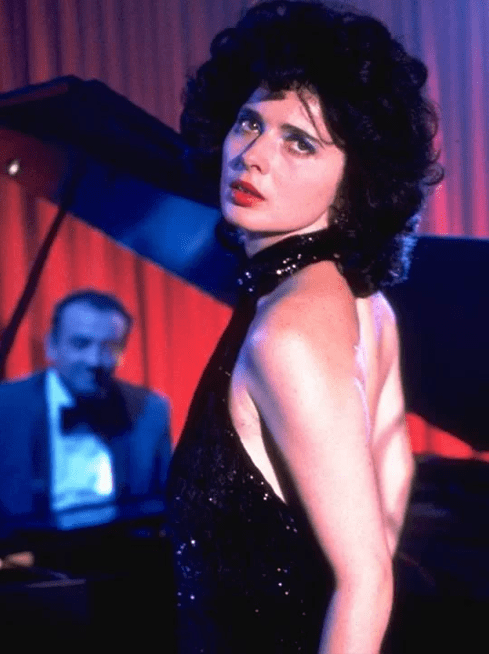
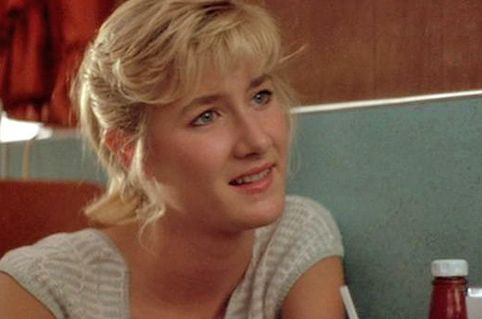
Again, “dark” isn’t quite the right word. For the movie is as concerned with light as much as darkness. Jeffrey soon finds himself drawn to two very different women—Sandy (Laura Dern), the blond-haired, sweet daughter of the detective; and Dorothy (Isabella Rossellini), the sultry femme fatale who might have something to do with the severed ear. He experiences a life-altering, mind-blowing moment with each of them, in turn. With Sandy, he glimpses a bit of transcendent, romantic bliss when they first dance together at a party, to the angelic voice of July Cruz on the soundtrack. With Dorothy, he witnesses her violation at the hands of a psychotic drug-lord, Frank, who has sexually enslaved her.
That latter scene, which comes at the end of Act I, is one of the most powerful and perverse in the history of cinema. Even today, in our porn-saturated culture, many people find it shocking. And they should. It’s meant to shock. But it’s also meant to question. To ask the viewer: why is evil so seductive? Why is it so powerful?
Or, as Jeffrey asks Sandy, “Why are there men like Frank?” He might just as well have asked: Do all of us have a sadistic streak like Frank (and maybe Dorothy)? Do all of us have a masochistic streak like Dorothy (and maybe Frank)?
For me, this questioning aspect is what separates art from pornography, even when the line is blurred, as it very much is in Blue Velvet. Val Kilmer, who was in consideration for the role of Jeffrey, dismissed the script as “pornography.” He might have been right about that script, but he was wrong about the final product. Blue Velvet is art. In fact, it’s high art. There is something sublime about it. Something that transcends ordinary definitions and categories. It seems to exist on a higher plane of existence.
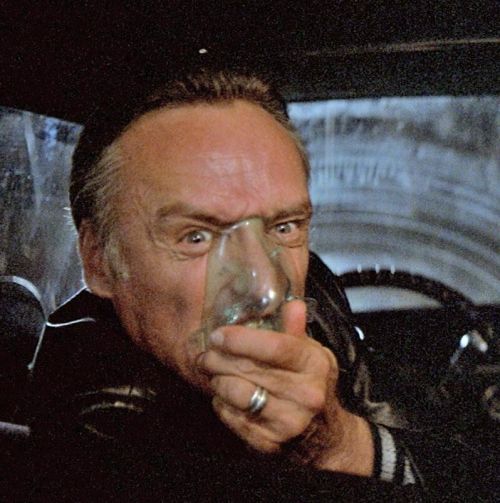
Looking back on the film, another aspect I find amazing about it is the sheer number of careers it launched—or, in many cases, rejuvenated. MacLachlan and Dern became movie stars almost overnight. (Yeah, MacLachlan had been in Dune, but the movie bombed). Rossellini went from being a model and cosmetics spokesperson to an acclaimed, A-list actress. Veteran actor Dean Stockwell made an instant comeback based on his one, over-the-top scene in the movie, vamping and lip-synching Roy Orbison’s “In Dreams” (which the film also re-popularized). And 1960s counter-culture hero Dennis Hopper—whose performance as Frank was so electrifying that he was nominated for Golden Globe—found his career jumpstarted. He went on to star in many films throughout the 1990s, and also to direct a couple.
But the biggest winner of Blue Velvet was, of course, Lynch himself. He went from being that cool-but-weird art film director (who had somehow made both Dune and also Eraserhead) to a Bonafide cultural phenomenon. A phenomenon would reach its apex a few years later in 1990, when Lynch had both the hippest TV show on air (Twin Peaks) and the hippest movie in theaters (Wild at Heart).
Despite all those later successes (and a few failures, too; he was such a great artist that even his “failures” were pretty damned good), Lynch would never top Blue Velvet. Sure, he came close a few times, especially with his phantasmagoric Hollywood tale, Mulholland Drive in 2001, but he never quite equaled it.
And that’s okay. Blue Velvet remains his masterpiece, not to mention one of my favorite films of all time.
A couple of weeks ago I reposted an old essay of mine called The Anti-Heroes of American Cinema: A Tribute. Ever since then, I’ve been thinking that there is a counterpart to the anti-hero—the anti-villain. Whereas anti-heroes often display characters that seem to contradict the classical definition of a hero, such as occasional selfishness, comical cowardice, and foolishness, anti-villains often run counter to the classical definition of a villain. That is, they can be courageous, charming, and even noble (albeit in a misguided fashion).
Ironically, it is classic literature itself, I think, that gives the first, prototypical anti-villain: Hector, the Trojan prince who flummoxes the Greeks in The Ilyad. Hector is, in many ways, more compelling and even sympathetic than the nominal “hero” of the work, Achilles, who spends most of his time sulking in his tent. Hector, whose moniker is “the breaker of horses,” is determined to defend his country from the invading Greeks, which makes him far more relatable than the glory-hound Achilles. He is also shown to be a devoted family man, gentle to his wife and infant child, as well as being a loving son and older brother.
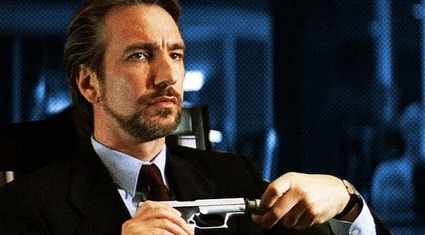
In the same way, the very best films of American cinema often have a great “villain” who is actually more of an “anti-villain.” In John McTiernan’s Die Hard, for instance, Alan Rickman gave a career-making performance as the hissable Hans Gruber. Hans isn’t just smart. He’s resourceful, courageous, and disciplined. When he accidentally gets cornered by John, he fakes a brilliant American accent that we can understand how someone would fall for it.
But what really makes Hans such a compelling character is that, in some ways, Hans seems to be struggling almost as much as the hero, John McClane. We sense that Hans really needs this heist to work. That, despite all his bravado and (yes) cruelty, he’s really just a guy trying to make his mark while there is still time. “You’re just a common thief,” Holly says to him, to which he replies, “I am an exceptional thief.” And we have to agree. He is exceptional.
More importantly, he feels like a fully rounded, three-dimensional character. Yeah, he’s still the bad guy, with wicked and even evil motives, but he is still compelling, likeable, and real. Much of this depth, of course, comes from the brilliant script by Jeb Stuart and Steven E. de Souza, but is it mainly due to Rickman’s refusal to play the character as a trope, the dimestore villain. As Rickman explained in an early interview: “I’m not playing ‘the villain’. I’m just playing somebody who wants certain things in life—who’s made certain choices—and goes after them.”
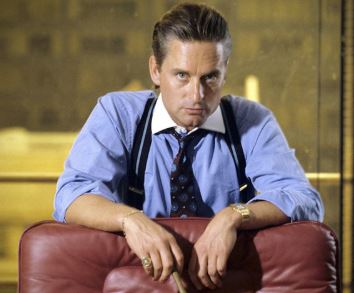
To take another great film from the 1980s, Oliver Stone’s Wall Street presented us with one of the great anti-villains of all time, Gordon Gekko, as brilliantly played by Michael Douglas in an Oscar-winning performance. Gekko is whip-smart, ruthless, and willing to play for table-stakes when the circumstances call for it. He also has a bit of an inferiority complex, as he reveals in an early scene when he and the film’s young hero, Bud Fox, play squash. Bud compliments Gekko on the luxury of his health club, to which Gekko responds, “Yeah, not bad for a City College boy. I bought my way in, now all these Ivy league schmucks are sucking my kneecaps.”
Of course, this kind of admission on Gekko’s part—that he comes from humble beginnings, and that he harbors a huge amount of resentment against the American aristocracy—serves to make him more compelling, not less. In other words, he becomes an anti-villain. We can understand how the movie’s young protagonist, Bud Fox, would be in awe of the man’s talent and grit. It’s only later in the film, when Bud figures out the man’s true, reptilian character, that he turns on Gekko and reclaims some of his dignity.
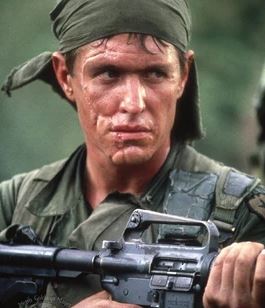
Come to think of it, Oliver Stone’s other great movie from the 80s, Platoon, also has a great anti-villain, who also tempts the movie’s young hero toward the dark side. In Platoon, it is the ruthless Sergeant Barnes (brilliantly played by Tom Berringer in a career-highpoint). Barnes is surely the most capable and lethal soldier in his platoon, displaying enormous courage and self-control in battle. He seems to genuinely care about the well-being of his troops (up to a point) and to harbor an authentic (if perverse) form of patriotism. Unfortunately, he is also a bit of a fascist, set on revenge against the Vietnamese people (both the Viet Cong and the villagers who sometimes aid them). We sense the depth of the trauma he has suffered from his previous war experience (manifested in a symbolic wound, the disfigurement of his face).
An earlier Vietnam movie, Francis Ford Coppola’s Apocalypse Now, presents us with another great anti-villain, the mad Colonel Kurtz (played by Marlon Brando). As we learn from the film’s (anti-)hero, Willard, Kurtz is a former war-hero, a West Point grad whose patriotism and courage led him to achieve high rank at a young age. But then, deep in the existential maw of Vietnam, he suffered a psychic that led him to go rogue, becoming a renegade war-lard in Cambodia, waging his own horrific, private version of the war.
It’s not surprising that Vietnam was such a great source of cinematic anti-heroes (and anti-villains), considering the way moral lines became so blurred in the long, horrific conflict. In the same way, modern military conflicts in the Twenty-First Century also generate their share of vexed, morally complex characters. In fact, one the greatest anti-villains of all time appeared in Dennis Villeneuve’s 2015 thriller, Sicario. In that film, the nominal hero, a young police officer named Kate Macer (Emily Blunt) finds herself entangled in a covert, CIA-run military operation against a Mexican drug cartel. One of the CIA operatives, Alejandro (Benecio del Toro), becomes a kind of demented mentor to her, showing her how to survive in the morally-inverted universe of the U.S. War or Drugs.
Alejandro is such an effective villain because neither the viewer nor Kate realize he is a villain until late in Act III, when we discover that Alejandro is, in fact, an assassin—the “hitman” of the film’s title—whose mission is to kill the cartel’s leader, Fausto Alarcón. The entire plot is then revealed to be an elaborate scheme to secretly insert Alejandro into Mexico, where he breaks into Alarcón’s house and kills him—along with his wife and children—while the family is having dinner.
It’s a shocking moment, one that might sink any other film. But Villeneuve and the screenwriter, Taylor Sheridan (later of Yellowstone fame), have prepared us for it by fully fleshing-out Alejandro’s character to the point that we can understand—almost—his actions. Throughout the movie, he is presented to us unfailingly cheerful yet lethal, fearless yet controlled, protective yet ruthless. We also learn that Alarcón brutally murdered his daughter in the past, which goes a long way to explain his wrath.
Most importantly, in the climactic scene in which Alejandro first sneaks into Alarcón’s house, he is spotted by a kitchen maid. Instead of killing her, though, he lets her go, knowing she won’t warn anybody about his presence. In this way, the film subtly suggests that Alejandro doesn’t necessarily kill the wife and kids out of wrath. Rather, he has to make the assassination look like an inter-cartel hit, so he has to be as brutal as required—but no more so—to maintain that fiction.
It’s a great movie, and it also presages what I’ve seen as growing development in American action cinema. Namely, the blurring together of anti-heros and anti-villains, to the point where they are not only indistinguishable from each other, but they inhabit the same (main) character. What is Walter White of Breaking Bad if not an agglomeration of anti-villain/anti-hero? Or Frank Lucas in American Gangster? Or John Wick?
It’s almost as if Hollywood has entered some kind of time-warp and looped back to the gritty, neo-noir films of the early 1970s. Movies with dark, morally ambiguous protagonists like Point Blank, Charley Varrick, The Mechanic, and even Super Fly. That Vietnam-era when the American cinema goer became more hardened, more cynical toward government and law enforcement and Capitalism and…well…just about everything.
Author’s Note: This morning, I read that the 2026 Oscars Ceremony, which was held last night, omitted the great character actor Tom Noonan from its In Memoriam segment. I can’t throw stones at the Oscars. When Noonan passed away a few weeks ago, I didn’t say anything about it, either, in part because I had just posted a tribute to the great Robert Duval, who died about the same time. Also, I simply didn’t know enough about Noonan to do a proper post. He only had a few notable film roles, but they were all doozies.
His best was as the serial killer Dollarhyde in Michael Mann’s Manhunter. I am reposting this essay about the film as a kind of (admittedly lame) tribute.
*** SPOILERS BELOW ***
As any old movie buff knows (and many younger ones, too), crime thrillers in 1980s almost constituted their own sub-genre. That is, they had their own special vibe. Slick. Stylish. Erotic. Typically, they boasted good-looking actors with great 80s hair, wearing garish 80s clothes and doing dangerous things. These were exotic and entertaining films, usually set in one of two environments: a dark city landscape (i.e. L.A.) or a gorgeous, sun-drenched beach (i.e. Miami).
And then there was the soundtrack. Synth-heavy, but punctuated with propulsive rock songs from the era—usually something from Genesis or Phil Collins. Take 1984’s Against All Odds, for example, starring Jeff Bridges and Rachel Ward. Collins wrote and sang the theme song for that one, garnering him an Oscar nom. (And, yes, that movie was set against a dark L.A. landscape and a gorgeous beach.)
But my absolute favorite 1980s crime thriller, by far, is a movie almost no one remembers: Michael Mann’s 1986 serial killer flick Manhunter. I saw it when it first came out in 1986, and then saw it again, quickly, before it vanished from the cineplexes forever. In the forty years since, the film has gotten almost no respect, except from a few cinephiles like me. (Quinten Tarantino is a famous booster; he put Manhunter on his list of favorite 1980s films.)
I’ve often wondered why Manhunter is so underappreciated. It probably has something to do with its lame title, which the studio forced Mann for reasons too stupid to discuss here. The original working title was, of course, Red Dragon, taken from the source novel by Thomas Harris. I often think that if the studio had stuck with that title, the film would have been a hit. Another reason is that the brilliant soundtrack, which mostly samples great songs from the era but includes great original music from The Reds, was soon deemed as “dated”. (It has actually come back into fashion thanks to the rise of the Synthwave aesthetic.)
Yesterday I got a three-word text message from my son Connor: Kilgore is dead.
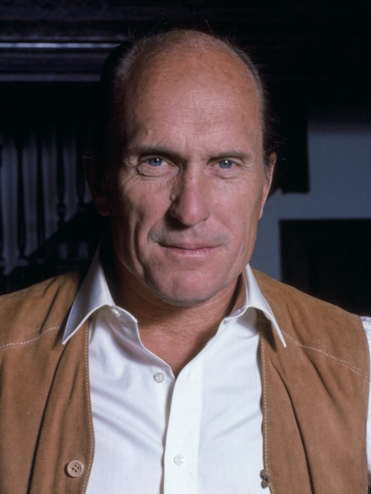
I knew, of course, exactly who he was referring to—Robert Duvall, the great actor who passed away yesterday at the age of 95. More specifically, Connor was calling out one of Duvall’s most memorable characters, that of Lt. Colonel Kilgore, the cheerfully psychopathic Army commander in Francis Ford Coppola’s Apocalypse Now.
Everyone, it seems, has a favorite Duvall role. For many young dudes these days, it is Kilgore. For others, it’s the soft-spoken but iron-willed Tom Hagen in the Godfather films. For still others, it is the authoritarian Marine dad in The Great Santini, or the fearless Texas Ranger Augustus McCrae. No matter what kind of character he was playing, Duvall’s own, real-life character always shone through: smart, fierce, tough, and comfortable in his own skin.
Being a mega-film-nerd, my definitive Duvall role was that of THX 1138, the titular character in George Lucas’s first film, which is still one of the most daring and visually stunning movies ever made. THX 1138 also marked one of the few films in which Duvall got to play the lead. Most of the time, he was cast in supporting roles, working in the background. Invariably, this allowed him—like Kilgore in his helicopter—to swoop in and steal the movie.
Although he trained with many famous Method actors, he was not generally considered to be one himself. Yet, he could hang with the De Niros, Pacinos, and Hoffmans of the world with seemingly effortless ease. Indeed, as an actor, he could hang with anybody.
For many (White) guys my age, Duvall represented the ideal American man. German/Irish but still cool. Macho but not toxic. Smart but not showy.
And funny. Even in the midst of mass-slaughter, Kilgore is funny. So is Santini. So, in his own way, is THX 1138. One of my favorite, later roles that Duval played is that of the craggy old Marine who helps Tom Cruise in the 2012’s Jack Reacher. With just a few lines of dialogue, and a barely suppressed, ghoulish chuckle, he manages to deliver some of the funny moments in recent cinema.
If you’re a liberal-arts nerd like me who thinks about culture all the time, you have probably pondered this question: why do people remake movies, but not books?
Yeah, I know. On the surface, this seems like a silly and even naive question. Movies, after all, are a popular medium. They belong primarily in the category of the performing arts, like theater and ballet and classical music. And, as we all understand, no one over ever gives the “final” performance of Hamlet or Don Giovanni or The Jupiter Symphony. Yes, there are certainly “classic” performances of all these works—some of them, made in the past century, have been recorded for the ages—but none is ever the last performance. Each generation must have its own Hamlet, Don Giovanni, etc.
The great scholar Joseph Campbell once explained that every time we go into a cinema and see a movie star—Tom Cruise, for example—up on the screen, some part of our brains is aware that the real person, the actor Tom Cruise, is alive somewhere else in that same, exact moment. This ability to exist in two places at once, Campbell said, is an aspect of a God, a living divinity.
Our subconscious perception of actors as gods is one reason we are always surprised by the death of a movie star, especially one who has been around since we, ourselves, were kids. How could they ever die? They seem to occupy a higher plane of reality, immortal, always youthful if not actually young.
Robert Redford was surely one of the greatest movie stars of my youth, and he starred in two of my favorite films of all time, All the President’s Men and Three Days of the Condor, both of which I have written about on this blog. What made him interesting was that weird dichotomy of blond, athletic, all-American good-looks combined with a reserved, wary intelligence. (On my list of Hollywood Archetypes, he fits squarely in the “Dark Prince” slot.) He was a very smart man, who did a lot of amazing things both on-screen and off-. Among the most notable of these was his founding of the Sundance Film Festival, which has come to rival Cannes as the preferred venue for indie-film directors to premiere their movies.
The fact that Redford would create an alternative festival for “the little guys” in the film industry was typical. He was, in some ways, the most counter-cultural movie star of the last fifty years—even more so than Easy Rider himself, Peter Fonda—in that he made movies about men fighting some vast, evil establishment. Often, this was the military-industrial complex in either its actual (All the President’s Men) or its fantasy (Three Days of the Condor) form. In his later years, when Redford could no longer play the lead, he took on the role of the villain who represents this evil empire, as in Captain America: The Winter Soldier.
As a kid, I always found something soothing about Robert Redford, even in movies filled with threats and violence. I suspect that, in my mind, he represented the best spirit of my parents’ generation (he was roughly the same age as my father). That is, the young adults of the 1960s and 70s. Post-hippie, but very hip. World-weary, but not broken. Brave, but not foolhardy. Idealistic, but not naïve.