Author’s Note: I was bemused by the recent outrage expressed by some very silly (and possibily racist) people regarding the casting of Lupita Nyong’o as Helen of Troy in Christopher Noland’s The Odyssey. That is, outrage regarding the casting of a non-white woman in a surrealist fantasy film that is, itself, an adaptation of a surrealist fantasy story from 3,000 years ago. Yes, a movie with cyclopses and sorceresses and a wooden horse (built on a beach with no trees) big enough to hold 20 men but light enough to be rolled into a city!!!
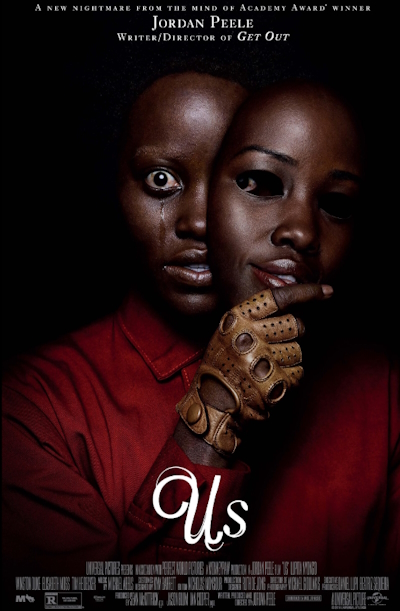
I thought this would be a good time to repost an essay I wrote some time back about Nyong’o’ truly amazing dual performance in a truly amazing film, Us. Enjoy!
The better part of a decade has passed since Jordan Peele’s landmark horror film Get Out was released, marking Peele’s transformation from famed comedy writer and sketch artist to one of the most important filmmakers of our time. Peele has since added two more films to his horror oeuvre—2019’s Us and 2022’s Nope.
All three are great, but my favorite is Us. For me, it hits on the deepest and most disturbing level, and it has the richest palette in terms of effects. It’s also the hardest to figure out in terms of plot. With Nope and Get Out, the viewer has a vague sense of what’s going on, even early in the film (although the details turn out to be more shocking and terrifying than anyone suspected). But while watching Us, I was totally mystified. I knew it had something to do with evil twins—true doppelgängers in both the literal and the psychological sense—but I had no real idea of what the actual plot would turn out to reveal. And what a reveal it is!
But I’m getting ahead of myself. Part of Us’s appeal lies in its slow-burn first act. (This is true of Get Out and Nope, too, but Us takes it to the next level.) The movie starts with a flashback to 1986, when a little girl, Adelaide, breaks away from her bickering parents at a beach boardwalk and finds a strange funhouse. It’s a simple premise, yet so much disturbing stuff is going on in this segment that it’s almost impossible to describe. We have the tension between the parents, raising the specter of divorce (the thing most kids fear more than anything else except death). Then, we have the separation of the child from the parents (another primal fear). And, finally, we have the freakish funhouse, which, though apparently deserted, is still lit with eerie neon light.
A couple of weeks ago I reposted an old essay of mine called The Anti-Heroes of American Cinema: A Tribute. Ever since then, I’ve been thinking that there is a counterpart to the anti-hero—the anti-villain. Whereas anti-heroes often display characters that seem to contradict the classical definition of a hero, such as occasional selfishness, comical cowardice, and foolishness, anti-villains often run counter to the classical definition of a villain. That is, they can be courageous, charming, and even noble (albeit in a misguided fashion).
Ironically, it is classic literature itself, I think, that gives the first, prototypical anti-villain: Hector, the Trojan prince who flummoxes the Greeks in The Ilyad. Hector is, in many ways, more compelling and even sympathetic than the nominal “hero” of the work, Achilles, who spends most of his time sulking in his tent. Hector, whose moniker is “the breaker of horses,” is determined to defend his country from the invading Greeks, which makes him far more relatable than the glory-hound Achilles. He is also shown to be a devoted family man, gentle to his wife and infant child, as well as being a loving son and older brother.
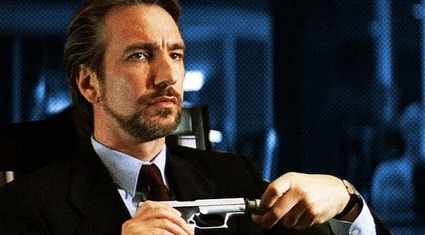
In the same way, the very best films of American cinema often have a great “villain” who is actually more of an “anti-villain.” In John McTiernan’s Die Hard, for instance, Alan Rickman gave a career-making performance as the hissable Hans Gruber. Hans isn’t just smart. He’s resourceful, courageous, and disciplined. When he accidentally gets cornered by John, he fakes a brilliant American accent that we can understand how someone would fall for it.
But what really makes Hans such a compelling character is that, in some ways, Hans seems to be struggling almost as much as the hero, John McClane. We sense that Hans really needs this heist to work. That, despite all his bravado and (yes) cruelty, he’s really just a guy trying to make his mark while there is still time. “You’re just a common thief,” Holly says to him, to which he replies, “I am an exceptional thief.” And we have to agree. He is exceptional.
More importantly, he feels like a fully rounded, three-dimensional character. Yeah, he’s still the bad guy, with wicked and even evil motives, but he is still compelling, likeable, and real. Much of this depth, of course, comes from the brilliant script by Jeb Stuart and Steven E. de Souza, but is it mainly due to Rickman’s refusal to play the character as a trope, the dimestore villain. As Rickman explained in an early interview: “I’m not playing ‘the villain’. I’m just playing somebody who wants certain things in life—who’s made certain choices—and goes after them.”
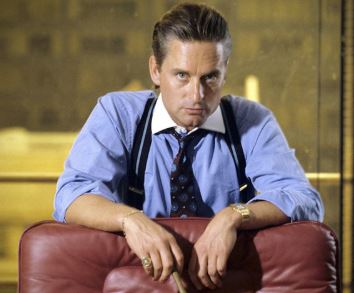
To take another great film from the 1980s, Oliver Stone’s Wall Street presented us with one of the great anti-villains of all time, Gordon Gekko, as brilliantly played by Michael Douglas in an Oscar-winning performance. Gekko is whip-smart, ruthless, and willing to play for table-stakes when the circumstances call for it. He also has a bit of an inferiority complex, as he reveals in an early scene when he and the film’s young hero, Bud Fox, play squash. Bud compliments Gekko on the luxury of his health club, to which Gekko responds, “Yeah, not bad for a City College boy. I bought my way in, now all these Ivy league schmucks are sucking my kneecaps.”
Of course, this kind of admission on Gekko’s part—that he comes from humble beginnings, and that he harbors a huge amount of resentment against the American aristocracy—serves to make him more compelling, not less. In other words, he becomes an anti-villain. We can understand how the movie’s young protagonist, Bud Fox, would be in awe of the man’s talent and grit. It’s only later in the film, when Bud figures out the man’s true, reptilian character, that he turns on Gekko and reclaims some of his dignity.
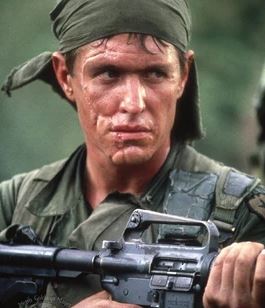
Come to think of it, Oliver Stone’s other great movie from the 80s, Platoon, also has a great anti-villain, who also tempts the movie’s young hero toward the dark side. In Platoon, it is the ruthless Sergeant Barnes (brilliantly played by Tom Berringer in a career-highpoint). Barnes is surely the most capable and lethal soldier in his platoon, displaying enormous courage and self-control in battle. He seems to genuinely care about the well-being of his troops (up to a point) and to harbor an authentic (if perverse) form of patriotism. Unfortunately, he is also a bit of a fascist, set on revenge against the Vietnamese people (both the Viet Cong and the villagers who sometimes aid them). We sense the depth of the trauma he has suffered from his previous war experience (manifested in a symbolic wound, the disfigurement of his face).
An earlier Vietnam movie, Francis Ford Coppola’s Apocalypse Now, presents us with another great anti-villain, the mad Colonel Kurtz (played by Marlon Brando). As we learn from the film’s (anti-)hero, Willard, Kurtz is a former war-hero, a West Point grad whose patriotism and courage led him to achieve high rank at a young age. But then, deep in the existential maw of Vietnam, he suffered a psychic that led him to go rogue, becoming a renegade war-lard in Cambodia, waging his own horrific, private version of the war.
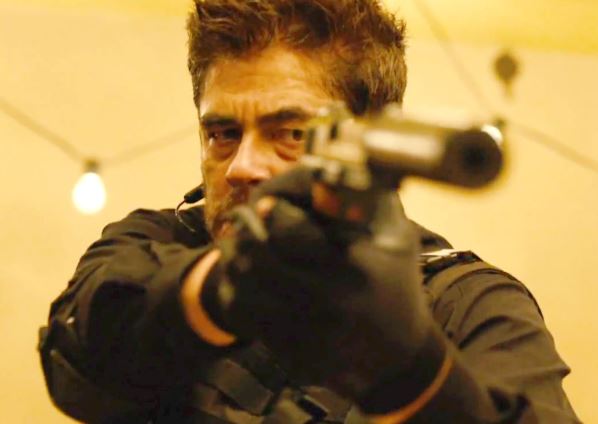
It’s not surprising that Vietnam was such a great source of cinematic anti-heroes (and anti-villains), considering the way moral lines became so blurred in the long, horrific conflict. In the same way, modern military conflicts in the Twenty-First Century also generate their share of vexed, morally complex characters. In fact, one the greatest anti-villains of all time appeared in Dennis Villeneuve’s 2015 thriller, Sicario. In that film, the nominal hero, a young police officer named Kate Macer (Emily Blunt) finds herself entangled in a covert, CIA-run military operation against a Mexican drug cartel. One of the CIA operatives, Alejandro (Benecio del Toro), becomes a kind of demented mentor to her, showing her how to survive in the morally-inverted universe of the U.S. War or Drugs.
Alejandro is such an effective villain because neither the viewer nor Kate realize he is a villain until late in Act III, when we discover that Alejandro is, in fact, an assassin—the “hitman” of the film’s title—whose mission is to kill the cartel’s leader, Fausto Alarcón. The entire plot is then revealed to be an elaborate scheme to secretly insert Alejandro into Mexico, where he breaks into Alarcón’s house and kills him—along with his wife and children—while the family is having dinner.
It’s a shocking moment, one that might sink any other film. But Villeneuve and the screenwriter, Taylor Sheridan (later of Yellowstone fame), have prepared us for it by fully fleshing-out Alejandro’s character to the point that we can understand—almost—his actions. Throughout the movie, he is presented to us unfailingly cheerful yet lethal, fearless yet controlled, protective yet ruthless. We also learn that Alarcón brutally murdered his daughter in the past, which goes a long way to explain his wrath.
Most importantly, in the climactic scene in which Alejandro first sneaks into Alarcón’s house, he is spotted by a kitchen maid. Instead of killing her, though, he lets her go, knowing she won’t warn anybody about his presence. In this way, the film subtly suggests that Alejandro doesn’t necessarily kill the wife and kids out of wrath. Rather, he has to make the assassination look like an inter-cartel hit, so he has to be as brutal as required—but no more so—to maintain that fiction.
It’s a great movie, and it also presages what I’ve seen as growing development in American action cinema. Namely, the blurring together of anti-heros and anti-villains, to the point where they are not only indistinguishable from each other, but they inhabit the same (main) character. What is Walter White of Breaking Bad if not an agglomeration of anti-villain/anti-hero? Or Frank Lucas in American Gangster? Or John Wick?
It’s almost as if Hollywood has entered some kind of time-warp and looped back to the gritty, neo-noir films of the early 1970s. Movies with dark, morally ambiguous protagonists like Point Blank, Charley Varrick, The Mechanic, and even Super Fly. That Vietnam-era when the American cinema goer became more hardened, more cynical toward government and law enforcement and Capitalism and…well…just about everything.
Yesterday I got a three-word text message from my son Connor: Kilgore is dead.
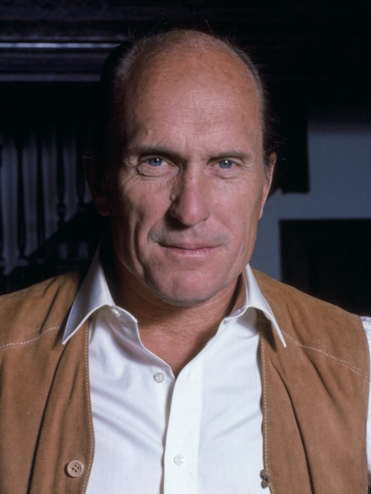
I knew, of course, exactly who he was referring to—Robert Duvall, the great actor who passed away yesterday at the age of 95. More specifically, Connor was calling out one of Duvall’s most memorable characters, that of Lt. Colonel Kilgore, the cheerfully psychopathic Army commander in Francis Ford Coppola’s Apocalypse Now.
Everyone, it seems, has a favorite Duvall role. For many young dudes these days, it is Kilgore. For others, it’s the soft-spoken but iron-willed Tom Hagen in the Godfather films. For still others, it is the authoritarian Marine dad in The Great Santini, or the fearless Texas Ranger Augustus McCrae. No matter what kind of character he was playing, Duvall’s own, real-life character always shone through: smart, fierce, tough, and comfortable in his own skin.
Being a mega-film-nerd, my definitive Duvall role was that of THX 1138, the titular character in George Lucas’s first film, which is still one of the most daring and visually stunning movies ever made. THX 1138 also marked one of the few films in which Duvall got to play the lead. Most of the time, he was cast in supporting roles, working in the background. Invariably, this allowed him—like Kilgore in his helicopter—to swoop in and steal the movie.
Although he trained with many famous Method actors, he was not generally considered to be one himself. Yet, he could hang with the De Niros, Pacinos, and Hoffmans of the world with seemingly effortless ease. Indeed, as an actor, he could hang with anybody.
For many (White) guys my age, Duvall represented the ideal American man. German/Irish but still cool. Macho but not toxic. Smart but not showy.
And funny. Even in the midst of mass-slaughter, Kilgore is funny. So is Santini. So, in his own way, is THX 1138. One of my favorite, later roles that Duval played is that of the craggy old Marine who helps Tom Cruise in the 2012’s Jack Reacher. With just a few lines of dialogue, and a barely suppressed, ghoulish chuckle, he manages to deliver some of the funny moments in recent cinema.
The better part of a decade has passed since Jordan Peele’s landmark horror film Get Out was released, marking Peele’s transformation from famed comedy writer and sketch artist to one of the most important filmmakers of our time. Peele has since added two more films to his horror oeuvre—2019’s Us and 2022’s Nope.
All three are great, but my favorite is Us. For me, it hits on the deepest and most disturbing level, and it has the richest palette in terms of effects. It’s also the hardest to figure out in terms of plot. With Nope and Get Out, the viewer has a vague sense of what’s going on, even early in the film (although the details turn out to be more shocking and terrifying than anyone suspected). But while watching Us, I was totally mystified. I knew it had something to do with evil twins—true doppelgängers in both the literal and the psychological sense—but I had no real idea of what the actual plot would turn out to reveal. And what a reveal it is!
But I’m getting ahead of myself. Part of Us’s appeal lies in its slow-burn first act. (This is true of Get Out and Nope, too, but Us takes it to the next level.) The movie starts with a flashback to 1986, when a little girl, Adelaide, breaks away from her bickering parents at a beach boardwalk and finds a strange funhouse. It’s a simple premise, yet so much disturbing stuff is going on in this segment that it’s almost impossible to describe. We have the tension between the parents, raising the specter of divorce (the thing most kids fear more than anything else except death). Then, we have the separation of the child from the parents (another primal fear). And, finally, we have the freakish funhouse, which, though apparently deserted, is still lit with eerie neon light.
My parents divorced when I was a little kid. My mom was struggling with mental illness (undiagnosed, at the time) and so I went to live with my father and his new wife, my step-mother Eileen. I saw my mom mostly on the weekends, and we would invariably go to the movies. I probably saw over fifty movies in the theater per year, all with my mom.
I seldom went to the movies with my father, and even more seldomly when it was just the two of us. The last time I remember was in 1992. Eileen was out-of-town with my brother and sister, so Dad and I went to see Clint Eastwood’s Unforgiven. It’s a great movie, and both my father and I loved it. We especially admired Gene Hackman’s performance as the villainous sheriff Little Bill Daggett, who, as Hackman himself revealed, is a kind of precursor to the modern right-wing movement.
My dad and I went out to dinner after the movie, and we shared our favorite moments from the film. It’s one of my fondest memories. I thought of it this morning when I read that Hackman had died. And I thought of something else, too. It occurred to me that the last movie I saw alone with my mother was also a Gene Hackman film, 1985’s Twice in a Lifetime. It’s about as different a film from Unforgiven as one can possibly imagine, with Hackman playing a completely different kind of character. And yet, it was still Hackman. Still low-key. Still forceful. Still brilliant.
What are the odds that the two last movies I saw with each of my parents alone were both Hackman films? Pretty good, actually. He was in a lot of movies. In fact, you could argue that he was the most versatile, compelling, and attractive character actor in Hollywood history. He played villains and heroes, and everything in between, across genres from action to mystery to sci-fi. In Twice in a Lifetime, he played an unassuming everyman who, on the tail-end of middle-age, leaves his wife to make a new start. He was also Lex Luthor in Superman. And Pop-eye Doyle in The French Connection. And the blind guy in Young Frankenstein.
Being a writer of mysteries, I’m particularly fond of Authur Penn’s 1975 film Night Moves, in which Hackman played a world-weary P.I. searching for a missing girl. It’s one of trademark, understated performances, and yet it crackles with energy. That was his gift.
I’ve been meaning to write a post listing some great movies about the press. Normally, I would make this a “top-10” list, but the fact is that I couldn’t think of that many, unless I resorted to some cheating (yes, Citizen Kane involves the muckraking journalism of the early 1900s, but you can’t really call it a movie about the press). So, here’s my list, from great to greatest…
The Paper
Ron Howard’s 1994 film The Paper focuses on one frantic day in the newsroom of a major metropolitan newspaper. The day begins with a high-profile murder, for which two young African-American men are arrested. Michael Keaton, Glenn Close, and Robert Duvall are the editors who are fighting to uncover the truth—before deadline. The Paper is a bit broad compared to the other entries on my list, but it’s still a fine movie with a great story.
In one of those strange, synchronicity moments that sometimes happen, I recently stumbled upon an article in Collider about how the classic John Carpenter film Escape from New York is getting a new 4K release from Shout Factory. This was a heart-warming bit of information, for me, since the film has been one of my favorites since I saw it in the theaters in 1982. It’s nice to think that new generations of film lovers might be given a chance to appreciate its many charms.
The news was also timely, for me, because I had been contemplating writing a post about the things I love most about movies like Escape from New York. That is, B-Movie Action Flicks. As anyone who reads this blog or my old one will realize, I am somewhat obsessed with B-Movie Action Flicks, especially from their golden age back in the 1970s-80s. Part of my obsession is mere nostalgia, of course. I spent many a late Saturday watching such movies on HBO with my equally nerdy, reprobate friends, and they (the films and the friends) helped me get through the agonies of growing up. But the other part of my obsession has to do with the nature of B-Movie Action Flicks. Why are they so much fun?