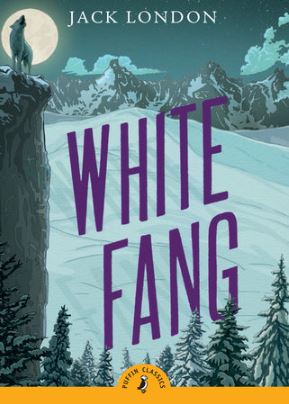
This installment of my on-going Synchronicity for Bookworms series came about when I was re-reading one of the cherished novels of my childhood, Jack London’s White Fang. Many decades have passed since I last read the book, yet I have vivid memories of riding the school bus while engrossed in the story of the young Alaskan wolf who becomes the protagonist of London’s story. Note that I don’t call him the “hero” of the story; London’s literary school of Naturalism doesn’t really believe in heroes. But few have ever written so movingly about the physical and emotional plight of animals—including the most dangerous animals of all, human beings.
As I was reading the book this time, I was struck by this passage, in which London describes, from the point-of-view of the wolf-pup, what the inside of his cave is like. And how scary one bright “wall” of the cave is…
By the time his mother began leaving the cave on hunting expeditions, the cub had learned well the law that forbade his approaching the entrance. Not only had this law been forcibly and many times impressed on him by his mother’s nose and paw, but in him the instinct of fear was developing. Never, in his brief cave-life, had he encountered anything of which to be afraid. Yet fear was in him. It had come down to him from a remote ancestry through a thousand thousand lives. It was a heritage he had received directly from One Eye and the she-wolf; but to them, in turn, it had been passed down through all the generations of wolves that had gone before. Fear!—that legacy of the Wild which no animal may escape nor exchange for pottage.
For some reason, I focused on the phrase “a thousand thousand lives,” and I immediately wondered whether this were even roughly accurate. After all, a “thousand thousand” lives is a million lives. That seemed like a lot, even from an evolutionary standpoint.
So, I dialed up the Wikipedia page on wolves and found that the question really depends on what kind of “wolf” one is talking about. Gray wolves of the sort found in Alaska split off from the African wolf roughly one million years ago (mya) . If you include the African wolf or its predecessors, that takes you all the way back to 1.6 mya. Therefore, if you fudge a bit and replace the word “lives” in London’s passage with “generations,” you can properly say that little White Fang carries the genetic memory of one million ancestors inside him, at least.
Of course, wolves, like so many great mammalian lineages, first evolved in Africa. Specifically, they are descended from African jackals, having split off from the jackal line over two million years ago. Reading all this, I remembered something I learned in one of my anthropology classes in college—the so-called Out-of-Africa Theory in which modern humans (Homo sapiens) are believed to have evolved in Africa and then migrated out to Europe and Asia. This new, improved, model of humanity soon displaced the human species in those lands such as Homo erectus, Neanderthals, and so on.
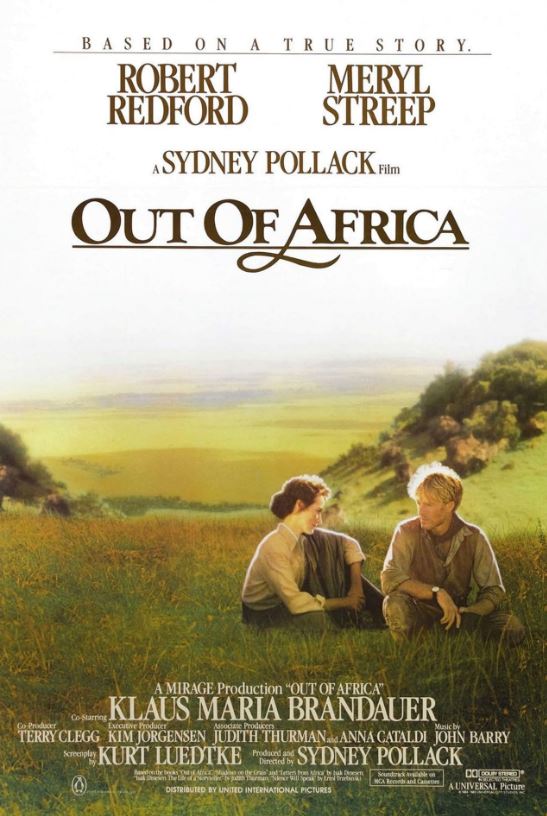
I did another web search on the “Out-of-Africa” theory and got a million hits for…Out of Africa, Sydney Pollack’s 1985 film starring Meryl Streep and Robert Redford. Instead of staying on-course, I immediately went down this new rabbit-hole, hitting the Wikipedia page for the movie. I went to see it in the theaters at the time, but I have almost no memory of it. It is, in fact, one of the most forgettable films of the 1980s, the sort of big-budget, star-heavy drivel that Hollywood has been churning out for almost a century. I do remember that many people in the audience were crying at the tear-jerker ending, and that I wanted to cry, too, out of sheer boredom.
Naturally, the film went on to win seven Oscars that year.
In fact, I am being unfair. It’s not a bad movie. The cinematography is lavish. And the acting is brilliant (even though Robert Redford doesn’t even attempt a British accent for his real-life character, Denys Finch Hatton, probably because Pollack told him not to). Streep, in contrast, shows off her usual, preternatural ability with foreign accents, playing Swedish noblewoman Karen Blixen, on whose fabulous memoir (it’s great; you should read it) the film is based.
But the real standout of the film, for me—in fact, the film’s only actor whose scenes I actually remember—was German actor Klaus Maria Brandauer, who was a minor movie star at the time. I became a fan of Brandauer when I saw the movie Mephisto, in which he plays a conflicted Berlin actor who finally achieves fame when his most famous character (the devil in Faust) goes viral with the ascendent Nazi party. Brandauer also played a Bond villain in Never Say Never Again (another bit of drivel, but better than Out of Africa), in which he steals every scene.
I always liked Brandauer because he exuded the air of a blazing intellect, yet one that was tightly controlled. (Rather like Jack Nicholson, in fact, only German.) He was also just really, really charming and magnetic.

Unfortunately, Brandauer’s film career tapered off quite a bit after Out of Africa. You can imagine my surprise when I went up to IMDB, looked him up, and found that one of his more successful films of the 1990s was a Disney production of Jack London’s White Fang.
Yes, I had come full circle on the Great Synchronicity Wheel, returning to where I had begun. Only now, I knew a lot more about wolves, Jack London, Out of Africa, and Klaus Maria Brandauer.
Not a bad hour, actually.


I liked the movie but I knew what I was getting. I really, really, really liked the book. The ending of that made me cry like a baby: I’m not going to go pull it out of the bookshelf right now, but it’s something like “Nelson has lions too, but his are made out of stone.” One of my favorite endings in literature, better than ‘and so we beat on, boats against the current.’
LikeLiked by 1 person