
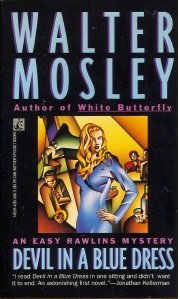
Like a lot of people, my first exposure to Walter Mosely was when I saw the 1995 film adaptation of his novel, Devil in a Blue Dress, starring Denzel Washington. It’s a good movie, with fine performances by Washington and Don Cheadle, but it didn’t inspire me to seek out Mosely’s fiction. As far as I knew, he was just another solid mystery writer, one of many whom I hadn’t read.
Sometime later, I bought a copy of The Best American Short Stories and I was surprised to see a story by Mosely among that year’s selections. The story is called “Pet Fly” and it’s a deceptively simple tale of an office grunt (who happens to be black) trying to keep his integrity while working in modern corporate America. I was knocked-out by it. Later still, I stumbled upon an actual novel by Mosely, a science fiction work called The Wave, which turned out to be one of the best novels (sci-fi or otherwise) that I had read in years.
Clearly there was something to this Mosely guy. So, I finally took the plunge on his debut novel, the first in a series for which he is still best-known. And, yes, once again I was blown away. Devil in a Blue Dress is a creative, poetic, and empathetic novel, written in a genre not known for any of these qualities. It’s also a kick-ass P.I. story.
Many famous detective novels center around an ambivalent, anti-heroic P.I., and this one does, too. But seldom has a mystery writer infused their main character with such desperation and dread as Mosely. Ezekial “Easy” Rollins is a Black machinist from Louisiana working in post-war L.A. When he loses his job due to an overbearing, racist boss, he faces the prospect of losing his house. So, when a rich businessman named Albright (great name, that) offers him cash to find a missing girl, he takes the gig, even though he senses that Albright is a psychopath and that his—Easy’s—life will be in danger.
Another thing that makes Easy’s character different from most P.I. protagonists is his epic reluctance to talk. Sam Spade and Philip Marlow might be laconic, but Easy is damn near mute. He only speaks when spoken to, or when he’s trying to get information out of someone. Other than that, he remains guarded, afraid of saying (or doing) something that might get a Black man in trouble in a White man’s world.
It’s this pervasive sense of danger that marks the great strength of the novel. P.I. are supposed to get into dangerous situations, but Easy is always in danger, even when sitting in his favorite bar. (Maybe especially then.) So, as the plot progresses and he finds himself in deep trouble, Easy is aided by an old acquaintance named Mouse, who comes visiting from down south. Like Albright, Mouse is a psychopath, but he’s Black, he’s a friend, and he is (at least nominally) on Easy’s side. For the second half of the novel, Easy finds himself caught between these twin monsters—Albright and Mouse—as he slowly unravels the mystery.
Not surprisingly, that mystery centers around a beautiful femme fatale whose name might be Daphne, and who might be a killer. In due course, Easy finds himself romantically entangled with her, even as he helps her escape the clutches of the White men who are after her, for various reasons. In a book that deals so creatively with the themes of racism and identity, the ultimate secret that Easy discovers about Daphne seems perfect, and the ending of the book falls into the reader’s hand like ripe fruit.
Good stuff. Check it out…

 Ash Clifton, Writer