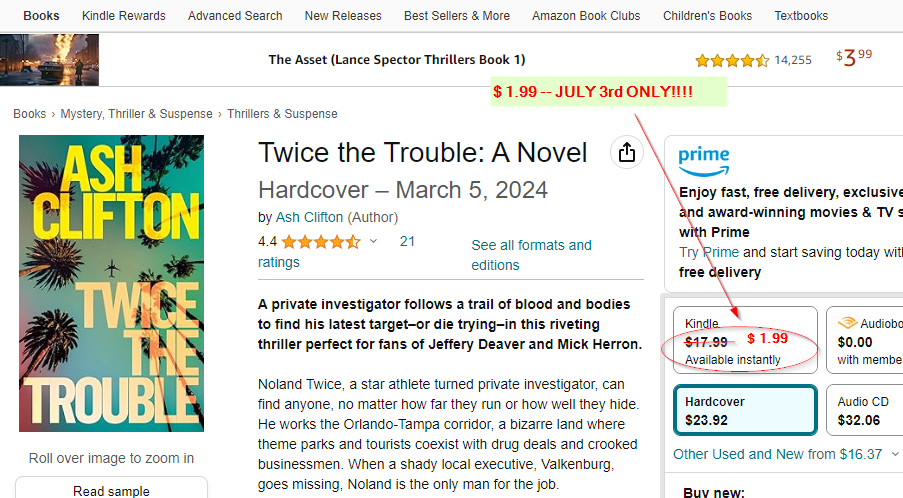
Heads Up!!! For today only, Twice the Trouble will be on sale for $1.99 on Amazon Kindle!!! Yes, you read that correctly. $1.99!!! Not even 2 bucks! Cheap!!! Buy it for your ma! Buy it for your pa! Buy it for your Significant Other! Buy it for your ex! Buy it for your Significant Other’s ex! Just buy the damn thing! Buy buy buy!
I’ve been meaning to post this for a while (sorry, I’m a flake). Marshal Zeringue has (another) really cool web site called The Page 69 Test, where he invites writers to turn to page 69 of their latest book and write about it. It’s actually a lot of fun! Here is my entry (for which I am grateful to Mr. Zeringue for inviting me to write).
The 1990s gave us two great, new genres in popular music. The first was Grunge, and the second was Big Beat. I’ve written a lot about the first but hardly anything on the second, even though it represented some of my favorite electronic bands like The Prodigy and The Chemical Brothers.
So, as a small acknowledgement of this fact, I’m doing this week’s Friday Night Rock-Out on Fatboy Slim. Specifically, his remix of “Brimful of Asha” by Cornershop. I’ll admit that I’ve never heard the original release, but the remix is pure genius.
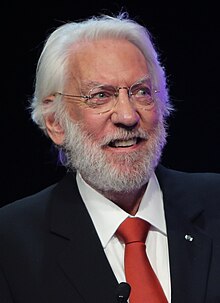
I really enjoyed The Hunger Games movies when they came out. Not only were they great examples of dystopian science fiction, but they served as a refresher course in the nature of fascism. The main baddie in the films was, of course, President Snow, played with great menace and understatement by the great Donald Sutherland.
I am very grateful to the producers of The Hunger Games for introducing Sutherland to a new generation of film lovers, especially at a time when his career was in a bit of a lull. Sutherland was one of my favorite actors when I was growing up, best known for career-making roles like Hawkeye Pierce in M.A.S.H., Oddball in Kelly’s Heroes, and the titular role in Klute. One of the great ironies of film history is that Sutherland should now be so closely associated with the role of President Snow—literally a right-wing fascist dictator—when his early, defining performances were usually as lovable, left-of-center antiheroes (Hawkeye Pierce especially).
Sutherland was one of the few movie stars from the 70s and 80s to have curly, hippie-hair, and his entire persona seemed to be that of a counter-cultural smart guy. The Alpha-Hippie that all Beta-Hippies aspired to be. I say he was a smart-guy, and it’s true—never did an actor so effortlessly exude intelligence, even without dialog, as Sutherland did. But while he was so obviously a smart-guy, he was never a smart-ass. Even the irreverent Hawkeye Pierce—perhaps the most famous prankster in cinema history—reserved his mocking for when he needed it to retain his sanity, and focused it on those who most deserved it.
One of the best ways to understand Sutherland as an artist is to imagine his stylistic opposite, Nicholas Cage. Like Sutherland, Cage is a brilliant actor, and a very smart guy, but while Cage is famous for his artistic daring, often taking his performances to frenetic heights that would seem ridiculous for other, lesser actors, Sutherland was known for his almost impenetrable reserve. He always seemed to be holding something back, in a good way. He kept the viewer guessing about what was really going on behind those crystalline blue eyes.
Perhaps my favorite Sutherland role when I was growing up was as a world-weary health inspector in Philip Kaufman’s 1978 sci-fi horror masterpiece The Invasion of the Body Snatchers. In this film, Sutherland almost drips existential cool, even when faced with an invasion of alien pod-people (read: communists, right-wing conformists, or your boogey-men of choice) who want to eliminate humanity.
People love tag-teams. It’s in our nature. Have you noticed that almost every work of epic literature across the world has not one but two main heroes. The Gilgamesh epic has Gilgamesh and Enkidu. The Iliad has Achilles and Odysseus. The Authurian legends have Arthur and Lancelot. DC has Superman and Batman.
In all of these examples, the two heroes have much in common, but they are also different in some fundamental and defining way. They not only compliment each other, they contrast each other.
More importantly, they make the story a lot more fun.
I think of this dynamic whenever I hear “Under Pressure” by Queen and David Bowie. Together, the band and the singer represented a group of pop titans of the 1980s. But there were huge functional and artistic differences between them. Bowie was probably the greatest musical artist of his generation, known for inventive and experimental works that never failed to surprise or thrill his fans. Queen was a great rock band, constructed around the epic voice of Freddie Mercury and the epic guitar skills of Brian May. The idea of bringing these two forces together might have been disastrous. That is, they might have canceled each other out.
But no. Instead, their talents together to create one of the best rock songs ever recorded. From the amazing bass riff (whose author is disputed) to the colossal bridge near the end, it’s still one of my favorites.
Enjoy…!
BONUS: Here is a great live performance of the song by Bowie and Annie Lennox.
How often do you see a mainstream, broadcast news interview that covers so many nerd-worthy topics? This one has astronomy professor Janna Levin discussing Dyson Spheres, alien civilizations, sci-fi writer Olaf Stapledon, and Freeman Dyson himself.
Very few writers in history have had as big an influence on my imagination as Freeman Dyson. Not only did he come up with the idea (mostly) of a Dyson Sphere (which, in slightly modified form, became the inspiration for Larry Niven’s Ringworld novels), he always wrote visionary articles on space exploration, climate change, genetic engineering, the future of energy, and even E.S.P.
When I was an English major at the University of Florida, one of the best classes I took was a Survey of Science Fiction Literature course. It covered a lot of famous American and British SF, some of which I had already read as a teenager and some of which were new to me.
Looking back on it now, it occurs to me that two of the writers we read in the class were not only totally different from each other, they also presented two completely opposite visions of what we now call artificial intelligence. These writers were Isaac Asimov and Harlan Ellison.
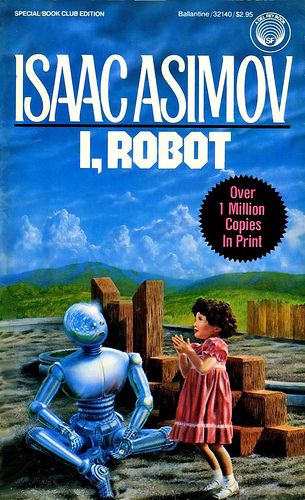
For Asimov, we read his early, seminal work, I, Robot. This is the short story collection that included his first formulation of the Three Laws of Robotics, which have been alluded to (i.e, ripped off) in countless other science fiction stories, including Star Trek. The book came out before the term AI became common parlance. Yet, in Asimov’s imagined future, the world is rife with robots that are essentially AIs with mechanical bodies. All of them have positronic brains (yeah, Star Trek ripped off this conceit, too) with the Three Laws hard-wired in. The result is that all robots function as humanity’s tireless, benevolent servants. (Some would say, slaves.)
Actually, they are much more than that. They can think, reason, and make choices. In fact, they have to make choices. The moral dilemmas created by the Three Laws as the robots interact with chaotic (and often evil) human beings is the source of drama in most of the stories.
Despite the mystery and drama of the stories, though, Asimov’s vision is a very optimistic, almost Buck-Rogers-esque idea of the future—not quite a utopia but close to it. There is no poverty, no hunger, no war. It’s only upon close reading of the stories in I, Robot that the exact nature of the master/servant relationship between humans and robots appears fraught—probably more so than Asimov consciously intended. This is especially true in a few of the stories, where it’s revealed that future governments are secretly run by the highest order of HAL 9000 style robots, whose plans might be beyond human comprehension.
Later in the Science Fiction class, we read Harlan Ellison’s short story “I Have No Mouth and I Must Scream,” which is quite possibly the darkest and most disturbing short story I have ever read, sci-fi or otherwise. And, of course, it involves an AI.
The story is mostly set underground, about one hundred years after a nuclear war wiped out all of humanity except for five people. The war was started by a mutinous Pentagon computer (yeah, just like Skynet) called AM that becomes self-aware and decides it hates human beings more than anything. After killing everyone on the planet, it preserves the five people as its playthings, running them through an endless number of elaborate, sadistic games. Unfortunately for them, AM has somehow obtained God-like technological power over physics, able to shape and project matter wherever it wishes, and also to keep the humans alive and immortal in their banged-up, miserable state. So, in effect, the protagonists spend an eternity in a kind of Holodeck-like hellscape, trying to figure out how to either escape or kill themselves.
Yeah, it’s heavy.
This enormous gulf between Asimov’s and Ellison’s visions of the future—an AI paradise versus an almost literal AI hell—is, in part, symptomatic of various generational and cultural shifts between the two men. I, Robot was published in 1950, on the tail-end of the Golden Age of Science Fiction, the time when the prosperity of America in the post-war years seemed destined to go on forever, fueled by newer and greater technological innovations (AI among them). In contrast, Ellison’s short story was published in 1967, at the height of a counter-cultural revolution that extended into science fiction literature —the New Wave that introduced some of my favorite sci-fi writers of all time, such as Samuel R. Delany, Ursula K. Le Guin, Roger Zelazny, and Ellison himself.
Thus, the difference between Asimov and Ellison’s work is essentially the difference between the lingering triumph of World War II and the horrors of VietNam. Between the optimism of the Atomic Age and the nihilism of the Cold War. In some ways, it’s also the difference between fantasy and realism, and between genre fiction and literary fiction. As dark as Ellison’s short story is, it’s also a much better work of fiction than Asimov’s. More convincing, too, alas. Told from the point-of-view of AM’s youngest victim, Ted, the story is filled with vivid, sharp writing and devastating passages, like this one:
Nimdok (which was the name the machine had forced him to use, because AM amused itself with strange sounds) was hallucinating that there were canned goods in the ice caverns. Gorrister and I were very dubious. “It’s another shuck,” I told them. “Like the goddam frozen elephant AM sold us. Benny almost went out of his mind over that one. We’ll hike all that way and it’ll be putrified or some damn thing. I say forget it. Stay here, it’ll have to come up with something pretty soon or we’ll die.”
Benny shrugged. Three days it had been since we’d last eaten. Worms. Thick, ropey.
You don’t have to be a literary critic to see that Asimov and Ellison are worlds apart, not just on the subject of Artificial Intelligence but on literally everything. Asimov was a scientist, a rationalist, and his optimistic views on the future of humanity were deeply rooted in the legacy of the Enlightenment. Ellison is more of a Gothic Romantic, full of existential angst and cosmic horror. His story is essentially an updated version of Mary Shelley’s Frankenstein, with the supercomputer in the role of the monster, determined to torment its creator.
Of course, the Frankenstein story is, itself, a reworking of an even older one—the Faustian myth. According to German legend, Faust is an intellectual who sells his soul to the devil in exchange for knowledge, and ends up going to hell. If the story seems familiar, it’s probably because the legend has been the psychological basis for countless tales of perverted science for centuries. Scientists, the story goes, want to attain the power of God, and thus end up being destroyed by their own hubris (often in the form of some infernal creation like Frankenstein’s monster or, more recently, SkyNet).
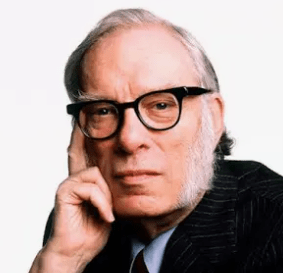
Isaac Asimov
Perhaps the biggest irony here (at least for me, personally) is that while I have great admiration for Ellison’s story, and I believe it is a much greater artistic work that anything ever penned by Asimov, Asimov’s vision is probably more accurate of what we can actually expect from the AI revolution. For all the hype about AIs destroying art and music and literature and taking away our jobs, I think AI will be a net positive for humanity. Perhaps a big net positive. It’s already making contributions in the fields of materials science, medicine, and even fusion energy. Yeah, it’s probably going to take away some people’s jobs, but those were probably crap jobs anyway. (If you train an AI to do it as well as a human, it’s probably not worth doing.)
As for the whole AM/Skynet thing, I don’t worry about it because I don’t believe computers will ever become conscious. In fact, the very idea of a machine becoming conscious seems like a category error, the kind of conceit that will seem laughable a hundred years from now as those old drawings of “men of the future” with feathered wings strapped to their arms.
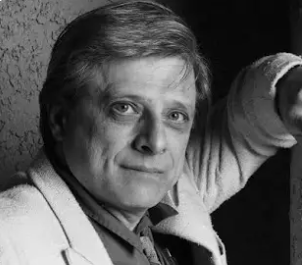
Harlan Ellison
This doesn’t mean, of course, that we won’t, someday, create an artificial life form that might replace us. But it won’t be a computer. It will be…something else.
I just watched a great inteview by Rick Beato of Ed Roland, the lead singer and mastermind of Collective Soul. I enjoyed the interview so much that I decided to re-post an essay I wrote on my old blog some years ago for my on-going “Battle of the Bands” series. Enjoy…!
The 1990s were a strange time. It was the decade between the two George Bushes—after the Gulf War but before 9/11—but it was also the first decade of the Internet and cell phones. The first truly digital special effects began to appear in films like Terminator 2 and Jurassic Park. The Soviet Union had fallen, only to be replaced by a globalized Russian mafia. Genocide was being committed in both Africa and Europe, all televised via the 24/7 global news cycle.
In short, this was the time when technology and social chaos really started to put the zap on our collective brain. And no bands were better at capturing this zeitgeist of psychological disintegration better than these two—Collective Soul and Garbage–although each did so in its own way.
Strangely, my concept of the “The 90s” didn’t really form until almost mid-decade. This was about the time that the amazingly vital Grunge movement began to fade from the scene. In its wake came a more diverse and accessible series of alternative rock bands. At the forefront was a five-man ensemble called Collective Soul, which had its first big hit in 1994 with “Shine.” While not their best song, “Shine” is an ambitious and even inspirational bit of rock that displays the band’s two great strengths: hard-edged, soaring vocals from frontman Ed Roland, and a vicious main riff from lead guitarist Ross Childress.
But the really cool thing about “Shine” was that despite having a very modern alterna-dude vibe it felt extremely retro. As Jon Pareles wrote in the New York Times, “Collective Soul breaks old ground. Its songs are comfortable where Southern-rock overlaps folk-rock, with solidly serviceable riffs in the usual places.”
Collective Soul was not trying to be Nirvana. It was trying to be Lynyrd Skynyrd.
Just one year after Shine, a band from Madison, Wisconsin named Garbage released their first album, Garbage (a.k.a. Garbage I). When I first heard the band, I was struck by lead singer Shirley Manson and her fabulously expressive voice—at times monotonal, at other times growling. This pale goth girl from Scotland had somehow tailored her vocals to exactly fit the manic-depressive zeitgeist of the 90s.
Indeed, I would argue that the band’s premier song, “Stupid Girl,” is the definitive song of the period (yes, even more so than Nirvana’s brilliant “Smells Like Teen Spirit”). In the song’s now-famous lyric, the narrator accuses an unnamed girl of being…well…stupid. In fact, the aspects of her stupidity are those evidenced by practically every person under 40 in modern urban America: vanity, self-absorption, consumerism, nihilism.
And fakery. Especially fakery. “[I] can’t believe you fake it…” as Manson sings portentously to the stupid girl in question. What is she faking? Being human.
Garbage I firmly established Garbage as the pre-eminent art-rock act of the decade, much as Collective Soul had ensconced itself as the pre-eminent hard-rock act. Collective Soul quickly cemented its position with their follow-up album (also eponymously titled), which included some of its greatest hits: “December,” “Where The River Flows,” and “Gel.” “December” went on to become the band’s second biggest hit (after “Shine”) and it remains my favorite, with Roland’s soulful lyrics counterpointed perfectly by Childress’s diamond-edged guitar work. I tell you, the Allman Brothers couldn’t have done better.
The song was so successful, in fact, that it engendered an almost immediate backlash which continues to this day. As far as I can tell, detractors of the song (and of Collective Soul in general) are upset by the fact that it not very Grungy. But wasn’t that the point? Grunge was a great period in American music, obviously. But in the end, it was just Punk’s Second Act. Like Punk, Grunge ran out of gas rather quickly. This is not surprising. Rage can only sustain an artist for so long; at some point, you have to write a song that works on multiple levels, and I think Collective Soul achieved that.
As for Garbage, the band was able to build on its initial success with the album Version 2.0 (which was produced under the delicious working title of Sad Alcoholic Clowns). The album has some good songs—I especially like the trippy and propulsive “Temptation Waits”—but none quite achieved the sublime level of “Stupid Girl.”
Ultimately, both bands were able to sustain themselves through the rest of the decade and beyond. Collective Soul suffered a near-fatal rift when Childress left the band in 2001. Even so, it has fared better than Garbage since the Millennium, producing some really fine albums especially 2004’s Youth. From that album come two of my favorite songs, “Better Now” and “There’s a Way”, which pick me right up whenever I am feeling lazy or down.
And yet, whenever I think of the 1990s, I remember “Stupid Girl,” with its techno-crazed background noises and jangly guitar riffs, all overlaid by Manson’s dirge-like vocals. To this day, “Stupid Girl” warns us like a klaxon just outside the entrance to hell: Don’t fake it…
Once again, the title of this series, “Friday Night Rock-Out” is a total misnomer. This week, it’s a Friday Night Rap-Out. Or, more accurately (but more awkwardly), a Friday Night Hip-Hop.
Hip-hop is, of course, the musical genre most closely associated with the African-American, inner-city youth experience. But a lot of great hip-hop comes from big cities outside the U.S. (in this case, Stereo MC’s, from London).
I think what I like about this song is the way it combines the main element of rap—the propulsive, virtuosic spoken poetry—with the beats and grooves of R&B, especially Cath Coffee’s seering background lyrics.
In the past decade or so, it’s become fashionable to talk about creativity as the result of freedom, relaxation, and “flow”—that ineffable point where the artist connects with the sources of inspiration deep within the human soul. I, for one, believe in this idea. Art is really about connecting with the spiritual subconscious, and all of us have the ability to channel this source (although very few of us are willing to put in the work that is also required to develop it).
But not enough has been written about the role of conflict in creativity. Specifically, the role of rivalry, competition, and—yes—jealousy, at its most venomous and sincere. The history of art is, in some ways, a history of rivalries. Picasso and Matisse. Faulkner and Hemingway. The Eagles and Fleetwood Mac. Rivals have a way of inspiring each other, of spurring each other on in ways that “healthier” forms of motivation just can’t reach. The greatest rivalries of all are, perhaps, those that exist within a rock-and-roll band. Would Lennon have been as good without McCartney breathing down his neck? Richards without Jagger? Henley without Frey?
Such internal rivalries are more intense because they also bring the family dynamic to bear. A rock band is like a family, and the members are like siblings. They love each other, but they hate each other, too. Worst of all, they know each other’s weaknesses. Which buttons to push.
Surely one of the greatest rock rivalries of all time is that between Roger Daltrey, the mesmerizing lead-singer for The Who, and that band’s lead guitarist and resident genius, Pete Townshend. As in any rivalry, one competitor eventually gets the upper-hand—in the judgment of history, at least—and that is also the case with Daltrey and Townshend. Daltrey has long been acknowledged as a brilliant singer, but it’s Townshend who gets the real credit for The Who’s iconic status. After all, Townshend is the writer of the pair, the creator of all the band’s great hits, including the classic rock opera Tommy.





 But not enough has been written about the role of conflict in creativity. Specifically, the role of rivalry, competition, and—yes—jealousy, at its most venomous and sincere. The history of art is, in some ways, a history of rivalries. Picasso and Matisse. Faulkner and Hemingway. The Eagles and Fleetwood Mac. Rivals have a way of inspiring each other, of spurring each other on in ways that “healthier” forms of motivation just can’t reach. The greatest rivalries of all are, perhaps, those that exist within a rock-and-roll band. Would Lennon have been as good without McCartney breathing down his neck? Richards without Jagger? Henley without Frey?
 Ash Clifton, Writer