Even though I live in Florida, I am guardedly optimistic about our chances of surviving (I almost typed weathering–HA!) the global warming crisis. New green technologies are being created everyday, and the ones we’ve already got have to the potential to completely transform the world.
Here is a recent, positive article from one my favorite websites, Inhabitat.com.
I have a confession to make: I love concrete architecture. I know, I know. Concrete Architecture (CA, for short) is not fashionable. It’s not renewable (not yet, anyway). It’s not touchy-feely. It’s not cool.
Part of the bad-rap CA has is due to its association with brutalism, the quasi-Soviet style that was popular in the 1970s, especially in England. Brutalism is cold. Windowless. Dystopian. Think 1984. A Clockwork Orange. Total Recall. Et cetera.
Obviously, that’s not the type of CA that I’m talking about. Rather, when I think of great concrete architecture, I think of buildings that mix smooth, rectilinear slabs of stone (that’s all concrete is, after all—artificial stone) with glass and other construction elements. When built to a more human scale, and combined with greenery and organic decoration, CA can be soothing. Symmetrical. Ordered. Neat. Human.
I keep thinking of that scene in Lawrence of Arabia when a reporter asks Lawrence, an Englishman, why he loves the desert so much. “Because it’s clean,” he says. His answer resonates on many levels: literal, moral, political, and philosophical. That’s sort of why I like CA. It’s clean. It’s calming.
Salk Institute – Louis I. Kahn, Architect
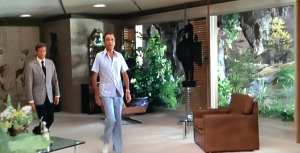
I think my first exposure to CA was from movies. Specifically, James Bond movies. There’s Willard Whyte’s desert mansion in Diamonds Are Forever (actually the Elrod House in Palm Springs by John Lautner). Then, in The Man with the Golden Gun, there’s Scaramanga’s secret lair, carved into the rock of a volcanic island. Almost every male nerd has a secret fantasy of being a Bond villain (or, at least, of having a Bond villain’s lair). What could be cooler for a bookish, introverted, probably asthmatic kid than to have his own secret, clean (pollen-free) hideout where no one, not even MI6, can find you?
Which brings me to my main point. Introverts of both sexes have a fondness for CA because we associate it with solitude, in a good way. After all, the only real experience with CA that most of us have is from public spaces—libraries, museums, research centers, etc.—whose sense of empty space is soothing to introverts (who tend to have too much internal stimulation).
So it’s no surprise that the ultimate fictional incarnation of CA would be owned by the ultimate fictional nerd, Tony Stark. His mansion in the Marvel MCU is a Lautner-esque swirl of concrete perched on a California cliff over the Pacific. The mansion is the epitome of the Bond-villain/mad scientist aesthetic. Stark, who seems to be a selfish lout but is actually psychologically damaged by the remembered death of his parents, is free to be alone in the mansion’s cavernous rooms, jammed with post-modern decorations and transhuman technology. Stark doesn’t need a human heart; he has a mechanical one, powered by cold fusion. It can’t be broken.
So, what does it say about me that I like CA so much? Basically, it says that I am an unreconstructed nerd, who likes things clean and controlled. Oh, well.
Ah, New Wave music. I remember you well. Post-disco. Post-punk. Post-modern. Post-everything. Synthesizers. Spandex. Dry ice fog in the videos. Bizarro special effects.
What a lot of people fail to remember is how flat-out danceable a lot of New Wave music was, even in its most cerebral and soaring example, Gary Numan’s Cars.
Yes, that’s Numan—as in human, but not quite. The song is about a guy who becomes so alienated from the rest of humanity that he only feels alive when he’s alone in his car (where he “can only receive”). And yet the song feels completely real, sympathetic, and…well, human.
I recently got a BritBox subscription, and I’ve been nerding-out. Mainly, I’m rewatching the original Inspector Morse series that aired on Mystery! back in the 80s and 90s. I’ve loved the show since I first saw it back in college. Morse is a genuinely interesting and conflicted character, and John Thaw played him brilliantly.
Morse is smart and righteous, but also very funny. Emphasis on funny. I remember the first episode I ever saw, back when I was in college, when I was channel surfing one late night. My dad happened to be awake at the same time, and we watched an episode titled The Wolvercote Tongue, in which the world-weary Morse tries to solve the mysterious murder of an American tourist. There is one especially good, laugh-out-loud moment, and both my father and I cracked up. It’s one of my fondest memories. Ever since that moment, I was hooked.
I also love the show’s setting of Oxford (the town and the university). I keep hoping to go there someday. I’m sure they’ve got the murder-rate down by now.
Of all the novels I have read in my life, only two ever disturbed me on a deep, lasting level. One was The Constant Gardener by John le Carré. The other was Money by Martin Amis.
Money is, by any reasonable definition, a brilliant novel. Full of symbolism and thematic complexity, Money is a phantasmagoric mediation on the evils of modern capitalism, whose only purpose is to make every living human being into a customer. And the very best customers, Amis reminds us, are addicts. They simply can’t stop.
The novel’s protagonist, a low-budget film director named John Self (ahem), certainly can’t stop. Addicted to sex, booze, fast-food, and pornography, he spends his days and night rambling around 1980s London, ostensibly in preparing to shoot a low-budget film with an egomaniac has-been movie star and a young, nymphomaniac actress, amongst other tragic-comic types. The movie is being funded by a shady character named Fielding Goodney, who might just be the devil himself.
Money is a triumph of style and imagery (although—be warned—much of that imagery is very, very gross). Self is a kind of stand-in for the entirety of modern Western civilization, and the novel might have been irredeemably bleak if not for Amis’s ferocious sense of humor, which he surely inherited from his equally brilliant father, the novelist Kingley Amis.
Martin Amis was a very fine writer, and the world will be a lot less interesting without him.
The only time I ever got in trouble with my parents over a book was when I was thirteen. The book was Nova by Samuel R. Delany, and was reading while nested in the back of the family car on a long trip. My stepmom read the back-jacket copy, which made the book sound a lot racier than it really was, and freaked out. However, she was (and is) a great reader herself, and she and my dad knew better than to try to keep me from reading the book. (You can’t keep kids from reading what they want, not even back then, in the pre-Internet days.)
So, yeah, I read the book, and I loved it. And not for the prurient reasons my parents might have expected. Rather, Nova is classic Delany—literary science fiction that somehow feels gritty and realistic despite being set in a far future environment. I had never read Delany before, and I was blown away by his ability to write a “hard” sci-fi novel, full of fresh ideas and plausible technologies, that also kept my interest as a work of fiction. That is, it’s about believable characters with believable agendas and distinct personalities. It felt more like Stephen Crane than Isaac Asimov.
I probably picked up the book because I was drawn to the great cover art, one of a fine series of Delany works that Ballantine published in the 1970s. Its cover, which is still my favorite of any Delany novel, was done by fan-artist-turned-pro Eddie Jones. It might seem dated, but for me it still captures the surreal, distant-future vibe that Delany managed to bring to his best books.
I still have it on my bookshelf, lo these many years later…
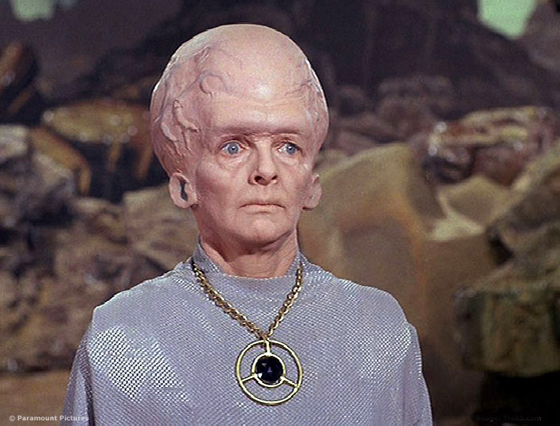
All this spring, my son Connor and I have been watching of the original Star Trek on Netflix. Connor likes the original shows almost as much as The Next Generation, and even I find myself getting caught up in some of the more classic episodes like Space Seed (the one with Khan). I also really like the pilot, The Cage. That’s the episode where Jeffrey Hunter is Captain Pike, trapped on a planet run by bubble-headed alien telepaths who throw him in a zoo with the luscious Susan Oliver. (Poor bastard.)
As we watched this particular episode—Connor for the first time, me for the bazillionth—it occurred to me that the Big-Brained Alien is one science fiction trope that has pretty much disappeared. As far as I can tell, it has gone the way of the jet-pack and the glass-tube elevator. This dearth of chrome-domed alien baddies is just another indication, I suppose, of how much things have changed. Back when I was a kid, every extra-terrestrial was guaranteed to have a skull like a beach ball. Even the wise, Christ-like alien Klatuu from Robert Wise’s The Day the Earth Stood Still had a big head (although this was probably no one’s fault—Michael Rennie just had a big damned head!).
Remember those aliens who want to invite all of humanity over for dinner in the classic Twilight episode, To Serve Man? Huge heads. Or the killer vegetable alien in The Thing. Huge freaking head.
As to how this visual cliché came about in the first place, I can only assume it was because of Anthropology class. Specifically, all those anthropology classes that educated, middle-class kids started taking in college during the Cold War. For the first time, ordinary people began to learn about human evolution, and how the human brain has tripled in size during the last two million years. The implication was obvious. Bigger brains means bigger intellect. To extrapolate this trend into the future led to the obvious conclusion: beings of the future will have enormous brains.
In other words, the original Big Brained Alien is…us.
This Thursday will mark the six-year anniversary of Chris Cornell’s death, and I am still pretty messed up about it.
Apparently, his friend Alice Cooper referred to him as “The Voice,” a moniker that, as some students of pop culture might recall, was also given to Frank Sinatra, back in his day. It makes sense. Cornell was my generation’s Sinatra.
Actually, with his four-octave range, Cornell was my generation’s Freddie Mercury. Whoever you compare him to, he was a genius, not just for his voice but for his ability to make you feel something, to strike deeply at some hidden spot in the soul. Like the other two titans of the grunge era, Kurt Cobain and Eddie Vedder, Cornell’s singing made you feel unhinged, as if he was doing the hard work of going mad so that you didn’t have to. Only more so.
Anyway, here’s one of my favorites from Soundgarden…
I am continually amazed at how, even in my advanced middle-age, I still encounter perfectly reasonable words that I have never seen before. The latest is panentheism, which I ran into while reading an article on my favorite theological scholar, David Bentley Hart. When I first saw the word, I read it out loud to myself: pan-en-theism. Theism I knew. That’s the belief in a God who created the universe and who participates in its functioning. Pantheism I knew. That’s the belief that nature and God are the same thing. (I.e., the universe is God; this is pretty much the idea behind many Eastern religions.)
But panentheism? WTF?
David Bentley Hart
It turns out that panentheism is a pretty old idea, too, although the term itself dates only to the 19th Century. Panentheism states that God created the universe but also transcends the universe. Basically, the universe (heck, make that the multiverse) is a manifestation of the mind of God. It exists inside God, but it is not the same thing as God.
Unless you’re an atheist (which is cool), you might be scratching your head right about now and saying “duh!” If so, that means you were probably not raised in an orthodox Christian or Jewish tradition, which, in the mode of classical theism, states that God created the world out of nothingness, and that God is inherently separate from (external to) the world.
As modern, post-Star Wars (read: “the Force”) Americans, we tend to have a belief system much more in line with eastern traditions. Namely, that God is everywhere and everything. But that is not what classical, western, old-time religions teach.
Since I’ve learned about panentheism, I’ve found it an increasingly seductive idea. It merges the inclusive spirituality of pantheism with the belief in a personal, transcendent god that is more familiar to western theists. It also has implications to the concepts of God’s participation in time and to human free will.
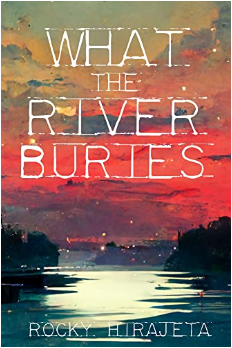
Two mysteries lie at the heart of Rocky Hirajeta’s fine novel. The first regards the identity of a killer, whom the protagonist, high school senior Natalie, witnesses disposing of a body in the river. But there is a deeper one, too, concerning the emotional and spiritual rut in which Natalie finds herself stuck after the death of her father. Not only is Hirajeta’s book beautifully written, it also captures the sense of desperation and longing that many YA novels miss.










 Ash Clifton, Writer