Classic Sci-Fi Book Cover: “Childhood’s End”

When I was in high school back in the early 1980s, Arthur C. Clarke had already been a legend for decades. He was, in fact, one of science fiction’s “Big Three” writers, along with Isaac Asimov and Robert Heinlein.  And so, the reprints that Del Rey books released of Clarke’s catalogue were especially clever in their cover art. Created by commercial artist Stanislaw Fernandes, they were minimalist, glossy, and retro (even then). In fact, they were almost art deco in style, somehow managing to suggest the “classic” quality that Clarke’s work had attained. After all, if people already know the author’s name, you don’t really have to “sell” the story itself.

My favorite cover from this line was for Clarke’s best novel, Childhood’s End. I love how it only details two objects: the U.N. building in New York, and the giant flying saucer hovering over it. (This isn’t a spoiler, really, since it happens in the first chapter.)

It’s a very simple cover, yet somehow evocative and beautiful. I especially like the little trident (or is that a pitchfork?) that sits atop the saucer. (I would reveal the significance of this in the story, but that would be a spoiler.)

What I’m Reading: “What Meets the Eye”

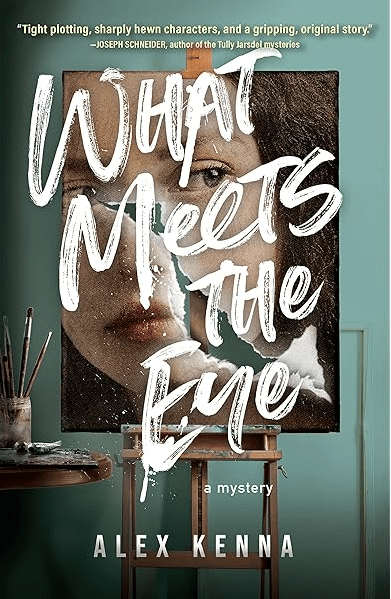
One can hardly imagine my admiration and delight as I read Alex Kenna’s fine and refreshingly original novel, What Meets the Eye. One thing that sets this book above—far above—the vast majority of mysteries is the symbolic connection it draws between two central characters–a cop-turned-P.I. named Kate Myles, and a brilliant artist named Margot Starling. Kenna sets them up as linked opposites, each a very smart and driven woman struggling to succeed in a dangerous (and largely male-dominated) world. Both are driven by a deep outrage at the injustice they see around them. And both have some dark history. 

Ultimately, of course, Kate and Margot are connected in a different way: Margot becomes the victim of a murder, and Kate is hired to find her killer.

Very seldom have I seen a mystery novel that attempts multiple points-of-view, and never with such skill. Kenna bounces back and forth between past and present, giving the reader before-and-after clues as to what, exactly, befell Margo, even as Kate unravels the mystery. It’s a very fresh and compelling technique. I also really enjoyed the surprising and original insights the novel offers about both women’s realms: the art world for Margot, and the law enforcement world for Kate.

But the real triumph of this book, for me, is Kate herself. It’s her book, and she’s a great character. Funny, smart, earthy, and fearless, she gives the reader an unequivocal here to root for. Yes, she’s done some questionable things in her past (she had a bit of an opioid habit), but she’s a devoted mother and a driven seeker of truth. She makes a great, new entry in the cannon of classic private detective heroes. 

(Cheapskate’s note: Right now, there is a steal-of-a-deal for this book on Amazon. (No, I don’t get a kick-back. I wish!))

Check it out…

“Twice the Trouble” Book Launch

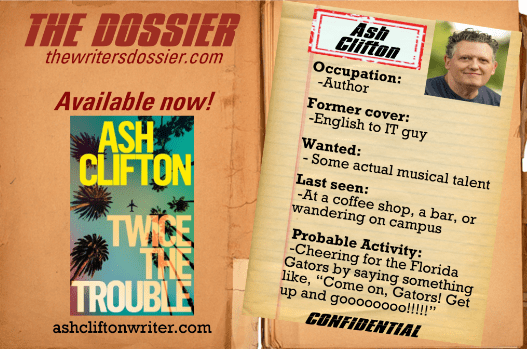
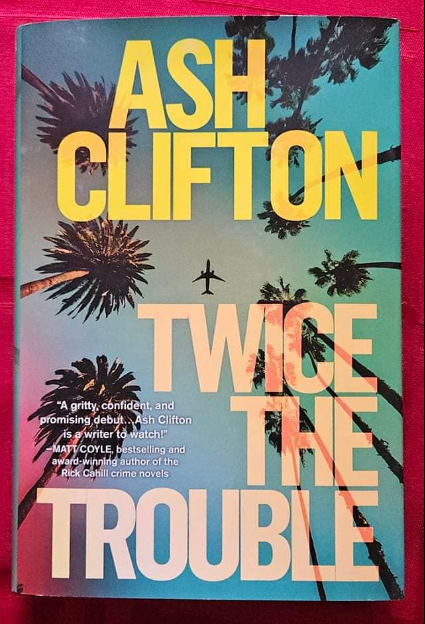
Well, it finally happened—my first novel, Twice the Trouble, is now out in the world.

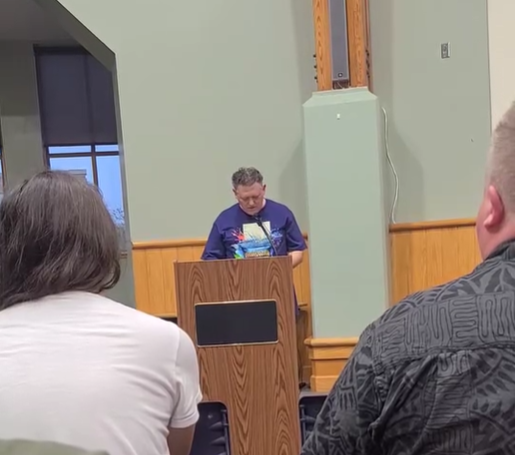
I gave a short (but probably not short enough!) reading at the Alachua Country library, after which we all retired to the fine Cypress & Grove brewery here in Gainesville for beers and pizza. Not a bad evening, I must say. 

Big thanks to my brother Colin and my great friends Cindi Lea, Laura Fitzpatrick, Bill Cellich, Rhonda Reilly and many others for helping make my launch event a success.

“Wide Sargasso Sea” — Part 2 of 2!!!

In this episode, Ash and Margaret finish-off Jean Rhys’s classic 1967 novel, “Wide Sargasso Sea.” Also, Margaret explains the Manic Pixie Dream Girl trope to Ash, while Ash considers how “Wide Sargasso Sea” might have been improved if the main character had known Kung Fu.

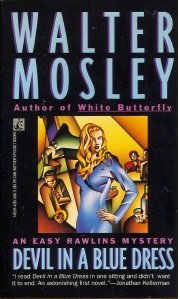
What I’m (Re-)Reading: “Devil in a Blue Dress”

Like a lot of people, my first exposure to Walter Mosely was when I saw the 1995 film adaptation of his novel, Devil in a Blue Dress, starring Denzel Washington. It’s a good movie, with fine performances by Washington and Don Cheadle, but it didn’t inspire me to seek out Mosely’s fiction. As far as I knew, he was just another solid mystery writer, one of many whom I hadn’t read.

Sometime later, I bought a copy of The Best American Short Stories and I was surprised to see a story by Mosely among that year’s selections. The story is called “Pet Fly” and it’s a deceptively simple tale of an office grunt (who happens to be black) trying to keep his integrity while working in modern corporate America. I was knocked-out by it. Later still, I stumbled upon an actual novel by Mosely, a science fiction work called The Wave, which turned out to be one of the best novels (sci-fi or otherwise) that I had read in years.

Continue reading “What I’m (Re-)Reading: “Devil in a Blue Dress””

Today I Learned a Word: Extremophile

Recently, I stumbled upon the Wikipedia page for panspermia—a concept I was already familiar with, relating to the theory that life on Earth might have originated from an external source. Specifically, a primitive microorganism might have landed here on a meteorite (or, in some versions of the theory, on an alien probe).

While reading about panspermia—a theory that has gained a lot of scientific traction in recent years—I encountered a term I hadn’t seen before: extremophile. It refers to  “a microorganism, especially an archaean, that lives in conditions of extreme temperature, acidity, alkalinity, or chemical concentration.” In other words, a really tough bug. Tough to live in the deepest of the ocean, or even in the earth’s mantle.

Recently, I stumbled upon the Wikipedia page for panspermia—a concept I was already familiar with, relating to the theory that life on Earth might have originated from an external source. Specifically, a primitive microorganism might have landed here on a meteorite (or, in some versions of the theory, on an alien probe).

While reading about panspermia—a theory that has gained a lot of scientific traction in recent years—I encountered a term I hadn’t seen before: extremophile. It refers to any microorganism that has evolved to exist in an environment so extreme that most other life would be prohibited. Examples of such environments are hydrothermal vents, salt-ridden lakes, and frozen ice sheets.

Or, perhaps, outer space.

AndromedaStrain

Apparently, the concept of extremophiles—and of panspermia, in general—has taken on new relevancy in the past ten years. Even as we find more and more exoplanets (the most recent count is around 2,000), we have yet to find a single sign of life, intelligent or otherwise. This has led some cosmologists to adopt the so-called Rare Earth Hypothesis, which stipulates that while earth-like planets are a dime-a-dozen, actual Earths—that is, planets with life—might be fabulously uncommon. In fact, there might have only been a few in the early universe, from which all the other life-bearing planets were seeded. This could happen either accidentally (from asteroids; hence the extremophiles) or intentionally (from aliens deliberating spreading life across the galaxies).

All this speculation struck a chord with me. For one thing, it took me back to my youth, to all the sci-fi books and films I consumed. The idea of alien invaders taking the form of germs or seeds goes all the way back, I think, to Jack Finney’s classic The Invasion of the Body Snatchers, in which the evil “seed pods” are actually alien weeds that travel from planet to planet on the solar wind.

Continue reading “Today I Learned a Word: Extremophile”

Read a Classic Novel…Together!!!

My great friend Margaret Luongo and I just released the premier episode of our new YouTube Channel, Read a Classic Novel…Together. In this series, we tackle classic novels that we’ve been meaning to read forever, and we invite the viewer to read each chunk along with us. (We try not to read ahead, but do anyway sometimes. Sorry.)

For this first episode, we take on Part I of Jean Rhys’s Wide Sargasso Sea. Check it out when you can.

What I’m Reading: “The Big Goodbye: Chinatown and the Last Years of Hollywood”

BigGoodbye

Anyone who follows this blog knows that my two primary obsessions are movies and history. So, you can imagine my excitement whenever I encounter that rare intersection of these two interests: a well-written film history book. And, still further within this category, there is the vaunted production-of-a-classic-movie book, which is a special favorite.

The supreme example of this sub-sub-sub-genre is Mark Harris’s Pictures at a Revolution, which recounts the making of not one film but four, all of which marked the changing nature of Hollywood—and America—at a specific moment in time, 1967. But if Harris’s book is the touchstone of this subject,  then Sam Wasson’s The Big Goodbye: Chinatown and the Last Years of Hollywood is a very close second. Put simply, I enjoyed the hell out of it.

Where Harris’s book describes the making of four movies, Wasson’s reveals the making of four men, the principal creators of Chinatown. These were the producer (Robert Evans), the screenwriter (Robert Towne), the director (Roman Polanski), and the star (Jack Nicholson).

Continue reading “What I’m Reading: “The Big Goodbye: Chinatown and the Last Years of Hollywood””

“I’m Probably Wrong About Everything” Podcast Interview

Many thanks to Gerry Fialka for interviewing me on his great podcast. I have no idea why he thought of me, but I’m glad he did. It was fun.

Yes, my lighting sucks. I’m working on it. Check it out anyway, pls…