A lot of movies have been made about a so-called eco-apocalyse, in which catastrophic climate change, or pollution, or crop-failure, or overpopulation, or some mixture of all-of-the-above wipes out big swathes of humanity. And some of those scenarios might yet play-out if we keep sleepwalking (make that speed-walking) into the future.
Smithsonian Magazine
Right now, however, environmental issues are manifesting in unexpected and almost mundane ways. Take house insurance. Here in Florida, frequent and more-powerful hurricanes are driving up premiums to insane levels. It’s the same along the gulf coast of Mississippi and Alabama. And a friend of mine from Texas told me the same thing is happening there (flooding is the disaster-de-jour, in his neck-of-the-woods). And then we have electric bills. Each year, increased demand for electricity (for air-conditioning and, now, frickin data centers) is driving up the cost of utilities. And what about clean drinking water? Near-constant drought (punctuated by hurricanes) makes it difficult to provide clean drinking water to growing populations in some parts of the country. This leads more people to buy bottled water. In parts of Mississippi, you will see everyone buying huge flats of the stuff from Wal-Mart, leading me to believe that bottled water is the primary of hydration for many rural Southerners.
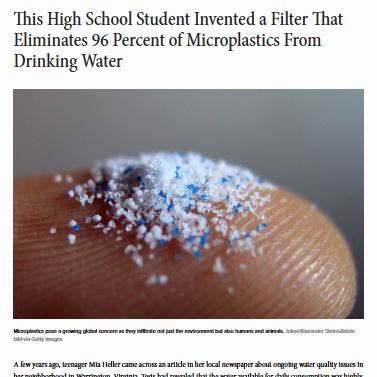
So, whenever I run across a news story like this one about a small, ingenious invention of the sort that might—just might—help get us out of this mess, it warms my heart. And even more so when the inventors are young people. In this case, seventeen-year-old Virginian Mia Heller came up with a new, cheap, reliable way to filter microplastics from water. Her system is based on a type of nanoparticle-infused oil called a ferrofluid, which basically pulls the microplastics out of the water like a magnet. The oil is reusable and easy to make.
Will this invention take off? Will it scale? I don’t know, but it gives me hope. I often think of how the great Nazi Wehrmacht was defeated, in part, by clever G.I.s from America, some of whom came up with the clever idea of mounting a phone on the back of their tanks. With this phone, a ground-trooper could speak directly with the guys inside the tank and tell them where to shoot and move. It was the kind of simple, “no-brainer” innovation that the Germans, with their rigid class system and demoralized population, never came up with. And it helped win the war.
Climate change and pollution are Ms. Heller’s generation’s World War II. And I’m really hoping that smart people like her can figure out a way to save my generation’s collective butt.
Have you ever noticed that, at any given time, the tech bros and sci-fi nerds of the world are obsessed with one current, real-world technology. Right now, it’s AI. A few years ago, it was cryptocurrency. The topic itself changes over time, but whatever it is, they can’t stop talking about it.
I’m a bit of a nerd myself, but I must confess that I was never much intrigued by cryptocurrency, and I am only mildly interested in AI. Rather, my technological obsession is the same as it was when I was in high school: controlled fusion energy, a.k.a. fusion.
Fusion was a staple of almost every sci-fi book of the 1970s and ‘80s in which space travel or future civilization was described. Heck, even Star Trek’s U.S.S. Enterprise uses fusion to power its impulse engines. That’s why nerds of a certain age were so bewitched by the idea, and we still are.
But the idea itself isn’t science fiction—at least, not for much longer.
Fusion’s potential as the ultimate, clean power source has been understood since the 1940s. The required fuel is ubiquitous (basically water), the radioactive waste negligible (much lower volume and shorter-lived than fission waste), the risk of a meltdown non-existent (uncontrolled fusion reactions don’t ramp-up; they snuff-out), and the maximum power potential unlimited (fusion literally powers the stars).
The very idea of a world powered by clean, cheap fusion energy is enough to make a nerd’s eyes twinkle. (Well, this nerd, anyway.) No more oil wars. Fossil fuels would be worthless. We could use all the extra power for next-gen construction, manufacturing, water desalination, enhanced food production, and on and on and on. Best of all, we could start actively removing all the CO2 that we’ve been pumping into the earth’s atmosphere for 300 years.
Of course, a good bit of that power windfall will probably go to AI data centers, whose appetite for energy seems insatiable. And growing. Whatever your feelings are regarding the AI revolution, it is going to be one of the most important, disruptive, and consequential developments of human history, second only to the invention of the digital computer.
We’ll need fusion to power it.
So, I find it pleasingly ironic that AI might turn out to play a role in the mastery of fusion energy itself. I learned of this from an article on the World Economic Forum’s website, entitled “How AI will help get fusion from the lab to the grid by the 2030s”. To grasp the gist of the article, however, one should first understand how incredibly, maddeningly, ridiculously difficult controlled fusion is.
Fusion works by pressing atoms (of hydrogen, usually) together at enormous pressure—so enormous that it can overcome the mutual repulsion of these atoms and cause them to fuse and form a bigger atom (helium), while “sweating” a photon or two in the process.
This photon sweat is the bounty of the fusion energy, and it’s YUGE. Unfortunately, the process of squeezing a hydrogen plasma into a tight enough space for a long enough period of time at millions of degrees Celsius, without it leaking out the side or, worse, squirting off into the walls of your reactor and melting everything, is damned hard. You remember those prank spring snakes that pop out of a can when you open a lid? Imagine cramming a billion of those snakes into a can the size of a thimble and you’ll have some idea of the challenge.
Taming a fusion plasma is so hard, in fact, that it well be one of those hyper-intensive tasks mere human beings—with our leaden reflexes, sluggishly throwing switches and pushing buttons—might not be able to manage.
For an analogy, I often think of the F-117 Nighthawk, the first true “stealth” bomber produced back in the 1980s. The Nighthawk didn’t look like a regular airplane because it wasn’t a regular airplane. Rather, the distinctive, saw-tooth pattern of its wings and fuselage, which was the essence of its radar-evading design, made it look ungainly. And, indeed, it was ungainly, so much so that no human pilot could fly it unaided. Instead, an on-board computer was required to make constant corrections, microsecond by microsecond, to keep the plane in the air and on target.
Controlling a nuclear plasma is, I suspect, a lot like flying a stealth-bomber; constant corrections are needed to keep the fluid stable. And they need to happen much faster than a human being can comprehend, no less attend to.
Enter AI.
As we all should know by now, you can teach an AI how to do almost anything—including (we hope) how to maintain a fusion plasma. As the article I mentioned above explains, a partnership has been created between the private company Commonwealth Fusion Systems (CFS) and AI research company Google DeepMind to do just that. One of the more notable achievements of this partnership so far is the creation of a fusion plasma simulator called TORAX, which could be used to train an AI.
Of course, I have no idea if this partnership will turn out to be fruitful. For that matter, I have no idea if we will ever, truly, crack the fusion code once and for all. But I think we will. And I’m not alone. As one expert, Jean Paul Allain, states in the article, “Fusion is real, near and ready for coordinated action.” In other words, fusion might soon be a real thing. For this reason, capitalists have caught the fusion bug and are funding dozens, if not hundreds, of related start-ups, including CFS.
In some ways, this fusion mania is reminiscent of the very earliest days of aviation (way earlier than the Nighthawk). Back in 1908 or so, there were literally hundreds of amateur aviators in Europe, desperately trying to master the trick of powered flight. Many of these enthusiasts were smart, self-funded, and brave. But their craft were not much better than cannonballs with wings, unable to turn or steer, or even stay in the air for very long. Sure, they had all heard rumors of a possible breakthrough that might have been achieved by those bicycle-shop boys, the Wright brothers, over in the U.S., but no one knew exactly what had happened. And they certainly hadn’t seen the proof.
At an exhibition in Le Mans, France, Wilbur flew his and Orville’s latest model over the famous racecourse, remaining in-flight for a full one minute and 45 seconds. More important than the duration, though, was the fact that he could steer the airplane, demonstrating banked turns, climbs, and dives.
Three years later, he flew a newer model over the same racecourse for 31 minutes and 25 seconds.
The world had changed.
The same kind of progression is now happening in fusion. In 2024, Korea’s KSTAR tokamak sustained plasma for 102 seconds. In February of 2025, the WEST in France sustained a plasma for 22 minutes. Each year or so, the record gets longer, and the plasma becomes more stable. And all this is happening before the ITER mega-reactor has even come on-line (as it is expected to do this year).
One of these days, fusion is going to take off and never land.
In his amazingly good sci-fi novel, The Peripheral, William Gibson describes a environmental cataclysm called The Jackpot. The name is perfect, in that it evokes not a single-cause catastrophe but rather a horrific alignment (like the diamonds on a slot machine) of multiple ones. Global heating. Drought. Pollution. Pandemics. Poverty. Et cetera.
But, as is ruefully noted by the protagonists of Gibson’s novel, The Jackpot hit at almost the same time as a technological revolution (actually several revolutions) that might have avoided it. Geoengineering. Nanotechnology. Artificial Intelligence. Fusion power. Genetic engineering.
All of these fields are exploding, right now, in the early 21st Century. That’s why I’m guarded optimistic about humanity’s chances of surviving the next fifty years. (Note that I said “surviving”; it’s going to be incredibly challenging, and will involve great suffering and sacrifice.) Many environmentalists scoff at this kind of optimism. There is no technological silver bullet, they warn, that will get us off the hook.
And, of course, they’re right. There is no big silver bullet. But there might be a lot of small silver bullets that, if aimed precisely (have I tortured this metaphor long enough?) might at least blunt the looming crisis.
After all, we’ve been here before. In the mid-20th Century, scientists were warning that current agriculture techniques would not be sufficient to feed the booming post-war population of Earth. A global famine was almost inevitable. But it didn’t happen. Why? Well, in a word, we innovated our way out of it. Improved science resulted in the so-called Green Revolution, which allowed farmers to feed millions more people on the same amount of arable land (which they continue to do to this day).
So, I like to collect articles about possible new “revolutions” that might help us survive, and even thrive, in this century. Here is an article for The Guardian about how scientists are manipulating natural enzymes to break down plastic into basic nutrients (i.e., food). Yes, plastic into food. Will it pan out? Will it be scalable? I don’t know. But it gives me hope.
Recently I was enjoying a long-distance phone chat with an old friend of mine, and the conversation turned, as it inevitably does, to the weather. She lives in Ohio, I live in Florida, and yet our answers to our respective inquiries about “How’s the weather where you are” were identical: Hot AF.
Fortunately, scientists like David Keith have been telling us for years that we are not helpless in the battle against climate change. If worse comes to worst, for a few billion dollars we could deploy specialized aircraft to release particles of sulfur (or some more exotic material) into the upper atmosphere, thus reflecting enough sunlight back into space to cool the planet very quickly. Of course, as professor David warns, we have a poor grasp of what possible, global side-effects such a radical course of action might have (although one one wonders if these side-effects could be any worse than a Canada-sized wildfire or a continent-wide heat-wave in India). It is precisely because of these unknown side-effects, he explains, that we need to start thinking about the problem now, with a clear head.
Along these lines, one of the strangest—and yet most encouraging—options to the “solar dimming” set of possible mitigation strategies is the idea that we might blast moondust into outer space. Yeah. For real. This dust, if aimed properly, would linger in one of the Lagrange points between the earth and the sun and, for a time, reduce solar radiation falling on the earth’s surface. The effect would be short-lived due to solar wind blowing the dust away into interplanetary space, but this is a good thing in that the technique would thus be throttleable. We could blast as much as or little dust as needed to cool the planet without plunging it inadvertently into a new ice age. (Have you seen that movie SnowPiercer?) Also, unlike the sulfur-in-the-sky option, the lunar dust wouldn’t contribute to air pollution or acid rain here on earth.
Obviously, the notion that we might somehow shoot lunar dust into space on a routine, industrial scale seems like science fiction. But is it? The space agencies of many nations such as the U.S., China, and Japan have planned future missions to the moon. One can imagine a gradual infrastructure of settlements, supplies, and equipment gathering on the moon over time, much as one formed in the American West in the 19th Century. One could presumably build some kind of mass-driver or rail-gun that could shoot the dust into space, and power it with solar energy. (Extra power could be stored during the two-week long lunar “day” to keep the gun shooting during the “night”).
How much would such a setup cost? Billions? Trillions? On the other hand, how much would it cost to rescue two-hundred million people from Europe if the Atlantic thermohaline circulation is disrupted, as some scientists predict it will? Or to build sea-walls around New York and Miami and San Diego and every other major coastal city? Or to feed South America if the crops there dry up during the next heat wave?
It’s time to think outside-the-box, people.
If worse comes to worst, we shouldn’t rule out going back to the moon. And building a huge cannon there. Or anything else we have to do to cool off the planet.
Here is the original article on SingularityHub where I learned about this idea:
Even though I live in Florida, I am guardedly optimistic about our chances of surviving (I almost typed weathering–HA!) the global warming crisis. New green technologies are being created everyday, and the ones we’ve already got have to the potential to completely transform the world.
Here is a recent, positive article from one my favorite websites, Inhabitat.com.


 Ash Clifton, Writer