Back in the dot.com boom of the 1990s, I was lucky enough to work for an IT company based in New York City. I was a remote worker, writing software eight hours a day in my spare bedroom in Gainesville, Florida. It was a win-win situation. I got to work from home, and my bosses got a good developer for country-boy wages (and I was still in the same time zone).
Occasionally they would fly me to the city for a meeting and I would spend my evenings wandering the streets of Manhattan, which is surely the most beautiful and bewitching cities of the earth. My favorite spot is the Met. Like a lot of introverts, I love museums, and the Met is the greatest of them all. I mean, how many museums have their own Egyptian Temple? Indoors?
Once I spent an entire weekend roaming its halls, barely scratching the surface of its vast collections. I tend to gravitate toward the Modern period from the early- and mid-twentieth century. From guys like Matisse and Picasso all the way to Hopper and O’Keefe.
From a historical perspective, my interest stopped after that. I never much got the whole Post-Modern thing—Abstract Expressionism and all that. It seemed too theoretical. A joke that high-brow art critics had played on the rest of us, as Tom Wolfe wrote so wittily in The Painted Word.
I have a confession to make: I love concrete architecture. I know, I know. Concrete Architecture (CA, for short) is not fashionable. It’s not renewable (not yet, anyway). It’s not touchy-feely. It’s not cool.
Part of the bad-rap CA has is due to its association with brutalism, the quasi-Soviet style that was popular in the 1970s, especially in England. Brutalism is cold. Windowless. Dystopian. Think 1984. A Clockwork Orange. Total Recall. Et cetera.
Obviously, that’s not the type of CA that I’m talking about. Rather, when I think of great concrete architecture, I think of buildings that mix smooth, rectilinear slabs of stone (that’s all concrete is, after all—artificial stone) with glass and other construction elements. When built to a more human scale, and combined with greenery and organic decoration, CA can be soothing. Symmetrical. Ordered. Neat. Human.
I keep thinking of that scene in Lawrence of Arabia when a reporter asks Lawrence, an Englishman, why he loves the desert so much. “Because it’s clean,” he says. His answer resonates on many levels: literal, moral, political, and philosophical. That’s sort of why I like CA. It’s clean. It’s calming.
Salk Institute – Louis I. Kahn, Architect
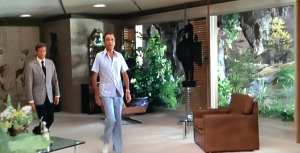
I think my first exposure to CA was from movies. Specifically, James Bond movies. There’s Willard Whyte’s desert mansion in Diamonds Are Forever (actually the Elrod House in Palm Springs by John Lautner). Then, in The Man with the Golden Gun, there’s Scaramanga’s secret lair, carved into the rock of a volcanic island. Almost every male nerd has a secret fantasy of being a Bond villain (or, at least, of having a Bond villain’s lair). What could be cooler for a bookish, introverted, probably asthmatic kid than to have his own secret, clean (pollen-free) hideout where no one, not even MI6, can find you?
Which brings me to my main point. Introverts of both sexes have a fondness for CA because we associate it with solitude, in a good way. After all, the only real experience with CA that most of us have is from public spaces—libraries, museums, research centers, etc.—whose sense of empty space is soothing to introverts (who tend to have too much internal stimulation).
So it’s no surprise that the ultimate fictional incarnation of CA would be owned by the ultimate fictional nerd, Tony Stark. His mansion in the Marvel MCU is a Lautner-esque swirl of concrete perched on a California cliff over the Pacific. The mansion is the epitome of the Bond-villain/mad scientist aesthetic. Stark, who seems to be a selfish lout but is actually psychologically damaged by the remembered death of his parents, is free to be alone in the mansion’s cavernous rooms, jammed with post-modern decorations and transhuman technology. Stark doesn’t need a human heart; he has a mechanical one, powered by cold fusion. It can’t be broken.
So, what does it say about me that I like CA so much? Basically, it says that I am an unreconstructed nerd, who likes things clean and controlled. Oh, well.





 Ash Clifton, Writer