I was surfing the YouTube this morning when I stumbled upon this really cool video essay about the (diminished) immersive experience of modern films as opposed to old, classic ones. The author echoes some of the ideas I sketched out in a similar post from a few years ago called Whatever Happened to Open-Form Films?
Please check-out the video and the post if you are interested.
Many thanks to Cara Putman for interviewing me on her excellent Book Talk podcast. She’s a great writer and interviewer and I’m very grateful. Please check it out.
Me with Danni and Michelle of the BCAD Podcast at the Barnes & Noble on Colonial
Well, Cathy and I got back from Orlando on Thursday, and this is the first chance I’ve had to write a post about it. All in all, it was a fine trip! My book talk at Barnes and Noble went well, mostly due to Danni and Michelle, the hosts of the excellent podcast Book Club After Dark, who were nice enough to interview me. They asked great, insightful questions, and I had a lot of fun. The turn-out was modest, but the people who did show up seemed really interested. They asked some great questions, too. It was especially nice to see my old friend Norm, who came to the event to cheer me on. He also snapped the picture above.
Afterward, Cathy and I had a great dinner and some fine beers at the Harp and Celt Pub downtown. The next day, we did a driving tour of Orlando, Noland Twice’s home turf, refamiliarizing ourselves with our old stomping grounds. As one might expect, parts of the city seem completely different from when we lived there, while other parts seemed exactly the same. Overall, O-Town still feels like two cities. There’s the lovely, old, Southern city, with its tree-shaded streets and gorgeous houses from the 1930s and ‘40s. Then, there’s the litter-on-a-stick, urban sprawl of Generica, with its strip-malls and fast-food shacks and liquor stores. And traffic. Lots of traffic. The really sad part about Orlando is that you have to drive through the nasty bits to get to the nice, old, quaint bits. But oh well. I still love the city.
Catchup by the Pool by Slim Aarons (snapped from my phone in Orlando)
When we were done exploring, Cathy and I drove down Mills Avenue and visited the Mennello Museum of American Art, which is perhaps the best small museum I’ve ever visited. I was especially taken with their current exhibit, entitled Pool Party, which had lots of amazing photos and paintings of American pool culture from all over the country. I was especially taken with this 1970 photo, above, by former combat photographer Slim Aarons. It’s titled Catchup by the Pool, and it seems to encapsulate the entire upper-class, White, suburban culture of the U.S., right on the cusp between two equally garish decades. And yet, it’s also kind of…sweet. I find myself wanting to go to this party.
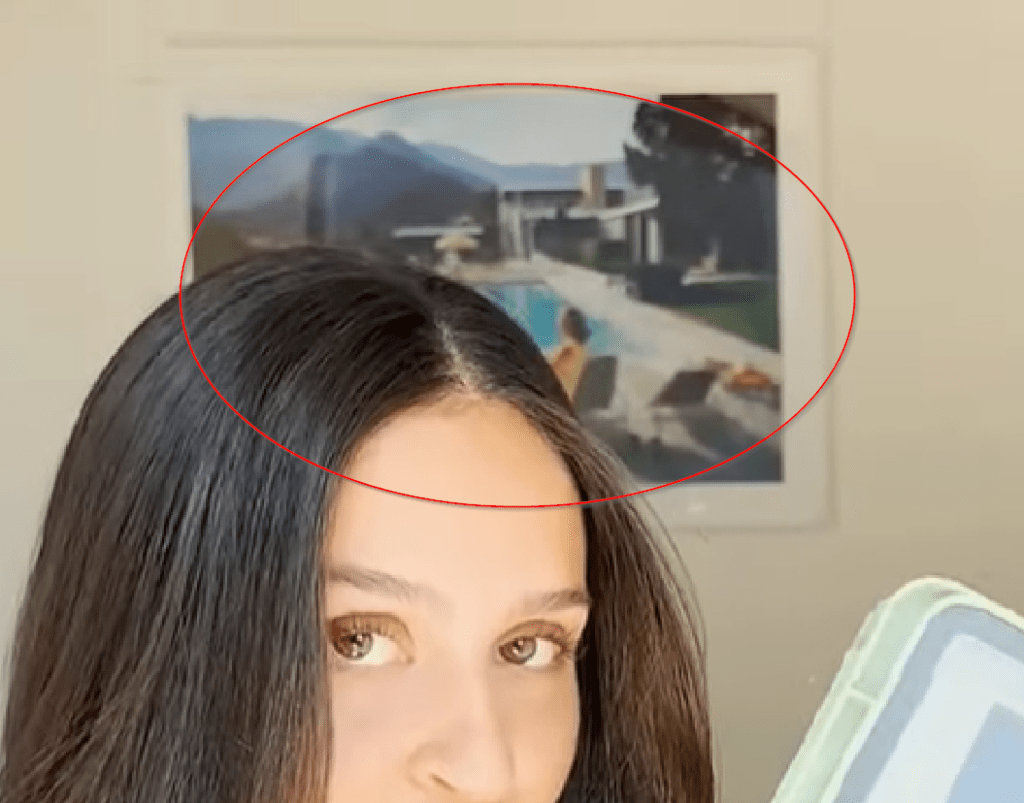
Screen Grab of a Random Speechify Ad from my Youtube Account
And then, just this morning, in one of those instances of synchronicity that seem to happen fairly often to me (and which I blog about, a lot), I happened to be presented with a YouTube ad (for Speechify, of all things). Before the skip button came up, I had to leave the room, so I paused the ad so I wouldn’t miss the beginning of the actual video I was waiting for. (Just to prove I wasn’t crazy, I did a screen grab, above left.)
When I came back, I noticed that there was something weirdly familiar about the freeze-frame that I happened to pause on. If you look at the background, on the wall of whatever apartment or motel room the ad was apparently filmed in, you can see—lo-and-behold!—the same photo by Slim Aarons.
What are the odds? Like, a bazillion-to-0ne! Talk about synchronicity-on-steroids!
Anyway, it seemed like a magical end to a good trip.
In this latest episode of our on-going YouTube series, Read a Classic Novel…Together!, Margaret and I go over the first half of The Dispossessed, Ursula K. Le Guin’s classic literary science fiction novel. We also address other topics such as was Communism doomed from the start, are flashbacks overused in fiction, and do New York City rats constitute their own, separate species?
I thought I would use this Fourth of July 2025 installment of my Friday Night Rock-Out series to celebrate one of the greatest triumphs of enlightened American capitalism: Schoolhouse Rock! The brainchild of ABC executive David McCall, the series ran on Saturday mornings during cartoon-time and was seen, enjoyed, and effortlessly memorized by millions of America kids, myself included. Even kids today will be somewhat familiar with the series—mainly because their Baby-Boomer and Gen-X parents made them watch it on DVD!
My favorite episode is Verb: That’s What Happening, which was performed with great soul by Zachary Sanders, along with a little help from The Pointer Sisters (allegedly). After fifty-odd years, it still hits.
If you were a nerdy poor kid growing up in the 1970s and ’80s, you probably watched a lot of public television. Starting with kid shows like Sesame Street and the Electric Company, you graduated in your teens to science shows like Nova and edgy entertainment shows like Monty Python and surreal action series like The Prisoner, which PBS stations played late at night.
As for myself, I also watched a lot of PBS news, especially The MacNeil/Lehrer NewsHour. And Bill Moyers. Lots of Bill moyers. If MacNeil and Lehrerwere the Kings of PBS news, then Bill Moyer was the high-ranking courtier. Moyers, who passed away last week, specialized in thoughtful and intelligent interviews with brilliant people of various stripes. As a would-be teenage intellectual, I really loved and appreciated these shows, and they introduced me to a lot of very smart artists, politicians, and writers. Chief among these was the iconic scholar of world mythology Joseph Campbell. Moyers’s now-famous interviews with Campbell, conducted at George Lucas’s Skywalker ranch (Lucas was inspired by Campbell’s writing when he penned the Star Wars saga), were probably the pinnacle of both men’s careers.
I’ve been a fan of Campbell ever since, and also of Moyers. A one-time Baptist preacher, Moyers was a gentle, kind-spirited man who never descended into sentimentality or fatuous optimism. He was, rather, a first-rate journalist. And God knows there are very few of those these days.
Moyers has been the subject of many on-line tributes in the past few days, including this one by the excellent historian Jonathan Alter.
Recently I chatted with my friend Jeff Circle on his excellent “The Writer’s Dossier” podcast. We discussed topics ranging from growing up in Gainesville to 80s music to crime fiction. I had a great time, even though I was slow to grasp the concept of “rapid-fire responses.” Oh, well. I’m getting old.
I have a confession to make: I dream about shopping malls. Specifically, one shopping mall, the Oaks Mall here in Gainesville.
The “Collapsed Time” Effect of Vaporwave
After my parents’ divorce, I saw my mother mostly on the weekends, and one of our routine activities was to go to the mall. We would have lunch, see a movie, and wander around. Later, when I got into my teens, I spent a lot more time at the mall with my friends. We hit all the usual spots—the arcade, both bookstores (Waldenbooks and B. Dalton’s), the record store, Spencer’s Gifts, the toy store. And we did anything else we felt like.
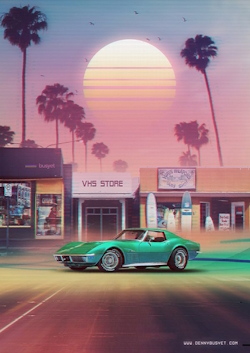
Trappings of the 1980s, along with “Broken Sun” motif
We weren’t alone, of course. After the collapse of downtown America, the mall was the last remaining public square. In suburban America, particularly, it was also the only fun thing to do on a Saturday afternoon. Or a Saturday night, for that matter. When I entered high school and started going on dates, we often went to a movie at the mall. One of my most vivid memories is of how strange and eerie the mall felt after the movie let out at 11:00 or so, and we would walk through the empty, dark hall with all the shops closed and metal gates drawn down. It was one of my first experiences of liminal space, and it sticks with me even today.
In fact, it haunts my dreams. Literally. For when I dream of the Oaks Mall now, I often find myself lost among its corridors near closing time, the wings still busy with shoppers but with the crowd starting to thin out, little by little. Stranger still, my dream-mall is huge—the size of Manhattan Island, practically. A gigantic labyrinth of brand-name stores, all of which are in the early stages of shutting down for the night. (My subconscious, I think, is warning me that the mall is shutting down forever.) These dreams often end in a sense of panic as I realize I am on the wrong side of the mall from my friends, or my car, or whatever, and I will never be able to reach them/it in time before…what? Closing? It’s not clear, but whatever it is, it’s kind of scary.
Despite the disquieting nature of these dreams—or perhaps because of it—I find myself endlessly fascinated by what has come to be known as the Vaporwave aesthetic. Vaporwave is primarily a visual genre, marked by artistic images of 1980s culture. That is, computer graphics, shopping malls, the Miami skyline (alaMiami Vice), fast food restaurants, music videos, video stores, and old-style video games.
And neon. Lots and lots of neon.
Empty Mall / Liminal Space Vibe Typical of Vaporwave
The overriding effect is that of a hyper-real fantasy that feels like a time-portal back to the 1980s. I love these images because they somehow evoke the memory of that long ago time, at least for me. More accurately, they evoke the feeling I wanted to have at the timebutcould never quite capture. The feeling of an endless, prosperous, fun, high-tech future.
I think that this is the real power of nostalgia. A wise man once defined nostalgia as a fondness for a Time that never existed. I don’t think that’s quite right. Nostalgia is a fondness not for a lost time but for a lost hope—the hope one felt and in a familiar place and a long-ago time. A hope that, though never realized, still lingers in the heart.
That sense of lost opportunity is, I think, reflected in the very name of the genre itself, vaporwave, which is very similar to vaporware, a term coined in the 1980s to mean great-looking software that was promised by advertisers and corporations but which never actually materialized. It simply evaporated.
The same thing happened to our collective dreams back in the 1980s. My friends and I all hoped that we could look forward to a glorious future, one better than that of our parents’ and teachers’ generation. A future that would be made bright by the many technological revolutions (the digital revolution, especially) that were impacting every aspect of our culture: movies, TV, music, art, games, fashion, and even books. The haunting images of vaporwave reflect that lost dream—rather than the sterile reality—of the 1980s and ’90s.
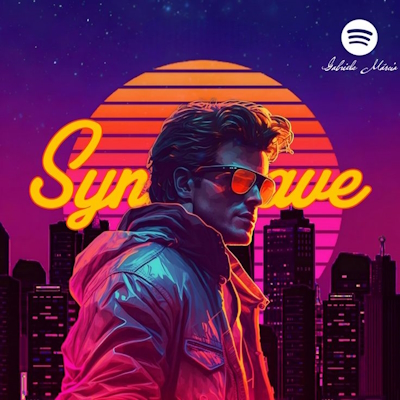
Many vaporwave images seem to have a psychedelic “collapsed time” feel to them, as did many of the music videos and computer-generated short films of that era. The hippie generation had the psychedelic flower as their symbol. We had the computer-generated sun—the so-called “broken sun”—which seems to have been pulled directly from of a film poster or a television commercial from 1982.
As attracted as I am to vaporwave, I am equally drawn to its parallel music genre, synthwave. Like vaporwave, synthwave is characterized by the early computer-era vibe, as symbolized in synthesized music. Not actual synthesized music from the 1980s, of course, but rather music that sounds a lot like it, yet is somehow drained of all melodrama and false tension that characterized synth-music back then. Synthwave has a kind of purity to it. A simple beauty that surpasses the actual music of that time.
In other words, synthwave is to actual 1980s music what Andy Warhol was to actual advertisements of the 1950s. His silk screen images of Campbell’s soup cans looked almost exactly like actual soup cans, but larger, stylized, more vivid. They made the world really see Campbell’s soup cans—the sublime nature of everything, even a mass-produced soup can—for the first time. Warhol’s genius lay in his ability to show us the beauty and promise of something that was once central and even commonplace in our lives, even as it mocked (lovingly) that very same thing.
That’s what vaporwave does, too. Through the alchemy of art, it somehow humanizes the relentless, corporate-controlled media barrage of the 1980s. For me, and millions of others like me, it is literally the stuff that dreams are made of.
Or were made of, that is. Back in the day.
Lo-Poly, Computer-Generated Background with Broken Sun
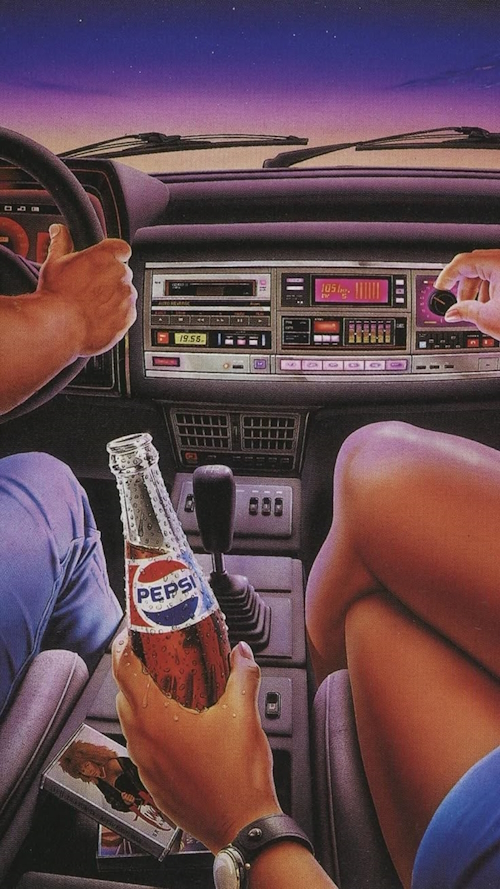
Blatent Consumerism of the 1980s, both celebrated and mocked









 Ash Clifton, Writer