Unless you’re over forty, or from the U.K., you’ve probably never heard of the great 80s/90s band World Party. It was the creation of a Welsh dude named Kurt Wallinger, who, like many other musical geniuses (Lindsey Buckingham springs to mind) wrote all his own songs, and made demo tapes by playing every instrument. Pretty cool, huh?
Back in 1986, this little gem came out. It had a bluesy, funky feel that was different from anything else on the radio at the time. Like a lot of great songs, it seems to exist on many levels. That is, it’s a warning about the future. More importantly, it’s just a great song.
Strangely, it did better in the U.S. than the U.K., where the band’s biggest hit was a haunting gem called “She’s the One.”
I finally moved out of my parents’ house when I was twenty-two, when I embarked on a cross-country move to Tucson, Arizona. I had enrolled in an M.F.A. program at the university there, and I arrived knowing not a single, living soul. Once I found a place to live and acquired a U-of-A ID card, I spent my evenings going to the small, student gym in the basement of the football stadium, where I and a few other lonely souls (all dudes) worked out until the lights went off.
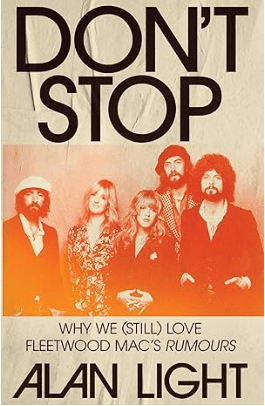
I vividly remember my first night at that gym. There were radio speakers in the ceiling tuned to the local F.M. rock station. That night, as it happened to be running an hour-long special devoted entirely to one rock album: Fleetwood Mac’s Rumours. The show included a few tracks off the album along with interviews with Lindsey Buckingham, Stevie Nicks, and Christine McVie. (For some reason, Mick Fleetwood and John McVie were left out.)
By this time, Rumours had already achieved legendary status of the sort afforded very few pop-music albums. (Sgt. Pepper’s Lonely Hearts Club Band is perhaps the only other.) Today, many years after that first night in Tucson, the album’s popularity and reputation has not diminished. If anything, it has increased. It’s gone from being a recognized artistic masterpiece to a timeless cultural colossus. As each new generation of music fans and musicians have discovered Rumours, an entire legendarium has been constructed around it.
Entire books have been devoted to the months-long, tortuous period in 1977 when the album was recorded. Two of the band’s members, John and Christine McVie, were in the midst of an ugly divorce. Two other members, Stevie Nicks and Lindsey Buckingham, were in the midst of an ugly breakup. And the remaining member, drummer and band leader Mick Fleetwood, was on the verge of breaking up with his famous wife, Jenny Boyd. The five members alternated between screaming obscenities at each other and slipping into effortless, soulful harmonies, all while drinking heavily and vacuuming titanic amounts of cocaine up their collective nose.
At one point late in the process, the album’s producer, Ken Caillat, was horrified to discover that the master recording tapes were literally flaking-out. They had been re-run through the mixing machines so many times that the metal-oxide strip was coming loose from the plastic, threatening to lose all the work he and the band had done. A technician from the manufacturer was flown in to manually transfer the recording onto a new tape before disaster struck.
In short, the fact that Rumours was made at all seems like something of a miracle.
I’ve been saddened by the deaths of many famous people, but only three genuinely depressed me. Like, for a good while. These were Robin Williams, David Bowie, and Dolores O’Riordan.
Everybody remembers the first two, and I would bet that many people shared my crestfallen reaction to those two deaths. But relatively few will recognize the third. Unless, that is, you were alive in the 1990s and listening to alt-rock.
I was in the early stages of a career at the time, writing code for a series of software companies, and I was always amazed at how many macho, tech-bros I met were also huge fans of The Cranberries, the band that O’Riordan joined when she was eighteen years old and soon made famous. The band’s first mega-hit, Linger, is also their best song. It displayed O’Riordan’s unique genius—her amazing, Irish voice, alternating between dreamy-and-angelic to fierce-and-vengeful. And the lyrics! Even as a teenager, she could really write! The song’s tale of a woman who has been deceived by the one she loves is sad but not sentimental. Never weepy. Rather, it surges forward with tremendous power.
But it was this song, Zombie, that proved how powerful the band—and O’Riordan—could hit. It’s a protest song, but like all good protest songs, it works both as a political statement as well as a kick-ass song. Some have called it the definitive grunge-rock song. I don’t know about that, but it’s damned good.
Interesting fact: The music video was partially filmed on the streets of war-ravaged Belfast. The kids (and the soldiers) are real folk, for better or worse.
Gainesville has a famous bar called The Salty Dog Saloon, across the street from the University of Florida and just two blocks away from Ben Hill Griffin Stadium. Back in the 1990s, I spent many an evening at The Salty Dog, shooting pool, drinking beer, and inhaling so much second-hand smoke that, as I soon discovered, I could smoke an entire cigarette without coughing, even though I had never officially taken up the habit.
The Salty Dog also had a great jukebox (maybe it still does). And, this being the height of the grunge era, my friends and I played a lot of Nirvana, Soundgarden, and Pearl Jam. Somehow, a joke started among us that the next Godzilla movie should be set in Seattle, where the great kaiju would be battled (and, no doubt, defeated) by the likes of Chris Cornell, Eddie Vedder, and Kurt Cobain.
It was a dumb joke, but it struck a chord. These guys were the superheroes of rock, cultural warriors that always seemed brilliant, dedicated, and brave. So, in 1993, when two of three, Vedder and Cornell, teamed up to form a super-group called Temple of the Dog, we should have been ecstatic. It was like Batman and Superman joining forces to fight evil (if not Godzilla).
In fact, the band—which was formed by Cornell as a kind of tribute to his late friend and lead singer of Mother Love Bone, Andrew Wood—made very little impact on us. Except for one song: “Hunger Strike.” For a few weeks, it was the practically the only thing on the radio (yes, we still listened to radio in those days). An unlikely duet between Cornell and Vedder, it shows off the vocal strengths of both men, whose voices complement each other in kind of harmonic unity not often heard in alt-rock (and especially not in grunge). I love how Cornell’s magnificent tenor soars high above Vedder’s mournful baritone, which seems to anchor it.
Somehow, through the alchemy of art, the song becomes less of a dirge than a jubilant cry of defiance.
Everything you need to know about alt-rock in the 1980s can be learned from listening to four bands: The Smiths, Echo & the Bunnymen, Siouxsie and the Banshees, and The Cure. I’ve featured all of these bands except The Cure, so it’s about time, especially considering that they were, in some ways, the most innovative and versatile of the four.
Most people know the song “Just Like Heaven“, and they should because it’s a masterpiece. But I love this song, too, because it’s so strange and powerful. With Robert Smith singing on the edge of his vocal range, his voice breaking and whinging like the embodiment of every teenage neurosis you can think of, “Why Can’t I Be You?” is the ultimate song about Nerd Love.
It’s also a great dance song. (Yes, a danceable goth-rock song. Who knew?) And the horn section is epic. (A goth-rock song with horns? Yes, again!)
I had never heard of Young the Giant until a few months ago, when this song, “My Body,” popped up on the playlist at my gym. I liked the groove so much that I paused my incredibly wimpy set of curls (“Hey, I’m going for tone, dammit. TONE!”), went to my locker, got out my phone, and Googled it.
The rest is history…
People have compared Young The Giant to The Cure, but they remind me more of Coldplay, but with more of a rock-edge (not to mention a bit more soul).
If you’re of a certain age (i.e., over fifty), you probably spent many a summer afternoon in the long-ago past listening to the 45 single of “Hotel California” over and over and over. (You might also have enjoyed a mildly illegal form of herbal, hand-rolled cigarette as you listened.) If you did, you’ve probably read a lot of articles about the song, and heard a lot of interviews by Don Henley or Glenn Frey or others about it, to the point that you probably think you know everything about it. You know, for instance, that Henley and Frey wrote the lyrics in a very short period of time (by some accounts, a few hours; by others, over a weekend). You know that the album cover is a photo of the Beverly Hills Hotel, and that some people think they see a mysterious figure in the bell tower. And you know that the song is really about Hell, or California-as-Hell, or American hedonism, or…something cool like that.
What you probably don’t know is that song is, primarily, the creation of guitarist Don Felder, who wrote the melody by himself before he even joined the band. As Marty Jourard recounts in his excellent non-fiction book Music Everywhere: The Rock and Roll Roots of a Southern Town:
One afternoon while enjoying his ocean view and no doubt the general situation, Felder sat on his sofa and idly strummed an acoustic twelve-string, eventually refining his musical idea into a carefully crafted guitar arrangement. Using a Teac four-track reel-to-reel recorder, Felder first recorded his Rhythm Ace drum machine playing a cha-cha beat, then added acoustic and electric guitar and bass, then an idea for two solo guitars. Don Henley listened to a cassette mix of this song and more than a dozen others Felder had submitted for consideration and declared this rhythmically complex instrumental the best, giving it a working title of “Mexican Bolero,” and along with Glenn Frey wrote lyrics that transformed Felder’s music demo into “Hotel California,” the title track of the next Eagles album and its first single.
It’s also Felder’s actual guitar playing, along with that of co-lead Joe Walsh, that gives the song its unbelievably haunting tone and its indelible, dark crescendo. I’m not just saying this because Felder, like his childhood friend Tom Petty, is a Gainesville boy like me. Felder is, in fact, one of the most underrated musician/composers in the history of rock-and-roll.
Of course, I don’t mean to denigrate Henley’s and Frey’s brilliant lyrics, gave the song its cachet among the teenage set of the 1970s (and now, even). One thing I’ve noted about “Hotel California” is that is one of those rare examples of a narrative poem (i.e., it tells a continuous story). Also, it’s written in ballad quatrains, with a rhyming scheme of ABCB. How cool is that?
And, yes, I do see a mysterious figure in the bell tower.
I must admit that I had never heard of Awolnation until a few years ago when my son played me a couple of their songs. This song, in particular, has a big, anthemic sound of the sort one doesn’t hear very often in alt-rock. I really like it. Even the soft parts sound really, really loud. And lead singer Aaron Bruno has the vocal range to pull it off without sounding like he’s screaming.
“Passion” is from Awolnation’s 2017 album Here Come the Runts. Rock on…
There have been a lot of great rock duos over the years—Hall and Oates, Tears for Fears, The White Stripes, David and David—but there haven’t been that many hard rock duos. I’m guessing this because you typically need a minimum of three musicians to form a hard rock band: a drummer, a bassist, and a lead guitarist. (One of those folks has to sing, too, obviously.)
The great British duo Royal Blood gets around this minimum by ditching the lead guitarist and having their bassist, Mike Kerr, do double-duty. On this little gem, which has become one of my favorites, he is actually playing a distorted bass that sounds like a lead guitar. (Jack White does the same thing on “Seven Nation Army“.)
The great comedian George Burns once attended an Alice Cooper concert, and he was impressed by all the crazy costumes, make-up, special effects, and over-the-top acting that made that artist famous. Later, he saw Cooper back-stage and told him “You’re the last vaudeville act.” He was right! Cooper was one the first artists to realize that great rock-and-roll can be…well…theater. Especially in its stadium-arena-sized version.
Another band that was quick to pick-up on the theater aspect of rock was Kiss, who hit the cultural pop-scene of 1970s like an earthquake. Yes, they were the silliest rock band of that era (perhaps of any era). Kind of like Spinal Tap, but even dumber. However, if you ignored the make-up and the pleather sci-fi costumes, you realized that Kiss was just a kick-ass, New York City rock-band, with tough-guy lyrics and hard-hitting musicianship.
Ace Frehley, their great guitarist, passed away yesterday. I thought I would dedicate this episode of my Friday Night Rock-Out series to him by posting my favorite Kiss song.

 Ash Clifton, Writer