Back in the early 1990s when I was a poor graduate student, I used to stay home on Saturday nights and watch my little black-and-white TV. I couldn’t afford cable, of course, but thankfully there was always PBS, so I watched a lot of documentaries and episodes of Great Performances. On one such night, I saw a filmed performance of Peter Brook’s stage play The Mahabharata. The play is, of course, a dramatic adaptation of the great Hindu epic, the tale of a feud between two groups of royal cousins, the Pāṇḍava princes and their arch-nemeses, the Kauravas. As epic tales are wont to do, the feud escalates into a civil war so catastrophic that even the gods are pulled into the conflict (in the same way that the Greek gods Mars, Apollo, and Venus involve themselves in the The Illiad).
Being a filmed staged play, Brook’s TV version is low on special effects (this was before CGI) but packed with minimalistic, highly-stylized interpretations of sweeping battles, multi-armed demons, and flying chariots. Somehow, it all works, and I found myself obsessed with both the film and the story. A few years later I would finally read a popular translation of The Bhagavad Gita, which is really just one portion of the much larger Mahabharata.
How often do you see a mainstream, broadcast news interview that covers so many nerd-worthy topics? This one has astronomy professor Janna Levin discussing Dyson Spheres, alien civilizations, sci-fi writer Olaf Stapledon, and Freeman Dyson himself.
Very few writers in history have had as big an influence on my imagination as Freeman Dyson. Not only did he come up with the idea (mostly) of a Dyson Sphere (which, in slightly modified form, became the inspiration for Larry Niven’s Ringworld novels), he always wrote visionary articles on space exploration, climate change, genetic engineering, the future of energy, and even E.S.P.
When I was an English major at the University of Florida, one of the best classes I took was a Survey of Science Fiction Literature course. It covered a lot of famous American and British SF, some of which I had already read as a teenager and some of which were new to me.
Looking back on it now, it occurs to me that two of the writers we read in the class were not only totally different from each other, they also presented two completely opposite visions of what we now call artificial intelligence. These writers were Isaac Asimov and Harlan Ellison.
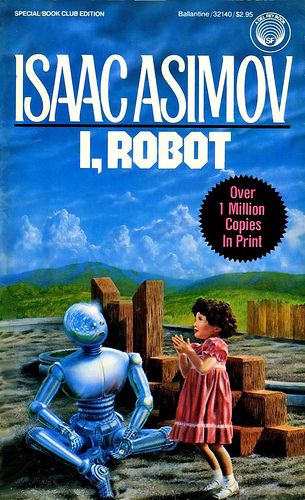
For Asimov, we read his early, seminal work, I, Robot. This is the short story collection that included his first formulation of the Three Laws of Robotics, which have been alluded to (i.e, ripped off) in countless other science fiction stories, including Star Trek. The book came out before the term AI became common parlance. Yet, in Asimov’s imagined future, the world is rife with robots that are essentially AIs with mechanical bodies. All of them have positronic brains (yeah, Star Trek ripped off this conceit, too) with the Three Laws hard-wired in. The result is that all robots function as humanity’s tireless, benevolent servants. (Some would say, slaves.)
Actually, they are much more than that. They can think, reason, and make choices. In fact, they have to make choices. The moral dilemmas created by the Three Laws as the robots interact with chaotic (and often evil) human beings is the source of drama in most of the stories.
Despite the mystery and drama of the stories, though, Asimov’s vision is a very optimistic, almost Buck-Rogers-esque idea of the future—not quite a utopia but close to it. There is no poverty, no hunger, no war. It’s only upon close reading of the stories in I, Robot that the exact nature of the master/servant relationship between humans and robots appears fraught—probably more so than Asimov consciously intended. This is especially true in a few of the stories, where it’s revealed that future governments are secretly run by the highest order of HAL 9000 style robots, whose plans might be beyond human comprehension.
Later in the Science Fiction class, we read Harlan Ellison’s short story “I Have No Mouth and I Must Scream,” which is quite possibly the darkest and most disturbing short story I have ever read, sci-fi or otherwise. And, of course, it involves an AI.
The story is mostly set underground, about one hundred years after a nuclear war wiped out all of humanity except for five people. The war was started by a mutinous Pentagon computer (yeah, just like Skynet) called AM that becomes self-aware and decides it hates human beings more than anything. After killing everyone on the planet, it preserves the five people as its playthings, running them through an endless number of elaborate, sadistic games. Unfortunately for them, AM has somehow obtained God-like technological power over physics, able to shape and project matter wherever it wishes, and also to keep the humans alive and immortal in their banged-up, miserable state. So, in effect, the protagonists spend an eternity in a kind of Holodeck-like hellscape, trying to figure out how to either escape or kill themselves.
Yeah, it’s heavy.
This enormous gulf between Asimov’s and Ellison’s visions of the future—an AI paradise versus an almost literal AI hell—is, in part, symptomatic of various generational and cultural shifts between the two men. I, Robot was published in 1950, on the tail-end of the Golden Age of Science Fiction, the time when the prosperity of America in the post-war years seemed destined to go on forever, fueled by newer and greater technological innovations (AI among them). In contrast, Ellison’s short story was published in 1967, at the height of a counter-cultural revolution that extended into science fiction literature —the New Wave that introduced some of my favorite sci-fi writers of all time, such as Samuel R. Delany, Ursula K. Le Guin, Roger Zelazny, and Ellison himself.
Thus, the difference between Asimov and Ellison’s work is essentially the difference between the lingering triumph of World War II and the horrors of VietNam. Between the optimism of the Atomic Age and the nihilism of the Cold War. In some ways, it’s also the difference between fantasy and realism, and between genre fiction and literary fiction. As dark as Ellison’s short story is, it’s also a much better work of fiction than Asimov’s. More convincing, too, alas. Told from the point-of-view of AM’s youngest victim, Ted, the story is filled with vivid, sharp writing and devastating passages, like this one:
Nimdok (which was the name the machine had forced him to use, because AM amused itself with strange sounds) was hallucinating that there were canned goods in the ice caverns. Gorrister and I were very dubious. “It’s another shuck,” I told them. “Like the goddam frozen elephant AM sold us. Benny almost went out of his mind over that one. We’ll hike all that way and it’ll be putrified or some damn thing. I say forget it. Stay here, it’ll have to come up with something pretty soon or we’ll die.”
Benny shrugged. Three days it had been since we’d last eaten. Worms. Thick, ropey.
You don’t have to be a literary critic to see that Asimov and Ellison are worlds apart, not just on the subject of Artificial Intelligence but on literally everything. Asimov was a scientist, a rationalist, and his optimistic views on the future of humanity were deeply rooted in the legacy of the Enlightenment. Ellison is more of a Gothic Romantic, full of existential angst and cosmic horror. His story is essentially an updated version of Mary Shelley’s Frankenstein, with the supercomputer in the role of the monster, determined to torment its creator.
Of course, the Frankenstein story is, itself, a reworking of an even older one—the Faustian myth. According to German legend, Faust is an intellectual who sells his soul to the devil in exchange for knowledge, and ends up going to hell. If the story seems familiar, it’s probably because the legend has been the psychological basis for countless tales of perverted science for centuries. Scientists, the story goes, want to attain the power of God, and thus end up being destroyed by their own hubris (often in the form of some infernal creation like Frankenstein’s monster or, more recently, SkyNet).
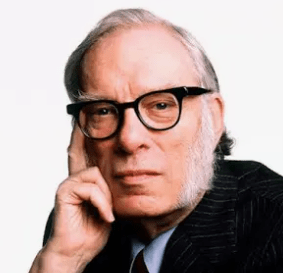
Isaac Asimov
Perhaps the biggest irony here (at least for me, personally) is that while I have great admiration for Ellison’s story, and I believe it is a much greater artistic work that anything ever penned by Asimov, Asimov’s vision is probably more accurate of what we can actually expect from the AI revolution. For all the hype about AIs destroying art and music and literature and taking away our jobs, I think AI will be a net positive for humanity. Perhaps a big net positive. It’s already making contributions in the fields of materials science, medicine, and even fusion energy. Yeah, it’s probably going to take away some people’s jobs, but those were probably crap jobs anyway. (If you train an AI to do it as well as a human, it’s probably not worth doing.)
As for the whole AM/Skynet thing, I don’t worry about it because I don’t believe computers will ever become conscious. In fact, the very idea of a machine becoming conscious seems like a category error, the kind of conceit that will seem laughable a hundred years from now as those old drawings of “men of the future” with feathered wings strapped to their arms.
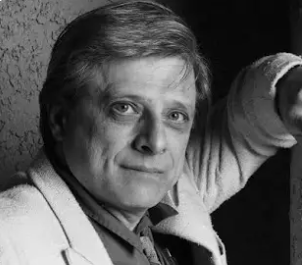
Harlan Ellison
This doesn’t mean, of course, that we won’t, someday, create an artificial life form that might replace us. But it won’t be a computer. It will be…something else.
It’s hard to believe that 32 years have passed since Neal Stephenson’s Snow Crash was published. Not only is it one of the best books of the 1990s, it’s also one of the definitive novels of the cyberpunk genre. In retrospect, one of the most surprising things about Snow Crash is that it’s not really a dystopian novel. It’s more like a satire, a spoof of corporate America’s relentless pursuit of wealth and power in the 21st Century. Its hero (deftly named Hiro) is a Ninja-level hacker by night and a pizza-delivery guy by day. The pizza company he works for is run by the mafia (which has become legal), and if he fails to deliver a pizza in thirty minutes or less, Hiro faces summary execution.
Yeah, it’s that kind of book. It also has some really kick-ass fight scenes.
I love this cover by Bruce Jensen because it’s photorealistic and immediately suggests a narrative, which is perfect for this kind of sci-fi, quasi-adventure novel. More importantly, it captures the crazy melange of elements that Stephenson squeezes into the novel. you’ve got a hero with his samurai sword walking towards a clearly futuristic, cyberpunk city. Paradoxically, he’s passing through an ancient stone doorway that might be a relic from Bronze Age Persia.
It’s an enigmatic cover but also thrilling and stimulating to the imagination. Which is exactly what one expects from a great sci-fi book cover.
When I was in high school back in the early 1980s, Arthur C. Clarke had already been a legend for decades. He was, in fact, one of science fiction’s “Big Three” writers, along with Isaac Asimov and Robert Heinlein. And so, the reprints that Del Rey books released of Clarke’s catalogue were especially clever in their cover art. Created by commercial artist Stanislaw Fernandes, they were minimalist, glossy, and retro (even then). In fact, they were almost art deco in style, somehow managing to suggest the “classic” quality that Clarke’s work had attained. After all, if people already know the author’s name, you don’t really have to “sell” the story itself.
My favorite cover from this line was for Clarke’s best novel, Childhood’s End. I love how it only details two objects: the U.N. building in New York, and the giant flying saucer hovering over it. (This isn’t a spoiler, really, since it happens in the first chapter.)
It’s a very simple cover, yet somehow evocative and beautiful. I especially like the little trident (or is that a pitchfork?) that sits atop the saucer. (I would reveal the significance of this in the story, but that would be a spoiler.)
I did not grow up in the 1960s, and I can’t claim any special knowledge of the magical and tumultuous period of American culture. However, I did grow up in the 1970s, when there was still just a faint afterglow of that glorious time. I vividly remember that day in 1975 when Saigon fell to the North Vietnamese Army, and thus ended the most divisive and catastrophic the U.S. has ever fought. I also remember the election of Ronald Reagan, which finished, once for all, the last vestiges of what was once called the counterculture—that semi-revolutionary, underground movement characterized by sex, drugs, and rock-and-roll. (Especially the drugs.)
I remember, in fact, some of my parents’ friends, who were obviously adherents to this so-called counterculture. They wore cool clothes (lots of paisley), drank run-and-cokes, and laughed at everything, as if they were seeing a different world through their bloodshot, dilated eyes. (I am pretty sure some mind-altering substances were involved.)
Most of the art I’ve included in my on-going Classic Sci-Fi Book Covers series has been from the 1970s and 1980s. Two golden ages of sci-fi, surely, which, more importantly, marked my golden age of sci-fi—my middle- and high-school years when I devoured all kinds of science fiction novels from the previous decades.
And so it is with some surprise that I submit this episode’s sci-fi cover, which is only from 1998. But it’s still a classic. An instant classic, actually, and not just because it was done for one of the most influential sci-fi novels of all time, Philip K. Dick’s Do Androids Dream of Electric Sheep? Calling PKD a science fiction writer makes a bit more sense that calling Kurt Vonnegut a science fiction writer, or Franz Kafka a science fiction writer, but not much. Like Vonnegut and Kafka, Dick wrote surreal, even psychedelic novels that deal with issues of compassion, violence, identity, sanity. Most of all, they describe the problem of discerning reality from the fake. (The “ersatz,” as Dick likes to call it in his typical Germanophilic style).
Do Androids Believe in Electric Sheep is Dick’s most famous book, in part because it inspired Blade Runner but also because it’s just a fine, complex, and vivid novel. Rick Deckert, the protagonist, is a bounty hunter who finds and kills runaway androids (called replicants in the film, these are flesh-based artificial people who look and act like human beings, only crueler.)
The book was published in 1968 and has gone through dozens of editions and covers. But this cover, created by commercial artist Bruce Jensen, is my favorite. It depicts a male figure who might be a Greek statue, or a wax dummy (or an android), and yet whose expression conveys a sense of pathos that the viewer can’t quite look away from. This sense of pathos is amplified by the fact that lying between the viewer and the figure is a grid of what seems to be hog-wire, evoking a plot point in the book. Deckert, like many people in his dystopian future, keeps a farm animal as a pet—in his case, a sheep. But the wire also has echoes of the Holocaust, which is especially interesting since Dick’s inspiration for the book came after reading the diary of an S.S. Officer guarding a concentration camp. The figure is, we sense, a prisoner, although we don’t know what of. (Spoiler: it’s modern civilization.)
And then there is the sheep itself, rendered in a hallucinogenic little box over the male figure’s left eye. The only point of color in the work, the sheep draws the viewer’s attention the same way Deckert’s sheep draws out his latent humanity—it represents nature, vitality, warmth. Most importantly, it serves as something to love.
Love, as it turns out, is the last human quality that the androids learn (and most never do). It is also, Dick strongly suggests, the defining aspect of living things.
Recently, I stumbled upon the Wikipedia page for panspermia—a concept I was already familiar with, relating to the theory that life on Earth might have originated from an external source. Specifically, a primitive microorganism might have landed here on a meteorite (or, in some versions of the theory, on an alien probe).
While reading about panspermia—a theory that has gained a lot of scientific traction in recent years—I encountered a term I hadn’t seen before: extremophile. It refers to “a microorganism, especially anarchaean, that lives in conditions of extreme temperature, acidity, alkalinity, or chemical concentration.” In other words, a really tough bug. Tough to live in the deepest of the ocean, or even in the earth’s mantle.
Recently, I stumbled upon the Wikipedia page for panspermia—a concept I was already familiar with, relating to the theory that life on Earth might have originated from an external source. Specifically, a primitive microorganism might have landed here on a meteorite (or, in some versions of the theory, on an alien probe).
While reading about panspermia—a theory that has gained a lot of scientific traction in recent years—I encountered a term I hadn’t seen before: extremophile. It refers to any microorganism that has evolved to exist in an environment so extreme that most other life would be prohibited. Examples of such environments are hydrothermal vents, salt-ridden lakes, and frozen ice sheets.
Or, perhaps, outer space.
Apparently, the concept of extremophiles—and of panspermia, in general—has taken on new relevancy in the past ten years. Even as we find more and more exoplanets (the most recent count is around 2,000), we have yet to find a single sign of life, intelligent or otherwise. This has led some cosmologists to adopt the so-called Rare Earth Hypothesis, which stipulates that while earth-like planets are a dime-a-dozen, actual Earths—that is, planets with life—might be fabulously uncommon. In fact, there might have only been a few in the early universe, from which all the other life-bearing planets were seeded. This could happen either accidentally (from asteroids; hence the extremophiles) or intentionally (from aliens deliberating spreading life across the galaxies).
All this speculation struck a chord with me. For one thing, it took me back to my youth, to all the sci-fi books and films I consumed. The idea of alien invaders taking the form of germs or seeds goes all the way back, I think, to Jack Finney’s classic The Invasion of the Body Snatchers, in which the evil “seed pods” are actually alien weeds that travel from planet to planet on the solar wind.
One of the first books I ever checked out by myself from the library was Ray Bradbury’s The Illustrated Man. I was a tween-aged sci-fi nerd at the time (as opposed to a middle-aged sci-fi nerd now), and this book started my life-long love affair with Bradbury’s fiction. More magical realism than actual sci-fi, his work always evokes a sense of the wonder I first felt when reading great science fiction.
Like Bradbury’s other masterpiece, The Martian Chronicles, this book is actually a “fix-up”—a collection of previously published short stories that are grouped together by a framing device. In this case, the “frame” is an unnamed drifter and former carnival worker who has tattoos all over his body (except for one crucial, bare spot on his upper back; you’ll have to read it to find out why). If you stare at any of the tattoos long enough, it comes to life and shows you a story—which leads directly into the short story in question.
It’s a very clever idea, and hauntingly rendered. Some of the more famous stories in the collection are “The Veldt,” “Zero Hour,” and (my favorite) “The Long Rain.”
The cover for the book’s first edition, by artist Dean Ellis, is still the best, and is also the one on the edition I checked out from the library, lo those many years ago. A work of trippy surrealism, the man in the painting does not look like the character in the book (who is flabby and middle-aged and has hair) but it captures brilliantly the sense of intellectual lyricism and magic, of which Bradbury was a master.
Ever since the first publicly available AI SaaS offerings (that’s Software-as-a-Service for all you non-geeks) like ChatGTP hit the market, the media ecosystem has been in love with the subject of AI as a major disruptive force. Disruptive, that is, in the creative industries hitherto regarded as safe from any kind of automation: illustration, film-making, acting, and writing. Story after story has run about how AI-generated art, screenplays, journalistic articles, etc. might soon replace the work of human content creators.
Within this maelstrom, a smaller, subset of articles has begun circulating related to whether AI will ever achieve consciousness. (Some experts believe it already has.) And, within this subset, there is a sub-subset devoted to what I call AI alarmism. That is, the idea that AI, if left to its own devices, might soon overthrow—and perhaps even exterminate—humanity itself, ala the “evil AI” tropes of the Terminator films, the Matrix films, the Tron films, et cetera, et cetera.
Such visions of an AI apocalypse are not new. Hal, the murderous supercomputer in Stanley Kubrick’s 2001: A Space Odyssey, is perhaps the most famous example of an AI gone bad. And a cool but largely forgotten movie from the 1970s called Colossus: The Forbin Project lays out exactly how a psychotic AI (in this case, one entrusted with the care and maintenance of the American nuclear arsenal, just like SkyNet) could take over the world by force.





 Ash Clifton, Writer