
Author’s Note: a slightly different version of this post first ran on my old blog, Bahktin’s Cigarettes.
It’s hard to believe, but the 40th Anniversary of the Watergate break-in is fast approaching, on June 17. The day will be commemorated by Chapman University and many others. It will not be the most uplifting of anniversaries, surely. I would much rather commemorate August 9, 1974, the anniversary of Richard Nixon’s resignation, brought about by the heroic reporting of Carl Bernstein and Bob Woodward.
I have already commemorated the event in my own, couch-potato way: I re-watched All The President’s Men on Netflix. It’s still a great movie—smart, tense, dramatic, and well-acted. Alan Pakula loaded the cast with great American actors: Dustin Hoffman, Robert Redford, Jason Robards, Jack Warden, Hal Holbrook, etc. And he manages to tell a vast, complicated story with the breathless pacing of a crime drama (which, of course, it is). As I was watching it, I was struck by something that I hadn’t thought of before.
What ever happened to open-form films?
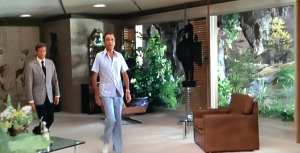
Open-form (sometimes called open-frame) refers to a style of filmmaking where the camera is placed at a medium distance from the action, creating a sense of realism and narrative objectivity. The action is not limited to the visible frame. Much as in real life, important things are happening off-screen. What we are looking at in any given moment is not, necessarily, the whole story.

Many of my favorite movies from the 1970s are open form, including 2001: A Space Odyssey, Butch Cassidy and the Sundance Kid, and (of course) All the President’s Men. But the master was Robert Altman. Watching one his movies like M.A.S.H. or McCabe & Mrs. Miller (one the greatest films ever made), you get the feeling that you are an invisible guest, somehow transported into the action. Characters come and go in and out of the frame. They talk over each other, and external forces (weather, sound, bullets) often intrude from the outside world.
Another, less obvious effect of open-form is that it makes a movie feel more like a documentary. This is, in part, because most documentaries are shot in the medium distance, with stationary cameras. The films of Michael Moore are a classic example.
However, as far as I can tell, open-form has pretty much been abandoned by fiction film directors. The only recent examples I could think of are portions of Steven Soderbergh’s Traffic and Paul Thomas Anderson’s Boogie Nights. Both are very fine films, but they are the exceptions, aberrations in a modern film aesthetic that is dominated by closed form, immersive narration. Specifically, it is dominated by film expressionism.
Remember that famous, virtuoso tracking shot in Goodfellas, when the camera follows Henry and Karen through the nightclub? This is the epitome of closed-form filmmaking. Scorsese reduces the distance between us and the main character to essentially zero as Henry leads us through his princely world of sensual delights. It’s a great movie, and a great moment. But the style itself has come to dominate movies so completely that they have almost become a dead art form, at least in the U.S. When practiced by less masterful directors than Martin Scorsese (and, let’s face it, who isn’t less masterful than Scorsese?), closed-form can become meretricious, slick, and boring.
So why has open-form disappeared in favor of closed-form? The simple explanation is that closed-form is a more intuitive mode of narration, much like first-person point-of-view in short stories and novels. Open-form is more like third-person omniscient. It’s more challenging, both intellectually and visually.
The more insidious explanation is that closed-form expressionism allows the filmmaker to manipulate the viewer more directly. And manipulation is something we Americans know a lot about.
In his landmark essay, Hollywood: The Ad, Mark Crispin Miller wrote about how motion pictures have adapted many of the film techniques of TV commercials—fast-editing, propulsive music, slow motion—in order to keep the viewer bathed in stimulus. Not only are commercial products carefully featured in motion pictures (with characters slurping coke-a-colas and nibbling Doritos), the movies themselves have become commercials. As Norman Mailer might have put it, they have become advertisements for themselves.
When did the transition take place? Sometime in the 1980s, with the advent of MTV. The horror classic Alien, directed by Ridley Scott in 1979, is an open-form movie—realistic, gritty, and provoking. The sequel, Aliens, directed by James Cameron in 1985, is a hyped-up, kinetic, closed-form movie—exciting, entertaining, and ultimately disposable.

Of course, there’s nothing wrong with entertainment. And there’s nothing inherently better about open-form versus closed-form filmmaking. But it does give one pause that we expect so little from our movies these days. Are we so used to being told what to feel, and how to think, in every moment of our waking lives?
Which leads me back to my original topic: Watergate. The reporting of Woodward and Bernstein marked a triumph of intellectual freedom in this country. And so does the movie made about them, All the President’s Men. Is anyone making movies like this today?






 Ash Clifton, Writer