

It still amazes me that Norman Jewison, the same guy that directed Moonstruck, also directed Rollerball. I can’t imagine two films that are more different in content, genre, style, and tone. Moonstruck is a rom-com (imho, the best ever made); Rollerball is a dystopian sci-fi movie. Moonstruck is a comedy; Rollerball is a violent, brutal drama.
And yet, when one thinks about it, the twinning of these two movies under Jewison’s visionary eye kind of makes sense. Both are about an individual seeking personal freedom—self-actualization, as the shrinks say. The main difference is that, in Moonstruck, the obstacle is the protagonist’s own self-doubt and traumatized soul, while in Rollerball, it’s an oppressive, corporatist state.
Moonstruck is the better film, by far. But, as a kid, I absolutely loved Rollerball. It came out fifty years ago, in 1975, and it’s hard to describe how incredibly cool it was among the 11-to-14-year-old boy demographic. It checked all the teenage-boy boxes: sci-fi, sports, violence, motorcycles, and sex.
And then there was the novelty of the game itself, a nightmarish blend of NFL football, roller derby, motocross, and MMA. Of these, football seemed to be the primary influence, with the protagonist coming off very much like one of the celebrity quarterbacks of the era (think Joe Namath or Snake Stabler).
So, basically you had a futuristic, ultra-violent sport where Joe Namath got to kill people! How cool is that??? The film also had the appeal of forbidden fruit. A “hard R”-rated movie, its violence was deemed shocking, even transgressive, at the time. This was especially true considering the film’s A-list imprimatur; it was released by a major Hollywood studio (United Artists) with a major star (James Caan) and a major director (Jewison).
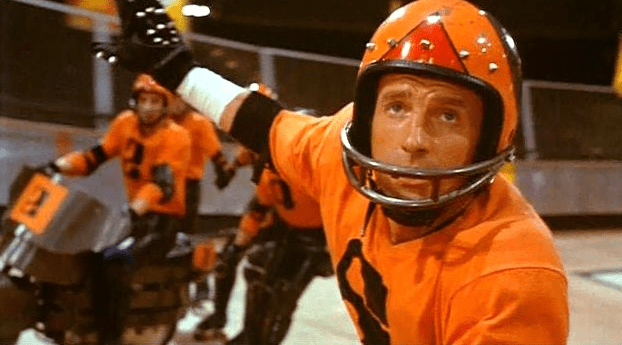
In retrospect, the fact that Rollerball was made at all seems a bit miraculous. It’s a good movie, and there is still much to love about it. Set on a near-future Earth where huge mega-corporations have replaced governments, it tells the story of an elite athlete, Jonathan E., who plays the violent, gladiatorial sport of Rollerball. Jonathan is so good that, after ten years in the sport, he is its oldest living practitioner, as well as its best. He is beloved and famous—so famous, in fact, that he worries the reigning cabal of corporate bosses, who use the game as a kind of panem et circenses form of mass entertainment, giving the oppressed masses an outlet for their (potentially revolutionary) rage.
Mr. Bartholomew, the CEO of the corporation that owns Jonathan’s team (and, it is implied, Jonathan himself, bodily, as a kind of company chattel), is especially concerned. He orders the aging star to announce his retirement. Jonathan refuses. Bartholomew orders him again. Jonathan refuses, again. Unfortunately, Jonathan is too famous to arrest or kill, so Bartholomew contrives to make the next few Rollerball matches so absurdly violent, even by the standards of the game, that Jonathan will change his mind, get injured, or get killed.
If this plot sounds familiar, it’s because it is. Rollerball essentially invented the extreme-sports-of-the-future sub-genre of sci-fi, beginning with Death Race 2000 and continuing all the way up to The Hunger Games series. It also anticipated cyberpunk, in which evil corporations have taken over all aspects of modern life, creating an authoritarian hellscape of haves vs have-nots.
In our current, CGI-corrupted age of cinema, Rollerball is especially impressive for its great, practical stunts. Supposedly, the stuntmen got so adept at the titular game that they would play matches amongst themselves between shooting sessions. And the acting is great, too. James Caan’s understated, nuanced performance as Jonathan is one of his best. He was bashed by some film critics for seeming “checked-out” in the role, but I think they were wrong. He’s playing a somewhat inarticulate but courageous character who is trying to make sense of his plight—and find a way to win.
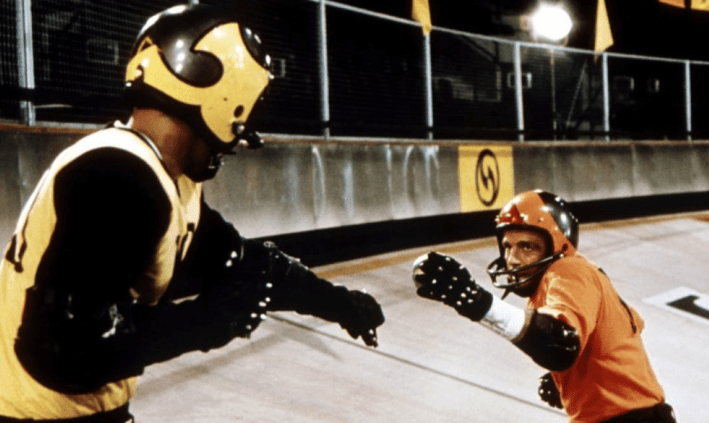
Now that I have said all those good things about Rollerball, it’s time for me to add that it is also an extremely dated film. Alas, it suffers from much of the garishness of the 1970s, as well as a whiff of misogyny that even the patriarchal/fascist setting cannot quite explain. But if you can get past these flaws, it’s a good movie.
Check it out. It’s currently streaming on Amazon Prime.

 Ash Clifton, Writer