Friday Night Rock-Out: “Hotel California”

If you’re of a certain age (i.e., over fifty), you probably spent many a summer afternoon in the long-ago past listening to the 45 single of “Hotel California” over and over and over. (You might also have enjoyed a mildly illegal form of herbal, hand-rolled cigarette as you listened.) If you did, you’ve probably read a lot of articles about the song, and heard a lot of interviews by Don Henley or Glenn Frey or others about it, to the point that you probably think you know everything about it. You know, for instance, that Henley and Frey wrote the lyrics in a very short period of time (by some accounts, a few hours; by others, over a weekend). You know that the album cover is a photo of the Beverly Hills Hotel, and that some people think they see a mysterious figure in the bell tower. And you know that the song is really about Hell, or California-as-Hell, or American hedonism, or…something cool like that.  

What you probably don’t know is that song is, primarily, the creation of guitarist Don Felder, who wrote the melody by himself before he even joined the band. As Marty Jourard recounts in his excellent non-fiction book Music Everywhere: The Rock and Roll Roots of a Southern Town:

One afternoon while enjoying his ocean view and no doubt the general situation, Felder sat on his sofa and idly strummed an acoustic twelve-string, eventually refining his musical idea into a carefully crafted guitar arrangement. Using a Teac four-track reel-to-reel recorder, Felder first recorded his Rhythm Ace drum machine playing a cha-cha beat, then added acoustic and electric guitar and bass, then an idea for two solo guitars. Don Henley listened to a cassette mix of this song and more than a dozen others Felder had submitted for consideration and declared this rhythmically complex instrumental the best, giving it a working title of “Mexican Bolero,” and along with Glenn Frey wrote lyrics that transformed Felder’s music demo into “Hotel California,” the title track of the next Eagles album and its first single.

It’s also Felder’s actual guitar playing, along with that of co-lead Joe Walsh, that gives the song its unbelievably haunting tone and its indelible, dark crescendo. I’m not just saying this because Felder, like his childhood friend Tom Petty, is a Gainesville boy like me. Felder is, in fact, one of the most underrated musician/composers in the history of rock-and-roll.

Of course, I don’t mean to denigrate Henley’s and Frey’s brilliant lyrics, gave the song its cachet among the teenage set of the 1970s (and now, even). One thing I’ve noted about “Hotel California” is that is one of those rare examples of a narrative poem (i.e., it tells a continuous story). Also, it’s written in ballad quatrains, with a rhyming scheme of ABCB. How cool is that?

And, yes, I do see a mysterious figure in the bell tower.

Rock on…
R.I.P. Robert Redford

The great scholar Joseph Campbell once explained that every time we go into a cinema and see a movie star—Tom Cruise, for example—up on the screen, some part of our brains is aware that the real person, the actor Tom Cruise, is alive somewhere else in that same, exact moment. This ability to exist in two places at once, Campbell said, is an aspect of a God, a living divinity. 

Our subconscious perception of actors as gods is one reason we are always surprised by the death of a movie star, especially one who has been around since we, ourselves, were kids. How could they ever die? They seem to occupy a higher plane of reality, immortal, always youthful if not actually young. 

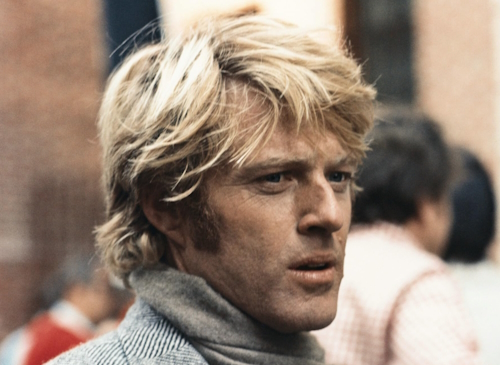
Robert Redford was surely one of the greatest movie stars of my youth, and he starred in two of my favorite films of all time, All the President’s Men and Three Days of the Condor, both of which I have written about on this blog. What made him interesting was that weird dichotomy of blond, athletic, all-American good-looks combined with a reserved, wary intelligence. (On my list of Hollywood Archetypes, he fits squarely in the “Dark Prince” slot.) He was a very smart man, who did a lot of amazing things both on-screen and off-. Among the most notable of these was his founding of the Sundance Film Festival, which has come to rival Cannes as the preferred venue for indie-film directors to premiere their movies. 

The fact that Redford would create an alternative festival for “the little guys” in the film industry was typical. He was, in some ways, the most counter-cultural movie star of the last fifty years—even more so than Easy Rider himself, Peter Fonda—in that he made movies about men fighting some vast, evil establishment. Often, this was the military-industrial complex in either its actual (All the President’s Men) or its fantasy (Three Days of the Condor) form. In his later years, when Redford could no longer play the lead, he took on the role of the villain who represents this evil empire, as in Captain America: The Winter Soldier.

As a kid, I always found something soothing about Robert Redford, even in movies filled with threats and violence. I suspect that, in my mind, he represented the best spirit of my parents’ generation (he was roughly the same age as my father). That is, the young adults of the 1960s and 70s. Post-hippie, but very hip. World-weary, but not broken. Brave, but not foolhardy. Idealistic, but not naïve. 

And, above all, ready to fight the system. 

Godspeed, Mr. Redford…

R.I.P. Donald Sutherland

I really enjoyed The Hunger Games movies when they came out. Not only were they great examples of dystopian science fiction, but they served as a refresher course in the nature of fascism. The main baddie in the films was, of course, President Snow, played with great menace and understatement by the great Donald Sutherland. 

I am very grateful to the producers of The Hunger Games for introducing Sutherland to a new generation of film lovers, especially at a time when his career was in a bit of a lull. Sutherland was one of my favorite actors when I was growing up, best known for career-making roles like Hawkeye Pierce in M.A.S.H., Oddball in Kelly’s Heroes, and the titular role in Klute. One of the great ironies of film history is that Sutherland should now be so closely associated with the role of President Snow—literally a right-wing fascist dictator—when his early, defining performances were usually as lovable, left-of-center antiheroes (Hawkeye Pierce especially). 

Sutherland was one of the few movie stars from the 70s and 80s to have curly, hippie-hair, and his entire persona seemed to be that of a counter-cultural smart guy. The Alpha-Hippie that all Beta-Hippies aspired to be. I say he was a smart-guy, and it’s true—never did an actor so effortlessly exude intelligence, even without dialog, as Sutherland did. But while he was so obviously a smart-guy, he was never a smart-ass. Even the irreverent Hawkeye Pierce—perhaps the most famous prankster in cinema history—reserved his mocking for when he needed it to retain his sanity, and focused it on those who most deserved it.

One of the best ways to understand Sutherland as an artist is to imagine his stylistic opposite, Nicholas Cage. Like Sutherland, Cage is a brilliant actor, and a very smart guy, but while Cage is famous for his artistic daring, often taking his performances to frenetic heights that would seem ridiculous for other, lesser actors, Sutherland was known for his almost impenetrable reserve. He always seemed to be holding something back, in a good way. He kept the viewer guessing about what was really going on behind those crystalline blue eyes. 

Perhaps my favorite Sutherland role when I was growing up was as a world-weary health inspector in Philip Kaufman’s 1978 sci-fi horror masterpiece The Invasion of the Body Snatchers. In this film, Sutherland almost drips existential cool, even when faced with an invasion of alien pod-people (read: communists, right-wing conformists, or your boogey-men of choice) who want to eliminate humanity.

Check it out.