

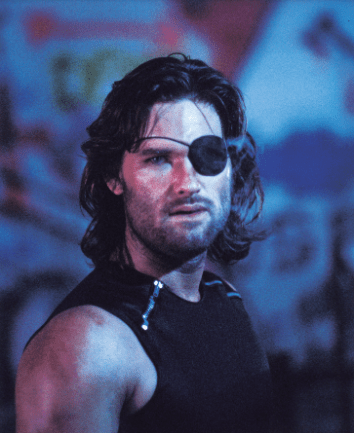
In one of those strange, synchronicity moments that sometimes happen, I recently stumbled upon an article in Collider about how the classic John Carpenter film Escape from New York is getting a new 4K release from Shout Factory. This was a heart-warming bit of information, for me, since the film has been one of my favorites since I saw it in the theaters in 1982. It’s nice to think that new generations of film lovers might be given a chance to appreciate its many charms.
The news was also timely, for me, because I had been contemplating writing a post about the things I love most about movies like Escape from New York. That is, B-Movie Action Flicks. As anyone who reads this blog or my old one will realize, I am somewhat obsessed with B-Movie Action Flicks, especially from their golden age back in the 1970s-80s. Part of my obsession is mere nostalgia, of course. I spent many a late Saturday watching such movies on HBO with my equally nerdy, reprobate friends, and they (the films and the friends) helped me get through the agonies of growing up. But the other part of my obsession has to do with the nature of B-Movie Action Flicks. Why are they so much fun?
As I thought about it more and more, I began to realize that such flicks constitute their own, weird little sub-genre. It’s not just a matter of being low-budget (although that is, of course, a crucial quality). They have their own particular structure and aesthetic.
So, what, exactly, makes for a great B-Movie Action Flick (henceforth, BMAF). That is, if one were to imagine the archetypal, Platonic Ideal of a B-Movie Action Flick, what would its most common elements be?
To do this, I decided to take some classic examples as my starting point. These are:
Escape from New York, The Warriors, Mad Max: The Road Warrior, Pitch Black, The Terminator, Commando, and Hard Target.
And here are ten qualities that all of these movies share, to a greater or lesser degree, and which I believe are crucial for a great BMAF.
1.) Unity of Time and Space – The majority of the action takes place in a single location (a single city, town, or even a single neighborhood) and over a very short period of time (often, a single night or perhaps a twenty-four period). The single location reduces production costs, obviously, but it also makes for a more compelling story, IMHO. The tight time-frame is also better for creating suspense because the hero(s), usually, are facing some very, very hard deadlines. In Escape from New York, Snake has 24 hours to rescue the President before his (Snake’s) neck blows up. In The Warriors, the good guys have to survive the night and get home safe.
2.) A Simple (but Novel) Premise – The premise often involves one or more heroes who have just a few hours to achieve some nearly impossible goal. In Commando, Matrix has 24 hours to rescue his daughter and kill the bad guys. In The Terminator, Sarah and Reese have to escape L.A. before the Terminator finds them.
Despite its simplicity, though, the premise must somehow be new. Novel. Cool. I think Escape from New York has the coolest, most original premise of any action movie ever (except, perhaps, The Terminator). I mean, what could be cooler than turning Manhattan into a giant Federal prision? And losing the President in there? And having to send in the most bad-ass soldier in America (who also happens to be a criminal) to rescue him. Sheer genius!
Speaking of bad-asses…
3.) A Bad-Ass Anti-Hero – The very best BMAFs have a main hero who—while being a good guy, deep down—is an extreme bad-ass who is more interested in his own survival than in any lofty goal. We can all relate to this, right? A complicated moral landscape is an aspect of modern literature (modern everything, really). Also, an anti-heroic main character is more appealing to young guys, who (let’s face it) are the main consumers of BMAFs.
4.) Low Budget – (Duh!) Yes, by definition, B-Movies have low budgets, usually from necessity. They are often produced by guys with unpronounceable names from 3rd-world countries. But this low-budget limit is often a strength, in some ways, to be a low-budget movie. The locales tend to be simple and familiar (a big city; a small country town; a desert plain; etc.), and these can be more relatable to the people (i.e., young, working-class guys) who go to see B-movies. The low-budget also leads me to my next point…
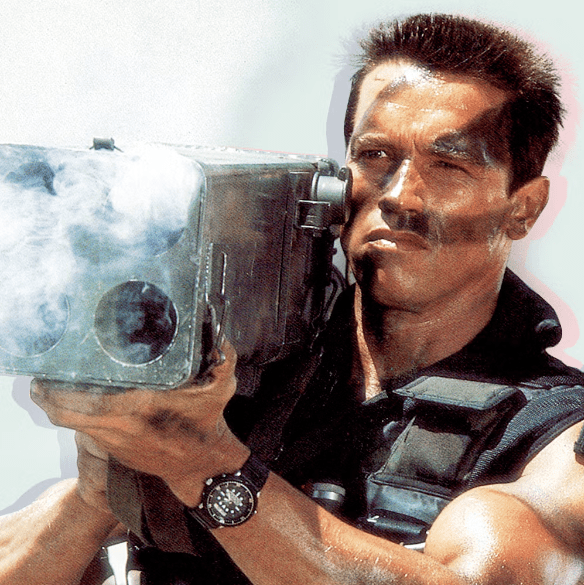
5.) Under-the-Radar (i.e.: Cheap) Actors – Obviously, low-budget movies can’t afford A-list stars (or even, sometimes, B-list stars). Rather, they depend on up-and-coming, unknown actors who will work for peanuts. Or, at the other end of the spectrum, well-known actors on the downside of their careers (who will also work for peanuts). Both sources of talent can yield fine results. Mel Gibson was a star-to-be when he made Mad Max: The Road Warrior, as was Kurt Russel in Escape from New York. And Lee Van Cleef was already a legendary veteran of Westerns from the 1950s and 60s. (For Pete’s Sake, he was “The Bad” in Sergio Leone’s The Good, The Bad, and The Ugly). Escape from New York gave him one last chance to shine.
6.) A Great Villain – Yes, BMAFs need to have at least one, central, overwhelming villain. The Terminator. The Great Humongous. The Duke of New York. Emil Fouchon (played with especially hissable menace in Hard Target). Et cetera.
7.) Stunts – Again, having a low-budget can be a blessing in disguise. Because they can’t afford high-end special effects, B-Movie Action Flicks depend on practical effects—and stunts, especially—for the big set pieces. This reliance on real, flesh-and-blood stunts actually increases the viewer’s involvement in the drama because…well…it’s more real.
8.) Romance (Sort Of) – If you’re going to appeal to young movie goers, you better have at least some hint of romance in your B-Movie. And while none of the movies on my list have any actual romance—and certainly no graphic sex scenes—they do have some strong (usually female) characters who offer the promise of a relationship to the hero. In The Warriors, it’s the radiant Deborah Van Valkenburgh. In Pitch Black, it’s the equally radiant Radha Mitchell. And, of course, in The Terminator, it’s the (not radiant, but wonderful) Michael Biehn.
9.) Humor – Have you ever noticed that every great movie—even great “A” movies—has some significant amount of humor in it? That’s because life is funny—not to mention absurd—and humor is important. It’s even more important in B-Movies, which are, after all, entertainment more than art. Also, humor is needed to give some comic relief to the viewer between action sequences, and to round-out the character of the main hero who might otherwise seem unbearably stalwart.

10.) A Deflected Ending – This goes along with the anti-hero nature of the main character that one typically finds in the best B-Movie Action Flicks. That is, an anti-heroic ending. In the best two movies on my list, the ending is actually somewhat dark. Escape from New York ends with Snake secretly destroying the cassette tape that was more valued than the President’s (or Snake’s own) life. And The Road Warrior ends with Max refusing to accompany the settlers whose lives he has just saved as they make their way to a new future on the coast. But even when the ending isn’t that dark, it’s usually vexed in some way, even absurd. In The Warriors and Pitch Black, the hero has survived the night, but that’s all. What have they learned? Nothing. What have they gained? Nothing (except, of course, a chance to survive the following night).
And this quality is, perhaps, the most compelling quality of B-Movie Action Flicks, their aspect of realism mixed with working-class pragmatism. As my old teacher Harry Crews once famously said, “Survival is triumph enough.”


 Ash Clifton, Writer
One thought on “Ten Things I Love About B-Movie Action Flicks”