

The ad starts with a thirty-something blond man standing in the kitchen of what appears to be an expensive, post-modern home, spacious and bright, with some well-manicured trees visible through the bay windows. Dressed in a tasteful-yet-generic linen shirt, the man is vaguely handsome yet nerdy. With his Germanic features, beard, and shoulder-length blond hair, he looks a bit like Thor, if Thor were retired and had become a web designer. In other words, he seems to represent the best-case scenario for a lot of aging tech-bros. Sure, your features might have sagged a little, and you might have a bit of a paunch, but you’re still a stud.
The opening shot shows the man slipping on what appears to be an extra-large set of ski goggles, with some strange, high-tech Whangdoodles on the side. This is, we instantly realize, the product that the ad is hawking—Apple latest virtual reality headset, the Apple Vision Pro. Meanwhile, the soundtrack is taken up by the opening ostinato of Supertramp’s “Dreamer,” a song once beloved by the late 70s, post-Vietnam counterculture but which has now been co-opted by the Apple Corporation. Indeed, the song sets the theme for the entire ad. The man we are looking at is the “dreamer,” but we, the viewers, are too. We are all, the ad suggests, preparing to enter a world of high-technology magic, where our entire lives will be transformed (for the better, as in a dream) by this newest gizmo.
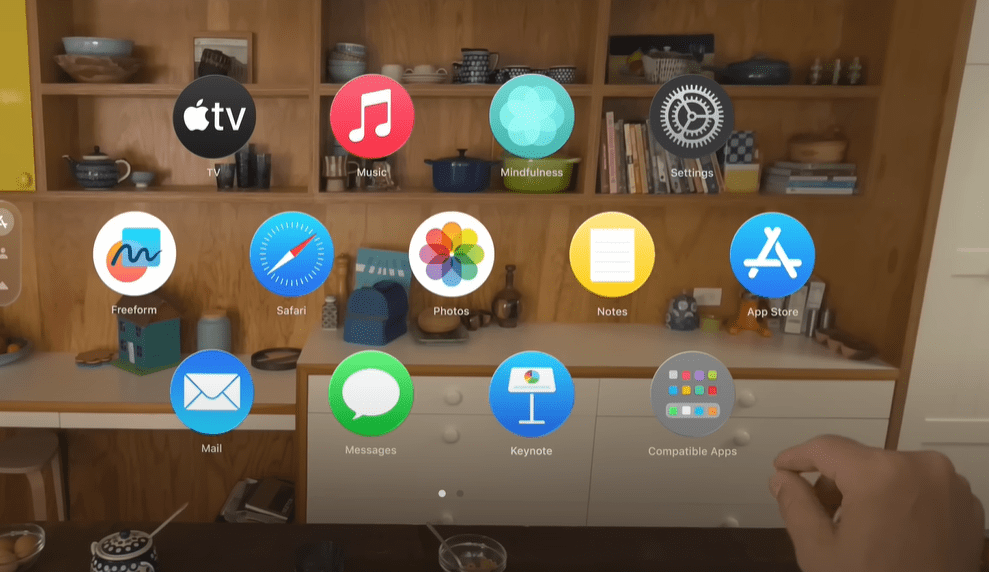
Indeed, once the man has the goggles on, we switch to his point-of-view, seeing his living room as he would. It looks like a standard, upper-middle-class living room, with tiled floors and nice furniture. But superimposed over this view is some kind of computer interface, rather like the start screen of a smartphone. The POV switches again, and we see the man making a pinching gesture with his hand, which opens a series of computer applications that seem to float above his kitchen-island like the UI of every bad science fiction movie we have ever seen.
The ad then switches to another man, a younger and much nerdier version of the first, with a mop of unkempt dark hair shoved under the clamp of his own Apple Vision goggles. This man settles onto his couch with a giant mixing bowl full of popcorn in his lap. At this point, the ad seems to be saying: You don’t have to be as old (or as buff) as Thor-guy to enjoy this product. You can be an average Schmoe and use it, too.

While Thor-guy seemed to be using his goggles to do work, this second guy is a classic couch potato, watching a movie with his goggles and using the same pinch gesture to zoom in on a shot. Cool, huh? I mean, who hasn’t wanted to interrupt their film-viewing experience by changing the focal point and angle that the director and the cinematographer chose? Artistic vision be damned!
The scene changes again. This time, we are presented with an attractive, youngish Black woman who is packing a suitcase while wearing her Apple Vision goggles. Naturally. I mean, who wouldn’t want to wear a clumsy headpiece on their face while folding clothes and arranging luggage? Her choice of high-tech accoutrement becomes propitious, however, when she gets a call from another attractive, youngish Black woman (her sister? friend?) and they enter upon a face-to-face, full VR conversation, with the second woman’s head floating Zardoz-like above the bed.
The scene switches again, and we find ourselves looking at yet another man, a bit less nerdy than the previous two. Instead of an aging tech bro, he looks like an aging rock star, his thin features suggesting a haggard sort of world-weary dissipation. Beneath his goggles, his jaw is set (rather like Robocop’s) as he leans forward to look at…something. A city skyline, as it turns out, floating in a crescent-moon shape above his living room floor. The man rises from his couch and strolls along the VR city, as if pondering which building he is going to buy next.
The scene then cuts back to the Thor-dude, who watches (through his goggles, of course) a boy playing with a soccer ball. “Dad,” the kid yells, and kicks the ball. Fortunately, our Thor-dude is no mere dweeby web designer. He intercepts the ball and kicks it right back.

If were watching a Hollywood movie (instead of a Madison Avenue ad), this shot would end the second act. By this point, we, as viewers, “get” the message—the Apple Vision Pro is a technology that will totally change the way we work and live. Literally any environment—every environment—can be instantly overlaid with a computer interface, allowing us to do all the things we now do on our laptops/smartphones without having to…well…look down? Sit down? Focus?
Is that it? Is that all? Can you boil-down the entire promise of augmented reality (AR, to those in the know) to the convenience of not having to get out your phone?
It seems like a small advantage, given the price one must pay. I mean, these goggles seem to have all the brain-addling, addictive features of smartphones, but multiplied by a billion. Why spend time playing with your kid when you can do that and work on your company’s web site? Why watch a movie when you can watch a movie and fuck around with the zoom? Why do anything at all, in fact, for its own reward, uncomplicated by any other need?
Which brings me to the last scene in the ad, which strikes me as the most significant and telling, albeit in an unintentional way. We switch to a close-up of the goggles, with someone’s finger twisting a knob. Then, after a quick zoom-out, we see that the goggles belong to a woman sitting on an airplane in flight. When we switch back to her POV, the rows of passenger seats before her disappear into a vast horizon of clouds and a setting sun. Again, we “get” it; she’s seeing what’s outside the plane. It’s as if the plane has disappeared.
But even this distraction is not enough. A square frame appears, in which a film is playing. It’s a close-up of Michelle Yeoh from the 2022 film Everything Everywhere All At Once. In the scene depicted, Yeoh seems to be getting sucked into some kind of cosmic void, and her facial expression twists into one of terror.
Obviously, this moment is not meant to be genuinely frightening. The film, I am told, is a sort of mad-cap comedy. And yet, this peculiar choice of image seems entirely too fitting, given what the ad has shown us beforehand. With the Apple Vision Pro, we can all be sucked into a void of distraction, anxiety, and over-stimulation.

Which makes the next shot all the more perfect. We zoom out of the woman’s POV, but just a little, so that we are presented with a massive close-up of her beautiful blue eye. And inside that eye, a reflection of the movie is playing on her iris. We see a tiny, postage-stamp-sized image of Yeoh’s anguished face in there, screaming at us in horror.
The dream has become a nightmare.

 Ash Clifton, Writer
One thought on “Let’s Deconstruct an Ad: “Hello Apple Vision Pro””