

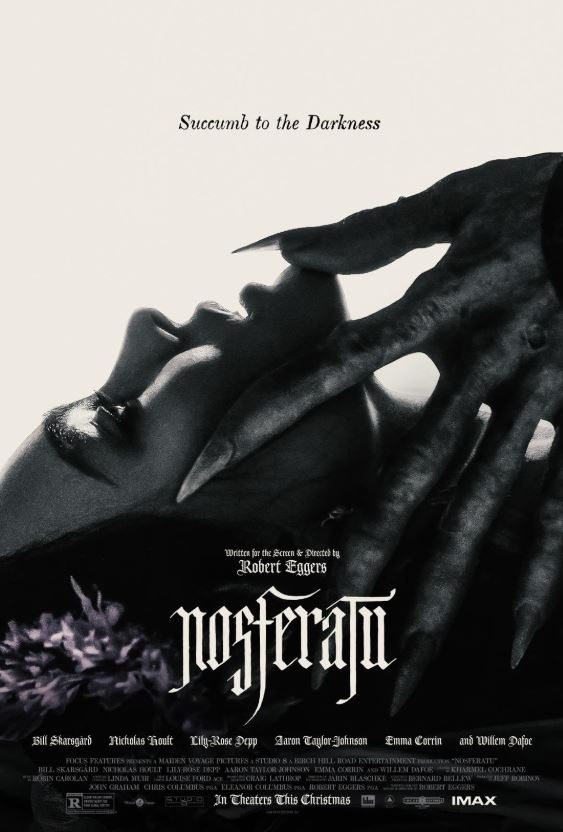
I’ve been seeing a lot of on-line ads for the new Nosferatu movie directed by Dave Eggers. It looks like a pretty good movie, although, judging by the trailers, it seems to be emphasizing the horror (e.g., slasher) elements of the classic Nosferatu/Dracula story over the erotic angle (which most film adaptations have veered toward).
Or does it? Looking at the poster, the hook line poster reads “Succumb to the Darkness.” It’s a seductive line, which doesn’t quite seem to go with the image portrayed—that of a beautiful young woman in a nightgown lying on her back with her mouth open, while a skeletal, monstrously taloned hand reaches for her face.
Erotic? Not really. Gross? Yeah, kinda. This thematic confusion between the film’s trailer and its poster reflects, I think, the difficulty in adapting the Dracula story to the screen. (Yes, I know that Nosferatu is not the same as Dracula, but close enough.) The difficulty is made worse in our present time, the 21st Century, when porn is only a few clicks away and the idea of truly transgressive sexual activity is more and more difficult to imagine.
As it happens, I’ve been re-reading Bram Stoker’s Dracula for about the 200th time. I usually start around Halloween and then inch through it for the remaining two months of the year. It’s an extremely entertaining book. In fact, it’s tied with the Collected Stories of Sherlock Holmes as my favorite genre book from the 19th Century. (Twenty-Thousand Leagues Under the Seas is up there, too.) The writing is sharp and the story fast-paced. Even its archaic, epistolary style (it’s told as a series of letters and diary entries from and by the main characters, with a newspaper report or two thrown in) seems just right for the content.
And then, of course, there’s the villain, Count Dracula himself, a four-century old Wallachian prince skulking around his ancestral castle, sleeping all day and sneaking out a night to suck the blood of innocents (including, in the book’s most horrific scene, an infant). Dracula is intelligent, courtly, and supremely confident, in the way one would expect a feudal count to be. In other words, he’s a bit of a fascist. He brags about his family history and his military prowess. He speaks multiple languages, including English, which had recently taught himself from books. He has a photographic memory and a sick sense of humor. And, most important of all, he is immensely, almost limitlessly strong. One of the protagonists estimates that the count can easily face five men in hand-to-hand battle and beat them.
In short, Dracula is a killing machine, with the airs of a proto-fascist monarch. But there is, of course, something attractive about him. Though very old (he looks old, in the novel’s opening chapters before he finally gets access to the rejuvenating blood of young English virgins), he is handsome and magnetic. It is these aspects of Drac’s appeal that have most eluded the abilities of filmmakers and actors going all the way back to the 1930s. Bella Lugosi got close to it, as did (much later), Frank Langella. My personal favorite depiction came in a 1977 BBC production starring Louis Jourdan, who, with his European elegance, classical good-looks, and velvety voice—not to mention his status as a bona fide 1960s movie star—made him a brilliant choice. Jourdan doesn’t chew the scenery; he savors it.
But an even bigger challenge to filmmakers is the matter of the book’s erotic themes. Dracula is a sexy book. It’s literally full of sucking. Men sucking women. Women sucking men. And while there is no explicit sex in the book (vampires, it seems, don’t engage in sexual intercourse, either with the victims or with each other), all this sucking is barely sublimated stand-in for outright sex. That’s why the book was damned popular in its day. It wasn’t porn, like some other Victorian “dirty-books,” but it was still erotic. Even shocking.
Most filmmakers made the mistake of making the sexual themes of the novel explicit. That is, actual sex. But what form of sex could possibly shock a modern audience the way all that sucking did in the 19th Century? Oral sex? Meh. S&M? Seen it. That’s one reason most Dracula films not only fail, but fail badly. (How many cheesy, cringey, unintendedly funny Dracula movies have been released? Dozens, at least.)
But the real reason that it’s so hard to make a good Dracula movie—or, at least, one that is true to the novel—is that most people completely miss what the book is about. It’s not primarily concerned with the erotic temptations of evil, or even with horror.
Rather, it is a book about science.
Yes, science. More specifically, it’s about the relationship of science to morality, and to civilization itself. After all, who is the hero of the book? Van Helsing, the old medical professor, who, despite being a renowned man of science, is also the only person who knows what’s really infecting the English town that Dracula has moved into. Van Helsing tries to save Lucy’s life using the armaments of science—blood transfusions, inoculations (well, garlic), and psychological profiling. It’s Van Helsing who overcomes the disbelief of the other male protagonists, especially his former pupil, John Seward, who finds it hard to believe that a supernatural blood-sucker is roaming around the countryside.
Van Helsing is the “active” hero of the book, but the most important character is that of Mina, Lucy’s best friend and Jonathan Harker’s wife. Mina is an intelligent, chaste, yet shrewd woman who senses that something diabolical is to blame for Lucy’s anemia and for Jonathan’s near-death in Transylvania. When Van Helsing finally assembles his team to hunt down and destroy Dracula, is it Mina who handles the logistics, coordinating shipping and travel plans, and even typing up their meeting notes on a typewriter (a new-fangled gizmo that she has just learned to use).

Even after Dracula attacks Mina and forces her to suck his blood (and thereby ingest the vampire curse), she keeps her sanity and continues to help with the mission. She considers suicide, but decides to wait until the mission is either over or lost.
As the hunt proceeds across England and Europe, the team uses the telegraph system, rail services, newspapers, and other trappings of modern civilization to track Drac back to his castle. When they finally corner him, they use a slew of weapons from rifles to hatchets and stakes to drive off his human guards and kill him. In the end, Dracula, despite all his superhuman and supernatural powers, can’t compete with a handful of determined, rational, well-organized westerners. The fact that all the heroes are from the west (four Brits, one American, and one Dutchman) is significant. The west is Modernity. The west is the future.
After all, why does Dracula want to move to England in the first place? It’s because England, as the most powerful country in the western world, is the most vibrant and dynamic place on earth. It’s so full of life.
On the other hand, Dracula himself represents a medieval past of superstition and barbarism. Much is made of the backwardness of the fearful peasants that Jonathan meets on his journey to Dracula’s castle. (The fact that their fear turns out to be well-founded is beside the point.) In his diminished state, Dracula is an obscene, withered being, in possession of vast wealth and knowledge but unable to enjoy any of it. Worst of all, he’s evil. He embodies a dark, pre-Enlightenment Europe, full of rituals and dogma and class-defined roles. Wars. Famine. Disease.
Especially disease. Dracula is a disease. He infects every place he visits with the disease of vampirism, which is, itself, just a metaphor for ignorance, depravity, and selfishness.
I guess what I am really trying to say is that Dracula is, ultimately, a Victorian novel. It’s about good people doing their best to overcome the clutches of the past, and to define their goodness in modern terms that go beyond duty and religion.
The best part is, they pull it off.

 Ash Clifton, Writer