
( *** Spoilers Below ***)
When most people think of the archetypal techno-thriller writer, they probably think of Tom Clancy. He didn’t invent the genre, but with the publication of his 1984 mega-hit The Hunt for Red October, he took it to a whole new level of mainstream popularity. Henceforth, the pop lit shelves in bookstores and airport gift shops across the countries would be filled with works by Clancy and an army of his imitators.
And why not? The techno-thriller novel combines aspects of several other genres, including “caper” fiction (a group of determined men taking on a seeming impossible mission), science fiction (the “techno” part is often so cutting-edge that it is more like sci-fi), mysteries (there is always a hidden bad guy in the mix), and, of course, thrillers (duh).
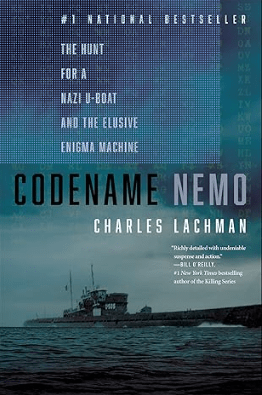
I kept thinking of The Hunt for Red October as I read an excellent history book recently, Codename Nemo: The Hunt for a Nazi U-Boat and the Elusive Enigma Machine by Charles Lachman. It recounts the fantastical story of a visionary naval captain, Daniel Gallery, who comes up with a hare-brained plan to capture a German U-boat. He developed the idea while stationed at a naval base in Iceland, seeing the damage that U-boats could wreak. He also learned how to sink them.
At some point, Gallery befriended an operative in U.S. Naval Intelligence, who fed him information about where U-boats were likely to be. Later, when Gallery was placed in command of a naval group centered around the U.S.S. Guadalcanal, he began to devise a practical means of capturing a U-boat instead of sinking it. The group had already sunk two U-boats by mid-1944, and Gallery had learned that not all U-boat sailors were fanatical enough to sacrifice themselves to prevent a crippled U-boat from falling into enemy hands. Standard procedure on a U-boat required the captain and senior engineers to scuttle their boat in the event of a possible capture, but Gallery suspected that he might be able to assemble a specialized assault team that could enter a sinking sub, overwhelm the remaining crew, and disable any scuttling explosives.
Naturally, this plan required a dizzyingly improbable series of circumstances to align. First, Gallery and his crew had to find a U-boat (already their main job, fortunately), disable it without sinking it (a much harder task), and get land boarding party onto the (still active) enemy ship in the midst of battle (a tactic that hadn’t been executed by the U.S. Navy since the War of 1812).
The great strength of the book lies in the novelistic techniques Lachman uses, presenting the narrative in alternating point-of-views, with some sections recounting the experience of the crew of U-Boat 505 (the sub that Gallery eventually captured) and that of the Guadalcanal. Gallery meticulously picks his team of raiders from the ship’s crew, picking some for their technical prowess, others for their speed and agility, and others for their sheer, brute strength.
One quality that all the team members shared was raw, physical courage. The job of boarding and entering an active U-boat was seen as a suicide mission, especially for the men tasked with first opening the hatch and entering the sub. They expected to be shot on sight by any remaining German crewmembers or, failing that, to find themselves trapped in a rapidly sinking sub. And the danger does end when they finally secure the sub. For days, Herculean efforts and vast amounts of engineering skill were required to keep the sub from sinking and/or blowing up. (In one particularly hair-raising moment, the boarders learn that the sub’s remaining, high-tech torpedoes might detonate in their tubes from lack of maintenance.)
Of course, it wouldn’t be a good story if they didn’t manage to pull it off, somehow. After a truly hair-raising struggle, Gallery’s men not only capture the sub intact but most of the sailors. This creates a problem since the whole point of capturing the sub was the desire to get at its intelligence resources—its codebooks and, in particular, its Enigma encryption device—which would have mooted if the Germans ever found out that the sub had been captured. The Geneva Convention, however, required the U.S. Navy to report the P.O.W. status of the imprisoned Germans and, worst of all, let them communicate with their families.
In the film version of The Hunt for Red October, Admiral Painter sums this dilemma up nicely when he asks Jack Ryan if he plans to “liquidate” the Russian crew of the sub. It probably comes as no surprise to modern readers that, in fact, Captain Gallery never considered such a dark solution to his problem. Rather, U-505s crew were smuggled off to a secret military P.O.W camp in Louisiana, where they were kept incommunicado for the remainder of the war.
All modern warfare is grotesque, surreal, and absurd. And so, no honest retelling of a World War II story would be complete without at least one shattering, existential absurdity. In this case, it lies in the fact that, instead of being thrilled at Gallery’s achievement in capturing U-505, his top-level superiors were horrified. None of them had been informed of his plans, and his success left them with a terrifying prospect, of which Gallery himself never suspected. The source of their fear lay in the simple (but highly secret) fact that the German enigma machine had already been cracked years before by Alan Turing and his team of cryptographers in England. Thus, should the capture of U-505 become known to the German command, they might cease their use of the Engima as a precaution, thus removing one of the Allies’ greatest advantages in the war. Rather than a boon, the capture of U-505 might be a disaster.
Ironic, huh?
Fortunately, the Germans never found out, in large part due to the inventiveness of Gallery and Navy brass in hiding the U-boat. They gave it a new name, Nemo, to prevent German spies from figuring out what, exactly, the U.S.S. Guadalcanal was towing to shore. And the fact that the brave efforts of Gallery and his crew were (almost) counterproductive in no way diminishes their heroism. The capture of U-505 did yield significant intelligence (albeit for a short time—the war was over just a year later). And Gallery and his men were recognized for their valor.
Codename Nemo is a fine bit of W.W. II history. Check it out…

 Ash Clifton, Writer
Thank you for this fascinating review of Codename Nemo! I had no idea about the story behind the capture of U-505, and your description of the book makes it sound like an edge-of-your-seat thriller as much as a historical account. I love how you draw parallels between this real-life mission and the narrative style of The Hunt for Red October. It’s incredible how history sometimes mirrors the most gripping fiction.
I’m particularly intrigued by the moral and strategic dilemmas Gallery faced, such as the need to keep the Enigma machine’s capture secret from the Germans and the tension between adhering to the Geneva Convention and preserving intelligence. It really highlights how complex and absurd war can be, as you pointed out so eloquently.
Your description of the bravery and ingenuity of Gallery’s crew is inspiring. It’s amazing to think of the risks they took and how their efforts contributed to the larger war effort, even with the ironic twist of almost jeopardizing a key Allied advantage.
This is definitely going on my reading list—I can’t resist well-written history that reads like a thriller. Thank you for the recommendation!
Kris x
LikeLiked by 1 person
You bet! Thanks for the encouragement!
LikeLiked by 1 person