Orlando Trip De-Brief (with a Bit of Synchonicity)

Me with Danni and Michelle of the BCAD Podcast at the Barnes & Noble on Colonial

Well, Cathy and I got back from Orlando on Thursday, and this is the first chance I’ve had to write a post about it. All in all, it was a fine trip! My book talk at Barnes and Noble went well, mostly due to Danni and Michelle, the hosts of the excellent podcast Book Club After Dark, who were nice enough to interview me. They asked great, insightful questions, and I had a lot of fun. The turn-out was modest, but the people who did show up seemed really interested. They asked some great questions, too. It was especially nice to see my old friend Norm, who came to the event to cheer me on. He also snapped the picture above. 

Afterward, Cathy and I had a great dinner and some fine beers at the Harp and Celt Pub downtown. The next day, we did a driving tour of Orlando, Noland Twice’s home turf, refamiliarizing ourselves with our old stomping grounds. As one might expect, parts of the city seem completely different from when we lived there, while other parts seemed exactly the same. Overall, O-Town still feels like two cities. There’s the lovely, old, Southern city, with its tree-shaded streets and gorgeous houses from the 1930s and ‘40s. Then, there’s the litter-on-a-stick, urban sprawl of Generica, with its strip-malls and fast-food shacks and liquor stores. And traffic. Lots of traffic. The really sad part about Orlando is that you have to drive through the nasty bits to get to the nice, old, quaint bits. But oh well. I still love the city.

Catchup by the Pool by Slim Aarons (snapped from my phone in Orlando)

When we were done exploring, Cathy and I drove down Mills Avenue and visited the Mennello Museum of American Art, which is perhaps the best small museum I’ve ever visited. I was especially taken with their current exhibit, entitled Pool Party, which had lots of amazing photos and paintings of American pool culture from all over the country. I was especially taken with this 1970 photo, above, by former combat photographer Slim Aarons. It’s titled Catchup by the Pool, and it seems to encapsulate the entire upper-class, White, suburban culture of the U.S., right on the cusp between two equally garish decades. And yet, it’s also kind of…sweet. I find myself wanting to go to this party.

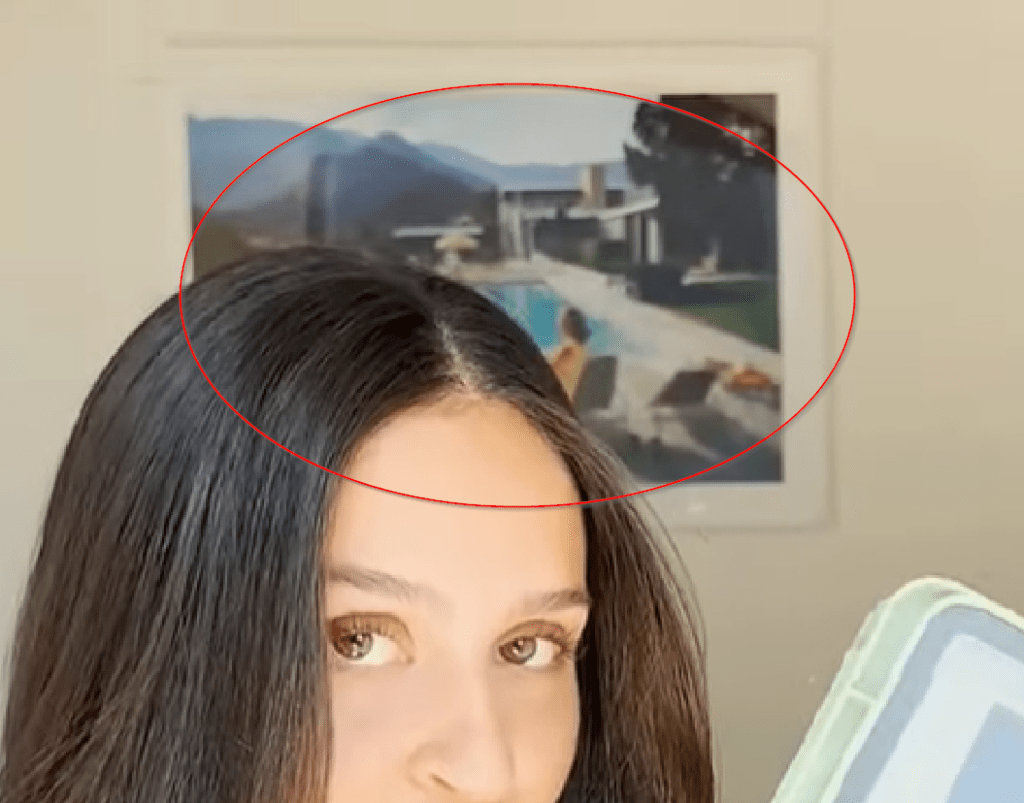
Screen Grab of a Random Speechify Ad from my Youtube Account

And then, just this morning, in one of those instances of synchronicity that seem to happen fairly often to me (and which I blog about, a lot), I happened to be presented with a YouTube ad (for Speechify, of all things). Before the skip button came up, I had to leave the room, so I paused the ad so I wouldn’t miss the beginning of the actual video I was waiting for. (Just to prove I wasn’t crazy, I did a screen grab, above left.)

When I came back, I noticed that there was something weirdly familiar about the freeze-frame that I happened to pause on. If you look at the background, on the wall of whatever apartment or motel room the ad was apparently filmed in, you can see—lo-and-behold!—the same photo by Slim Aarons

What are the odds? Like, a bazillion-to-0ne! Talk about synchronicity-on-steroids!

Anyway, it seemed like a magical end to a good trip. 

My Latest Obsession: Vaporwave

I have a confession to make: I dream about shopping malls. Specifically, one shopping mall, the Oaks Mall here in Gainesville.

The “Collapsed Time” Effect of Vaporwave

After my parents’ divorce, I saw my mother mostly on the weekends, and one of our routine activities was to go to the mall. We would have lunch, see a movie, and wander around. Later, when I got into my teens, I spent a lot more time at the mall with my friends. We hit all the usual spots—the arcade, both bookstores (Waldenbooks and B. Dalton’s), the record store, Spencer’s Gifts, the toy store. And we did anything else we felt like. 

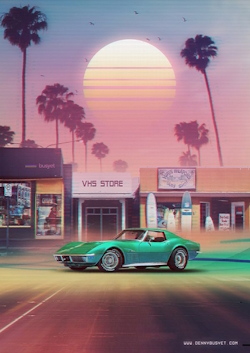
Trappings of the 1980s, along with “Broken Sun” motif

We weren’t alone, of course. After the collapse of downtown America, the mall was the last remaining public square. In suburban America, particularly, it was also the only fun thing to do on a Saturday afternoon. Or a Saturday night, for that matter. When I entered high school and started going on dates, we often went to a movie at the mall. One of my most vivid memories is of how strange and eerie the mall felt after the movie let out at 11:00 or so, and we would walk through the empty, dark hall with all the shops closed and metal gates drawn down. It was one of my first experiences of liminal space, and it sticks with me even today.

In fact, it haunts my dreams. Literally. For when I dream of the Oaks Mall now, I often find myself lost among its corridors near closing time, the wings still busy with shoppers but with the crowd starting to thin out, little by little. Stranger still, my dream-mall is huge—the size of Manhattan Island, practically. A gigantic labyrinth of brand-name stores, all of which are in the early stages of shutting down for the night. (My subconscious, I think, is warning me that the mall is shutting down forever.) These dreams often end in a sense of panic as I realize I am on the wrong side of the mall from my friends, or my car, or whatever, and I will never be able to reach them/it in time before…what? Closing? It’s not clear, but whatever it is, it’s kind of scary.

Despite the disquieting nature of these dreams—or perhaps because of it—I find myself endlessly fascinated by what has come to be known as the Vaporwave aesthetic. Vaporwave is primarily a visual genre, marked by artistic images of 1980s culture. That is, computer graphics, shopping malls, the Miami skyline (ala Miami Vice), fast food restaurants, music videos, video stores, and old-style video games.

And neon. Lots and lots of neon.

Empty Mall / Liminal Space Vibe Typical of Vaporwave

The overriding effect is that of a hyper-real fantasy that feels like a time-portal back to the 1980s. I love these images because they somehow evoke the memory of that long ago time, at least for me. More accurately, they evoke the feeling I wanted to have at the time but could never quite capture. The feeling of an endless, prosperous, fun, high-tech future.

I think that this is the real power of nostalgia. A wise man once defined nostalgia as a fondness for a Time that never existed. I don’t think that’s quite right. Nostalgia is a fondness not for a lost time but for a lost hope—the hope one felt and in a familiar place and a long-ago time. A hope that, though never realized, still lingers in the heart. 

That sense of lost opportunity is, I think, reflected in the very name of the genre itself, vaporwave, which is very similar to vaporware, a term coined in the 1980s to mean great-looking software that was promised by advertisers and corporations but which never actually materialized. It simply evaporated.

The same thing happened to our collective dreams back in the 1980s. My friends and I all hoped that we could look forward to a glorious future, one better than that of our parents’ and teachers’ generation. A future that would be made bright by the many technological revolutions (the digital revolution, especially) that were impacting every aspect of our culture: movies, TV, music, art, games, fashion, and even books. The haunting images of vaporwave reflect that lost dream—rather than the sterile reality—of the 1980s and ’90s.

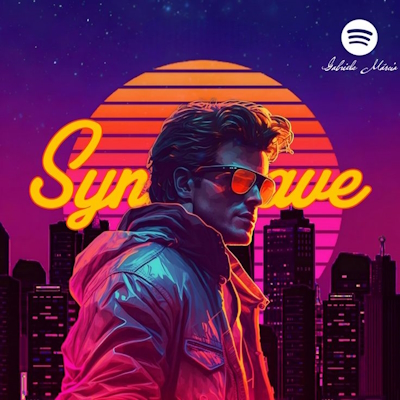
Many vaporwave images seem to have a psychedelic “collapsed time” feel to them, as did many of the music videos and computer-generated short films of that era. The hippie generation had the psychedelic flower as their symbol. We had the computer-generated sun—the so-called “broken sun”—which seems to have been pulled directly from of a film poster or a television commercial from 1982. 

As attracted as I am to vaporwave, I am equally drawn to its parallel music genre, synthwave. Like vaporwave, synthwave is characterized by the early computer-era vibe, as symbolized in synthesized music. Not actual synthesized music from the 1980s, of course, but rather music that sounds a lot like it, yet is somehow drained of all melodrama and false tension that characterized synth-music back then. Synthwave has a kind of purity to it. A simple beauty that surpasses the actual music of that time.

In other words, synthwave is to actual 1980s music what Andy Warhol was to actual advertisements of the 1950s. His silk screen images of Campbell’s soup cans looked almost exactly like actual soup cans, but larger, stylized, more vivid. They made the world really see Campbell’s soup cans—the sublime nature of everything, even a mass-produced soup can—for the first time. Warhol’s genius lay in his ability to show us the beauty and promise of something that was once central and even commonplace in our lives, even as it mocked (lovingly) that very same thing.

That’s what vaporwave does, too. Through the alchemy of art, it somehow humanizes the relentless, corporate-controlled media barrage of the 1980s. For me, and millions of others like me, it is literally the stuff that dreams are made of.

Or were made of, that is. Back in the day.

Lo-Poly, Computer-Generated Background with Broken Sun
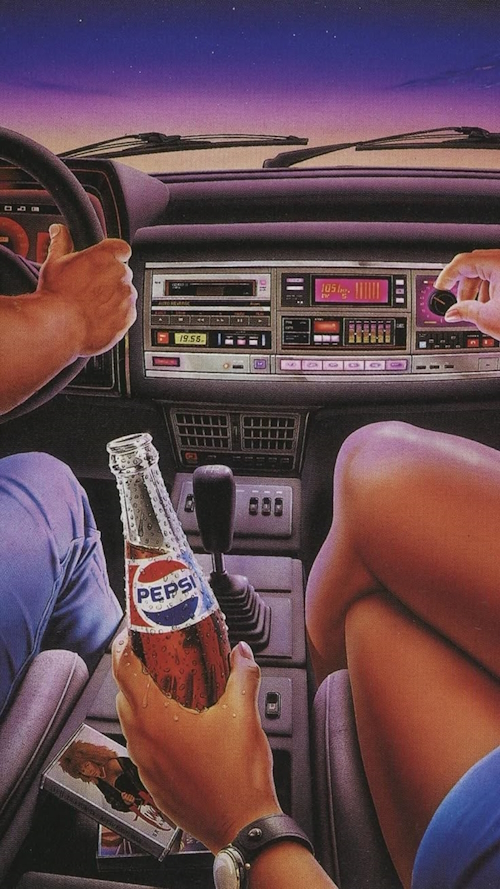
Blatent Consumerism of the 1980s, both celebrated and mocked

Let’s Deconstruct an Ad: “Hello Apple Vision Pro”

The ad starts with a thirty-something blond man standing in the kitchen of what appears to be an expensive, post-modern home, spacious and bright, with some well-manicured trees visible through the bay windows. Dressed in a tasteful-yet-generic linen shirt, the man is vaguely handsome yet nerdy. With his Germanic features, beard, and shoulder-length blond hair, he looks a bit like Thor, if Thor were retired and had become a web designer. In other words, he seems to represent the best-case scenario for a lot of aging tech-bros. Sure, your features might have sagged a little, and you might have a bit of a paunch, but you’re still a stud.

The opening shot shows the man slipping on what appears to be an extra-large set of ski goggles, with some strange, high-tech Whangdoodles on the side. This is, we instantly realize, the product that the ad is hawking—Apple latest virtual reality headset, the Apple Vision Pro. Meanwhile, the soundtrack is taken up by the opening ostinato of Supertramp’s “Dreamer,” a song once beloved by the late 70s, post-Vietnam counterculture but which has now been co-opted by the Apple Corporation. Indeed, the song sets the theme for the entire ad. The man we are looking at is the “dreamer,” but we, the viewers, are too. We are all, the ad suggests, preparing to enter a world of high-technology magic, where our entire lives will be transformed (for the better, as in a dream) by this newest gizmo.

Continue reading “Let’s Deconstruct an Ad: “Hello Apple Vision Pro””

Why Do YouTube Commercials Suck?

As I get older (and older), I begin to suspect that I will, eventually, become nostalgic about literally everything in my past. Right now, I am feeling nostalgic for old TV commercials.

If you grew up in the 1970s and 80s, like me, you watched a lot of TV commercials. Like, thousands and thousands. And as much I hated most of them, at least they were flogging products that I could…you know…actually use.

Since I cut the cable-TV cable a decade ago, most of my TV consumption has been via YouTube, and I have found myself bombarded with ads for various IT groupware products, web hosting sites, industrial-grade machines, religious groups, and exotic home decorations. WTF? How did the vaunted algorithms, in all their wisdom, pick this menu of irrelevancies to inflict on me.

Don’t get me wrong. I love YouTube, and I am grateful that it exists. And I know that they have to pay the bills somehow, so I try to watch the ads. (Yeah, I know, there are ad-blocker plugins out there, but I find myself morally opposed to them.) Still, these ads suck.

So, yeah, I am sentimental about old-world commercials. Here is a classic, landmark ad that I remember from 1977, the same year as Star Wars was released.