Classic Sci-Fi Book Cover: “Babel-17”

I know, I know. This cover is a bit out-there. Not every sci-fi book cover, after all, has a spaceship hovering in a night sky over a plus-size female model in a metal bikini, go-go boots, and mail headdress. (But I kind of wish they did.)

Even so, this cover for Babel-17 by Samuel R. Delany is a bonafide classic by the great Spanish illustrator Vicente Segrelles, who has created a ton of great covers throughout his long and brilliant career. It was done for a series of Delany’s novels that were re-released by Bantam in the 1980s, all of which had great, subtle, off-beat covers.

Now, I’ve read a lot of snark about this cover on various chat-boards. Younger guys, especially, find it hilariously bad (and perhaps a lot of girls, too). I think this is because the woman depicted is not the usual, skinny, spandex-clad sci-fi babe. Personally, that’s one reason I like her. I think she’s mysterious, regal, and (yes) sexy.

More importantly, she captures the essence of the novel’s main character, Rydra Wong, who is not only the captain of a spaceship but also a master linguist. When government operatives seek her help in cracking an enemy, alien code called Babel-17, she discovers that it is not just a code—it’s an entire language. She promptly sets-off on a space-adventure to decipher the language, a quest that leads her into a war zone on the edge of the galaxy.

One of the things I love about Babel-17 is the way Delany, even way back in 1966, managed to push a message of tolerance and multi-culturalism. Wong’s spaceship is crewed by a rag-tag group of mercenaries, some of whom are not only transsexual but transhuman, opting for synthetically altered bodies that make them resemble wild animals or fairy tale creatures, and so on. Moreover, Wong’s desire to find the source of Babel-17—and, thus, better understand the aliens who are attacking humanity—suggests a deeper response to the usual fear and xenophobia that was so endemic in America at the time (and is again now, alas).

Babel-17 a classic sci-novel with a classic cover. Check it out…

Classic Sci-Fi Book Cover: “A Clockwork Orange”

The most important novel in the dystopian science fiction sub-genre is George Orwell’s 1984. The second most important is Anthony Burgess’s A Clockwork Orange. I would go so far to argue that Burgess’s book has, in some ways, been even more influential and culturally significant than Orwell’s, especially for those generations that grew up in the 1970s and later. 

It was in 1971 that Stanley Kubrick adapted the book into a landmark film, which was how I first discovered the novel. By the time I was a teenager, in the early 80s, Kubrick’s movie had taken on cult status—almost as much as 2001: A Space Odyssey. My friends and I all loved the movie. And I, being a particularly bookish kid, decided to check the novel out, too.

The secret to A Clockwork Orange’s success, topping that of almost all other dystopian novels, is that it has a great, exciting twist. Its protagonist, a fifteen-year-old delinquent named Alex, seems more like a villain than a hero. He is, after all, a thug, a thief, a gang-member, a rapist, a drug user, and a lover of all things violent (“ultraviolence,” as he and his gang friends call it). Yet, in comparison to the oppressive, authoritarian, end-stage-Capitalist society in which he lives, he is a kind of hero. Against that iron-grey backdrop, his better, human qualities come to the fore—his intelligence, his ferocious courage, and his absolute dedication to personal pleasure, the state-be-damned.

This twist is one of the greatest, central ironies in modern literature, and it’s the reason teenage boys (and probably a few girls, too) continue to find themselves drawn to the book, just as they have been for sixty years. Conversely, this is also the reason that social conservatives have hated the book for just as long. In fact, as I recently learned from openculture.com, A Clockwork Orange was the most banned book of the 2024-25 school year

I have no doubt that Burgess would have been very, very proud.

Kubrick’s film version was so powerful that it influenced the cover-design for most subsequent editions of the book. Many of these covers were thinly-veiled riffs on the movie poster or on Malcolm McDowell’s brilliant performance, wearing his singularly perverse, false-eyelash. I really like this cover from 1995 by Robert Longo because it bucked that trend and did something new. 

Also, I think it really captures the madness of the book—the ferocity of Alex’s character as he rages against the machine. Yes, he’s an evil character, but that’s sort of the point of the whole book. Alex has a God-given right to be evil, if that’s his choice. Evil is an implied, but not a  necessary, product of his free will, and he fights valiantly against being “programmed” by the cold authority figures of the story.

Just like most teenagers. Even the ones that aren’t psychopaths.

Classic Sci-Fi Book Cover: “The Deathworld Trilogy”

Cover art by David Egge

Harry Harrison’s Deathworld trilogy kept me sane during one long-ago summer when I was bored and lonely. As I recall, my father gave it to me, having bought it in an airport bookshop after a long trip. (Yes, he was a good dad.) 

Harrison is most famous for his Stainless Steel Rat series, but I liked these books better. As in all of Harrison’s work, the Deathworld stories center around a trickster anti-hero—in this case, Jason dinAlt, a smart, conniving rogue who is also telepathic. (He uses his E.S.P. to cheat at cards and thus travels from casino-to-casino, and planet-to-planet, having adventures but never a real job.) 

Looking back on it, I would bet that this cover by illustrator David Egge, depicting dinAlt in futuristic battle gear, had a lot to do with further popularizing the military science fiction sub-genre, of which Robert Heinlein’s Starship Troopers is the best-known example. (Current examples are too numerous to name.) In fact, the Deathworld books are not military sci-fi. The characters dress like soldiers because they live on a very dangerous planet named Pyrrus (as in pyrrhic; get it?) where every living thing from plants to animals is lethal to humans. Indeed, the entire ecosystem of Pyrrus seems determined to kill all the human colonists, for reasons that dinAlt will try to discover using his telepathic powers as well as his finely honed survival skills.

The Deathworld books are just fun, well-plotted, fast-paced adventure stories, reminiscent of science fiction’s Golden Age—albeit with a bit more wit attached to them than the average sci-fi fair. Moreover, Harrison should be lauded for the series’ strong ecological message (well hidden, at first, but definitely in there), which was usual at the time, especially in “guy’s” books. 

Check them out…

Classic Sci-Fi Book Cover: “The Early Asimov – Volume 1”

Ever since I started this series, I’ve been meaning to write a post about Chris Foss. For a sci-fi nerd growing up in the 1970s and ’80s, it was impossible not to see and be familiar with Foss’s artwork. After all, he illustrated more than 1,000 book covers during his long and celebrated career. His style is so distinct and memorable that one can recognize it on a bookshelf (or a computer screen) from twenty yards away. 

I remember seeing some of his sci-fi book covers back in the 1970s and being struck by their originality and vividness. He specialized in images depicting spaceships or futuristic craft, which he rendered with a strange, industrial-style realism that was new and striking. In particular, his spaceships look like real, constructed things with visible welds and spanners and plates, often painted in bright, almost nautical color schemes. He also likes to depict smoke. Or mist. Or dust. Something to give the otherwise static vacuum of space some drama and sense of motion. 

His work was so good, in fact, that no one seemed to care whether the depicted image had anything to do with the plot of the book itself. Often, it did not. But that didn’t matter. The cover always said two things: science fiction and drama. And that was enough. It was plenty. 

While I was doing a bit of research for this post, I was delighted to learn that Mr. Foss is still alive and still working. You can see more of his artwork on his website, which I encourage everyone to visit.

Classic Sci-Fi Book Cover: “Something Wicked This Way Comes”

Okay, let’s get this out of the way: Something Wicked this Way Comes is not a science fiction novel. It’s dark fantasy, and, in my opinion, a precursor to many famous books in that genre from the likes of Stephen King, Anne Rice, Erin Morgenstern, and others. 

However, Ray Bradbury’s books were always sold in the science fiction aisle when I was a kid. And I read all his books thinking they were science fiction. (I didn’t read fantasy back then.) So, I’m shoe-horning him into my classic sci-fi book covers thread. 

Having said all that, let me add that this is one of my favorite novels, not to mention Bradbury’s best. It’s the tale of two 13-year-old boys, Will and Jim, who have grown up next door to each other in 1930s Illinois. Will and Jim are almost exactly the same age, with Will being born one minute before midnight on October 30th and Jim being born one minute after midnight on October 31st. Yes, one boy is born a minute before Halloween begins and the other born a minute after. (Guess which one is the “bad” kid?)

It might seem like clunky symbolism, but in Bradbury’s prolix hands, it works. The duality between the introverted, good-natured Will and the adventurous, mischievous Jim—that is, between light and dark sides of our being—is repeated throughout the novel. Both boys are forced to confront their darker impulses when a demonic carnival arrives on the edge of town in the middle of the night. Will and Jim soon discover that the carnival is a vehicle for a bunch of malevolent,  vampire-like beings who want nothing more to lure innocent people onto the midway and tempt them into evil.

The only person who believes the boys when they tell what they’ve seen is Will’s father, an older man who doubts his own strength and courage. Together, they challenge the men who run the carnival, Mr. Cougar and Mr. Dark (another light/dark duality) for the soul of the town.

I really like this cover—created by veteran illustrator David Grove—because it captures the nostalgia, magic, and dark wonder that are the great strengths of the novel. Specifically, it refers to a moment in the story when Mr. Dark wanders through the town looking for Will and Jim. He has the images of the boy tattooed on his palms, and he shows them to passersby to see if anyone recognizes them. It’s an extremely creepy scene in an amazing book. (It’s also the first moment when Will’s father shows his courage and guile in besting Mr. Dark.)

My appreciation for the cover is in no way diminished by the fact that it appears to be a poster tie-in with the film adaptation produced by Disney in 1983, depicting the likenesses of some of the actors (most notably, the great Jonathan Pryce, who performance as Mr. Dark is worth the price of admission all by itself).

Also, not long after Mr. Grove passed away, Tor.com published a tribute to him and his career. You can see it here

Classic Sci-Fi Book Cover: “The War Against the Rull”

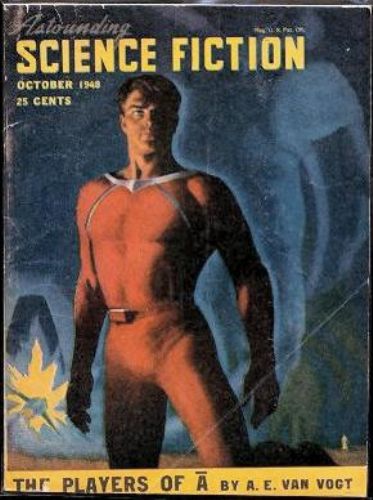
This entry in my on-going Classic Sci-Fi Book Covers series is both old and new. That is, it’s a modern touch-up of the cover from the October 1949 edition of Astounding Science Fiction painted by Hubert Rogers. That issue included a work by A.E. van Vogt, but not the one we are interested in here. This modern version is from a 1999 edition of van Vogt’s classic sci-fi novel, The War Against the Rull, which I distinctly remember devouring in two days when I was in eighth-grade.

I like this cover a lot. It’s not just a classic. It’s an archetype. Specifically, the archetype of the heroic (America) scientist, a buff intellectual and polymath whose ilk could be found in countless works of Isaac Asimov, Robert Heinlein, Roger Zelazny, and on an on. In The War Against the Rull, the man is Dr. Trevor Jamieson, a brilliant scientist who is also a fierce warrior and survival-expert. He’s stranded on an alien planet with a huge, six-legged, intelligent creature called an ezwal who wants to kill him. But when both Jamieson and the ezwal encounter a mutual enemy—a race of aggressive, centipede-like aliens called the Rull—they decide to work together to survive.

It’s a great story, like so many from the sci-fi’s Golden Age. I’ve written before about why sci-fi novels from that era are so much more enjoyable (to me, at least) than most of those written in the last ten years or so. I think it has to do with the gritty humanity of such stories. Yeah, Jamieson is essentially a comic-book character (think Doctor Quest and Race Bannon rolled into one), but van Vogt does a great job of making you believe he’s in real trouble. The ezwal, too—he’s a compelling character in his own right. You get involved in the desperate nature of their situation, and you keep reading to see how they will get out of it.

Anyway, check it out if you can…

Original Cover from Astounding
Cover from the 1970 edition that I read as a kid (by artist John Schoenherr)
Another version of the Scientist Hero Archetype (by artist James Bama)

Classic Sci-Fi Book Cover: “This Immortal”

My privious entry in this continuing “Classic Sci-Fi Book Covers” series was also devoted to Roger Zelazny, so please forgive me for double-dipping into the Zelazny well. But I couldn’t resist talking about one of Zelazny’s other great novels, …And Call Me Conrad—published in 1966 as This Immortal. Most people have never heard of it, but it’s an interesting book for several reasons.

For one, it was Zelazny’s first novel, and it has many of his signature obsessions (e.g, ancient mythology mixed with science fiction; a wise-cracking anti-hero who is also an Übermensch; epic fight scenes; etc.). For another, it actually won a Hugo Award, tying in 1966 with a slightly better-known book…Frank Herbert’s Dune. And finally, it’s just a hell of an entertaining adventure tale.

I chose this cover (by fantasy artist Rowena Morrill) because it really captures the sense of the book’s main character, Conrad Nomikos, a world-weary man-of-mystery who might be immortal. (The text suggests that he is at least a century old, and hints that he might be several thousand years older still.) He works as director of a government agency tasked with protecting and preserving the surviving relics of a destroyed earth. A nuclear war referred to by the characters as “The Three Days” has occurred many decades before, leaving most of the planet uninhabitable. The survivors, which include a wide variety of mutants both human and animal, live mainly on islands like Greece, Conrad’s home.

And that’s not even the main subject this wild, wild little book. Conrad is assigned the duty of escorting a group of VIP tourists—including Cort Myshtigo, an alien from the Vega star system whose race has purchased earth as a kind of vast museum—as they tour the planets once great sites (now ruins). Conrad soon realizes that another of the tourists, an Egyptian assassin named Hassan with whom Conrad has befriended in the past, is secretly on a mission to kill the Vegan. Hassan, it seems, has been hired for this task by an obscure, underground political group who want to reclaim earth for humanity. So, Conrad finds himself not only being a tour-guide but also an unpaid protector of Myshtigo—who he hates.

It’s a crazy book, and the cover conveys this craziness well. Though the edition is from 1980, the cover really feels like a 1970s cover, with its vaguely photorealistic painting of a ruggedly handsome dude with great hair (think Roger Staubach in his prime). I also like how Morrill works in the other tropes of the book—its setting among Greek ruins, as well as the presence of some mythological creatures in the background (which, the reader eventually learns, are actually just animals that have been mutated by radioactive fall-out).

It’s a very dated cover, but still a really cool one. Classic, one might say…

Classic Sci-Fi Book Cover: “Lord of Light”

I’ve read a lot of trippy science books in my time, but Roger Zelazny’s Lord of Light is probably the trippiest. The only one that sort of comes close is Frank Herbert’s Dune, which makes a lot of sense considering both were written in the 1960s by two extremely smart and talented writers. (One of Zelazny’s other books, This Immortal, actually shared the Hugo Award with Dune in 1967.)

In fact, there’s not really a name for what Lord of Light is. Technically, it’s science fiction fantasy (a sub-genre I’ve written about before). That is, it looks and feels like a fantasy novel (as does Dune) until you realize that the plot has a sci-fi underpinning. Lord of Light is set on an alien world in which the population is stuck in a pre-industrial state, ruled over by gods of the Hindu pantheon. These gods interact with mortal humans on a daily basis, using magical powers and objects to control their destiny. Throughout the novel, however, Zelazny drops carefully crafted clues that the “gods” are actually the crew of a starship called The Star of India, which crash-landed on the planet centuries before.

These faux-deities use high-technology to set themselves up as gods, complete with a kind of immortality (they can transfer their consciousness to new, young bodies when the old ones wear out). They rule over the common people (who are revealed to be the descendants of the passengers of the ship) with an iron fist, doling out justice and retrobution from a floating, anti-gravity city (“heaven”). This reign is, ostensibly, for the people’s own good (tyrants always say this, right?). But when one of the last democratically-minded crew members, Sam, takes on the role of Siddhartha, he poses a threat to the status quo, which has kept humanity stagnant for generations.

This 1987 edition from Avon was the one I read in college, and I still own it. Its cover was done by an English illustrator named Tim White. I really like it because it captures that essential trippiness. At first, it looks like a pop-religion book, depicting figures dressed like Hindu gods. But what’s with the blue electric bolts? Or the floating city? And why is one of the Hindu “goddesses” blonde?

Ahhh, it’s really a sci-fi novel.

Yes, it is.

Classic Sci-Fi Book Cover: “Neuromancer”

If I were to make a list of the most influential science fiction novels of all time, William Gibson’s Neuromancer would surely be on it. How often does a book create a whole genre—almost single-handedly? I say “almost” because there were other cultural touchstones of the cyberpunk genre, primarily Ridley Scott’s landmark film Blade Runner. But Neuromancer was the primary literary component of the movement, with its landscape of towering, high-tech super-cities where the rich live high (in every sense of the word), and the poor live very, very low.

Expanding on his ground-breaking short story, “Johnny Mnemonic,” Gibson created a dark near-future in which giant “mega-corporations,” many of them Japanese, have taken control of all aspects of life, and the richest people have almost become a different species. Average people either work as wage-slaves to the corporations, and the closest thing to a counterculture is a teeming underclass of rebel hackers who make their existence by spying on (and stealing from) the corporate oligarchy. 

These underground, anti-heroes are the punks of cyberpunk, and they are what made it so compelling as a genre. In a world where technology and corporate greed have dehumanized everyone, the punks beat the system at its own game. They do so by humanizing it, using their courage, individuality, and creativity to win in the one place where everyone is still equal—in the virtual world of cyberspace. 

That’s why I like this cover so much. Strangely, though Neuromancer was published forty years ago, there has never been a cover that really captured the vibe and essence of the book. Until this one. It’s a very obscure cover belonging to a Brazilian edition of the novel and created by Spanish artist Josan Gonzalez. I like it because it feels like a 1980s comic strip—specifically, the work of French artist Moebius from the magazine Métal hurlant back in the 1980s (truly, the golden age of cyberpunk). The character portrayed is, presumably, that of Case, the hacker-hero of the novel. With a cigarette dangling from his mouth and a welter of wires rising from his VR goggles (from his “brain,” essentially), he personifies the spirit of cyberpunk: a rebellious unflappability combined with human creativity and technical skill. 

Classic Sci-Fi Book Cover: “The Martian Chronicles” – Michael Whelan

When I was a public school kid back in the 1980s, I used to spend hours at the bookstore, mostly looking at science fiction books. It wasn’t just the stories themselves that interested me, but the cover art. Back then, before the internet gave one an endless supply of great sci-fi concept art of any kind, the only way to get one’s imagination going was to head to the bookstore.

So, it’s probably inevitable that I would regard that time as a golden age of sci-fi cover art. And I do. When I look at sci-fi books today, there is usually no cover art to speak of, but just an exercise in graphic design. The title goes in this font 38 point; the author’s name goes in this font at 28 point; etc.; with some blurry, abstract notion of an alien planet or a futuristic city. Back in the pre-digital days, sci-fi cover art consisted mainly of actual paintings, made by actual painters.

One of the best actual painters was (and is) Michael Whelan. His work has that perfect blend of realism, action, and whimsy that I always looked for in a good sci-fi cover. For five decades, he created some of the best covers ever made, and they earned him a place in the Science Fiction Hall of Fame.

One of my favorites is the one above, his cover for the 1990 Bantam/Spectra edition of Ray Bradbury’s The Martian Chronicles. If you haven’t read it (and you should), it’s an allegory about the loss of ancient wisdom, the horrors of capitalism, and even the conquest of the American West. Haunting the work are the ghosts of the Martians themselves, who once-great civilization is helpless in the face of the invading Earth-men, with their guns and disease and endless greed. I love this cover because it gives you a sense of that lost majesty, but it also makes you curious about the story.

In other words, it kindles the imagination.