The great B-Movie director Roger Corman has died. As a kind of tribute, I’m reposting an essay I wrote some years ago on my old blog. Enjoy!
Ever since I turned forty, I find myself going to see fewer and fewer movies. It’s only natural, I suppose. The less time you have left, the less time you want to spend in a darkened theater, lost in flights of fancy. And so, what little I know of recent film releases comes to me second-hand, either through friends or online reviews or through the film trailers that I see when I do occasionally go to a movie. Even from this limited perspective, I can glean a few obvious facts about movies these days: 1.) they are all rated PG-13 and 2.) they are all about the end-of-the-world and 3.) they all rely heavily on digital effects.
These three qualities go together, of course, for reasons that are based more in economics than anything else. The digital effects are required to attract a modern audience raised on video games and violent TV. And because these CGI effects tend to be horrifically expensive, the movies must be rated PG-13 in order to gather as large are a customer base as possible. Finally, the reliance on end-of-the-world plots come naturally, mainly because the plot-lines that justify these breathtaking explosions, airships, monsters, and laser guns usually involve some kind Biblical-style, science-fiction-themed catastrophe.
When U2’s Achtung Baby came out in 1991, critics joked that it was the album that saved the band from itself. After the enormous success of 1987’s The Joshua Tree, U2 too fell into an abyss of self-indulgence and ego with their follow-up album-and-movie extravaganza Rattle and Hum, which alienated some of their fans. Fortunately, Achtung Baby marked not only a return to form for the band but a whole new direction, one influenced by techno, funk, and other genres.
One of my favorite songs on the album is “Even Better Than the Real Thing.” Most young people today do not realize that the title and chorus on the song is a reference to Coca-Cola’s long-standing slogan: “It’s the real thing.” With his brilliant and demented lyrics, Bono twists the slogan into a critique of modern consumerism. The song is basically a sequel to The Rolling Stones’s “Satisfaction,” but with an even more apocalyptic bent.
It also has a great video, notable at the time for its innovative use of a harness in which Bono was strapped while the camera whirled around him. The final effect is both exhilarating and somewhat nauseating, literal sensory overload, in keeping with the theme of the song itself. Not to mention our modern age.
Back in the 1980s, I took a Humanities class during my freshman year of college. The professor was really good, and she supplemented her lectures by showing up a few episodes of Robert Hughes‘s BBC series Shock of the New, which covered the history of Modern Art as seen through Hughes’s own discerning, sardonic lens.
I remember being struck by how witty and intelligent Hughes seemed as he talked about numerous examples of iconic modern art and architecture. He did exactly what a good critic is supposed to do: open your eyes to meaning and resonance in art that you might have missed, and connections you never would have thought of.
I liked the series so much that I’ve watched it a couple of times since on YouTube, and I recently bought the book that Hughes wrote to accompany it. Hughes really was one the smartest and most interesting art critics of his generation, and he could really write. Take this passage, for instance, about Pablo Picasso’s most famous and disturbing work, Guernica,
Seen detached from its social context, if such a way of seeing were either possible or desirable (in Picasso’s view it would not have been, but there are still formalists who disagree), it is a general meditation on suffering, and its symbols are archaic, not historical: the gored and speared horse (the Spanish Republic), the bull (Franco) louring over the bereaved, shrieking woman, the paraphernalia of pre-modernist images like the broken sword, the surviving flower, and the dove. Apart from the late Cubist style, the only specifically modern elements in Guernica are the Mithraic eye of the electric light, and the suggestion that the horse’s body is made of parallel lines of newsprint, like the newspaper in Picasso’s collages a quarter-century earlier. [emphasis mine]
As I read this passage, I thought to myself: wow. Then I thought to myself: Mithraic? WTF is that? So, naturally, I googled it and discovered that Mithraism was a religious cult in 4th Century C.E. Rome that directly opposed Christianity and was popular with Roman soldiers. I don’t know exactly what sense Hughes was employing the word, but I think he was getting at the idolatrous aspect of Fascism—literally, an ideology opposed to Christ and Christian values—as manifested in the mid-Twentieth Century love of technology and machines. Reading Hughes’s moving and trenchant prose, I was reminded of how Picasso, eighty-seven years before Christopher Nolan’s Oppenheimer, Picasso painted the most powerful and grotesque indictment of war, and especially high-tech war, ever conceived. (Sadly, it is as relevant now as it was in 1937.)
If you have a chance, you should watch Shock of the New, or any of Hughes’s other series if you can find them. If nothing else, you’ll probably be smitten by his fascinating and highly idiosyncratic rhetorical style, with his strange (theoretically Australian) accent and tendency to punch words harder than Mike Tyson. My wife and I still joke lovingly about the way he pronounced various famous artists: i.e., Pehblo Pehkesso.
Big shout-out and many thanks to Jeff Circle for making one of his famous dossiers on me. I had a blast. He’s one of the smartest and funniest guys I’ve met in a long time.
Yeah, I know. Calling this song “rock” is a bit of a stretch. Like all of Bryan Ferry’s solo work, as well as all his hits with Roxy Music, “Don’t Stop the Dance” is a brilliant and elegant pop song. Emphasis on brilliant. What William Faulkner is to literature, Bryan Ferry is to pop music. Who else could create a song like this, one that is both eminently danceable and yet edgy and so, so cool?
I also love the music video, in which French model Laurence Treil features prominently. Ferry and Roxy Music were famous for using the faces and bodies of beautiful women as part of their branding, and Treil was the most beautiful of all. With her glamorous features and impossibly arched eye-brows, she looked like a Patrick Nagel painting that had come to life.
In some ways, Missing Persons was the ultimate west coast 80s band. With their heavy synth sound and propulsive drum beats, they were a band that could make you think and make you dance. Plus, I simply loved Dale Bozzio. Not just your average bottle-blonde space-age sex-kitten with a plexiglass bustier, Bozzio could really sing. And her baby-doll, hiccuping style was tempered with just enough knowing irony to make you realize how cool she was. In fact, she presaged another super-smart front-girl from a decade later, Shirley Manson of Garbage.
My favorite Missing Persons song is “Destination Unknown”. Ah, how true.
One of my favorite novels is William Makepeace Thackery’s The Luck of Barry Lyndon. I first got interested in it after seeing Stanley Kubrick’s amazing film adaptation, Barry Lyndon, which I didn’t really understand but which blew me away anyway. Like the movie, the book is a tragedy, the story of an honorable young man who slowly transforms into a selfish adventurer and scoundrel.
It’s a beautiful and rollicking novel, but the main reason I like it has to do with Thackery’s unusual take on the tragic hero. We were all taught in school that the reason a hero falls in a classic tragedy is because of some fatal flaw—some negative quality. But in Thackery’s vision, it is not Barry’s flaws that bring about his downfall, but rather his strengths. That is, the very qualities that bring him riches and fame in the short run—his intelligence, courage, and ambition—are the very qualities which lead to his eventual destruction.
It might seem melodramatic, but I was reminded of this idea as I read Brian J. Jones’s excellent biography, George Lucas: A Life. Although Jones never actually uses the term tragic hero in the book—to do so would be ludicrous in the case of an actual, living man, especially one as laid-back and funny as George Lucas—he nonetheless gives a sense of a person whose determination and genius have sometimes led him dangerously close to self-destruction.
When I first heard the band Garbage, I was struck by lead singer Shirley Manson and her fabulously expressive voice—at times monotonal, at other times growling. This pale goth girl from Scotland had somehow tailored her vocals to exactly fit the manic-depressive zeitgeist of the 90s.
Indeed, I would argue that the band’s premier song, “Stupid Girl,” is the definitive song of the period (yes, even more so than Nirvana’s brilliant “Smells Like Teen Spirit”). In the song’s now-famous lyric, the narrator accuses an unnamed girl of being…well…stupid. In fact, the aspects of her stupidity are those evidenced by practically every person under 40 in modern urban America: vanity, self-absorption, consumerism, nihilism.
And fakery. Especially fakery. “[I] can’t believe you fake it…” as Manson sings portentously to the stupid girl in question. What is she faking? Being human.
I have a confession to make: I love concrete architecture. I know, I know. Concrete Architecture (CA, for short) is not fashionable. It’s not renewable (not yet, anyway). It’s not touchy-feely. It’s not cool.
Part of the bad-rap CA has is due to its association with brutalism, the quasi-Soviet style that was popular in the 1970s, especially in England. Brutalism is cold. Windowless. Dystopian. Think 1984. A Clockwork Orange. Total Recall. Et cetera.
Obviously, that’s not the type of CA that I’m talking about. Rather, when I think of great concrete architecture, I think of buildings that mix smooth, rectilinear slabs of stone (that’s all concrete is, after all—artificial stone) with glass and other construction elements. When built to a more human scale, and combined with greenery and organic decoration, CA can be soothing. Symmetrical. Ordered. Neat. Human.
I keep thinking of that scene in Lawrence of Arabia when a reporter asks Lawrence, an Englishman, why he loves the desert so much. “Because it’s clean,” he says. His answer resonates on many levels: literal, moral, political, and philosophical. That’s sort of why I like CA. It’s clean. It’s calming.
Salk Institute – Louis I. Kahn, Architect
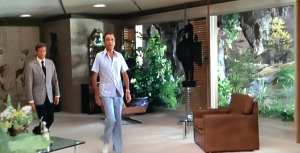
I think my first exposure to CA was from movies. Specifically, James Bond movies. There’s Willard Whyte’s desert mansion in Diamonds Are Forever (actually the Elrod House in Palm Springs by John Lautner). Then, in The Man with the Golden Gun, there’s Scaramanga’s secret lair, carved into the rock of a volcanic island. Almost every male nerd has a secret fantasy of being a Bond villain (or, at least, of having a Bond villain’s lair). What could be cooler for a bookish, introverted, probably asthmatic kid than to have his own secret, clean (pollen-free) hideout where no one, not even MI6, can find you?
Which brings me to my main point. Introverts of both sexes have a fondness for CA because we associate it with solitude, in a good way. After all, the only real experience with CA that most of us have is from public spaces—libraries, museums, research centers, etc.—whose sense of empty space is soothing to introverts (who tend to have too much internal stimulation).
So it’s no surprise that the ultimate fictional incarnation of CA would be owned by the ultimate fictional nerd, Tony Stark. His mansion in the Marvel MCU is a Lautner-esque swirl of concrete perched on a California cliff over the Pacific. The mansion is the epitome of the Bond-villain/mad scientist aesthetic. Stark, who seems to be a selfish lout but is actually psychologically damaged by the remembered death of his parents, is free to be alone in the mansion’s cavernous rooms, jammed with post-modern decorations and transhuman technology. Stark doesn’t need a human heart; he has a mechanical one, powered by cold fusion. It can’t be broken.
So, what does it say about me that I like CA so much? Basically, it says that I am an unreconstructed nerd, who likes things clean and controlled. Oh, well.









 Ash Clifton, Writer