As a long-time, struggling, nominal “artist,” I am aesthetically opposed to the idea of a supergroup. The very notion sounds like a BS, 1990s-era, dot-com bubble businessplan: 1.) Pick great musicians from two or more already famous and successful rock groups, 2.) put them in a studio with all the booze and/or drugs they want, and 3.) profit!
But I have to admit that my snobbery is unjustified, if not downright hypocritcal. There are a lot of “supergroups” whose music I love. Derek and the Dominos. Crosby, Stills, Nash and Young. The Traveling Wilburys. Hell, even friggin Toto was pretty good. (“I’ve felt the rains down in AAAAAFRI-CUH!!!”)
Them Crooked Vultures is one of the more recent (and also one of the best) rock supergroups. Representing at least two generations of great rock music, it boasts Dave Grohl on drums, Josh Homme on lead guitar and vocals, and John Paul Jones on bass. I find myself especially sentimental about Jones being in the band. Not only is he an older guy who proves that he still has the licks, but he’s one of the most under-appreciated musicians in the history of rock. When people say they love Led Zepplin, what they’s often, really saying is that they love John Paul Jones (and John Bonham, of course, rounding out one of the greatest rythym sections ever).
Below is a great live version of “Dead End Friends” in which you can see that, yes, Jones still knows how to rock. And Grohl and Homme haven’t forgotten, either.
Author’s Note: Michael Mann’s first feature film, Thief, is on-sale for dirt-cheap on Prime Video at the moment. So, I thought I’d re-post a short essay I wrote about it on my old blog some years ago. Enjoy!
When my son and I went to New York City over the summer, we stayed in Queens, just a few blocks from the Museum of the Moving Image. We spent most of our time in Manhattan, doing the tourist thing, and I never got around to the seeing the Museum. I regret this, and not only because it’s supposed to be a really cool place.
As fate would have it, I later found out that the film being screened at the Museum that week was Michael Mann’s first feature, Thief. It’s a fabulously entertaining crime thriller starring James Caan (a Bronx native) in one of the best performances of his long career. Caan plays Frank (we never learn his last name), a Chicago businessman by day and a high-end burglar by night. Like many heroes in Mann’s films, Frank is guy with a score to settle; he spent much of his youth in jail on trumped-up charges, and now stealing is his way of making for lost time.
I was going to make a new Christmas Sci-Fi List to go with the first one that I wrote some years ago. But…well…I flaked out. So, here is a belated list of some of my favorite science fiction novels. And why not? New Year’s Day is a time to think about the future, right? RIGHT?
Anyway, here’s the list…
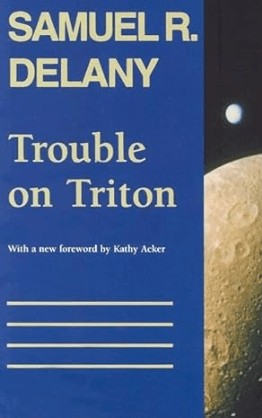
Trouble on Triton
Samuel R. Delany’s Trouble on Triton (published as Triton in the U.S.) is one of the finest written, poorly known works of literary sci-fi in publishing history. Perhaps this is due to the fact that it’s a short work—really a novella—with a post-modern, elliptical plot, not to mention some gender-bending content that was way ahead of its time. Set in a dome-style space colony on the farthest moon in the solar system, it tells the story of Bron, an ordinary schlemiel who’s in love with a mysterious, beautiful performance-artist. What really makes this book fascinating is its depiction of a high-tech, post-scarcity society that anticipated Iain Banks’s Culture novels by decades.
The Peripheral
William Gibson pretty much invented cyberpunk, so it’s fitting that he should write one of the best twists on that genre to come along in years. The Peripheral begins in what appears to be standard Gibson territory. Set in an economically devastated near-future, the story centers on Flynn, a young woman who makes her living as a remote contractor who works in the virtual reality of cyberspace. She thinks she is testing on a prototype for a video game set in a much farther distant, higher-tech future. But when she witnesses a murder in this other, virtual world, she realizes that it’s not virtual at all, but an actual, alternate future earth to which she is connected through a mysterious Chinese server.
The rest of the novel involves her getting to know her future-based boss, Wilf, and helping him solve the murder mystery. Wilf, in return, gives Flynn money and technology to help her and her friends change their timeline, hoping to avoid the environmental catastrophe—a.k.a. “The Jackpot”—that has denuded the planet in Wilf’s. (He explains that their timelines are now independent of each other, so she won’t be messing with his present.) It’s one of Gibson’s best, tightest books with a page-turner plot and some brilliant twists.
The Man in the High Castle
Speaking of alternate timelines, have you ever felt like you were stuck in the wrong one? And it’s not a good one? This is the experience of all the characters in The Man in the High Castle. Set in the 1960s, the book imagines an alternate earth where the Axis powers won World War II. Nazi Germany controls the American east coast, Japan the west coast, and the midwest serves as a vast DMZ between the two. Like most of Dick’s novels, the novel involves several interlocking narratives concerning characters from all classes, high and low, each of whom struggles to be a good person in an insane world.
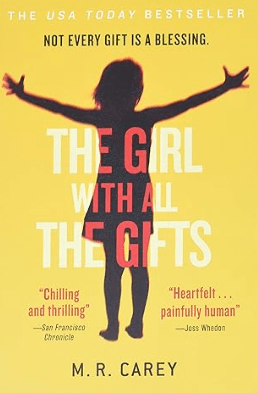
The Girl with All the Gifts
In the last twenty years, there have been so many zombie apocalypse novels, movies, tv shows, and video games that one would expect it to be completely…well, dead. Played out. Void of new ideas.
That’s what I thought when I picked up The Girl with All the Gifts. You can imagine my surprise when I found it to be one of the best written, engrossing, and often thrilling novels I’ve ever read. Its great strength lies in its central twist on the zombie story: the hero (actually heroine) is, herself, a zombie.Sort of. Ten year-old Melanie is infected with the fungus that turns people into zombies, but despite an almost irresistible hunger for human flesh, she retains her human intellect and sensibility. A prisoner in a military-run research station tasked with studying zombie children, Melanie has super-human strength, a genius I.Q., and a love of Greek mythology. She also loves her “teacher” (actually, a sympathetic scientist), Miss Justineau.
When the research station is overrun by zombies, Melanie becomes the savior of her former captors as they make their way across the English countryside, trying to get back to human-controlled territory. The great irony of the novel is that most of the evil Melanie confronts on her journey comes from humans, not zombies. (Or maybe that’s not so ironic, after all.)
The Wave
Known primarily for his mystery novels, Walter Mosley is just a damned good writer, period. The Wave is a rip-snorting, old-school sci-fi novel with a modern sensibility. It’s about a working-class stiff named Errol who comes home one night to find that his father has paid him a visit. No big deal, except for the fact that his father has been dead for years.
The explanation lies is an sentient extremophile that lives so deep in the earth’s crust it has never been discovered…until now. Intelligent and deadly, it can take the shape of any biological form (including poor Errol’s dead father), accessing the target’s memories and consciousness in the process. Errol soon finds himself on the run from scientists who want to study the entity and military men who want to kill it. Good stuff from one of the best.
(…or, Why I Leave My Christmas Lights Up Till January 5th)
I’m a big fan of the Brother Cadfael novels by Edith Pargeter. Brother Cadfael is a medieval monk who has two areas of expertise: botany (plant-based medicine) and solving crimes. Ever since I began reading the Cadfael series about twenty years ago, I’ve been fascinated by the richness and detail of Catholic dogma. Like all monks, Brother Cadfael observes the canonical hours that strictly divide the entire day into a schedule of prayer sessions (for which he is always late). And I also became interested in the various holy days that he and his fellow monks observe.
Perhaps that’s the reason I refuse to consider Christmas over on December 26. Rather, I prefer to stick to the original church concept of Christmastide, which begins on Christmas Day and extends all the way to Twelfth Night on January 5 (better known as Three Kings Day in the Latin community).
Twelfth Night is, of course, marks the Day of the Epiphany when the Christ-child was perceived by the wise men as a divine being. The wise men are, themselves, a subject of fascination for me. Their story—which is barely mentioned in the bible—has become embellished over the centuries by various Catholic fanboys. According to current tradition, there were three of them, and they were in fact kings from various parts of the orient: Balthasar of Arabia, Melchior of Persia, and Caspar of India. In some versions, their various ages are given as 20, 40, and 60, representing the three phases of a person’s life (youth, middle-age, and old-age).
So, if you’re still hung over from Christmas Day (I’m speaking metaphorically, although I did have a bit of whiskey in my eggnog), take heart. Christmas might be over, but Christmastide goes on and on. As it should. Those medievals had a much better sense of how to celebrate, from which we, as harried, stressed-out, modern Westerners have much to learn.
And whether you’re a Christian or a lapsed-Christian or just a secular person who respects the Christ figure and observes the holiday solely from a sense of tradition, why not extend the holiday a bit, even past New Year’s Day? Leave your Christmas lights up. Give another present or two to your loved ones. Have another feast.
I’ve been seeing a lot of on-line ads for the new Nosferatu movie directed by Dave Eggers. It looks like a pretty good movie, although, judging by the trailers, it seems to be emphasizing the horror (e.g., slasher) elements of the classic Nosferatu/Dracula story over the erotic angle (which most film adaptations have veered toward).
Or does it? Looking at the poster, the hook line poster reads “Succumb to the Darkness.” It’s a seductive line, which doesn’t quite seem to go with the image portrayed—that of a beautiful young woman in a nightgown lying on her back with her mouth open, while a skeletal, monstrously taloned hand reaches for her face.
Erotic? Not really. Gross? Yeah, kinda. This thematic confusion between the film’s trailer and its poster reflects, I think, the difficulty in adapting the Dracula story to the screen. (Yes, I know that Nosferatu is not the same as Dracula, but close enough.) The difficulty is made worse in our present time, the 21st Century, when porn is only a few clicks away and the idea of truly transgressive sexual activity is more and more difficult to imagine.
Last month, I reran an old post about how much I love the classic sci-fi film Forbidden Planet. Then, just over a week later in a striking and somewhat sad example of synchroncity, the last suriving cast member of that film, Earl Holliman, passed away at the age of 94.
Holliman’s brief performance as the boozing, womanizing cook in Forbidden Planet was a highlight of the movie. This is not surprising; Holliman was one of the best character actors of his generation, performing in countless movies and TV shows. These ran the gamut from Westerns, cop dramas, thrillers, and (of course) science fiction.
Physically, Holliman had the kind of rugged, Southern-style good looks that were a requirement for tough-guy roles back in the day. Actually, he looked a bit like another great TV actor, James Garner (not to mention my dad). The picture above shows him in all his 1970s-era glory.
Forbes Magazine has a nice tribute article about him here.
Like all great rock bands, U2 has always has always had the ability to reinvent itself. Just when you think it’s completely washed out and finished, the members come up with another great album. They did it in 1991 withAchtung Baby and again in 1994 with How to Assemble an Atomic Bomb. The best song off that latter album is “Vertigo,” which also has one of the cooler music videos the band has ever appeared in.
I have a theory about horror novels. The secret to a good horror novel, I think, is not gore, or violence, or even suspense. The secret is empathy. The empathy we, as readers, form for the main characters, and the empathy the main characters feel for each other.
This should be obvious, but it’s not. I have read (well, started) many celebrated horror novels, some of them very well written, only to set them aside after a chapter two because I didn’t care about any of the characters. Contrast this with the very best horror fiction from masters like Stephen King. King is famous for creating main characters who are kind, decent, spirited people with whom the reader instantly connects (and worries about). King’s characters also tend to be underdogs and outcasts. Nerds. Geeks. Handicapped kids. Fat kids. Gay kids. Such types are the most vulnerable in our society, and therefore most vulnerable to whatever monster Kings pits them against. Their underdog status makes them even more sypathetic to readers, and makes their courage even more admirable.
This is not to say that protagonists of horror novels should be all good. Far from it. In fact, King often presents the reader with deeply flawed, erratic main characters who must discover their own inner resilience and courage to face the evil that confronts them.
Recently, I found myself thinking about such matters as I read Lois Murphy’s excellent novel Soon from 2019. Like many great horror books (or many great books of any kind), Soon stays with you long after you finish the last page. It’s got some genuinely creepy stuff in it. Most of all, though, it has a likable, sympathetic, and funny main character named Pete.
Pete is a retired cop who lives in the tiny town of Nebulah in rural Australia. Nebulah is a new twist on the concept of a “ghost town” in that its inhabitants are literally tormented by ghosts. Rather, by a strange, evil entity called The Mist that descends upon the town every evening. From this vapor, a hellish gallery of semi-corporeal spirits attacks any person foolish or unlucky enough to be caught outside after sundown. The victims suffer grisly, violent deaths, but their bodies are never found. (Their remains dissolve mysteriously in the mist soon after being discovered.)
Not surprisingly, the town’s population rapidly dwindles from a few hundred to a few dozen, and then down to just eleven. Most people leave. The rest are picked off one by one. Pete is one of the de facto leaders of this tiny remnant of hard-core town folk, most of whom are too poor or feckless or otherwise attached to the place to ever leave. Pete is neither poor, nor attached, nor feckless, but he stays anyway, mainly to protect his friends. These survivors meet each night at one of their homes and spend the night together, trying to hear the demonic wailings and thrashings coming from outside the windows and doors. (The Mist, rather like vampires, can’t cross the solid threshold of a home unless there is some gap that would let it in.)
I find myself admiring much of Ms. Murphy’s writing, especially in the way she renders the character of Pete. The plot also has some genuinely surprising twists and interludes, such as when Pete goes to visit his estranged daughter in a distant city.
Most of all, I liked the psychological realism of the book. Everyone left in Nebulah has some damned good, practical reasons for not leaving (just ask them), but none of these seems greater than what we suspect is a fundamental weakness in their character. Some are afraid of being poor in a new place. Others are reluctant to give up the homesteads they have labored to improve over the years. Some are just too tired.
Others, like Pete himself, have some secret sin to atone for, and a guilt that keeps them from leaving.
If you were to ask a music lover to name the most iconic pop band of the 1970s, their answer would probably be The Bee Gees. And they’d be right–mostly. For about three years, The Bee Gees bestrode the world like a collosus, leading the musical and cultural era that was disco.
But, for my money, it was the Electric Light Orchestra that most defined 70s pop. The creation of musical genius Jeff Lynne, E.L.O. was hit machine that cranked out gold records with regularity. Their songs were all over the radio here Gainesville, and their records were coveted.
And expensive. I remember looking at Out of Blue in the record store and was shocked to see that it was priced at $14.99. (This was back when ten bucks would get you a decent dinner in a real restaurant.)
My favorite E.L.O. song is, of course, “Turn to Stone”, which is the perfect fusion of pop and rock. Cinemaphiles will note that it was this song that P.T. Anderson ended his great film Boogie Nights with.
When I was teenager (ahem, some years ago) I had the good fortune to see Robin Williams perform. He was the lead entertainment for that year’s Gator Growl, the annual pep rally thrown by the University of Florida. At the time, Williams was mainly known as the odd but extremely funny star of TV’s Mork & Mindy. Few were aware that he was first and foremost a stand-up comedian, and even fewer knew just how brilliant—not to mention obscene—his style of comedy could be. So, you can imagine the surprise (and shock) that ensued when he walked out on stage and did his first joke, miming the cocking action of a shotgun as well as the sound: KA-CHICK. “Down here in the South,” he said, “if you hear that sound, you’d better be one fast motherfucker!”
The ensuing performance became a local legend. I remember it as being as incredibly manic and astoundingly creative. William’s comedy was like nothing else around at that time. It wasn’t long before he emerged as the premier comedian of his generation. And, since his suicide in 2014, he has become firmly embedded in our national consciousness as the Greatest Comedian of All Time.
This is a justifiable opinion. For my money, though, there was one comic who surpassed even Williams in his intellect, inventiveness, and sheer genius. This was Richard Pryor.