Back in the late 1990s, every guy I knew under the age of thirty had a copy of The Prodigy‘s Fat of the Land album. This was the case even though there was nothing particularly new about the record itself; Big Beat had been around for years, and some of the songs on the album itself had come out on previous albums. Nevertheless, each song is more than the sum of its parts. Each one comes together into a delierously wicked electro-dance mash-up that remains unrivaled.
Back in the day, my favorite song off the album was the problematically entitled “Smack My Bitch Up”. (As far as I’m concerned, the title is camp, if not actual satire in the Spinal Tap mode.) But these days, my favorite The Prodigy song is probably this little gem, “Firestarter”.
Back in the dot.com boom of the 1990s, I was lucky enough to work for an IT company based in New York City. I was a remote worker, writing software eight hours a day in my spare bedroom in Gainesville, Florida. It was a win-win situation. I got to work from home, and my bosses got a good developer for country-boy wages (and I was still in the same time zone).
Occasionally they would fly me to the city for a meeting and I would spend my evenings wandering the streets of Manhattan, which is surely the most beautiful and bewitching cities of the earth. My favorite spot is the Met. Like a lot of introverts, I love museums, and the Met is the greatest of them all. I mean, how many museums have their own Egyptian Temple? Indoors?
Once I spent an entire weekend roaming its halls, barely scratching the surface of its vast collections. I tend to gravitate toward the Modern period from the early- and mid-twentieth century. From guys like Matisse and Picasso all the way to Hopper and O’Keefe.
From a historical perspective, my interest stopped after that. I never much got the whole Post-Modern thing—Abstract Expressionism and all that. It seemed too theoretical. A joke that high-brow art critics had played on the rest of us, as Tom Wolfe wrote so wittily in The Painted Word.
I recently found myself in the so-called “green room” of a TV studio in Biloxi, Mississippi, waiting to be interviewed about a book-reading I was doing that week. The interview was to air live on a local current events show, and another guest waiting for his spot was a musician for a band called The Molly Ringwalds. He was friendly and very smart, and we began to chat (I did so to relieve my nervousness; he was just being nice).
In the course of conversation, he explained that The Molly Ringwalds (as I should have guessed, but didn’t) is an 1980s tribute band that covers all kinds of hits from that by-gone era, which I also love. I asked him if they did any songs by The Smiths, and he said they did.
“Which one?” I asked.
“‘How Soon is Now?’ What else?”
What else, indeed. “How Soon is Now?” is not only The Smiths’ greatest song, it’s one of the greatest rock songs ever. It’s also one of the most complicated. From its famous guitar overture, warbling and full of dark menace, to its anguished lyrics by the brilliant Morrisey, “How Soon is Now?” is both a dance song and a dirge. It’s also a cry of rebellion against conformity, prejudice, and alienation.
Since it first hit the clubs in 1985, the song has been taken up as an anthem by the LGBTQ community, and rightly so. But I think it resonates equally well with any introvert, outcast, or general freak who just, well…needs to be loved.
People love tag-teams. It’s in our nature. Have you noticed that almost every work of epic literature across the world has not one but two main heroes. The Gilgamesh epic has Gilgamesh and Enkidu. The Iliad has Achilles and Odysseus. The Authurian legends have Arthur and Lancelot. DC has Superman and Batman.
In all of these examples, the two heroes have much in common, but they are also different in some fundamental and defining way. They not only compliment each other, they contrast each other.
More importantly, they make the story a lot more fun.
I think of this dynamic whenever I hear “Under Pressure” by Queen and David Bowie. Together, the band and the singer represented a group of pop titans of the 1980s. But there were huge functional and artistic differences between them. Bowie was probably the greatest musical artist of his generation, known for inventive and experimental works that never failed to surprise or thrill his fans. Queen was a great rock band, constructed around the epic voice of Freddie Mercury and the epic guitar skills of Brian May. The idea of bringing these two forces together might have been disastrous. That is, they might have canceled each other out.
But no. Instead, their talents together to create one of the best rock songs ever recorded. From the amazing bass riff (whose author is disputed) to the colossal bridge near the end, it’s still one of my favorites.
Enjoy…!
BONUS: Here is a great live performance of the song by Bowie and Annie Lennox.
The grunge era of rock music began around 1991, when bands like Soundgarden, Pearl Jam, and (especially) Nirvana began to get massive play on FM radio. I remember how earth-shaking the sound seemed to me, at the time, when I first heard “Smells Like Teen Spirit.” Even playing on the tinny speakers of my old econobox car, the power and passion of the music hit me like a revelation.
Sadly, of those three original, vanguard bands, the frontmen of two are no longer with us. Kurt Cobain and Chris Cornell committed suicide, decades apart, and only Eddie Vedder remains. It might sound strange, but I suspect that if someone had asked me back in 1991 which of those three men (and bands) would still be around in thirty years, I probably would’ve guessed Vedder—and not just because he sang “I’m still alive” so defiantly in the chorus of my original favorite Pearl Jam song, “Alive.” Vedder’s voice and lyrics had just as much power and pathos as Cornell’s or Cobain’s, but it was also tinged with a kind of dogged defiance that resonated with me. Like Vedder, I had a fairly traumatic childhood, and I liked the way he sang about the act of survival as, itself, a kind of redemption. As my old mentor Harry Crews once famously said, “Survival is triumph enough.”
Pearl Jam’s “Corduroy” came out a few years after that first grunge wave crested, but it has since become one of my favorite songs of all time.
There is a cool website called My Book, The Movie where authors can describe their dream movie production of their book. The gentleman who runs the site invited me to post, and here is the result…
Not long ago, I read a very fine biography called Furious Love: Elizabeth Taylor, Richard Burton, and the Marriage of the Century by Nancy Schoenberger. I picked it up not only because I am a huge fan of Richard Burton but also because of my growing interest in Taylor, who was surely one of the most remarkable people of the 20th Century. It was Taylor who, upon hearing that her great friend Montgomery Clift had just been in a car accident a few blocks away, literally ran to the scene. She got there in time to pull one of Clift’s dislodged teeth from his throat just before he choked on it. Pretty amazing.
Clift’s importance in the larger story of Taylor and Burton’s whirlwind romance is minor. He is only mentioned in one or two parts. And yet his unexpected appearance in the book fascinated me, especially when Schoenberger reveals the mutual disdain that Clift and Burton felt for each other. Jealously over Taylor’s affections surely had something to do with this, despite the fact that Clift was gay and by all accounts his relationship with Taylor was platonic. But even deeper than this personal rancor lay an artistic rivalry between the two men regarding their respective abilities as actors.
Clift was one of the first and greatest alumni of “the method” studios taught by Stella Adler and Lee Strasberg, which emphasized acting as a physical interpretation of deep psychological impulses. The actor seems to transform into the character from the “inside out”. (Think Robert De Niro in Raging Bull or…well…any other De Niro movie.)
The great B-Movie director Roger Corman has died. As a kind of tribute, I’m reposting an essay I wrote some years ago on my old blog. Enjoy!
Ever since I turned forty, I find myself going to see fewer and fewer movies. It’s only natural, I suppose. The less time you have left, the less time you want to spend in a darkened theater, lost in flights of fancy. And so, what little I know of recent film releases comes to me second-hand, either through friends or online reviews or through the film trailers that I see when I do occasionally go to a movie. Even from this limited perspective, I can glean a few obvious facts about movies these days: 1.) they are all rated PG-13 and 2.) they are all about the end-of-the-world and 3.) they all rely heavily on digital effects.
These three qualities go together, of course, for reasons that are based more in economics than anything else. The digital effects are required to attract a modern audience raised on video games and violent TV. And because these CGI effects tend to be horrifically expensive, the movies must be rated PG-13 in order to gather as large are a customer base as possible. Finally, the reliance on end-of-the-world plots come naturally, mainly because the plot-lines that justify these breathtaking explosions, airships, monsters, and laser guns usually involve some kind Biblical-style, science-fiction-themed catastrophe.
When U2’s Achtung Baby came out in 1991, critics joked that it was the album that saved the band from itself. After the enormous success of 1987’s The Joshua Tree, U2 too fell into an abyss of self-indulgence and ego with their follow-up album-and-movie extravaganza Rattle and Hum, which alienated some of their fans. Fortunately, Achtung Baby marked not only a return to form for the band but a whole new direction, one influenced by techno, funk, and other genres.
One of my favorite songs on the album is “Even Better Than the Real Thing.” Most young people today do not realize that the title and chorus on the song is a reference to Coca-Cola’s long-standing slogan: “It’s the real thing.” With his brilliant and demented lyrics, Bono twists the slogan into a critique of modern consumerism. The song is basically a sequel to The Rolling Stones’s “Satisfaction,” but with an even more apocalyptic bent.
It also has a great video, notable at the time for its innovative use of a harness in which Bono was strapped while the camera whirled around him. The final effect is both exhilarating and somewhat nauseating, literal sensory overload, in keeping with the theme of the song itself. Not to mention our modern age.
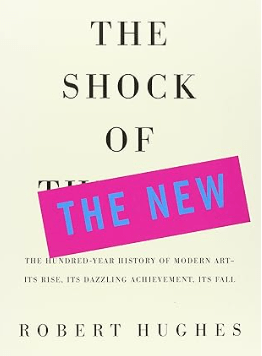
Back in the 1980s, I took a Humanities class during my freshman year of college. The professor was really good, and she supplemented her lectures by showing up a few episodes of Robert Hughes‘s BBC series Shock of the New, which covered the history of Modern Art as seen through Hughes’s own discerning, sardonic lens.
I remember being struck by how witty and intelligent Hughes seemed as he talked about numerous examples of iconic modern art and architecture. He did exactly what a good critic is supposed to do: open your eyes to meaning and resonance in art that you might have missed, and connections you never would have thought of.
I liked the series so much that I’ve watched it a couple of times since on YouTube, and I recently bought the book that Hughes wrote to accompany it. Hughes really was one the smartest and most interesting art critics of his generation, and he could really write. Take this passage, for instance, about Pablo Picasso’s most famous and disturbing work, Guernica,
Seen detached from its social context, if such a way of seeing were either possible or desirable (in Picasso’s view it would not have been, but there are still formalists who disagree), it is a general meditation on suffering, and its symbols are archaic, not historical: the gored and speared horse (the Spanish Republic), the bull (Franco) louring over the bereaved, shrieking woman, the paraphernalia of pre-modernist images like the broken sword, the surviving flower, and the dove. Apart from the late Cubist style, the only specifically modern elements in Guernica are the Mithraic eye of the electric light, and the suggestion that the horse’s body is made of parallel lines of newsprint, like the newspaper in Picasso’s collages a quarter-century earlier. [emphasis mine]
As I read this passage, I thought to myself: wow. Then I thought to myself: Mithraic? WTF is that? So, naturally, I googled it and discovered that Mithraism was a religious cult in 4th Century C.E. Rome that directly opposed Christianity and was popular with Roman soldiers. I don’t know exactly what sense Hughes was employing the word, but I think he was getting at the idolatrous aspect of Fascism—literally, an ideology opposed to Christ and Christian values—as manifested in the mid-Twentieth Century love of technology and machines. Reading Hughes’s moving and trenchant prose, I was reminded of how Picasso, eighty-seven years before Christopher Nolan’s Oppenheimer, Picasso painted the most powerful and grotesque indictment of war, and especially high-tech war, ever conceived. (Sadly, it is as relevant now as it was in 1937.)
If you have a chance, you should watch Shock of the New, or any of Hughes’s other series if you can find them. If nothing else, you’ll probably be smitten by his fascinating and highly idiosyncratic rhetorical style, with his strange (theoretically Australian) accent and tendency to punch words harder than Mike Tyson. My wife and I still joke lovingly about the way he pronounced various famous artists: i.e., Pehblo Pehkesso.