Classic Sci-Fi Book Cover: “The War Against the Rull”

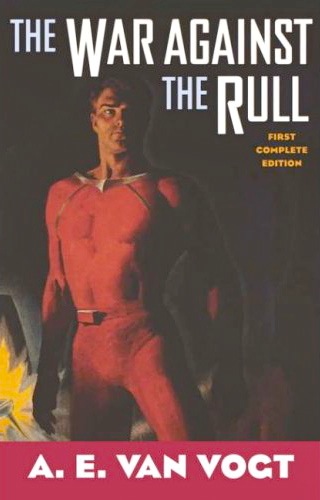
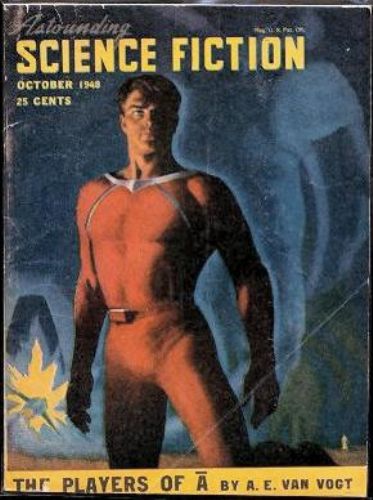
This entry in my on-going Classic Sci-Fi Book Covers series is both old and new. That is, it’s a modern touch-up of the cover from the October 1949 edition of Astounding Science Fiction painted by Hubert Rogers. That issue included a work by A.E. van Vogt, but not the one we are interested in here. This modern version is from a 1999 edition of van Vogt’s classic sci-fi novel, The War Against the Rull, which I distinctly remember devouring in two days when I was in eighth-grade.

I like this cover a lot. It’s not just a classic. It’s an archetype. Specifically, the archetype of the heroic (America) scientist, a buff intellectual and polymath whose ilk could be found in countless works of Isaac Asimov, Robert Heinlein, Roger Zelazny, and on an on. In The War Against the Rull, the man is Dr. Trevor Jamieson, a brilliant scientist who is also a fierce warrior and survival-expert. He’s stranded on an alien planet with a huge, six-legged, intelligent creature called an ezwal who wants to kill him. But when both Jamieson and the ezwal encounter a mutual enemy—a race of aggressive, centipede-like aliens called the Rull—they decide to work together to survive.

It’s a great story, like so many from the sci-fi’s Golden Age. I’ve written before about why sci-fi novels from that era are so much more enjoyable (to me, at least) than most of those written in the last ten years or so. I think it has to do with the gritty humanity of such stories. Yeah, Jamieson is essentially a comic-book character (think Doctor Quest and Race Bannon rolled into one), but van Vogt does a great job of making you believe he’s in real trouble. The ezwal, too—he’s a compelling character in his own right. You get involved in the desperate nature of their situation, and you keep reading to see how they will get out of it.

Anyway, check it out if you can…

Original Cover from Astounding
Cover from the 1970 edition that I read as a kid (by artist John Schoenherr)
Another version of the Scientist Hero Archetype (by artist James Bama)

What I’m Reading: “Dancing with Myself”

Dancing with Myself book

In any given decade, one or two musicians discovers exactly the right sound, look, and vibe to capture the spirit of the times. Such “triple-threat” artists are rare. Elvis Presley was one. David Bowie was another.

For many in my generation of kids growing up in the early 1980s, there were two such figures. One was Madonna. The other was Billy Idol. Unless you were a teenager in that dark, troubled time, you can’t imagine what a huge impact Idol had on youth culture. Let’s start with his look, an ingenious mix of pre-Goth romanticism (complete with black leather and rosary beads) and science-fiction cyberpunk (he had the same peroxide blond hair and chiseled features as Rutger Hauer’s Nazi replicant in Blade Runner).

Idol looked like…well…an idol. A pop idol, that is. But it was his sound that really mattered. Just as Elvis took the energy and soul of R&B and turned into something that middle-class, white American kids could enjoy, Idol took the punk sound of 1970s London and turned it into kick-ass American hard rock. His early hits like “White Wedding” and “Mony, Mony” stuck out a mile on FM radio (not to mention MTV, where they stuck out two miles). Not only were his songs vicious and fast, they had an actual beat; you could dance to them. And we did.

In short, Idol did what the Sex Pistols never could: he brought punk to mainstream America.

Continue reading “What I’m Reading: “Dancing with Myself””

Synchronicity for Bookworms: Martin Caidin

Iron_Annie
German Ju-52 “Iron Annie”

Some years ago, my son Connor and I were watching the movie Dunkirk on DVD. It’s a very good movie, telling the story of that fateful week from multiple points-of-view. Of course, the most compelling thread of the narrative is that of the lone RAF pilot (played by Tom Hardy) doing his heroic best to protect the stranded British troops.

These scenes inevitably led to a geek-worthy discussion between Connor and me about the relative merits of the RAF’s Spitfire versus the Luftwaffe’s Messerschmitt 109. Believe it or not, such discussions are becoming more common between fathers and sons (and mothers and daughters, for all I know), mainly because of online games like War Thunder, whose popularity has breathed new life into the study of military history by the Millennial generation.

Anyway…. At some point during the discussion, I offhandedly commented that I had once flown in Adolf Hitler’s airplane.

Continue reading “Synchronicity for Bookworms: Martin Caidin”

R.I.P. Gene Hackman

My parents divorced when I was a little kid. My mom was struggling with mental illness (undiagnosed, at the time) and so I went to live with my father and his new wife, my step-mother Eileen. I saw my mom mostly on the weekends, and we would invariably go to the movies. I probably saw over fifty movies in the theater per year, all with my mom.

I seldom went to the movies with my father, and even more seldomly when it was just the two of us. The last time I remember was in 1992. Eileen was out-of-town with my brother and sister, so Dad and I went to see Clint Eastwood’s Unforgiven. It’s a great movie, and both my father and I loved it. We especially admired Gene Hackman’s performance as the villainous sheriff Little Bill Daggett, who, as Hackman himself revealed, is a kind of precursor to the modern right-wing movement. 

My dad and I went out to dinner after the movie, and we shared our favorite moments from the film. It’s one of my fondest memories. I thought of it this morning when I read that Hackman had died. And I thought of something else, too. It occurred to me that the last movie I saw alone with my mother was also a Gene Hackman film, 1985’s Twice in a Lifetime. It’s about as different a film from Unforgiven as one can possibly imagine, with Hackman playing a completely different kind of character. And yet, it was still Hackman. Still low-key. Still forceful. Still brilliant.

What are the odds that the two last movies I saw with each of my parents alone were both Hackman films? Pretty good, actually. He was in a lot of movies. In fact, you could argue that he was the most versatile, compelling, and attractive character actor in Hollywood history. He played villains and heroes, and everything in between, across genres from action to mystery to sci-fi. In Twice in a Lifetime, he played an unassuming everyman who, on the tail-end of middle-age, leaves his wife to make a new start. He was also Lex Luthor in Superman. And Pop-eye Doyle in The French Connection. And the blind guy in Young Frankenstein

Being a writer of mysteries, I’m particularly fond of Authur Penn’s 1975 film Night Moves, in which Hackman played a world-weary P.I. searching for a missing girl. It’s one of trademark, understated performances, and yet it crackles with energy. That was his gift. 

Godspeed, Mr. Hackman…!!!

The Scientist Hero: Our Newest Cinema Archetype

Martian3

One of my favorite movies of the last twenty years is Ridley Scott’s The Martian. It’s a science-fiction/adventure movie about an astronaut (Matt Damon) who becomes stranded on Mars after his comrades leave him for dead. Marooned on a barren, hostile world, he has to use his brains and ingenuity to survive until his friends come back to rescue him. By the end of the movie, he has survived dust storms, explosions, freezing temperatures, and starvation.

How does he overcome all these challenges?

Science.

The story is familiar, of course. It has many antecedents, including with the original stranded-on-an-island novel, Robinson Crusoe, and also (more directly) to a great B-movie Robinson Crusoe on Mars. In that classic 1964 cheese-fest, the hero survives by finding a Martian cave full of air where plants still grow, water still flows, and there’s a steady source of light (which is never explained). He even befriends an alien who is also trapped on the planet.

Continue reading “The Scientist Hero: Our Newest Cinema Archetype”

Friday Night Rock-Out: “Anarchy in the U.K.”

Sometimes you just have to go back to basics. And what could be more basic than the definitive punk-rock song of all time?

Some things you might not know about the Sex Pistols: 1.) Their original name was The Pistols. Their favorite venue was a club called Sex. The rest is history. 2.) They only had one studio album. 3.) They broke up on stage in San Francisco on their one and only U.S. tour. 4.) John Lydon was given his nickname, Johnny Rotten, for his bad teeth (allegedly).

Also, Billy Idol uses the opening lines of “Anarchy in the U.K.” as the opening lines for his excellent memoir Dancing with Myself. Who am I to argue with Billy Idol?

R.I.P. David Lynch

Photo by Alan Light, CC BY 2.0

It has been a week since David Lynch passed away, and many great tributes have already been written about him. I’m tempted to say that I needed a week to process his passing and figure out what I wanted to say about him, but the truth is I was just too damned busy to write anything. In fact, I knew instantly what I wanted to say—simply, that Lynch was a very important person in my life, and in the lives of many of my friends.

I was a college English major in 1986 when Blue Velvet came out, and it hit me and my circle of arty friends like an atomic blast. I already knew of Lynch’s work (I was one of the few kids to see The Elephant Man, and in an actual movie theater, no less), and I knew that he was a director of enormous visual and thematic power. But even I was unprepared for Blue Velvet. On the one hand, it’s a murder mystery, an homage to the noir films of the 1950s in which an unsuspecting suburban kid discovers a hidden world of violence, evil, and, (of course) depraved sexuality. On the other hand, it’s a surrealist vision of the inner world of a modern young man (and, probably, many young women). I was roughly the same age as the main character, Jeffrey Beaumont, in 1986, and so the film had special resonance. I felt like the landscape of my own imagination was a strange blend of the beautiful and the grotesque—often in the same image. And that’s exactly what the film captures, somehow.

Continue reading “R.I.P. David Lynch”

Friday Night Rock-Out: “Authority Song”

There is a great documentary on Netflix about the legendary record producer Clive Davis. One of the more interesting moments in the film is when Davis describes some of the fine artists he didn’t sign to his label, either because someone else beat him to punch or because he thought the artist in question just didn’t fit in with his catalog.

One example he gives of the latter is John Mellencamp, who, despite being saddled with the dumb, management-invented stage-name of John Cougar, hit the airwaves like a thunderbolt in the early 1980s. Mellencamp, Davis lamented, seemed too similar to another of Davis’s great artists, Bruce Springsteen, in that they both played soaring, electrified dirges about working class America (i.e., so-called “Heartland Rock,” even though Springsteen is famously from New Jersey). So, to his later regret, Davis passed.

Too bad for him. Mellencamp sold a bazillion records over the years, while gradually ditching the John Couger moniker and returning to his own, real name. As he did so, I gradually came to like him more and more. His early hits like “Jack and Diane” didn’t speak to me, perhaps because I was in high school at the time (just like Jack and Diane), and while the song was a paeon to lost youth and spirit, I was miserable in high school. (Later, I would realize that I probably would have liked high school a lot better if I had gone to Mellencamp’s, nestled somewhere in small-town America, full of cool, down-to-earth, nice kids instead of the jocks and preppies I was used to. And, yes, I eventually fell in love with and married a girl named Diane.)

But my opinion of Mellencamp’s music changed when his “Authority Song” came out. Not only is it one of the most danceable songs of the 80’s, it’s also one of rock music’s most defiant and rebellious rejections of… well…authority.

I’ve liked Mellencamp ever since. In fact, I think he’s a bit of genius.

Rock on…

Friday Night Rock-Out: “Dead End Friends”

As a long-time, struggling, nominal “artist,” I am aesthetically opposed to the idea of a supergroup. The very notion sounds like a BS, 1990s-era, dot-com bubble businessplan: 1.) Pick great musicians from two or more already famous and successful rock groups, 2.) put them in a studio with all the booze and/or drugs they want, and 3.) profit!

But I have to admit that my snobbery is unjustified, if not downright hypocritcal. There are a lot of “supergroups” whose music I love. Derek and the Dominos. Crosby, Stills, Nash and Young. The Traveling Wilburys. Hell, even friggin Toto was pretty good. (“I’ve felt the rains down in AAAAAFRI-CUH!!!”)

Them Crooked Vultures is one of the more recent (and also one of the best) rock supergroups. Representing at least two generations of great rock music, it boasts Dave Grohl on drums, Josh Homme on lead guitar and vocals, and John Paul Jones on bass. I find myself especially sentimental about Jones being in the band. Not only is he an older guy who proves that he still has the licks, but he’s one of the most under-appreciated musicians in the history of rock. When people say they love Led Zepplin, what they’s often, really saying is that they love John Paul Jones (and John Bonham, of course, rounding out one of the greatest rythym sections ever).

Below is a great live version of “Dead End Friends” in which you can see that, yes, Jones still knows how to rock. And Grohl and Homme haven’t forgotten, either.

Rock on…!

Perfect Films: “Thief”

Thief2

Author’s Note: Michael Mann’s first feature film, Thief, is on-sale for dirt-cheap on Prime Video at the moment. So, I thought I’d re-post a short essay I wrote about it on my old blog some years ago. Enjoy!

When my son and I went to New York City over the summer, we stayed in Queens, just a few blocks from the Museum of the Moving Image. We spent most of our time in Manhattan, doing the tourist thing, and I never got around to the seeing the Museum. I regret this, and not only because it’s supposed to be a really cool place.

As fate would have it, I later found out that the film being screened at the Museum that week was Michael Mann’s first feature, Thief.  It’s a fabulously entertaining crime thriller starring James Caan (a Bronx native) in one of the best performances of his long career. Caan plays Frank (we never learn his last name), a Chicago businessman by day and a high-end burglar by night. Like many heroes in Mann’s films, Frank is guy with a score to settle; he spent much of his youth in jail on trumped-up charges, and now stealing is his way of making for lost time.

Continue reading “Perfect Films: “Thief””