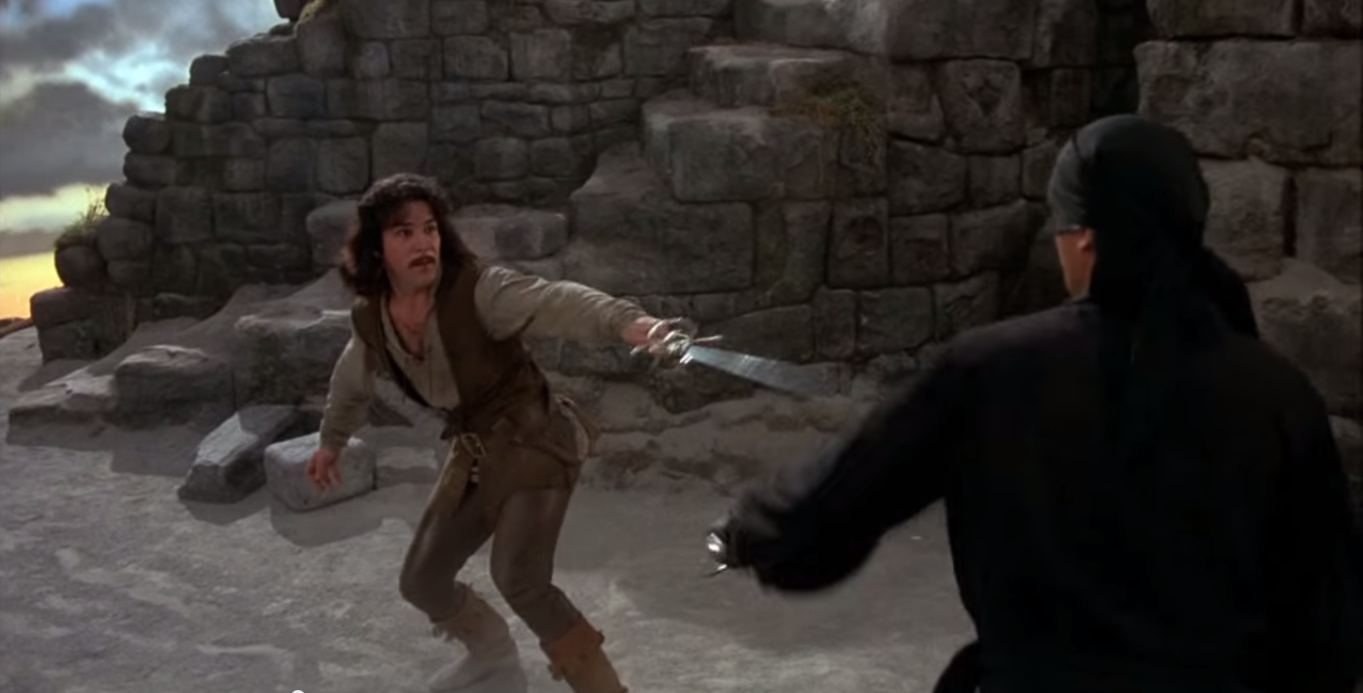
Author’s Note: Well, I finally watched Project Hail Mary a few days ago. The film is a mash-up of The Andromeda Strain, Planet of the Apes, E.T., Wall-E, and at least half-a-dozen other classic sci-fi movies. And that’s okay. Everything is a remix. And Project Hail Mary is a fine film—gorgeous, exciting, suspenseful, and (yes) heartwarming.
It’s also another great example the The Scientist Hero archetype that I suggested a while back (writing about another Andy Weir film, The Martian.) So, I thought I would repost. Enjoy…
One of my favorite movies of the last twenty years is Ridley Scott’s The Martian. It’s a science-fiction/adventure movie about an astronaut (Matt Damon) who becomes stranded on Mars after his comrades leave him for dead. Marooned on a barren, hostile world, he has to use his brains and ingenuity to survive until his friends come back to rescue him. By the end of the movie, he has survived dust storms, explosions, freezing temperatures, and starvation.
How does he overcome all these challenges?
Science.
The story is familiar, of course. It has many antecedents, including with the original stranded-on-an-island novel, Robinson Crusoe, and also (more directly) to a great B-movie Robinson Crusoe on Mars. In that classic 1964 cheese-fest, the hero survives by finding a Martian cave full of air where plants still grow, water still flows, and there’s a steady source of light (which is never explained). He even befriends an alien who is also trapped on the planet.
Author’s Note: The Department of Defense released some more really cool ufo videos yesterday. So, I thought it would be a good time to re-post a review I wrote some years ago of a great book on the subject. Enjoy…!!!
From 1989 to 1992 I went to graduate school at the University of Arizona. This was around the same time that Fife Symington was elected governor of that fine state. I don’t remember having any opinion of Symington at the time, except that he seemed a man very much in the mold of Arizona politicians: a conservative, folksy cowboy.
So it was probably not that big of a surprise when, six years later, Symington handled an unusual political crisis in what many saw as a callous, flippant way. The crisis in question was a UFO—literally, an unidentified flying object—that was spotted by hundreds of people in the Phoenix area on the night of March 13th, 1997. The incident, which has since become known as The Phoenix Lights UFO Incident, resulted in dozens of 911 calls and hundreds of letters being written to the governor. Eventually, Symington was forced to hold a press conference about the event, in which he essentially laughed-off the whole affair. (One of his aides came to conference dressed as a green alien. Hilarity ensued.)
This is just one of many stories which writer Leslie Kean has recounted in her fascinating book, UFOs: Generals, Pilots, and Government Officials Go on the Record. Kean, who has become a favorite bête noire of scientists and UFO debunkers, has been writing about the UFO phenomenon for many years. In this book, she describes many of the more famous incidents in a sober, agnostic tone that I found completely engrossing. In fact, after reading Kean’s meticulously documented and detailed narrative, I decided that one of two things must be true:
The book is an extremely clever work of fiction masquerading as journalism or…
UFOs are a genuine mystery, one which has been experienced by many people for a very long time.
Leslie Kean
Yeah, I know. Any rational skeptic would point out a third, more obvious possibility. Namely, that Kean is just a very silly woman who is misinterpreting the testimony of many other silly people who think they have seen something strange—odd lights in the sky which are almost certainly a natural phenomenon, probably the planet Venus. (Venus seems to be the go-to scapegoat put forth by many of these debunkers.)
But Kean has crammed her book with so many testimonials from so many apparently rational, non-silly people that I just can’t buy this argument. (I mean, have you ever mistaken Venus for a UFO?)
Most startling among these testimonials was that by none other than Symington himself. Incredibly, despite his ridicule of the sightings in 1997, Symington eventually admitted that he had seen the UFO. To his credit, he writes a chapter about this in Kean’s book, beginning with this simple, explosive statement:
Between 8:00 and 8:30 on the evening of March 13th, during my second term as Governor of Arizona, I witnessed something that defied logic and challenged my reality: a massive, delta-shaped craft silently navigating over the Squaw Peak in the Phoenix Mountain Preserve.
Symington goes on to explain that the sighting were so widespread that he felt compelled to “dampen any incipient panic” on the part of his constituents, hence the infamous press conference in which he basically made the whole matter into a joke.
Former Arizona Governor Fife Symington
Which leads me to another aspect of Kean’s book that I found totally fascinating: the idea that so-called “UFO coverups,” which are the bread-and-butter of The X-Files and so many other science fiction stories, might be nothing more than an institutional form of denial.
One is reminded of the late Soviet Union, in which prostitution was officially declared to no longer exist, which meant that women who were caught engaging in that trade had be arrested for some other crime, such as loitering. The Party Line is a powerful motivator, psychologically speaking, and it might also be at the root of the self-censorship that high officials like Symington (Jimmy Carter is another famous example) imposed on themselves.
In fact, Kean suggests that such a choice might actually be a complex psychological defense mechanism, a way of dealing with the anxiety which might otherwise result from an actual admission that one has perceived a genuine mystical experience. This idea was explicated in detail by two political scientists, Alexander Wendt and Robert Duval, in their 2008 academic paper, “Sovereignty and the UFO.” In this paper, they make the case that mere possibility that extraterrestrials might exist represents a such a mind-blowing idea that it cannot be entertained or harbored, not even secretly. Such a discovery, after all, would completely undermine the legitimacy of every national governments on earth, whose compact with the citizenry is based on the premise that human beings are alone in the universe and must be final arbiters of their own destiny.
It’s a very clever theory, and typical of the kind of intelligent discourse that pervades Kean’s book. As she herself states early on, 95% of all UFO sighting are simple cases of mistaken identity—aircraft, balloons, flares, hoaxes and (yes) Venus. But the other 5% remain a mystery. Nothing more or less; just a mystery.
So what’s the big deal? Can’t we still have mysteries without getting all bent out-of-shape? Apparently, not.
The problem, as Kean explains it, is that…
…[t]he term “UFO” has been misused and become so much a part of the popular culture that its original (and accurate) definition has been completely lost. Almost everyone equates the term “UFO” with extraterrestrial spacecraft, and thus, in a perverse twist of meaning, the acronym has been transformed to mean something identified instead of something unidentified.
When I first read this passage, I was impressed by Ms. Kean’s obviously lucid and graceful explanation of this fascinating paradox. But I could also detect a faint whiff of disingenuousness. After all, if strange triangular objects really are zipping around our skies at tremendous speeds, thumbing their noses at our own pathetic avionic abilities, what other explanation comes to mind?
Even so, I found buying Kean’s essential arguments: that UFOs really constitute some kind of unsolved atmospheric events, that the people who see them are not crazy, and that they might indicate some world-changing scientific discovery (yes, aliens). If she’s a nut, then I’m a nut too.
Author’s Note: There has a been a lot of really cool UFO news lately (especially this article), so I thought I would re-share an old post I wrote some years ago regarding a fine book on the subject. Enjoy!
From 1989 to 1992 I went to graduate school at the University of Arizona. This was around the same time that Fife Symington was elected governor of that fine state. I don’t remember having any opinion of Symington at the time, except that he seemed a man very much in the mold of Arizona politicians: a conservative, folksy cowboy.
So it was probably not that big of a surprise when, six years later, Symington handled an unusual political crisis in what many saw as a callous, flippant way. The crisis in question was a UFO—literally, an unidentified flying object—that was spotted by hundreds of people in the Phoenix area on the night of March 13th, 1997. The incident, which has since become known as The Phoenix Lights UFO Incident, resulted in dozens of 911 calls and hundreds of letters being written to the governor. Eventually, Symington was forced to hold a press conference about the event, in which he essentially laughed-off the whole affair. (One of his aides came to conference dressed as a green alien. Hilarity ensued.)
One of my favorite movies of the last twenty years is Ridley Scott’s The Martian. It’s a science-fiction/adventure movie about an astronaut (Matt Damon) who becomes stranded on Mars after his comrades leave him for dead. Marooned on a barren, hostile world, he has to use his brains and ingenuity to survive until his friends come back to rescue him. By the end of the movie, he has survived dust storms, explosions, freezing temperatures, and starvation.
How does he overcome all these challenges?
Science.
The story is familiar, of course. It has many antecedents, including with the original stranded-on-an-island novel, Robinson Crusoe, and also (more directly) to a great B-movie Robinson Crusoe on Mars. In that classic 1964 cheese-fest, the hero survives by finding a Martian cave full of air where plants still grow, water still flows, and there’s a steady source of light (which is never explained). He even befriends an alien who is also trapped on the planet.
I learned many things from reading the excellent nonfiction book Would You Baptize an Extraterrestrial? For instance, I learned that the Vatican has its own astronomical observatory, which is run, in part, by the authors, Guy Consolmagno and Paul Mueller. Both men are also Jesuits. (The current Pope, Francis, is also a Jesuit—that’s another thing I learned).
Now, I was raised Catholic, and I thought a knew a thing or two about the religion. But not only did I learn from this book that the Vatican has its own observatory, but that it has had one for hundreds of years. In fact, I was so taken by this discovery that I Googled “Vatican observatory” and, to my amazement, found that the Vatican also runs an observatory in Tucson, Arizona.
Talk about synchronicity! When I was twenty-two years old, I went off to attend grad school at the University of Arizona, in Tucson, and I distinctly remember the first night I spent there. I impressed by the size of the city—much larger than my little hometown of Gainesville, Florida—but also by how beautiful the desert sky was. Even in the downtown area, the stars were clearly visible. This was no accident; the city, I was told, purposely kept the streets relatively dark, in deference to the many astronomical observatories that surround the valley, which could not function if too much light pollution bled from the metro area.
Apparently, the Vatican’s observatory is one of them.
A few years ago, I was reading yet another popular science book—I think it was Brian Greene’s The Elegant Universe—when I came across a reference to one of those barroom brain teasers. It goes like this: if your image in a mirror is reversed with regard to right/left and left/right, why is not also reversed from up/down and down/up?
The answer, while elementary, is surprisingly difficult to articulate. It helps to imagine yourself, not face-to-face with your reflection, but back-to-back, with the plane of the mirror between you and your mirror-doppelgänger. Now stick your arms out and waggle your fingers. For both you and your reflection, up is still up, and down is still down. This side (left to you, right to your doppelgänger) is still this side, and that side (right) is still that side.
The only real difference is that up/down has an objective definition; that is, which direction is the earth and which the sky. But left/right has a purely subjective definition, relative to whose set of eyes one is looking through.