Why I am Nostalgic for Big-Brained Aliens

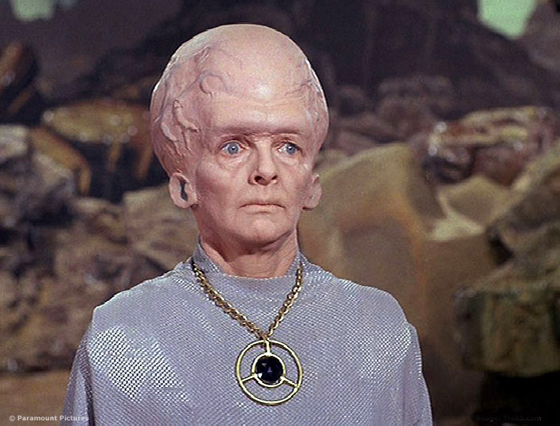
All this spring, my son Connor and I have been watching of the original Star Trek on Netflix.  Connor likes the original shows almost as much as The Next Generation, and even I find myself getting caught up in some of the more classic episodes like Space Seed (the one with Khan).  I also really like the pilot, The Cage.  That’s the episode where Jeffrey Hunter is Captain Pike, trapped on a planet run by bubble-headed alien telepaths who throw him in a zoo with the luscious Susan Oliver.  (Poor bastard.)

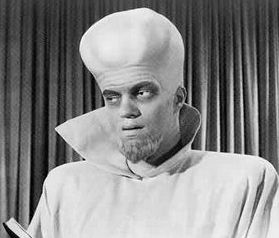
As we watched this particular episode—Connor for the first time, me for the bazillionth—it occurred to me that the Big-Brained Alien is one science fiction trope that has pretty much disappeared.  As far as I can tell, it has gone the way of the jet-pack and the glass-tube elevator.  This dearth of chrome-domed alien baddies is just another indication, I suppose, of how much things have changed. Back when I was a kid, every extra-terrestrial was guaranteed to have a skull like a beach ball.  Even the wise, Christ-like alien Klatuu from Robert Wise’s The Day the Earth Stood Still had a big head (although this was probably no one’s fault—Michael Rennie just had a big damned head!).

alien3

Remember those aliens who want to invite all of humanity over for dinner in the classic Twilight episode, To Serve Man?  Huge heads.  Or the killer vegetable alien in The Thing.  Huge freaking head.

As to how this visual cliché came about in the first place, I can only assume it was because of Anthropology class.  Specifically, all those anthropology classes that educated, middle-class kids started taking in college during the Cold War.  For the first time, ordinary people began to learn about human evolution, and how the human brain has tripled in size during the last two million years.  The implication was obvious.  Bigger brains means bigger intellect.  To extrapolate this trend into the future led to the obvious conclusion: beings of the future will have enormous brains.

In other words, the original Big Brained Alien is…us.

Continue reading “Why I am Nostalgic for Big-Brained Aliens”

Friday Night Rock Out

This Thursday will mark the six-year anniversary of Chris Cornell’s death, and I am still pretty messed up about it. 

Apparently, his friend Alice Cooper referred to him as “The Voice,” a moniker that, as some students of pop culture might recall, was also given to Frank Sinatra, back in his day. It makes sense. Cornell was my generation’s Sinatra. 

Actually, with his four-octave range, Cornell was my generation’s Freddie Mercury. Whoever you compare him to, he was a genius, not just for his voice but for his ability to make you feel something, to strike deeply at some hidden spot in the soul. Like the other two titans of the grunge era, Kurt Cobain and Eddie Vedder, Cornell’s singing made you feel unhinged, as if he was doing the hard work of going mad so that you didn’t have to. Only more so.

Anyway, here’s one of my favorites from Soundgarden…

Today I Learned a Word: “Panentheism”

I am continually amazed at how, even in my advanced middle-age, I still encounter perfectly reasonable words that I have never seen before. The latest is panentheism, which I ran into while reading an article on my favorite theological scholar, David Bentley Hart. When I first saw the word, I read it out loud to myself: pan-en-theism. Theism I knew. That’s the belief in a God who created the universe and who participates in its functioning. Pantheism I knew. That’s the belief that nature and God are the same thing. (I.e., the universe is God; this is pretty much the idea behind many Eastern religions.)

But panentheism? WTF?

David Bentley Hart

It turns out that panentheism is a pretty old idea, too, although the term itself dates only to the 19th Century. Panentheism states that God created the universe but also transcends the universe. Basically, the universe (heck, make that the multiverse) is a manifestation of the mind of God. It exists inside God, but it is not the same thing as God. 

Unless you’re an atheist (which is cool), you might be scratching your head right about now and saying “duh!” If so, that means you were probably not raised in an orthodox Christian or Jewish tradition, which, in the mode of classical theism, states that God created the world out of nothingness, and that God is inherently separate from (external to) the world. 

As modern, post-Star Wars (read: “the Force”) Americans, we tend to have a belief system much more in line with eastern traditions. Namely, that God is everywhere and everything. But that is not what classical, western, old-time religions teach.

Since I’ve learned about panentheism, I’ve found it an increasingly seductive idea. It merges the inclusive spirituality of pantheism with the belief in a personal, transcendent god that is more familiar to western theists. It also has implications to the concepts of God’s participation in time and to human free will. 

But those are topics for another post…

Old Robot Cheats Death

If there’s one kind of story I’m a sucker for, it’s the has-been-makes-a-comeback. You know the formula: a once-great hero (i.e. athlete/cop/musician/artist) is down on his luck. They’re disrespected, lonely, and all but forgotten. But then, with the help of a much younger and optimistic (or older and wiser) companion, the hero gets a burst of inspiration. They discover that they still have vast, untapped powers, and through great discipline, courage, and sacrifice, they focus those powers on a new challenge. Then, at the climax of the tale, they face that challenge and triumph.

I have, of course, just described every single Rocky movie (yes, even Rocky II) as well as 10% of all the Hollywood movies ever made. My favorite cinematic example is a little movie from 2005 called The World’s Fastest Indian, starring Anthony Hopkins. But I tend to like any variation of the formula, even the most banal and overused variety.

Continue reading “Old Robot Cheats Death”

15 Hollywood Archetypes

Well, another summer is about to begin, and, once again, I don’t plan on seeing any of the summer “blockbusters” that are coming out. I just can’t work up much enthusiasm for the big summer debut. The problem is that now, in my 50s, I have seen so many movies that I recognize the same characters over and over in an endlessly repeating loop.  Don’t believe me? Check out the list below…

The Dark Prince

flynn
redford
cage
dicaprio
mathew


Brooding, sexy, and smart, the Dark prince is often caught up in a hopeless battle against a larger system that is both impersonal and oppressive. These guys don’t smile a lot.

Famous Examples:

  • Errol Flynn
  • Robert Redford
  • Nicholas Cage
  • Leonardo Dicaprio
  • Matthew McConaughey

The Vixen (with a Brain)

dietrich
taylor
turner
basinger
scarlet


This archetype is reserved for actresses whose sex appeal is so strong that it blasts off the screen like a blowtorch. But the magic comes when the viewer realizes that there is much more to these women than just a pretty face. Often portrayed as a scarlet woman or a femme fatale, this archetype always has a troubled past and is unable to sustain a genuine relationship.

Continue reading “15 Hollywood Archetypes”