I’ve been seeing a lot of on-line ads for the new Nosferatu movie directed by Dave Eggers. It looks like a pretty good movie, although, judging by the trailers, it seems to be emphasizing the horror (e.g., slasher) elements of the classic Nosferatu/Dracula story over the erotic angle (which most film adaptations have veered toward).
Or does it? Looking at the poster, the hook line poster reads “Succumb to the Darkness.” It’s a seductive line, which doesn’t quite seem to go with the image portrayed—that of a beautiful young woman in a nightgown lying on her back with her mouth open, while a skeletal, monstrously taloned hand reaches for her face.
Erotic? Not really. Gross? Yeah, kinda. This thematic confusion between the film’s trailer and its poster reflects, I think, the difficulty in adapting the Dracula story to the screen. (Yes, I know that Nosferatu is not the same as Dracula, but close enough.) The difficulty is made worse in our present time, the 21st Century, when porn is only a few clicks away and the idea of truly transgressive sexual activity is more and more difficult to imagine.
Christmas came early for me this year! Many thanks to Ms. Oline Cogdill and the good folks at the Sun-Sentinel for putting Twice the Trouble on their Best Mystery Fiction Books of 2024 list! I am very honored.
The first DVD I bought was Blade Runner. The second was Forbidden Planet. This latter film is a science fiction classic from Hollywood’s second golden age, 1956 (the same year that John Ford’s landmark film The Searchers was released). Perhaps the definitive pulp sci-fi movie, it’s got everything you might expect: stalwart heroes, spaceships, lasers, aliens, a teen-aged hottie, a mad scientist, and even a talking robot.
And monsters, of course. Monsters from the Id.
Ever since I first saw Forbidden Planet on TV when I was kid, I’ve loved it. Here are ten reasons why…
1.) Altair IV
Forbidden Planet is, to my knowledge, the first Hollywood movie to depict human beings landing a spaceship on a planet of another star. This was a fairly landmark achievement in the history of science fiction cinema, made even better by the film’s two art directors, Cedric Gibbons and Arthur Lonergan. In their vision, Altair becomes a green- and blue-tinged desert, not unlike that of John Ford’s American Southwest. Considering this was done with matte paintings and other pre-CGI effects, it’s amazing how good the landscapes are, so desolate and full of foreboding. It’s a prefiguration of all the wild worlds of Star Wars, Star Trek, and so on, yet to come.
I have a theory about horror novels. The secret to a good horror novel, I think, is not gore, or violence, or even suspense. The secret is empathy. The empathy we, as readers, form for the main characters, and the empathy the main characters feel for each other.
This should be obvious, but it’s not. I have read (well, started) many celebrated horror novels, some of them very well written, only to set them aside after a chapter two because I didn’t care about any of the characters. Contrast this with the very best horror fiction from masters like Stephen King. King is famous for creating main characters who are kind, decent, spirited people with whom the reader instantly connects (and worries about). King’s characters also tend to be underdogs and outcasts. Nerds. Geeks. Handicapped kids. Fat kids. Gay kids. Such types are the most vulnerable in our society, and therefore most vulnerable to whatever monster Kings pits them against. Their underdog status makes them even more sypathetic to readers, and makes their courage even more admirable.
This is not to say that protagonists of horror novels should be all good. Far from it. In fact, King often presents the reader with deeply flawed, erratic main characters who must discover their own inner resilience and courage to face the evil that confronts them.
Recently, I found myself thinking about such matters as I read Lois Murphy’s excellent novel Soon from 2019. Like many great horror books (or many great books of any kind), Soon stays with you long after you finish the last page. It’s got some genuinely creepy stuff in it. Most of all, though, it has a likable, sympathetic, and funny main character named Pete.
Pete is a retired cop who lives in the tiny town of Nebulah in rural Australia. Nebulah is a new twist on the concept of a “ghost town” in that its inhabitants are literally tormented by ghosts. Rather, by a strange, evil entity called The Mist that descends upon the town every evening. From this vapor, a hellish gallery of semi-corporeal spirits attacks any person foolish or unlucky enough to be caught outside after sundown. The victims suffer grisly, violent deaths, but their bodies are never found. (Their remains dissolve mysteriously in the mist soon after being discovered.)
Not surprisingly, the town’s population rapidly dwindles from a few hundred to a few dozen, and then down to just eleven. Most people leave. The rest are picked off one by one. Pete is one of the de facto leaders of this tiny remnant of hard-core town folk, most of whom are too poor or feckless or otherwise attached to the place to ever leave. Pete is neither poor, nor attached, nor feckless, but he stays anyway, mainly to protect his friends. These survivors meet each night at one of their homes and spend the night together, trying to hear the demonic wailings and thrashings coming from outside the windows and doors. (The Mist, rather like vampires, can’t cross the solid threshold of a home unless there is some gap that would let it in.)
I find myself admiring much of Ms. Murphy’s writing, especially in the way she renders the character of Pete. The plot also has some genuinely surprising twists and interludes, such as when Pete goes to visit his estranged daughter in a distant city.
Most of all, I liked the psychological realism of the book. Everyone left in Nebulah has some damned good, practical reasons for not leaving (just ask them), but none of these seems greater than what we suspect is a fundamental weakness in their character. Some are afraid of being poor in a new place. Others are reluctant to give up the homesteads they have labored to improve over the years. Some are just too tired.
Others, like Pete himself, have some secret sin to atone for, and a guilt that keeps them from leaving.
For those of you who might be in the Atlanta area on October 7, please stop by the Flat Shoals library for my book talk. The event is at 6:00 p.m., and I’ll be reading from my mystery novel, Twice the Trouble.
Of all the categories of genre fiction that I’ve consumed over my lifetime, fantasy has probably best the least represented. Sure, I love The Lord of the Rings, and The Narnia Chronicles, and the works of Ray Bradbury that I consider to be dark fantasy (see Something Wicked this Way Comes). But I don’t keep up with many modern fantasy writers nor read many contemporary fantasy novels.
So, you can imagine my surprise when I took a chance on Susanna Clarke’s Piranesi, a fantasy novel that made quite a splash when it came out in 2020, and I enjoyed the hell out of it. It’s a fascinating story of a man trapped in a labyrinth that he calls The House, and which is composed of endless Greco-Roman halls lined with innumerable statues and vestibules. There is a sky above and ocean tides below, which often flood the lower levels. The man is called Piranesi by the only other person (i.e., “the Other”) in The House, an older man who seems able to leave somehow, only to return with key supplies like vitamins and batteries, which he shares with Piranesi.
It’s a fascinating book, and unexpectedly suspenseful, too, especially when Piranesi begins having flashbacks of who he is and how he came to be in the House. This happens about the same time as the sudden appearance of mysterious, written messages that are scattered throughout the House. They seem to have been left by another, recent intruder (one who seems interested in helping Piranesi escape).
For me, at least half of the appeal of Piranesi lies in this whodunnit factor. Like the protagonist himself, I was caught up in the mystery of how he came to be there, who he is, and how he might get out. But the other half lay in the dizzying, intricate nature of the setting—the endless labyrinth that Piranesi inhabits. Such dreamlike settings are more common in literature than one might think, and their appeal is very much like that of a vivid, fabulously detailed diorama, of the sort that all children love to gaze into (and imagine themselves inside).
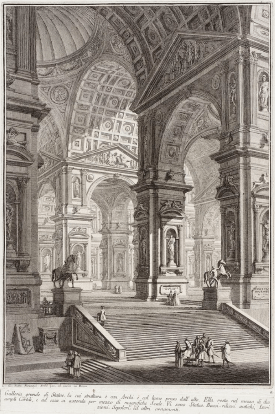
Capriccio Illustration by Giovanni Piranesi
I don’t know what it is, exactly, about mazes, labyrinths, and castles that evokes the power of imagination, But I think it has to do with their endless novelty, the promise of infinite rooms and corridors that we, like children, would love to explore. More to the point, such structures also symbolize the power of imagination—especially the child-like imagination that each of us still harbors. That’s why there is such a grand tradition of castles and mazes in fantasy literature and mythology, from the Minotaur’s labyrinth to the vast, rambling ruins of the Gormenghast trilogy.
Clarke herself acknowledges this tradition in her main character, Piranesi, who is named after Giovanni Battista Piranesi, the 18th Century illustrator who was famous for his drawings of impossibly grand and complicated imaginary buildings. His most famous works are a series of etchings titled Carceri d’invenzione (Imaginary Prisons), and these are, themselves, part of a much older tradition of so-called capricci, drawings that depict architectural fantasy.
Well, I finally watched Dune: Part Two (henceforth known as Dune 2) last night. I’m a big fan of the first film (part 1), and I was very eager to see this one (although not eager enough, apparently, to shell-out for theater tickets; oh, well).
Dune 2 is, obviously, an amazing film, even when viewed on a TV screen. A lot of people have commented on how much the movie reminds them of Lawrence of Arabia, and it’s true. Why not? Frank Herbert was, himself, influenced by Lawrence when he wrote the book. But as I watched Dune 2, I kept thinking of another classic film, The Godfather. They’re practically the same movie, when you think about it. Duke Leto is the Godfather, the noble monarch of a great and honorable kingdom. Arrakis is New York City, full of violence, corruption, and sadistic evil. Paul is Michael, the exiled prince, who is at first reluctant to take up his old man’s role but later succumbs to the circumstances that surround him, and to his own desire for revenge. Chani is Kay. Gurney is Clemenza. And on and on.
I mean this comparison, of course, as a compliment. Dune 2 is an archetypal film, as is The Godfather. And, like The Godfather, it’s got some electrifying scenes of action, woven inside a theme of how good can survive in an evil universe without becoming evil itself. (Dune 2, like The Godfather, leaves the question unresolved.)
I did have some pretty major complaints about the movie, especially in the way it handles time. Correct me if I’m wrong, but the entire story takes place during Lady Jessica’s pregnancy with the unborn Alia. Right? So, unless babies in the Dune universe take a lot longer to gestate, that’s less than nine months—which makes no logical sense. (In the book, it’s more like four years.) Even more problematic, for me, is the film’s unrelenting depictions of sadism. The Harkonnens—the greatest lovers of BDSM fashion in the galaxy—are always stabbing or crushing or slicing somebody up, usually someone helpless and innocent. Yeah, I get it; evil is the major theme of the movie. But I couldn’t help but think that director Denis Villeneuve (who is, I believe, a genius) takes it just a little…bit…too…far. I mean, we get four or maybe five scenes that are essentially remakes of The Empire Strikes Back with Darth Vader killing some dim-witted subordinate.
Still, it’s a great movie, exciting and fluid and beautifully acted. I’ll watch it again. If you haven’t seen it (which I seriously doubt), check it out…
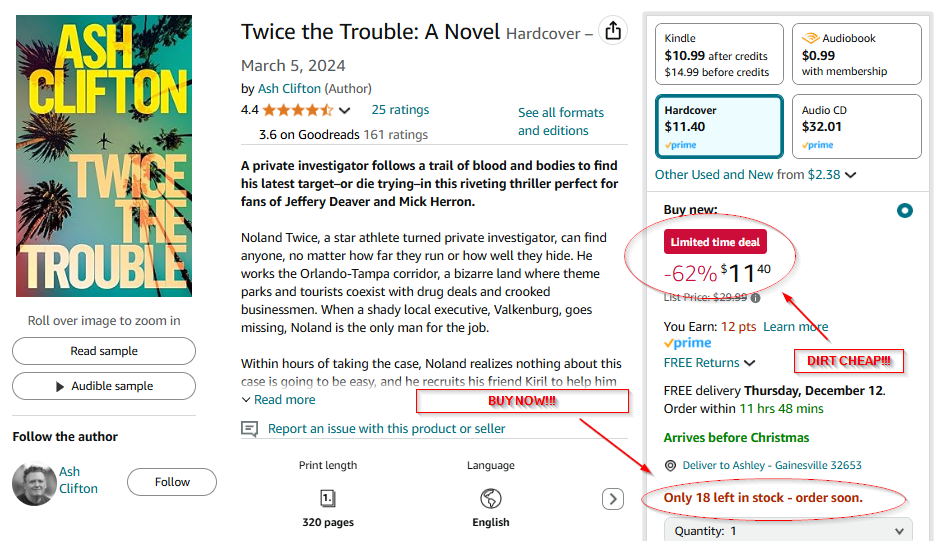
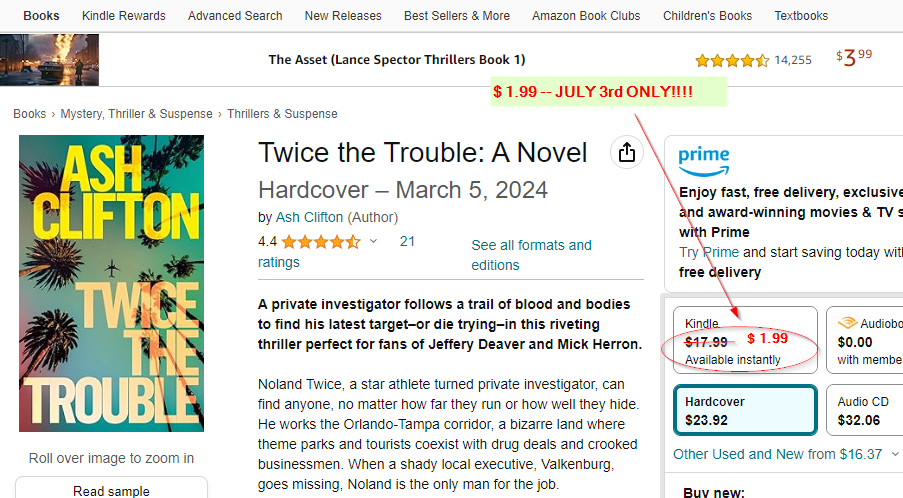
Heads Up!!! For today only, Twice the Trouble will be on sale for $1.99 on Amazon Kindle!!! Yes, you read that correctly. $1.99!!! Not even 2 bucks! Cheap!!! Buy it for your ma! Buy it for your pa! Buy it for your Significant Other! Buy it for your ex! Buy it for your Significant Other’s ex! Just buy the damn thing! Buy buy buy!





 Ash Clifton, Writer