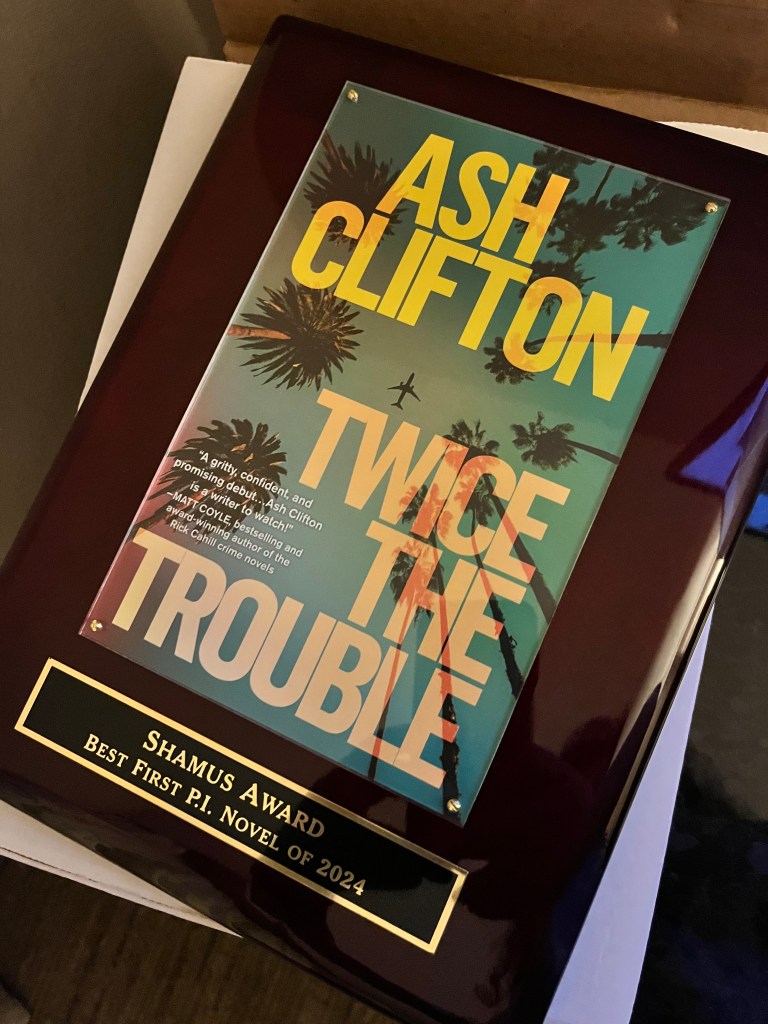
I’m very honored to announce that Twice the Trouble has won this year’s Shamus Award in the First Novel category. Many, many thanks to the Private Eye Writers of America, my incredible agent Cindy Bullard, and Crooked Lane Books!!!

I’m very honored to announce that Twice the Trouble has won this year’s Shamus Award in the First Novel category. Many, many thanks to the Private Eye Writers of America, my incredible agent Cindy Bullard, and Crooked Lane Books!!!

As I’ve stated before, one mark of a truly fine mystery novel—for me at least—is if I feel the need to go back and reread it. This isn’t just a matter of me waiting long enough to forget whodunnit (a period of time that grows shorter the older I get), it’s also an indication that something about the novel stuck with me, and made me want to revisit its imagined world.
So, it’s perhaps not surprising that I find myself rereading many of Edith Pargeter’s (writing as Ellis Peters) Brother Cadfael novels. Currently, I’m on The Rose Rent, which is about as fine an episode in the series as any. It has all the components of a truly great mystery novel—namely, a compelling and complicated sleuth; an entrancing and alien setting; original and interesting secondary characters; and a multi-layered plot.
And a voice. Of course, a great narrative voice. Take the opening paragraph of the novel:
By reason of the prolonged cold, which lingered far into April, and had scarcely mellowed when the month of May began, everything came laggard and reluctant that spring of 1142. The birds kept close about the roofs, finding warmer places to roost. The bees slept late, depleted their stores, and had to be fed, but neither was there any early burst of blossom for them to make fruitful. In the gardens there was no point in planting seed that would rot or be eaten in soil too chilly to engender life.
I love the elegance and almost romantic feel to this passage, which is characteristic of all Pargeter’s writing. You feel like you’re in competent hands, which is crucial considering that you’ve been transported to England in the Twelfth Century. (Specifically, to Shrewsbury, the town where Cadfael lives as the resident herbalist of the local Benedictine monastery.) I love the sense of desolation in this opening. We can almost feel the lingering winter, which has gone on too long and threatens the well-being of the town, including the ordinary folk, the monks, and even the nobles. It also suggests the coming tragedy of the murder around which the story will be revolve—that of a young, love-stricken monk who is killed trying to protect the woman with whom he has become infatuated.
Yes, it’s a desolate opening. But with Pargeter, you never really feel hopeless. Sure, it’s the Dark Ages, but her stories are populated with good, strong, shrewd people who always find a way to make the best of things. Take this paragraph, which comes a bit later and introduces Brother Cadfael himself:
Brother Cadfael, preoccupied with his own narrower concerns, continued to survey the vegetable patch outside the wall of his herb-garden, digging an experimental toe into soil grown darker and kinder after a mild morning shower. “By rights,” he said thoughtfully, “carrots should have been in more than a month ago, and the first radishes will be fibrous and shrunken as old leather, but we might get something with more juices in it from now on. Lucky the fruit-blossom held back until the bees began to wake up, but even so it will be a thin crop this year. Everything’s four weeks behind, but the seasons have a way of catching up, somehow. Wareham, you were saying? What of Wareham?”
#
He is speaking, of course, to his best friend, Hugh Berenger, the Sheriff of Shrewsbury. Berenger is a much younger man, but like Cadfael he is world-weary, experienced, and tough. Indeed, many of the best novels in the series depict bad guys who underestimate Berenger, with his mild demeanor and slight build, as weak. He is, in fact, an intelligent man and a cunning fighter. Berenger has just brought news of the most recent battle of the on-going English civil war (the Anarchy) which serves as the backdrop for all the novels. Berenger, we know, has befriended Cadfael in part because they have both been soldiers—in Cadfael’s case, a veteran of the First Crusade, which caused him to live in the Middle East for many years, where he lived with a Muslim widow and fathered a child with her.
A great part of the appeal of these novels is this tension between two sides of Cadfael’s character. He is the very opposite of an oblate—a person who has come into the monastery as a child. Rather, Cadfael has converted later in life, after have seen many terrible and wondrous things and had many worldly experiences. As such, he brings a shrewd, wise perspective to his role as a monk, healer, and protector of the innocent—a shrewdness that is matched by the “hatchet-faced” Abbot Rudolfus, who often conspires with Cadfael to bend the rules in favor of a remorseful miscreant or helpless person.
And, of course, there is just Pargeter’s unerring talent for winning, memorable description. For instance, take this passage, in which a self-serving (and possibly villainous) young character, Vivian, is introduced.
[Vivian] was a very personable young man indeed, tall and athletic, with corn-yellow hair that curled becomingly, and dancing pebble-brown eyes in which a full light found surprising golden glints. He was invariably elegant in his gear and wear, and knew very well how pleasant a picture he made in most women’s eyes. And if he had made no headway yet with the Widow Perle, neither had anyone else, and there was still hope.
The woman on whom Vivian has set his sights is Judith Perle, a young widow who has leased her old house to the monastery for the meager “rent” of a single rose per year, plucked from the bush that grows outside the doorway. Judith is, of course, very rich woman, and must of the plot revolves around a murder who is intent of separating her from that wealth—even if this means killing her in the process.
The Rose Rent is a great mystery novel. Check it out…
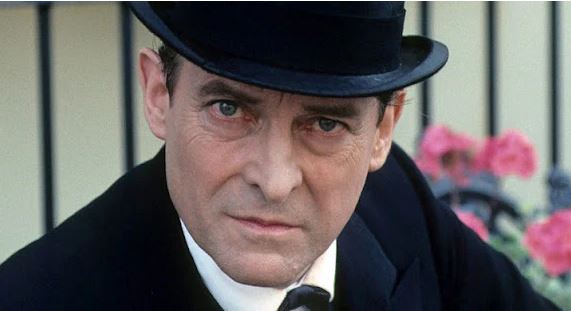
It’s time for another entry in my ongoing series Synchronicity for Bookworms. In this episode, I will describe the incredibly tenuous and yet undeniable connection I found between the great stage and film actor Jeremy Brett and George Eliot’s classic Victorian novel Middlemarch.
As you might recall, I recently did a blog post on Arthur Conan Doyle’s classic mystery novel, The Hound of the Baskervilles. In that post, I mentioned that my favorite actor to ever play the role of Sherlock Holmes was Jeremy Brett. While I was writing the post, I browsed various Internet pages pertaining to Brett. Brett was primarily a brilliant and prolific stage actor, appearing in everything from Shakespearean Tragedy (check out his performance as Macbeth on YouTube) to comic theater.

On one page, I found a photo of Brett standing in front of a billboard advertising a play in which he was appearing. As I looked closer at the image, I saw that Rex Harrison was also in the play. (As I later discovered, the production was a revival of Frederick Lonsdale’s “Aren’t We All?” that ran on Broadway in 1985.) This revelation made me smile because I am also a fan of Rex Harrison, ever since I read a biography of him a decade ago.
Naturally, I immediately went to the Wikipedia page for Rex Harrison and browsed through his biography. This included his great filmography. One of the more famous films he starred in was Blithe Spirit, a supernatural comedy based on a play by Noël Coward. I clicked on the link to the Wikipedia page for Blythe Spirit (the play) and discovered that Coward took the title from a poem by the great British romantic poet Percy Bysshe Shelley.
Naturally, I then clicked on the link to Shelly’s Wikipedia page and browse through his biography. Reaching the bottom of the page, I saw to my amazement that George Eliott had based the character of Will Ladislaw from her great novel Middlemarch on Shelley.

And there you have it, a cosmic filament connecting two of my recent topics—Sherlock Holmes and George Eliot. When my eyes settled on this last reference to Middlemarch, a little spark of amazement ran down my spine. That’s the sensation one gets when stumbling upon the sublime, hiding in the common-place.
Note that this was not some Six Degrees of Seven Bacon thing. That is, I was not looking for any connection. In fact, Middlemarch wasn’t on my mind at all when I started Googling Jeremy Brett. And yet, there the connection was.
I don’t know if it means anything or not. But it made my day.
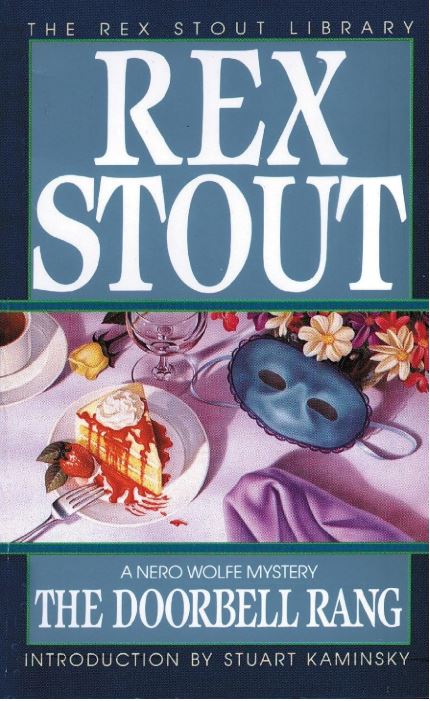
Frequent readers of this blog might remember a post a did some years ago called “My Rex Stout Shout-Out,” and will therefore already know of my long and abiding admiration for Rex Stout. Specifically, for his Nero Wolfe novels, the best of which is perhaps The Doorbell Rang.
It’s one of Stout’s later novels, published in 1960, and it was also the most controversial, involving as its central, unseen villain no other than J. Edgar Hoover himself. And, yeah, that’s one reason I like it. Stout’s detestation of the American right-wing’s tendency toward fascist behavior reached a fever-pitch level, which I share. But the main reason I like the book is for its story, which is actually two interlocking plot lines, each of which complements the other in inventive and surprising ways. The central line involves a very rich widow, Rachel Bruner, who suspects that the FBI is tapping her phones and generally harassing her. She wants Wolfe—the most brilliant man in New York City—to figure out a way to stop them. (Fun fact: this is an example of a little-known sub-sub-sub-genre of detective fiction in which the P.I. serves as a kind of fixer for some rich person’s critical problem.)
Through the intervention of NYPD Inspector Cramer (a highly intelligent but belligerent recurring character, who serves as a frequent foil for Wolfe throughout the series), Wolfe learns that FBI agents are suspects in the murder investigation of a journalist. Thus, Wolfe (and Stout) sees an opportunity to connect these two lines of inquiry. That is, by solving the mystery of the murdered journalist, Wolfe might be able to get some leverage on the FBI, and thus stop its harassment of Mrs. Bruner.
It’s a devilishly clever story, and made even more entertaining by the ways in which Wolfe and his loyal “leg-man,” Archie Goodwin (the narrator of all the Wolfe novels), contrive to outwit the dunder-headed FBI agents. This involves hiring actors to copy the dress and mannerisms of both Archie and Wolfe, so that the actors can impersonate both men and lure the agents into a trap.
Every good story is, in my opinion, a kind of whodunit, if only in a psychological or philosophical sense. Every successful novel asks a question, which the reader must keep reading to discover. With actual mystery novels, this question is explicit—who did the murder and how will the P.I. catch them—but that’s the only real difference. What always amazes me about Rex Stout is how good he is at asking this essential question. In fact, in The Doorbell Rang, he essentially poses it in the opening lines of the book…
Since it was the deciding factor, I might as well begin by describing it. It was a pink slip of paper three inches wide and seven inches long, and it told the First National City Bank to pay to the order of Nero Wolfe one hundred thousand and 00/100 dollars. Signed, Rachel Bruner. It was there on Wolfe’s desk, where Mrs. Bruner had put it. After doing so, she had returned to the red leather chair.
Already, the reader is sucked in. We have to find out what’s the deal with that check, which leads us to the crux of the entire mystery.
This passage also illustrates another great strength of the Nero Wolfe novels—and it ain’t Nero Wolfe. Rather, it’s Archie. Archie’s voice. Smart. Sharp. Sardonic. But a bit noble, too. Take this example from a few paragraphs, later:
After she was in the red leather chair I put her coat, which was at least a match for a sable number for which a friend of mine had paid eighteen grand, on the couch, sat at my desk, and took her in. She was a little too short and too much filled out to be rated elegant, even if her tan woolen dress was a Dior, and her face was too round, but there was nothing wrong with the brown-black eyes she aimed at Wolfe as she asked him if she needed to tell him who she was.
I love that bit about Brunner’s eyes. Archie is, of course, an avowed heterosexual, with some kind of romantic exploit in every book. Yet here he finds himself taken with a woman (an older woman, at that) not for her looks but for her obvious intelligence and determination. It’s a great detail, of the sort Stout always delivers.
It’s also a great example of how vividly drawn Stout’s characters are, especially the recurring characters. The snarky and slightly amoral newspaper editor Lon Cohen. The fastidious and unflappable chef, Fritz Brenner. The cool and precise leg-man Saul Panzer. All of them become as familiar to us over the course of the series, like old friends.
Naturally, Wolfe and Archie manage to pull off the caper, trap the FBI agents, and solve the murder, all simultaneously. I won’t spoil it by giving away the climax of the novel, but trust me…it’s a dozy.
Check it out…

*** SPOILERS BELOW ***
It feels a little silly, writing SPOILERS BELOW considering I am discussing a novel that came out 123 years ago. Is it possible that any reader of this blog—or, for that matter, any book nerd over the age of thirty—is not already familiar with the plot of The Hound of the Baskervilles? Even those who haven’t read the book have probably seen the movie in one of its many incarnations over the decades. I first saw the Basil Rathbone version from 1939 (which is free on Youtube) when I was about ten years old. This was about the same time my mom gave me a faux-leather bound edition of the complete Sherlock Holmes collection, which I read and re-read many, many times. And the work I re-read the most was The Hound of the Baskervilles (henceforth, HOTB).
Which might lead one to ask: Why would anybody re-read a mystery? After all, the whole point of a mystery is to figure whodunnit, right?
For the average mystery, this is largely true. But the great mysteries—like great books of any kind—operate on many levels and hold different kinds of appeal. For me, the very best mystery novels are character-driven, with a vivid setting and a lot of drama that stands above mere plot mechanics. HOTB is such a novel.
Continue reading “Great Mystery Novels: “The Hound of the Baskervilles”” Ash Clifton, Writer