The Coolest Discovery You’ve Never Heard Of

I recently learned that this year’s Nobel Prize in Physics went to a team of scientists who conducted experiments on quantum tunneling. Their experiments were conducted in the 1980s, which is typical of how the Nobel committees work—it takes around thirty years for a scientific consensus to build that a body of work was truly worthy of a Nobel Prize. 

I was interested in this news because, like most sci-fi nerds, I have an unflagging fascination with quantum mechanics. Heck, I even have a passing understanding of the fundamentals. (No, not just from Star Trek; I’ve read a few actual books! With facts, and stuff!)  A few years ago, I even tried to write a non-fiction book about Bell’s Theorem, which is a famous consent in Quantum Mechanics, albeit one that  you’ve probably never heard of (unless you’re a physicist or a science teacher or a sci-fi nerd). 

John Stewart Bell (copyright CERN)

To be frank, I had never heard of it either, until I read about it in a science book and then ventured to the Wikipedia page, where I learned that the theorem was written by an Anglo-Irish physicist named John Stewart Bell in the 1960s, and it hit the scientific community like a hurricane. Later, in 1975, another physicist Henry Stapp called it “the most profound discovery of science.

When I read this quote, I thought, “Whoa, dude! If it’s really the most ‘profound discovery of science’,” I should probably learn something about it.” 

And I did. Sort of.

Obviously, I will never really understand the underlying math, or even the root concepts that the math represents (which is one reason I abandoned the aforementioned book project). But the theorem itself is pretty easy to understand….

Continue reading “The Coolest Discovery You’ve Never Heard Of”

What I’m Reading: Would You Baptize an Extraterrestrial?

WouldYouBaptizeAnET

I learned many things from reading the excellent nonfiction book Would You Baptize an Extraterrestrial? For instance, I learned that the Vatican has its own astronomical observatory, which is run, in part, by the authors, Guy Consolmagno and Paul Mueller. Both men are also Jesuits. (The current Pope, Francis, is also a Jesuit—that’s another thing I learned).

Now, I was raised Catholic, and I thought a knew a thing or two about the religion. But not only did I learn from this book that the Vatican has its own observatory, but that it  has had one for hundreds of years. In fact, I was so taken by this discovery that I Googled “Vatican observatory” and, to my amazement, found that the Vatican also runs an observatory in Tucson, Arizona.

Talk about synchronicity! When I was twenty-two years old, I went off to attend grad school at the University of Arizona, in Tucson, and I distinctly remember the first night I spent there. I impressed by the size of the city—much larger than my little hometown of Gainesville, Florida—but also by how beautiful the desert sky was. Even in the downtown area, the stars were clearly visible. This was no accident; the city, I was told, purposely kept the streets relatively dark, in deference to the many astronomical observatories that surround the valley, which could not function if too much light pollution bled from the metro area.

Apparently, the Vatican’s observatory is one of them.

Continue reading “What I’m Reading: Would You Baptize an Extraterrestrial?”

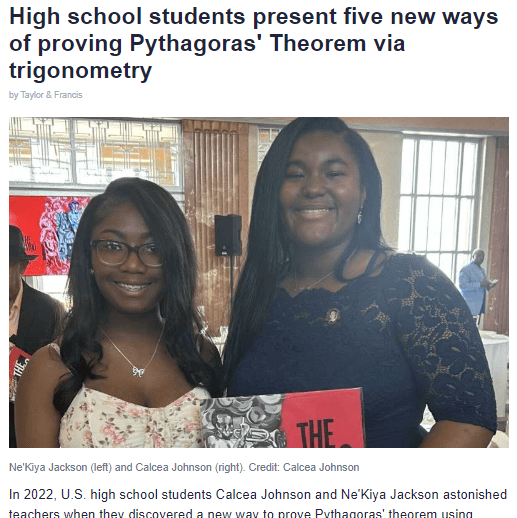
Nerds in the News: Calcea Johnson and Ne’Kiya Jackson

The latest entry in my continuing series celebrating Nerds in the News (STEM nerds, mostly, as opposed to book nerds, of which I am one) goes to these two young, awesome math nerds. Back in 2022, using nothing but trigonometry (which, as it happens, was the only class I failed in high school), they came up with an entire new proof of the Pythagorean Theorem. Even more incredible, these two mathematicians were both teenagers at the time. And they still are!

Now, they have updated their original proof with five new variations.

I am, of course, terrible at math, but I am endlessly fascinated by it. One of my favorite non-fiction books of all time is Simon Singh’s excellent Fermat’s Enigma, which recounts master-mathematician Andrew Wiles’ quest to solve Fermat’s Last Theorem, which eluded math nerds for hundreds of years. (Wiles solved it in 1993.) Coincidentally, that problem also directly concerned the Pythagorean Theorem, and Singh recounts the story like a centuries-old mystery. One interesting point about the tale is that many advances in the hunt for the solution were made by amateur mathematicians, which is exactly what Ms. Johnson and Ms. Jackson are. (This is due to their youth; I have a feeling they will go on to have great careers after…you know, they graduate college).

Congratulations, Ms. Calcea Johnson and Ms. Ne’Kiya Jackson!

Nerds in the News: Janna Levin

How often do you see a mainstream, broadcast news interview that covers so many nerd-worthy topics? This one has astronomy professor Janna Levin discussing Dyson Spheres, alien civilizations, sci-fi writer Olaf Stapledon, and Freeman Dyson himself.

Very few writers in history have had as big an influence on my imagination as Freeman Dyson. Not only did he come up with the idea (mostly) of a Dyson Sphere (which, in slightly modified form, became the inspiration for Larry Niven’s Ringworld novels), he always wrote visionary articles on space exploration, climate change, genetic engineering, the future of energy, and even E.S.P.

Enjoy!

Related:

A Book Nerd’s Reaction Oppenheimer

Freeman Dyson Interview

Classic Sci-Fi Book Cover: Ringworld

Nerds in the News

An Aperiodic Monotile has been discovered. Hooray!

When I was in my twenties, I read Roger Penrose’s The Emperor’s New Mind and was blown away by it. That is, in the 5% or so that I could understand, I was blown away. Never have I read a science book that, paradoxically, filled me with hope and optimism. And awe.

The book is probably more timely today than ever. With all the hype about AI and machine learning, people are starting to freak out about humanity’s place in the future. 

Penrose’s main thesis, after all, is that human consciousness is not machine-like. Citing the work of brilliant people such as Kurt Gödel, Alan Turing, and himself, Penrose lays out an extremely compelling argument as to why computers—no, not even quantum computers—will ever really think, no less achieve actual consciousness. This conclusion enraged an army of science fiction fanboys and others who believe that the “the brain is a machine made of meat”. 

In building his argument, Penrose refers to examples of discoveries scientists and mathematicians have made that could not (in his opinion) have been discovered by any algorithmic process. One of these examples is his own rather brilliant work in the area of aperiodic tilings

Aperiodic tilings are something that even a STEM idiot like myself can understand. Anyone who has ever looked down at an intricately tiled parquet floor and wondered about the pattern can relate to this. Most floor patterns—even very complicated ones—will reveal themselves as repetitive if viewed from a sufficient height. But some patterns never repeat, even if you view them from the second floor or the fifteenth or Alpha Centauri. This aperiodicity can only be demonstrated, of course, via mathematical proof, which is often maddeningly complex in and of itself. Mathematicians are constantly seeking out new collections of tile shapes (which, paradoxically, are usually simple enough to cut out of a piece of construction paper with kiddie scissors) that yield these aperiodic tiles. 

In the 1970s, Penrose himself discovered an aperiodic tiling that used only two shapes—a “kite” and a “dart”. This was a record at the time since other aperiodic tilings had been discovered but they made use of more shapes. 

Knowing this, I read with some amusement that a new aperiodic tiling had recently been revealed that uses only one shape. A funky shape, surely, but still just one, thus making it an aperiodic monotile. The only wrinkle was that the shape had to be “flipped” at certain points for the tiling to work. 

Then, a few months later, lo and behold, another aperiodic monotile was discovered, and this one required no flipping. The dudes who found it were David Smith, Joseph Samuel Myers, Craig Kaplan and Chaim Goodman-Strauss of the University of Yorkshire.

Truly, this discovery has no impact whatsoever on my daily life, or yours I would bet. And yet it’s still really cool. This mathematical artifact has been hidden there for all eternity, and just now, in 2023, some nerds discover it.

That’s why I still have faith in humanity. The nerds. They will save us.

Author’s Note: hat-tip to the good people at openculture.com for bringing this news to my attention, and for posting the video that I have linked above.