R.I.P. David Lynch

Photo by Alan Light, CC BY 2.0

It has been a week since David Lynch passed away, and many great tributes have already been written about him. I’m tempted to say that I needed a week to process his passing and figure out what I wanted to say about him, but the truth is I was just too damned busy to write anything. In fact, I knew instantly what I wanted to say—simply, that Lynch was a very important person in my life, and in the lives of many of my friends.

I was a college English major in 1986 when Blue Velvet came out, and it hit me and my circle of arty friends like an atomic blast. I already knew of Lynch’s work (I was one of the few kids to see The Elephant Man, and in an actual movie theater, no less), and I knew that he was a director of enormous visual and thematic power. But even I was unprepared for Blue Velvet. On the one hand, it’s a murder mystery, an homage to the noir films of the 1950s in which an unsuspecting suburban kid discovers a hidden world of violence, evil, and, (of course) depraved sexuality. On the other hand, it’s a surrealist vision of the inner world of a modern young man (and, probably, many young women). I was roughly the same age as the main character, Jeffrey Beaumont, in 1986, and so the film had special resonance. I felt like the landscape of my own imagination was a strange blend of the beautiful and the grotesque—often in the same image. And that’s exactly what the film captures, somehow.

Continue reading “R.I.P. David Lynch”
Friday Night Rock-Out: “Authority Song”

There is a great documentary on Netflix about the legendary record producer Clive Davis. One of the more interesting moments in the film is when Davis describes some of the fine artists he didn’t sign to his label, either because someone else beat him to punch or because he thought the artist in question just didn’t fit in with his catalog.

One example he gives of the latter is John Mellencamp, who, despite being saddled with the dumb, management-invented stage-name of John Cougar, hit the airwaves like a thunderbolt in the early 1980s. Mellencamp, Davis lamented, seemed too similar to another of Davis’s great artists, Bruce Springsteen, in that they both played soaring, electrified dirges about working class America (i.e., so-called “Heartland Rock,” even though Springsteen is famously from New Jersey). So, to his later regret, Davis passed.

Too bad for him. Mellencamp sold a bazillion records over the years, while gradually ditching the John Couger moniker and returning to his own, real name. As he did so, I gradually came to like him more and more. His early hits like “Jack and Diane” didn’t speak to me, perhaps because I was in high school at the time (just like Jack and Diane), and while the song was a paeon to lost youth and spirit, I was miserable in high school. (Later, I would realize that I probably would have liked high school a lot better if I had gone to Mellencamp’s, nestled somewhere in small-town America, full of cool, down-to-earth, nice kids instead of the jocks and preppies I was used to. And, yes, I eventually fell in love with and married a girl named Diane.)

But my opinion of Mellencamp’s music changed when his “Authority Song” came out. Not only is it one of the most danceable songs of the 80’s, it’s also one of rock music’s most defiant and rebellious rejections of… well…authority.

I’ve liked Mellencamp ever since. In fact, I think he’s a bit of genius.

Rock on…

Friday Night Rock-Out: “Kiss them for Me”

Was there ever a band more influential than Siouxie and the Banshees? Bands as diverse as Depeche Mode and Jane’s Addiction have expressed their admiration. And no less an iconic figure than Billy Idol has written about how awestruck he was the first time he saw the Banshees play live.

Not only were they one of the most important bands of the 1980s, they were one of the hardest to pigeonhole. Post-punk. Alt-rock. Alt-pop. Glam-rock. Goth-rock. All these labels have been applied to them.

All I know is that I always loved them, and still do.

Oh, and they’re really good to dance to.

Rock on…

Friday Night Rock-Out: “Firestarter”

Back in the late 1990s, every guy I knew under the age of thirty had a copy of The Prodigy‘s Fat of the Land album. This was the case even though there was nothing particularly new about the record itself; Big Beat had been around for years, and some of the songs on the album itself had come out on previous albums. Nevertheless, each song is more than the sum of its parts. Each one comes together into a delierously wicked electro-dance mash-up that remains unrivaled.

Back in the day, my favorite song off the album was the problematically entitled “Smack My Bitch Up”. (As far as I’m concerned, the title is camp, if not actual satire in the Spinal Tap mode.) But these days, my favorite The Prodigy song is probably this little gem, “Firestarter”.

Rock on…

R.I.P. Donald Sutherland

I really enjoyed The Hunger Games movies when they came out. Not only were they great examples of dystopian science fiction, but they served as a refresher course in the nature of fascism. The main baddie in the films was, of course, President Snow, played with great menace and understatement by the great Donald Sutherland. 

I am very grateful to the producers of The Hunger Games for introducing Sutherland to a new generation of film lovers, especially at a time when his career was in a bit of a lull. Sutherland was one of my favorite actors when I was growing up, best known for career-making roles like Hawkeye Pierce in M.A.S.H., Oddball in Kelly’s Heroes, and the titular role in Klute. One of the great ironies of film history is that Sutherland should now be so closely associated with the role of President Snow—literally a right-wing fascist dictator—when his early, defining performances were usually as lovable, left-of-center antiheroes (Hawkeye Pierce especially). 

Sutherland was one of the few movie stars from the 70s and 80s to have curly, hippie-hair, and his entire persona seemed to be that of a counter-cultural smart guy. The Alpha-Hippie that all Beta-Hippies aspired to be. I say he was a smart-guy, and it’s true—never did an actor so effortlessly exude intelligence, even without dialog, as Sutherland did. But while he was so obviously a smart-guy, he was never a smart-ass. Even the irreverent Hawkeye Pierce—perhaps the most famous prankster in cinema history—reserved his mocking for when he needed it to retain his sanity, and focused it on those who most deserved it.

One of the best ways to understand Sutherland as an artist is to imagine his stylistic opposite, Nicholas Cage. Like Sutherland, Cage is a brilliant actor, and a very smart guy, but while Cage is famous for his artistic daring, often taking his performances to frenetic heights that would seem ridiculous for other, lesser actors, Sutherland was known for his almost impenetrable reserve. He always seemed to be holding something back, in a good way. He kept the viewer guessing about what was really going on behind those crystalline blue eyes. 

Perhaps my favorite Sutherland role when I was growing up was as a world-weary health inspector in Philip Kaufman’s 1978 sci-fi horror masterpiece The Invasion of the Body Snatchers. In this film, Sutherland almost drips existential cool, even when faced with an invasion of alien pod-people (read: communists, right-wing conformists, or your boogey-men of choice) who want to eliminate humanity.

Check it out.

Friday Night Rock-Out: “Sweet Dreams (Are Made of This)”

When “Sweet Dreams (Are Made of This)” came out in 1983, I was a junior in high school. Being a bit of a music snob, not to mention a budding wannabe intellectual, I was pretty well versed in the New Wave music of the era, bands like the Talking Heads and Gary Numan and Devo, not to mention the more avant guard stylings of The Police. (Synchronicity came out that year, and if it’s not a New Wave song, I don’t know what is.) 

But, like everyone else, I was totally unprepared for “Sweet Dreams”. It wasn’t just the disconcerting, off-kilter, literally ass-backwards beat of the song. It was Annie Lennox’s soaring, operatic delivery of those out-there, nakedly perverse lyrics (“some of them want to abuse you; some of them want to be abused”). Most of all, it was the music video, which came spilling out of TVs everywhere and didn’t stop for about six months. 

Looking back on it now in our absurdly trans-phobic era, it’s hard to imagine how utterly trans the video was. Transexual. Transgressive. Trans-everything. The sight of the beautiful Annie Lennox decked out in a (tailored) man’s suit, with her orange hair and vaguely Hitlerian mannerism, was like an A-Bomb going off in the brain of middle America. It might have all been too much, except for one thing: It’s a hell of a good song.

Rock on.

Friday Night Rock-Out

In some ways, Missing Persons was the ultimate west coast 80s band. With their heavy synth sound and propulsive drum beats, they were a band that could make you think and make you dance. Plus, I simply loved Dale Bozzio. Not just your average bottle-blonde space-age sex-kitten with a plexiglass bustier, Bozzio could really sing. And her baby-doll, hiccuping style was tempered with just enough knowing irony to make you realize how cool she was. In fact, she presaged another super-smart front-girl from a decade later, Shirley Manson of Garbage.

My favorite Missing Persons song is “Destination Unknown”. Ah, how true.

Enjoy!

Classic Sci-Fi Book Cover

The only time I ever got in trouble with my parents over a book was when I was thirteen. The book was Nova by Samuel R. Delany, and was reading while nested in the back of the family car on a long trip. My stepmom read the back-jacket copy, which made the book sound a lot racier than it really was, and freaked out. However, she was (and is) a great reader herself, and she and my dad knew better than to try to keep me from reading the book. (You can’t keep kids from reading what they want, not even back then, in the pre-Internet days.) 

So, yeah, I read the book, and I loved it. And not for the prurient reasons my parents might have expected. Rather, Nova is classic Delany—literary science fiction that somehow feels gritty and realistic despite being set in a far future environment. I had never read Delany before, and I was blown away by his ability to write a “hard” sci-fi novel, full of fresh ideas and plausible technologies, that also kept my interest as a work of fiction. That is, it’s about believable characters with believable agendas and distinct personalities. It felt more like Stephen Crane than Isaac Asimov.

I probably picked up the book because I was drawn to the great cover art, one of a fine series of Delany works that Ballantine published in the 1970s. Its cover, which is still my favorite of any Delany novel, was done by fan-artist-turned-pro Eddie Jones. It might seem dated, but for me it still captures the surreal, distant-future vibe that Delany managed to bring to his best books. 

I still have it on my bookshelf, lo these many years later…   

Why I am Nostalgic for Big-Brained Aliens

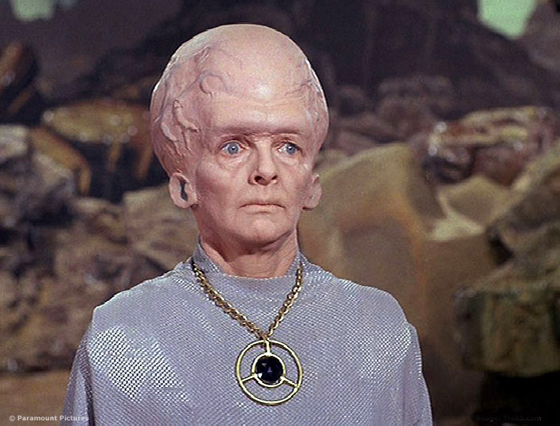
All this spring, my son Connor and I have been watching of the original Star Trek on Netflix.  Connor likes the original shows almost as much as The Next Generation, and even I find myself getting caught up in some of the more classic episodes like Space Seed (the one with Khan).  I also really like the pilot, The Cage.  That’s the episode where Jeffrey Hunter is Captain Pike, trapped on a planet run by bubble-headed alien telepaths who throw him in a zoo with the luscious Susan Oliver.  (Poor bastard.)

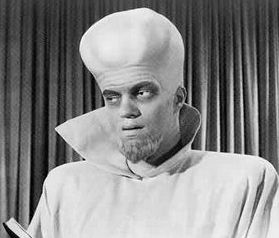
As we watched this particular episode—Connor for the first time, me for the bazillionth—it occurred to me that the Big-Brained Alien is one science fiction trope that has pretty much disappeared.  As far as I can tell, it has gone the way of the jet-pack and the glass-tube elevator.  This dearth of chrome-domed alien baddies is just another indication, I suppose, of how much things have changed. Back when I was a kid, every extra-terrestrial was guaranteed to have a skull like a beach ball.  Even the wise, Christ-like alien Klatuu from Robert Wise’s The Day the Earth Stood Still had a big head (although this was probably no one’s fault—Michael Rennie just had a big damned head!).

alien3

Remember those aliens who want to invite all of humanity over for dinner in the classic Twilight episode, To Serve Man?  Huge heads.  Or the killer vegetable alien in The Thing.  Huge freaking head.

As to how this visual cliché came about in the first place, I can only assume it was because of Anthropology class.  Specifically, all those anthropology classes that educated, middle-class kids started taking in college during the Cold War.  For the first time, ordinary people began to learn about human evolution, and how the human brain has tripled in size during the last two million years.  The implication was obvious.  Bigger brains means bigger intellect.  To extrapolate this trend into the future led to the obvious conclusion: beings of the future will have enormous brains.

In other words, the original Big Brained Alien is…us.

Continue reading “Why I am Nostalgic for Big-Brained Aliens”

Why Do YouTube Commercials Suck?

As I get older (and older), I begin to suspect that I will, eventually, become nostalgic about literally everything in my past. Right now, I am feeling nostalgic for old TV commercials.

If you grew up in the 1970s and 80s, like me, you watched a lot of TV commercials. Like, thousands and thousands. And as much I hated most of them, at least they were flogging products that I could…you know…actually use.

Since I cut the cable-TV cable a decade ago, most of my TV consumption has been via YouTube, and I have found myself bombarded with ads for various IT groupware products, web hosting sites, industrial-grade machines, religious groups, and exotic home decorations. WTF? How did the vaunted algorithms, in all their wisdom, pick this menu of irrelevancies to inflict on me.

Don’t get me wrong. I love YouTube, and I am grateful that it exists. And I know that they have to pay the bills somehow, so I try to watch the ads. (Yeah, I know, there are ad-blocker plugins out there, but I find myself morally opposed to them.) Still, these ads suck.

So, yeah, I am sentimental about old-world commercials. Here is a classic, landmark ad that I remember from 1977, the same year as Star Wars was released.