I’ve been seeing a lot of on-line ads for the new Nosferatu movie directed by Dave Eggers. It looks like a pretty good movie, although, judging by the trailers, it seems to be emphasizing the horror (e.g., slasher) elements of the classic Nosferatu/Dracula story over the erotic angle (which most film adaptations have veered toward).
Or does it? Looking at the poster, the hook line poster reads “Succumb to the Darkness.” It’s a seductive line, which doesn’t quite seem to go with the image portrayed—that of a beautiful young woman in a nightgown lying on her back with her mouth open, while a skeletal, monstrously taloned hand reaches for her face.
Erotic? Not really. Gross? Yeah, kinda. This thematic confusion between the film’s trailer and its poster reflects, I think, the difficulty in adapting the Dracula story to the screen. (Yes, I know that Nosferatu is not the same as Dracula, but close enough.) The difficulty is made worse in our present time, the 21st Century, when porn is only a few clicks away and the idea of truly transgressive sexual activity is more and more difficult to imagine.
One of the coolest classes I took at U.F. was Intro To Astronomy, taught by a funny old German guy named Heinrich Eichorn who, I later learned, was Chair of the Astronomy Department. (Yes, this was back in those quaint old days when top-notch professors had to actually, you know, teach class. And not just to grad students!) While Professor Eichorn’s lectures tended to meander a bit, he had a genuine enthusiasm for the subject that students, myself included, could sense and respond to. I remember one particular class when, in one of his usual, off-topic asides, he said, “We know the universe is not infinite. If it were, then every point in the sky above us would always be as bright as a star.”
For me, this was one of those mind-blowing moments when one is exposed to the wisdom of the ages. In this case, it was that of another German astronomer, Johannes Kepler, who in 1610 realized that if the universe really were infinitely large, and infinitely old, then every line-of-sight direction one looks at in the sky should eventually hit a star. Thus, the entire sky should be as bright as (and, worse still, as hot as) the surface of a star. Nevermind the fact that most of these stars would be very, very far away. Their light would still have an infinite amount of time to reach us, and there would be an infinite number of them shining down on us.
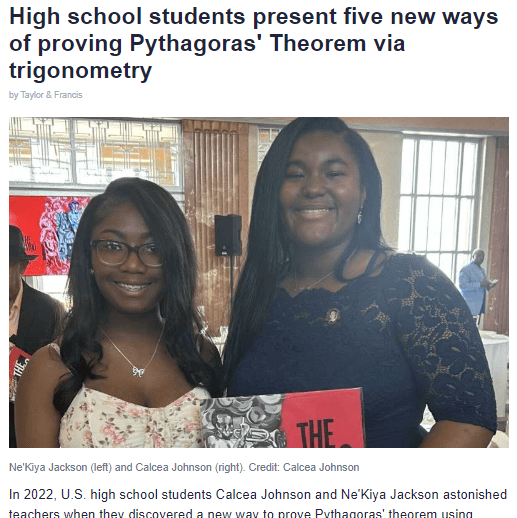
The latest entry in my continuing series celebrating Nerds in the News (STEM nerds, mostly, as opposed to book nerds, of which I am one) goes to these two young, awesome math nerds. Back in 2022, using nothing but trigonometry (which, as it happens, was the only class I failed in high school), they came up with an entire new proof of the Pythagorean Theorem. Even more incredible, these two mathematicians were both teenagers at the time. And they still are!
I am, of course, terrible at math, but I am endlessly fascinated by it. One of my favorite non-fiction books of all time is Simon Singh’s excellent Fermat’s Enigma, which recounts master-mathematician Andrew Wiles’ quest to solve Fermat’s Last Theorem, which eluded math nerds for hundreds of years. (Wiles solved it in 1993.) Coincidentally, that problem also directly concerned the Pythagorean Theorem, and Singh recounts the story like a centuries-old mystery. One interesting point about the tale is that many advances in the hunt for the solution were made by amateur mathematicians, which is exactly what Ms. Johnson and Ms. Jackson are. (This is due to their youth; I have a feeling they will go on to have great careers after…you know, they graduate college).
Congratulations, Ms. Calcea Johnson and Ms. Ne’Kiya Jackson!
Back in the dot.com boom of the 1990s, I was lucky enough to work for an IT company based in New York City. I was a remote worker, writing software eight hours a day in my spare bedroom in Gainesville, Florida. It was a win-win situation. I got to work from home, and my bosses got a good developer for country-boy wages (and I was still in the same time zone).
Occasionally they would fly me to the city for a meeting and I would spend my evenings wandering the streets of Manhattan, which is surely the most beautiful and bewitching cities of the earth. My favorite spot is the Met. Like a lot of introverts, I love museums, and the Met is the greatest of them all. I mean, how many museums have their own Egyptian Temple? Indoors?
Once I spent an entire weekend roaming its halls, barely scratching the surface of its vast collections. I tend to gravitate toward the Modern period from the early- and mid-twentieth century. From guys like Matisse and Picasso all the way to Hopper and O’Keefe.
From a historical perspective, my interest stopped after that. I never much got the whole Post-Modern thing—Abstract Expressionism and all that. It seemed too theoretical. A joke that high-brow art critics had played on the rest of us, as Tom Wolfe wrote so wittily in The Painted Word.
I love David Bentley Hart. He’s not only a great writer and philosopher, he’s a wonderful speaker and explainer of big, complicated ideas (actually, the biggest and most complicated ideas imaginable). He also has a scathing wit and a talent for skewering stupid ideas masquerading as wisdom.
I’ve read a lot of Hart’s work, and watched many of his interviews on Youtube (there are a ton of them). My favorite is posted above, and I encourage everyone to check it out. However, if you’re new to DBH’s work, you might find yourself frantically looking up a lot of terms that frequently come up. (I still do.) So, in order to ease the transition, here is a handy cheat-list of some of the more important ones:
Ontology – The philosophical study of being itself, especially in the questions of why is there something rather than nothing and does God exist.
Dualism – The idea that human beings are composed of two fundamental, separate things: mind and matter. This concept is most closely associated with René Descartes (i.e., Cartesian Dualism) and his famous statement, “cogito, ergo sum” (“I think, therefore I am”). Dualism is usually contracted with monism, the notion that all aspects of human life are reducible to one fundamental thing (typically, the physical laws of nature).
Materialism (a.k.a. Reductionism, Physicalism) – The notion that all aspects of human life, including consciousness, can ultimately be explained by scientific laws. That is, the fundamental forces of nature (gravity, electromagnetism, the strong force), genetics, Darwinian evolution, etc.
Apophatic – The idea that, because God (if He exists) is ineffable and beyond human comprension, we can only talk about Him in terms of what He is not rather than in terms of what He is (i.e., Cataphatic theology). For example, we can say that God is neither male nor female (despite the fact that most people use a male pronoun). But we can’t really say what His nature is.
Contingent – The concept of contingency refers to the fact everything in the physical universe exists as a result of something that came before it (including, ultimately, the Big Bang). THis becomes important in the so-called Ontological Arguments for the existence of God.
Thomist – The adjective used to describe ideas that derive from those of St. Thomas of Aquinas. (It’s pronounced TOME-ist.)
Qualia – Qualia is a fancy word used by philosophers–especially those concerned with the so-called Hard Problem of Consciousness–to describe feelings. That is, what it’s like to be conscious and experience things as a living being, and how is this possible.
Panpsychism – the ancient idea that all things–even those things we usually call inanimate–might have some kind of consciousness.
Apokatastasis – A Greek work referring to the restoration of all creation to a divine state. In some Christian philosophical schools of thought, it also refers to the eventual salvation of all souls (even those in hell, including the Devil). Hart has written extensively on this subject in his book That All Shall Be Saved.
I was born in the 1960s, which means I am among the first generation to grow up with color TV. This also means I am also among the first Americans who are able to see their past in color. Or, at least, the urban landscape of our past. Maybe that’s why I love old TV shows like The Rockford Files—shows with a lot of exterior shots of working class cities and suburbs from back then. Once in a while, Rockford will race through Los Angeles and there, flashing by in the background, a McDonald’s from 1976 will appear. Or maybe a Woolworth’s or a Wash King. (Yes, I do realize that most people have never heard of Woolworth’s or Wash King.)
These were the places I would visit with my parents when I was a kid, and it’s kind of neat to see them again, if only on a TV screen. Seeing them today, forty years later, I am often struck by how different the architecture was back then, especially the fast-food joints and coffee shops, many of which were getting on even when Rockford was in his prime. These vintage buildings from the 50s and 60s often had weird, playful curves and tilted walls, all of it stitched together at crazy angles. I remember one restaurant in particular that my mom used to take me to every weekend. It had plastic booths nestled under a rocket-red awning with trippy lights hanging down. It looked like something straight out of The Jetsons.
Like millions of others, my family and I have spent part of this year’s Christmas holiday watching some version of Charles Dickens’ A Christmas Carol. Actually, we watched two, starting with Bill Murray’s mad-cap Scroogedand following-up with a much darker made-for-TV film from 1999, starring Patrick Stewart. The production was inspired, in part, by Stewart’s one-man stage performances as the character, and Stuart gives a powerful, tragic interpretation of Scrooge, a man so consumed by his traumatic past that he is unable to experience any emotion other than anger, manifested as a chronic, toxic misanthropy.
A Christmas Carol is, of course, an unabashed Christian parable, perhaps the most influential in history outside the Bible itself. Scrooge is visited by ghosts over three nights (the same number as Christ lays dead in his crypt), until his “resurrection” on Christmas morning, having seen the error of his ways. But the story resonates with people of all faiths, or no faiths, because of its theme of hope. Scrooge is old, but he ain’t dead yet. There’s still time to fix his life. To change. To choose.
I have always thought that the power to choose–the divine gift of free will–lies at the heart of A Christmas Carol, as it does with all great literature. Of course, it’s hard to imagine Scrooge, after seeing the tragedies of his Christmases past, present, and future, to wake up on Christmas and say, “Meh, I’d rather keep being a ruthless businessman. Screw Tiny Tim.” But he could. He might. The ultimate choice given to us is the option to change the nature of our own hearts, our way of thinking.
This matter of free will seems particularly salient this year–this holiday season–because the very concept is under attack. If you Google the term “free will,” you will be presented with a barrage of links with titles like “Is Free Will an Illusion?” and “Is Free Will Compatible with Modern Physics?” Along with the rise of militant atheists like Richard Dawkins, a parallel trend has arisen among theoretical physicists who doubt that free will is even a meaningful concept. After all, if our consciousness is merely an emergent phenomenon of electrical impulses in our brains, and if our brains are, like everything else, determined by the laws of physics, then how is free will even a thing? Every idea we have—every notion—must somehow be predetermined by the notions that came before it, the action and reaction of synapses in our brains.
Our brains, in other words, are like computers. Mere calculators, whose order of operations could be rewound at any moment and replayed again and again and again, with exactly the same results.
Patrick Stewart as Scrooge
Ah, but what about quantum mechanics, you say? The principles that undergird all of quantum theory would seem to imply that human thought, even if you reduce it to electrons in the brain, might be on some level unpredictable, unknowable, and therefore capable of some aspect of free will. Not at all, reply the physicists. The scale at which Heisenberg’s Uncertainty Principle applies—the level of single electrons and other subatomic particles—lies so far below that of the electrochemical reactions in the human brain that their effect must be negligible. That is, a brain with an identical layout of neurons to mine would have exactly the same thoughts, the same personality, as I do. It would be me.
It’s this kind of reasoning that leads people to hate scientists at times, even people like me who normally worship scientists. The arrogance of the so-called “rationalist” argument—which comes primarily from physics, a field that, in the early 1990s, discovered that it could only explain 4% of everything in the universe—seems insufferable. But more to the point, I would argue that the rationalist rejection of free will leads to paradoxes—logical absurdities—not unlike those created by the time-travel thought problems that Einstein postulated over a hundred years ago.
For instance, imagine that one of our free-will denying physicists wins the Nobel Prize. He flies to Stockholm to pick up his award, at which point the King of Sweden says, “Not so fast, bub. You don’t really deserve any praise, because all of your discoveries were the inevitable consequence of the electrical impulses in your brain.”
“But what about all the hard work I put in?” the physicist sputters. “All the late nights in the lab? The leaps of intuition that came to me after countless hours of struggle?”
“Irrelevant,” says His Majesty. “You did all that work because your brain forced you too. Your thirst for knowledge, and also your fear of failure, were both manifestations of mechanicals in your brain. You had absolutely no choice in the matter.”
“Well, in that case,” replies the now angry physicist, “maybe YOU have no choice but to give me the award anyway, regardless.”
“Hmm,” muses the King. “I hadn’t thought of that.”
“So, can I have it?”
“I dunno. Let’s just stand here a minute and see what happens.”
As many critics have pointed out, this kind of materialist thinking inevitably leads to a kind of fatalism of the sort found in some eastern religions. If human beings really have no free will—that is, if we are basically automata in thrall to the physical activity of our brains—then what’s the use of struggle? Why bother trying to improve yourself, to become a productive member of society, or become a better person?
Straw man! scream the physicists. No one is advocating we give up the struggle to lead better lives. That would be the end of civilization. No, we simply mean that this struggle is an illusion, albeit one that we need to exist.
Okay. So, you’re saying that we all have to pretend to have free will in order to keep the trains running? We must maintain the illusion of free will in order to continue the orderly procession of existence? But doesn’t this position, itself, imply a kind of choice? After all, if we have no free will, it really makes no difference whether we maintain the illusion or not.
Doesn’t this very discussion represent a rejection of passivity and the meaningfulness of human will?
My fear is that many young people today will be overexposed to the “rationalism” I describe above, especially when it is put forth by otherwise brilliant people. For those who are already depressed by such assertions that free will is an illusion, I would direct you to the great stories of world history. All the enduring mythologies, from the Greek tragedies to the Arthurian legends to the Hindu Mahabharata, revolve around the choices made by their heroes, their triumphs and failings. As a fiction writer, I would argue that the concept of “story” itself is almost synonymous with choice. A boy is confronted by the wolf. Will the boy run left or right? Will he lead the wolf away from his friends back at the campsite, or will he lead the wolf to them, hoping they can help scare it away (or, more darkly, that it will eat one of his friends instead)?
One can also take hope in the fact that not only can physicists still not explain what 96% of the universe is but they can’t explain what consciousness is. Of course, some would argue that consciousness, itself, is an illusion. But this leads to an entirely new set of paradoxes and absurdities. (As David Bentley Hart once replied, “An illusion in what?”)
Personally, I suspect that consciousness comes to exist around or about the same moment in a specie’s evolution when the individual can choose. That is, consciousness implies a kind of choice. It might be a very elemental, even primal kind of choice—perhaps simply the choice of whether not to swim harder, or fight harder, which I believe even minnows and ants can make—but it’s still a choice, and not merely a matter of pure instinct.
One of my favorite TV shows from my childhood was Patrick McGoohan’s “The Prisoner”, whose every episode begins with the titular character proclaiming “I am not a number! I am a free man!” This assertion, shouted on a beach by the mysterious village in which he has been imprisoned, is followed by the sinister laughter of Number 2, the Orwellian figure who has been tasked with breaking the prisoner’s will. Number 2 is, of course, an awesome and terrifying figure, armed with all the weapons of modern society: technology, bureaucracy, and theory. But he’s still wrong, and he’s ultimately unable to grind the prisoner down.
That’s the hope I cling to, the Christmas message I espouse. Namely, that we’re all able to choose to resist the fatalism of rational materialism. That we can all, eventually, escape the village and be better human beings.
Anyway, that’s my Christmas Eve rant.
(Author’s Note: this is an updated version of a post that originally appeared on my old blog, Bakhtin’s Cigarettes.)
It’s hot as hell in Gainesville, as one would expect of Florida in July. But I mean, it’s really, really hot as hell.
All over the country, people are feeling the effects of the climate change. Even the most hard-core deniers (some of which are people in my own extended family, whom I love) are starting to sense the truth about what we’re facing as a civilization.
Unlike many, however, I think we can innovate our way out of the mess before it’s too late. But we need a World War II level mobilization of effort and resources to tackle it. In keeping with that idea, here is a cool video explaining one of the best weapons we have in the battle against global warming: carbon capture. No, it’s not a silver bullet, but it is part of the solution.
Even though I live in Florida, I am guardedly optimistic about our chances of surviving (I almost typed weathering–HA!) the global warming crisis. New green technologies are being created everyday, and the ones we’ve already got have to the potential to completely transform the world.
Here is a recent, positive article from one my favorite websites, Inhabitat.com.




 Ash Clifton, Writer