Science Fiction’s Latest Utopian Dream

When I was a kid, my parents bought me a book called A Pictorial History of Science Fiction by David Kyle, which covers the history of science fiction illustration from Jules Verne all the way through the 1970s. (The book was printed in 1976.) I still have it. I remember being especially enthralled by covers from pulp magazines in the 1930s like Astounding Science Fiction and Amazing Stories. Many of these covers were devoted to some artist’s vision of The City of The Future—usually some towering, high-tech, hive-like metropolis. 

It makes sense that sci-fi nerds of the 1930s would imagine a vertical, urban future. At the time, the most sophisticated places on earth were the great western cities of Europe and America. Paris. Berlin. And especially New York—Manhattan—with its great skyscrapers reaching ever higher. The obvious extrapolation of this trend was that someday everyone would be living in some vast, super-tall version of New York or Los Angeles, with buildings hundreds of stories high and millions of people living in close proximity. Ramps and walkways would connect these towers in the sky, allowing residents to hardly ever venture down to street-level. Airplanes, blimps, and elevated high-speed trains would speed residents from one end of the city to the next.

For most of these sci-fi artists and writers, this was going to be a good thing. A utopian vision, in fact. Future cities would be paradises of high technology, dense but egalitarian. Robots would do all the dirty work, and everyone would be rich. For others, though, the City of the Future would be a capitalist hell, with the decadent rich living high above the exploited poor. These upper-classes would hoard resources and technology, either out of fear or greed or sheer meanness. It is this dystopian vision that informs works like Fritz Lang’s Metropolis, as well as every instance of the cyberpunk genre from William Gibson’s Virtual Light to Ridley Scott’s Blade Runner.

Despite this dark side, however, the vision of an artificial, high-tech utopia has long existed in sci-fi, and it still does today. But the vision itself has changed. Relocated. These days, the City of Future is almost invariably depicted as being in outer space—”off-world,” in the lingo of movies like Blade Runner—either on a nearby planet or the moon or on a station floating in space.

Space stations, in particular, have captured the imagination of science fiction fans for the past four decades, ever since Princeton physicist Gerard K. O’Neill published The High Frontier: Human Colonies in Outer Space. In that landmark book, O’Neill explained the advantages of living on a space colony as opposed to a land-based colony like Mars or the moon. These include the fact that one could spin the colony to produce the same gravitational pull as Earth, thus avoiding any physiological problems the colonies might suffer from living on a smaller world. Unlimited solar power is another plus, as is the fact that, living outside the gravity well of a planet or moon, travel between colonies would be vastly cheaper. Trade would thrive, fueled by a steady flow of cheap, raw materials from the asteroid belt and various moons throughout the solar system.

Artist’s Depiction of Stanford Torus Interior, c. 1970s

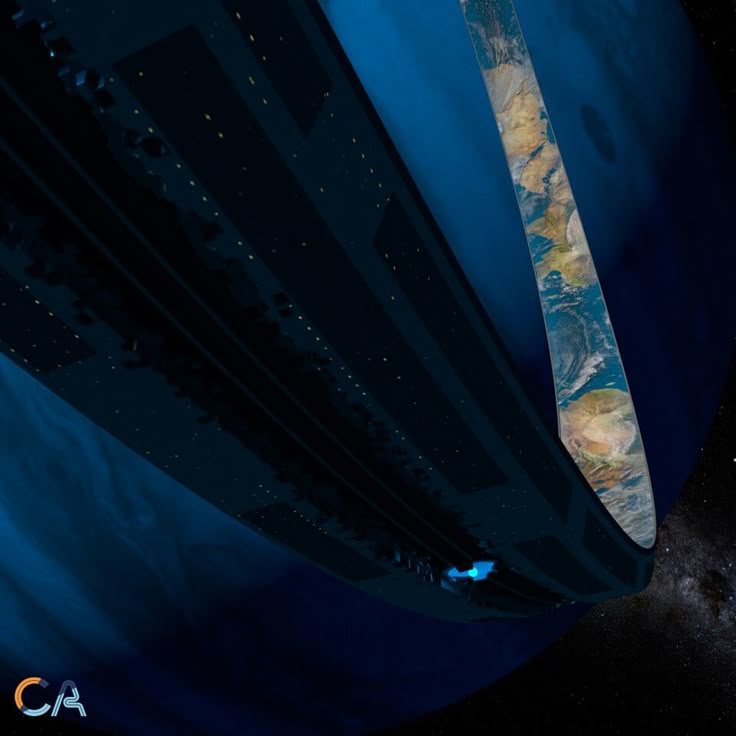
O’Neill was the first, legit scientist to take the idea of people living in outer space seriously, and he was able to back up his ideas with hard data, including actual blueprints for working stations. Namely, he invented the O’Neill Cylinder, a tube-shaped world the size of a city with its residents living on the inner surface. Other designs were created by a diverse group of like-minded theorists. Of these, the most compelling is the Stanford torus (named for the university where the plan was cooked up). Instead of a tube, it’s a giant wheel. For whatever reason, it’s this ring-like design that has dominated most sci-fi stories of recent decades. Larry Niven’s Ringworld is basically a humongous Stanford torus (large enough to encircle a star). And the design is also represented in the wheel-worlds of the Halo videogame franchise and the fabulous Orbitals of Iain Banks’s The Culture novels. 

As was the case with the high-rise super-cities that were imagined of the 1920s, the space-colony vision isn’t always utopian. In the 2013 film Elysium, for example, the titular space station is an exclusive haven for the ultra-rich, desperate to escape an Earth ravaged by global warming and end-stage capitalism. Perhaps this is why many people become uneasy when billionaire tech-bros like Jeff Bezos openly embrace the idea of building giant colonies in space. They seem to be confirming the dystopian side of the space colony coin.

I have very little in common with Jeff Bezos. But, like him, I must confess to be completely captivated by the idea of colonies in space. They are not only fun to imagine, but I believe that they probably do represent the best possible, long-term vision for the future of humanity. I don’t know if they will happen, but I hope they do. 

Recent Artistic Depiction of Stanford Torus

Why do I harbor this hope? Lots of reasons. For one, space colonies offer our best chance of surviving as a species into the far future. Even if we somehow avoid the worst consequences of global-warming, there will always be some other looming disaster that threatens to exterminate life on Earth, from planet-killer asteroids to super-volcanoes to the next pandemic. With space colonies, there would soon be more people living in space than earth—perhaps trillions of people within a few centuries—thus making us a lot harder to wipe out. 

For another, the quality of life on space colonies would probably be much, much higher for the average citizen than it is likely to ever be on Earth. This is due to the advantages I listed above, like abundant solar power and cheap resources for asteroids. And overpopulation would never be a problem—at least, not for long. Whenever a colony got too crowded, any citizens who craved more elbow-room would simply build a new space colony and move into it.

Of course, many people will never be disavowed of the idea that space colonies represent nothing more than a “Plan-B” for the ultra-rich. That is, after all the rich people trash the earth with their greed and unfettered capitalism, space colonies give them the ultimate chance for escape from the consequences of their actions. 

This is, I think, a real possibility for why space colonies might eventually be built. But it’s not the only possibility, nor even the most likely. Rather, my guess is that space colonies will be built for the positive reasons that I mentioned—abundance, room, and quality of life. Indeed, one could imagine an era—in the three or four-hundred perhaps—when so many people choose to emigrate to space that Earth could become a giant Hawaii. That is, an ecological and historical preserve, with less than a billion people on the entire planet. People who are born on space colonies might endeavor to make a pilgrimage down to Earth at least once in their lives, the way many Irish-Americans eventually take a vacation in “the Old Country” of Ireland.

One thing Bezos and I vehemently disagree on (one of many things, actually) is the time-table for when space colonies will eventually be built. It won’t happen any time soon–not in Bezo’s lifetime (unless he has a store of some immortality drug stashed somewhere), nor in mine, nor in the next generation. But I think it will happen. 

Artistic Depiction of a Roofless Bishop Ring

Which leads to the question: Will space colonies really be utopias? That depends on your definition of utopia. If a citizen of mediaeval Europe were to be magically transported to a modern, western city, they would probably perceive it as a utopia. I mean, running water? Toilets? Central heating? All the food you can eat? How much more utopian can you get? Such a person would probably dismiss any argument we might make to the contrary—that people in the 21st Century have as many problems as those in the 13th. Bullshit, they would probably say. And they’d be right. For, while modern western civilization isn’t perfect (and it seems to be getting less perfect by the day, alas), it’s still pretty freakin cool. Yes, we still have evil and stupidity and greed. And all of those human failings will find their way onto space stations.

But still, we will be making progress. It’s a worthwhile vision, and exactly the kind of dream that good sci-fi can deliver. 

And should. At least some of the time.

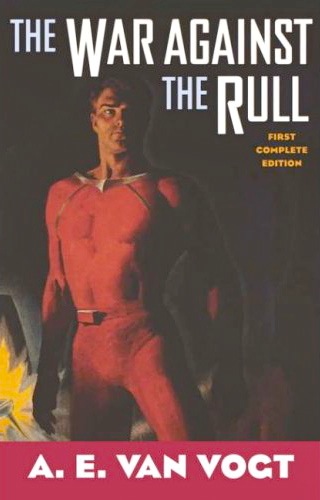
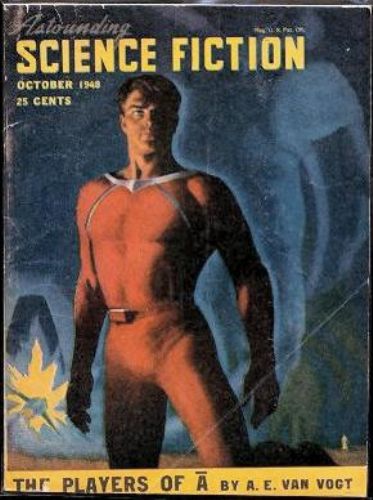
Classic Sci-Fi Book Cover: “The War Against the Rull”

This entry in my on-going Classic Sci-Fi Book Covers series is both old and new. That is, it’s a modern touch-up of the cover from the October 1949 edition of Astounding Science Fiction painted by Hubert Rogers. That issue included a work by A.E. van Vogt, but not the one we are interested in here. This modern version is from a 1999 edition of van Vogt’s classic sci-fi novel, The War Against the Rull, which I distinctly remember devouring in two days when I was in eighth-grade.

I like this cover a lot. It’s not just a classic. It’s an archetype. Specifically, the archetype of the heroic (America) scientist, a buff intellectual and polymath whose ilk could be found in countless works of Isaac Asimov, Robert Heinlein, Roger Zelazny, and on an on. In The War Against the Rull, the man is Dr. Trevor Jamieson, a brilliant scientist who is also a fierce warrior and survival-expert. He’s stranded on an alien planet with a huge, six-legged, intelligent creature called an ezwal who wants to kill him. But when both Jamieson and the ezwal encounter a mutual enemy—a race of aggressive, centipede-like aliens called the Rull—they decide to work together to survive.

It’s a great story, like so many from the sci-fi’s Golden Age. I’ve written before about why sci-fi novels from that era are so much more enjoyable (to me, at least) than most of those written in the last ten years or so. I think it has to do with the gritty humanity of such stories. Yeah, Jamieson is essentially a comic-book character (think Doctor Quest and Race Bannon rolled into one), but van Vogt does a great job of making you believe he’s in real trouble. The ezwal, too—he’s a compelling character in his own right. You get involved in the desperate nature of their situation, and you keep reading to see how they will get out of it.

Anyway, check it out if you can…

Original Cover from Astounding
Cover from the 1970 edition that I read as a kid (by artist John Schoenherr)
Another version of the Scientist Hero Archetype (by artist James Bama)

Classic Sci-Fi Book Cover: “This Immortal”

My privious entry in this continuing “Classic Sci-Fi Book Covers” series was also devoted to Roger Zelazny, so please forgive me for double-dipping into the Zelazny well. But I couldn’t resist talking about one of Zelazny’s other great novels, …And Call Me Conrad—published in 1966 as This Immortal. Most people have never heard of it, but it’s an interesting book for several reasons.

For one, it was Zelazny’s first novel, and it has many of his signature obsessions (e.g, ancient mythology mixed with science fiction; a wise-cracking anti-hero who is also an Übermensch; epic fight scenes; etc.). For another, it actually won a Hugo Award, tying in 1966 with a slightly better-known book…Frank Herbert’s Dune. And finally, it’s just a hell of an entertaining adventure tale.

I chose this cover (by fantasy artist Rowena Morrill) because it really captures the sense of the book’s main character, Conrad Nomikos, a world-weary man-of-mystery who might be immortal. (The text suggests that he is at least a century old, and hints that he might be several thousand years older still.) He works as director of a government agency tasked with protecting and preserving the surviving relics of a destroyed earth. A nuclear war referred to by the characters as “The Three Days” has occurred many decades before, leaving most of the planet uninhabitable. The survivors, which include a wide variety of mutants both human and animal, live mainly on islands like Greece, Conrad’s home.

And that’s not even the main subject this wild, wild little book. Conrad is assigned the duty of escorting a group of VIP tourists—including Cort Myshtigo, an alien from the Vega star system whose race has purchased earth as a kind of vast museum—as they tour the planets once great sites (now ruins). Conrad soon realizes that another of the tourists, an Egyptian assassin named Hassan with whom Conrad has befriended in the past, is secretly on a mission to kill the Vegan. Hassan, it seems, has been hired for this task by an obscure, underground political group who want to reclaim earth for humanity. So, Conrad finds himself not only being a tour-guide but also an unpaid protector of Myshtigo—who he hates.

It’s a crazy book, and the cover conveys this craziness well. Though the edition is from 1980, the cover really feels like a 1970s cover, with its vaguely photorealistic painting of a ruggedly handsome dude with great hair (think Roger Staubach in his prime). I also like how Morrill works in the other tropes of the book—its setting among Greek ruins, as well as the presence of some mythological creatures in the background (which, the reader eventually learns, are actually just animals that have been mutated by radioactive fall-out).

It’s a very dated cover, but still a really cool one. Classic, one might say…

What Is It Like to be The Terminator?

I can’t believe it’s been 41 years since James Cameron’s The Terminator came out. I first saw it in the movie theater and like everyone else I was completely stunned by its energy and creativity. It might well be the best B-movie action film ever made. (Its sequel, T2, is an A-movie action flick that still feels like a B-movie, in a good way.) Cameron’s spin on what is essentially the ancient hunter-vs.-the-hunted plot—mashed up with about a dozen sci-fi tropes and a heaping serving of the Frankenstein/Dr. Faust myth—results in an almost perfect piece of entertainment. There is not a dull moment or lame moment in it. Every scene either surprises, shocks, or tickles the viewer.

The sequel, T2, is even better, mainly because it’s a coming-of-age film. Rather, it’s a becoming-human film. We watch as the Terminator observes human beings, learns from them, and begins to emulate their best qualities. It’s an archetypal story, and I (almost) tire of watching it. And, in the process of watching the film so many times over the years, I’ve repeatedly asked myself: What is it like to be the Terminator?

Continue reading “What Is It Like to be The Terminator?”

Classic Sci-Fi Book Cover: “Lord of Light”

I’ve read a lot of trippy science books in my time, but Roger Zelazny’s Lord of Light is probably the trippiest. The only one that sort of comes close is Frank Herbert’s Dune, which makes a lot of sense considering both were written in the 1960s by two extremely smart and talented writers. (One of Zelazny’s other books, This Immortal, actually shared the Hugo Award with Dune in 1967.)

In fact, there’s not really a name for what Lord of Light is. Technically, it’s science fiction fantasy (a sub-genre I’ve written about before). That is, it looks and feels like a fantasy novel (as does Dune) until you realize that the plot has a sci-fi underpinning. Lord of Light is set on an alien world in which the population is stuck in a pre-industrial state, ruled over by gods of the Hindu pantheon. These gods interact with mortal humans on a daily basis, using magical powers and objects to control their destiny. Throughout the novel, however, Zelazny drops carefully crafted clues that the “gods” are actually the crew of a starship called The Star of India, which crash-landed on the planet centuries before.

These faux-deities use high-technology to set themselves up as gods, complete with a kind of immortality (they can transfer their consciousness to new, young bodies when the old ones wear out). They rule over the common people (who are revealed to be the descendants of the passengers of the ship) with an iron fist, doling out justice and retrobution from a floating, anti-gravity city (“heaven”). This reign is, ostensibly, for the people’s own good (tyrants always say this, right?). But when one of the last democratically-minded crew members, Sam, takes on the role of Siddhartha, he poses a threat to the status quo, which has kept humanity stagnant for generations.

This 1987 edition from Avon was the one I read in college, and I still own it. Its cover was done by an English illustrator named Tim White. I really like it because it captures that essential trippiness. At first, it looks like a pop-religion book, depicting figures dressed like Hindu gods. But what’s with the blue electric bolts? Or the floating city? And why is one of the Hindu “goddesses” blonde?

Ahhh, it’s really a sci-fi novel.

Yes, it is.

The Scientist Hero: Our Newest Cinema Archetype

Martian3

One of my favorite movies of the last twenty years is Ridley Scott’s The Martian. It’s a science-fiction/adventure movie about an astronaut (Matt Damon) who becomes stranded on Mars after his comrades leave him for dead. Marooned on a barren, hostile world, he has to use his brains and ingenuity to survive until his friends come back to rescue him. By the end of the movie, he has survived dust storms, explosions, freezing temperatures, and starvation.

How does he overcome all these challenges?

Science.

The story is familiar, of course. It has many antecedents, including with the original stranded-on-an-island novel, Robinson Crusoe, and also (more directly) to a great B-movie Robinson Crusoe on Mars. In that classic 1964 cheese-fest, the hero survives by finding a Martian cave full of air where plants still grow, water still flows, and there’s a steady source of light (which is never explained). He even befriends an alien who is also trapped on the planet.

Continue reading “The Scientist Hero: Our Newest Cinema Archetype”

Getting Stabbed Doesn’t Hurt

(…or, Everything That’s Wrong with Deadpool & Wolverine)

Well, I finally got around to watching Marvel’s latest blockbuster, Deadpool & Wolverine. This was the first Marvel movie I’d watched in a while, and now I remember why. Holy smoke, what a crappy film! As I watched it—doggedly, hoping it would get better, resisting the urge to switch it off—I began to realize that this film is not only bad, it is profoundly bad. That is, bad in a way that’s worth talking about.

Normally, being a nominal “artist” myself, I don’t lay into other people’s work just because I don’t like it. Why bother? But this movie triggered me in such a way that I have to rant about it for a while. Specifically, it pissed me off because it breaks the single most important rule of genre fiction (which applies equally to genre film): Keep it Real.

Wait a moment, you say. Realistic genre fiction? Realistic fantasy fiction? Sounds like an oxymoron, right? Actually, no. For while every Marvel movie, like every James Bond movie and every action movie and every horror movie and even every science fiction movie, is, in a sense a fantasy, the good ones display a kind of realism that’s critical, and vastly more important than any sense of day-to-day realism in the story itself. This is psychological realism. And psychological realism has its root in physiological realism—the realism of the human body.

Continue reading “Getting Stabbed Doesn’t Hurt”

Classic Sci-Fi Book Cover: “Neuromancer”

If I were to make a list of the most influential science fiction novels of all time, William Gibson’s Neuromancer would surely be on it. How often does a book create a whole genre—almost single-handedly? I say “almost” because there were other cultural touchstones of the cyberpunk genre, primarily Ridley Scott’s landmark film Blade Runner. But Neuromancer was the primary literary component of the movement, with its landscape of towering, high-tech super-cities where the rich live high (in every sense of the word), and the poor live very, very low.

Expanding on his ground-breaking short story, “Johnny Mnemonic,” Gibson created a dark near-future in which giant “mega-corporations,” many of them Japanese, have taken control of all aspects of life, and the richest people have almost become a different species. Average people either work as wage-slaves to the corporations, and the closest thing to a counterculture is a teeming underclass of rebel hackers who make their existence by spying on (and stealing from) the corporate oligarchy. 

These underground, anti-heroes are the punks of cyberpunk, and they are what made it so compelling as a genre. In a world where technology and corporate greed have dehumanized everyone, the punks beat the system at its own game. They do so by humanizing it, using their courage, individuality, and creativity to win in the one place where everyone is still equal—in the virtual world of cyberspace. 

That’s why I like this cover so much. Strangely, though Neuromancer was published forty years ago, there has never been a cover that really captured the vibe and essence of the book. Until this one. It’s a very obscure cover belonging to a Brazilian edition of the novel and created by Spanish artist Josan Gonzalez. I like it because it feels like a 1980s comic strip—specifically, the work of French artist Moebius from the magazine Métal hurlant back in the 1980s (truly, the golden age of cyberpunk). The character portrayed is, presumably, that of Case, the hacker-hero of the novel. With a cigarette dangling from his mouth and a welter of wires rising from his VR goggles (from his “brain,” essentially), he personifies the spirit of cyberpunk: a rebellious unflappability combined with human creativity and technical skill. 

My New Year’s Day Sci-Fi List

I was going to make a new Christmas Sci-Fi List to go with the first one that I wrote some years ago. But…well…I flaked out. So, here is a belated list of some of my favorite science fiction novels. And why not? New Year’s Day is a time to think about the future, right? RIGHT?

Anyway, here’s the list…

Trouble on Triton

Samuel R. Delany’s Trouble on Triton (published as Triton in the U.S.) is one of the finest written, poorly known works of literary sci-fi in publishing history. Perhaps this is due to the fact that it’s a short work—really a novella—with a post-modern, elliptical plot, not to mention some gender-bending content that was way ahead of its time. Set in a dome-style space colony on the farthest moon in the solar system, it tells the story of Bron, an ordinary schlemiel who’s in love with a mysterious, beautiful performance-artist. What really makes this book fascinating is its depiction of a high-tech, post-scarcity society that anticipated Iain Banks’s Culture novels by decades.

The Peripheral

William Gibson pretty much invented cyberpunk, so it’s fitting that he should write one of the best twists on that genre to come along in years. The Peripheral begins in what appears to be standard Gibson territory. Set in an economically devastated near-future, the story centers on Flynn, a young woman who makes her living as a remote contractor who works in the virtual reality of cyberspace. She thinks she is testing on a prototype for a video game set in a much farther distant, higher-tech future. But when she witnesses a murder in this other, virtual world, she realizes that it’s not virtual at all, but an actual, alternate future earth to which she is connected through a mysterious Chinese server. 

The rest of the novel involves her getting to know her future-based boss, Wilf, and helping him solve the murder mystery. Wilf, in return, gives Flynn money and technology to help her and her friends change their timeline, hoping to avoid the environmental catastrophe—a.k.a. “The Jackpot”—that has denuded the planet in Wilf’s. (He explains that their timelines are now independent of each other, so she won’t be messing with his present.) It’s one of Gibson’s best, tightest books with a page-turner plot and some brilliant twists.

The Man in the High Castle

Speaking of alternate timelines, have you ever felt like you were stuck in the wrong one? And it’s not a good one? This is the experience of all the characters in The Man in the High Castle. Set in the 1960s, the book imagines an alternate earth where the Axis powers won World War II. Nazi Germany controls the American east coast, Japan the west coast, and the midwest serves as a vast DMZ between the two. Like most of Dick’s novels, the novel involves several interlocking narratives concerning characters from all classes, high and low, each of whom struggles to be a good person in an insane world. 

The Girl with All the Gifts

In the last twenty years, there have been so many zombie apocalypse novels, movies, tv shows, and video games that one would expect it to be completely…well, dead. Played out. Void of new ideas. 

That’s what I thought when I picked up The Girl with All the Gifts. You can imagine my surprise when I found it to be one of the best written, engrossing, and often thrilling novels I’ve ever read. Its great strength lies in its central twist on the zombie story: the hero (actually heroine) is, herself, a zombie.Sort of. Ten year-old Melanie is infected with the fungus that turns people into zombies, but despite an almost irresistible hunger for human flesh, she retains her human intellect and sensibility. A prisoner in a military-run research station tasked with studying zombie children, Melanie has super-human strength, a genius I.Q., and a love of Greek mythology. She also loves her “teacher” (actually, a sympathetic scientist), Miss Justineau. 

When the research station is overrun by zombies, Melanie becomes the savior of her former captors as they make their way across the English countryside, trying to get back to human-controlled territory. The great irony of the novel is that most of the evil Melanie confronts on her journey comes from humans, not zombies. (Or maybe that’s not so ironic, after all.)

The Wave

Known primarily for his mystery novels, Walter Mosley is just a damned good writer, period. The Wave is a rip-snorting, old-school sci-fi novel with a modern sensibility. It’s about a working-class stiff named Errol who comes home one night to find that his father has paid him a visit. No big deal, except for the fact that his father has been dead for years.

The explanation lies is an sentient extremophile that lives so deep in the earth’s crust it has never been discovered…until now. Intelligent and deadly, it can take the shape of any biological form (including poor Errol’s dead father), accessing the target’s memories and consciousness in the process. Errol soon finds himself on the run from scientists who want to study the entity and military men who want to kill it. Good stuff from one of the best.

Ten Things I Love About “Forbidden Planet”

Author’s Note: A few days ago I saw that a remake of the sci-fi classic Forbidden Planet is in the works. So, I thought I’d repost a short essay I wrote about it some years back on my old blog, Bakhtin’s Cigarettes. Enjoy!

fb_1

The first DVD I bought was Blade Runner. The second was Forbidden Planet. This latter film is a science fiction classic from Hollywood’s second golden age, 1956 (the same year that John Ford’s landmark film The Searchers was released).  Perhaps the definitive pulp sci-fi movie, it’s got everything you might expect: stalwart heroes, spaceships, lasers, aliens, a teen-aged hottie, a mad scientist, and even a talking robot.

And monsters, of course. Monsters from the Id.

Ever since I first saw Forbidden Planet on TV when I was kid, I’ve loved it.  Here are ten reasons why…

1.) Altair IV

Forbidden Planet is, to my knowledge, the first Hollywood movie to depict human beings landing a spaceship on a planet of another star. This was a fairly landmark achievement in the history of science fiction cinema, made even better by the film’s two art directors, Cedric Gibbons and Arthur Lonergan. In their vision, Altair becomes a green- and blue-tinged desert, not unlike that of John Ford’s American Southwest. Considering this was done with matte paintings and other pre-CGI effects, it’s amazing how good the landscapes are, so desolate and full of foreboding.  It’s a prefiguration of all the wild worlds of Star Wars, Star Trek, and so on, yet to come.

Continue reading “Ten Things I Love About “Forbidden Planet””