Ten Things I Love About “Alien”

weaver

Next year will mark the 45th anniversary of Ridley Scott’s landmark sci-fi horror movie, Alien. I saw the movie when I kid way back in 1979. Here are ten things I (still) love about it:

  1. The Opening

For a movie that has the second-most disturbing scene in the history of cinema (the shower scene in Psycho is #1), the film starts with an empty field of quiescent darkness. The single letter I appears in the middle of the screen, and over the next few minutes as the opening credits appear and disappear on the screen, the I is joined by other letters to eventually form the single title: ALIEN. Talk about building tension. And what a great title it is! Both a noun and an adjective, it sums up everything frightening about this film. Namely, the fear of being consumed by the other, (the one outside and the one inside).

Continue reading “Ten Things I Love About “Alien””

What I’m Reading: “The Peripheral”

A few months ago, I wrote a post about M. R. Carey’s excellent sci-fi novel, The Girl with All the Gifts. I recounted how incredibly impressed I was by the way Carey took an exhausted genre—the zombie apocalypse story—and found a way to make it fresh and vital.

ThePeripheral

As luck would have it, the next novel I chose to read was William Gibson’s latest book, The Peripheral. I tore through it over the course of a weekend, and at some point, it occurred to me how similar the book is—in spirit, if not content—to Carey’s. Gibson, after all, faced a similar challenge to Carey in that his preferred genre, the cyberpunk novel, was also played out, in large part due to his (Gibson’s) own amazing success. His iconic works like Mona Lisa Overdrive and Burning Chrome helped define the cyberpunk aesthetic, that weirdly prescient vision of a future divided between poor street people and the ultra-rich. It was Gibson who coined the term cyberspace, and, by the end of the 1990s, the cyberpunk vibe had permeated not only popular fiction but movies (Blade RunnerThe Matrix) and anime (Akira).

Now, in 2019, reality itself seems to have caught up with Gibson’s work. We live in a world where the vast bulk of humanity is virtually impoverished and uneducated. These teeming masses distract themselves with 3D games and social media (literal cyberspace) while a few fantastically rich individuals build spaceships and private islands for themselves. We live in a world where teenaged soldiers kill people via satellite-controlled drones on the other side of the planet, and where rogue Chinese scientists make designer babies.

How’s a poor science fiction writer supposed to keep up?

Continue reading “What I’m Reading: “The Peripheral””

Random Dose of Optimism

In his amazingly good sci-fi novel, The Peripheral, William Gibson describes a environmental cataclysm called The Jackpot. The name is perfect, in that it evokes not a single-cause catastrophe but rather a horrific alignment (like the diamonds on a slot machine) of multiple ones. Global heating. Drought. Pollution. Pandemics. Poverty. Et cetera.

But, as is ruefully noted by the protagonists of Gibson’s novel, The Jackpot hit at almost the same time as a technological revolution (actually several revolutions) that might have avoided it. Geoengineering. Nanotechnology. Artificial Intelligence. Fusion power. Genetic engineering.

All of these fields are exploding, right now, in the early 21st Century. That’s why I’m guarded optimistic about humanity’s chances of surviving the next fifty years. (Note that I said “surviving”; it’s going to be incredibly challenging, and will involve great suffering and sacrifice.) Many environmentalists scoff at this kind of optimism. There is no technological silver bullet, they warn, that will get us off the hook.

And, of course, they’re right. There is no big silver bullet. But there might be a lot of small silver bullets that, if aimed precisely (have I tortured this metaphor long enough?) might at least blunt the looming crisis. 

After all, we’ve been here before. In the mid-20th Century, scientists were warning that current agriculture techniques would not be sufficient to feed the booming post-war population of Earth. A global famine was almost inevitable. But it didn’t happen. Why? Well, in a word, we innovated our way out of it. Improved science resulted in the so-called Green Revolution, which allowed farmers to feed millions more people on the same amount of arable land (which they continue to do to this day).

So, I like to collect articles about possible new “revolutions” that might help us survive, and even thrive, in this century. Here is an article for The Guardian about how scientists are manipulating natural enzymes to break down plastic into basic nutrients (i.e., food). Yes, plastic into food. Will it pan out? Will it be scalable? I don’t know. But it gives me hope. 

Check it out…

https://www.theguardian.com/environment/2023/sep/28/plastic-eating-bacteria-enzyme-recycling-waste

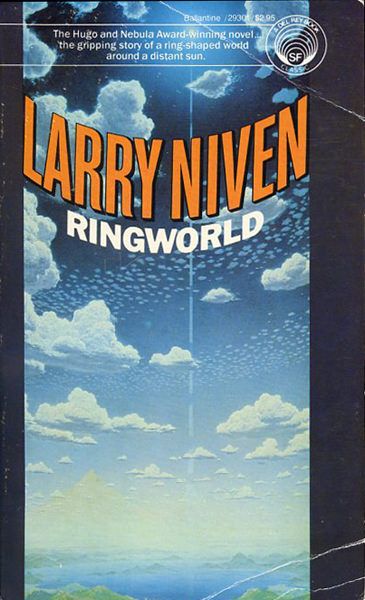
Classic Sci-Fi Book Cover: “Ringworld”

I started binge-reading science fiction when I was in 8th grade. That was the year that the local school board rezoned the kids from my White, suburban neighborhood to attend the largely Black, urban middle school, Lincoln, across town. This was a miraculous development for me because I had already attended Lincoln (back when my parents and I still lived in the ‘hood, or thereabouts), and I already loved it. But there was a downside—I had a really, really long ride on the school bus. Like almost an hour each way. 

So, I started reading seriously, and as with a lot of boys at that age, my go-to genre was sci-fi. I read a lot of Arthur C. Clarke and Ray Bradbury and John Christopher. But perhaps the most revelatory, amazing book I had read up to that time was Larry Niven’s Ringworld. Never had a novel held such wonder for me, such a Tolkienesque landscape of adventure and possibility. The fact that Niven was able to pull this off in a book which is, even today, a prime example of so-called “Hard SF,” in which every story element must be grounded in, or acknowledge the effect of, some scientific principle.

The fact that Niven’s novel (the first of a tetralogy) has never been adapted to film is perhaps  testament to this fact, the book’s off-the-chart nerd factor. Set in the 29th century, the story concerns an Earth-man, Louis Wu, who goes on adventure with two aliens and a human woman to visit a distant, recently discovered artifact called the Ringworld. It’s basically a giant, taurus-shaped space colony, so big that it wraps completely around its sun-like star. The entire ring spins to simulate 1G of gravity, and thousand-kilometer high mountains along the rim keep the air from leaking out. An inner ring of smaller, checker-box squares creates a shadow pattern on the inside of the big ring, creating a day/night cycle. 

And there you have it, a plausible sci-fi world with normal gravity and a recognizable biosphere, including oceans, forests, deserts, mountains, and so on, but with an unbroken surface area equivalent to three million earths

Oh, how this idea fired my thirteen-year-old imagination. Forget Shangri-La or Cathay or Edgar Rice Burroughs’s Mars or Middle Earth or any of the other fantasy lands of pre-1970s literature. Here was an endless realm that you could explore for a million years and never reach the end of. And, sure enough, as Louis and his alien comrades (one is a humanoid, Tiger-like creature called a Kzin, the other a two-headed cowardly alien called a Puppeteer) wander across the Ringworld, they encounter many of the tropes of 19th century adventure lit, including castles, galleons, savage tribes (including sexy native girls), shamans, sword-wielding heroes, etc. Niven accomplishes all this by establishing that the once high-tech inhabitants of the Ringworld have long since fallen into a pre-industrial state, leaving open the mystery of how this apocalypse happened and what remnants of the original civilization might remain, if any. 

It’s a great, great adventure book, and it has inspired a number of fine covers. My favorite is the one above by Don Davis. Davis was in some ways an inspired choice since he was best known as a “space artist,” doing representations of proposed space colonies for NASA. (And, as I said above, the Ringworld is basically a giant space colony.) Davis’s cover captures the sense of wonder and endless possibility that novel creates, depicting a typical (summer-like) day on the Ringworld. In the distance, you can see the arc of the ring itself (the primitive inhabitants think it is an “arch”), complete with light-and-dark sections from the shadow squares. 

It’s a fine cover, and I have no doubt that it and the book itself probably inspired the current obsession on the part of certain high-tech billionaires with the idea of space colonies, a possibility for a kind of endless utopia in outer space. And why not? Deep down, we’re all still thirteen-year-olds. Right?

Classic Sci-Fi Book Cover

I went into my favorite used bookstore recently, and I was shocked to find only a handful of Michael Crichton’s old books on hand. When I was a kid, he was ubiquitous. He was guaranteed to have not just an entire shelf dedicated to his work, but often an entire case

I mean, dozens of movies have been made out of his books, and that’s before I even need to mention his two most enduring franchises: Jurassic Park and Westworld. The guy was clearly a genius.

My early introduction to Crichton was when I was twelve and I read his first big hit, The Andromeda Strain. I would argue that this one book created the entire techno-thriller genre more than a decade before Tom Clancy took over the pop-novel world. The Andromeda Strain is packed with all things nerd: aliens (in the form of a lethal micro-organism that turns human blood to sludge and eats radiation for breakfast), lasers, supercomputers, a high-tech underground lab, and a nuclear bomb set to blow up in T-minus-Holy-Shit minutes. 

The copy I read was an early edition with a cover by Paul Bacon. The cover depicts what appears to be the outline of a petri dish containing two colonies of microscopic life, but with all the shapes described by computer-generated digits. To top it all off, the image is superimposed over an image of planet Earth, looking very small and vulnerable as the Andromeda strain begins to literally invade it.

A simple design, but one that perfectly evokes the book’s theme of technology-plus-biology-equals-disaster. (The organism, as is revealed in the plot, was harvested by a top-secret military program to find extraterrestrial extremophiles for bio-warfare.) 

You can read a great tribute to Paul Bacon here.

Classic Sci-Fi Book Cover

The only time I ever got in trouble with my parents over a book was when I was thirteen. The book was Nova by Samuel R. Delany, and was reading while nested in the back of the family car on a long trip. My stepmom read the back-jacket copy, which made the book sound a lot racier than it really was, and freaked out. However, she was (and is) a great reader herself, and she and my dad knew better than to try to keep me from reading the book. (You can’t keep kids from reading what they want, not even back then, in the pre-Internet days.) 

So, yeah, I read the book, and I loved it. And not for the prurient reasons my parents might have expected. Rather, Nova is classic Delany—literary science fiction that somehow feels gritty and realistic despite being set in a far future environment. I had never read Delany before, and I was blown away by his ability to write a “hard” sci-fi novel, full of fresh ideas and plausible technologies, that also kept my interest as a work of fiction. That is, it’s about believable characters with believable agendas and distinct personalities. It felt more like Stephen Crane than Isaac Asimov.

I probably picked up the book because I was drawn to the great cover art, one of a fine series of Delany works that Ballantine published in the 1970s. Its cover, which is still my favorite of any Delany novel, was done by fan-artist-turned-pro Eddie Jones. It might seem dated, but for me it still captures the surreal, distant-future vibe that Delany managed to bring to his best books. 

I still have it on my bookshelf, lo these many years later…   

Classic Sci-Fi Book Cover

I could write a whole post on the various covers of Ray Bradbury’s classic novel Fahrenheit 451 that have come out over the years, as other people already have. My favorite is this one from the 1970s (the time of my childhood). It’s by a great illustrator named Barron Storey.

I like it because it shows the main character, Montag, immersed in a kind of hell, which is a great metaphor for the authoritarian dystopia that he finds himself in. Also, Montag looks kind of like a bad-ass.