A lot of movies have been made about a so-called eco-apocalyse, in which catastrophic climate change, or pollution, or crop-failure, or overpopulation, or some mixture of all-of-the-above wipes out big swathes of humanity. And some of those scenarios might yet play-out if we keep sleepwalking (make that speed-walking) into the future.
Smithsonian Magazine
Right now, however, environmental issues are manifesting in unexpected and almost mundane ways. Take house insurance. Here in Florida, frequent and more-powerful hurricanes are driving up premiums to insane levels. It’s the same along the gulf coast of Mississippi and Alabama. And a friend of mine from Texas told me the same thing is happening there (flooding is the disaster-de-jour, in his neck-of-the-woods). And then we have electric bills. Each year, increased demand for electricity (for air-conditioning and, now, frickin data centers) is driving up the cost of utilities. And what about clean drinking water? Near-constant drought (punctuated by hurricanes) makes it difficult to provide clean drinking water to growing populations in some parts of the country. This leads more people to buy bottled water. In parts of Mississippi, you will see everyone buying huge flats of the stuff from Wal-Mart, leading me to believe that bottled water is the primary of hydration for many rural Southerners.
So, whenever I run across a news story like this one about a small, ingenious invention of the sort that might—just might—help get us out of this mess, it warms my heart. And even more so when the inventors are young people. In this case, seventeen-year-old Virginian Mia Heller came up with a new, cheap, reliable way to filter microplastics from water. Her system is based on a type of nanoparticle-infused oil called a ferrofluid, which basically pulls the microplastics out of the water like a magnet. The oil is reusable and easy to make.
Will this invention take off? Will it scale? I don’t know, but it gives me hope. I often think of how the great Nazi Wehrmacht was defeated, in part, by clever G.I.s from America, some of whom came up with the clever idea of mounting a phone on the back of their tanks. With this phone, a ground-trooper could speak directly with the guys inside the tank and tell them where to shoot and move. It was the kind of simple, “no-brainer” innovation that the Germans, with their rigid class system and demoralized population, never came up with. And it helped win the war.
Climate change and pollution are Ms. Heller’s generation’s World War II. And I’m really hoping that smart people like her can figure out a way to save my generation’s collective butt.
A few years ago, I wrote a post called “The Metaphysics of Left and Right (No, Not Politics; the Freakin Directions!),” in which I suggested that our ability to tell left from right, even as young children, and when facing a completely symmetrical landscape like the plane of the ocean, is somehow suggestive of a deeper truth about the nature of consciousness and dualism. As part of this philosophical (and very possibly harebrained) rumination, I explored how difficult it would be to communicate our definitions of left and right to a distant extraterrestrial civilization using only words or very simple pictures. One way, I argued, would be to use the inherent chirality of certain molecules, whose structure our hypothetical E.T. would recognize.
So, you can imagine my delight at discovering that one of my favorite YouTube channels, PBS Space Time, devoted an entire episode to this very subject. As host Matt O’Dowd explains, all biological life displays a mysterious homochirality, or bias toward either left- or right-handedness over the other. All DNA, for example, spirals the same way. Similarly, all sugar and amino acid molecules are not only chiral but unflippable. That is, their mirror images are never found in nature. And when these reversed molecules are deliberately created in a lab, they are biologically useless and, often, highly toxic. Not to mention totally…unnatural.
Even now, in the 21st Century, no one is sure why this handedness in nature exists, although it is theorized that it might be connected to the most fundamental laws of nature—specifically, the asymmetry of the weak force.
Have you ever noticed that, at any given time, the tech bros and sci-fi nerds of the world are obsessed with one current, real-world technology. Right now, it’s AI. A few years ago, it was cryptocurrency. The topic itself changes over time, but whatever it is, they can’t stop talking about it.
I’m a bit of a nerd myself, but I must confess that I was never much intrigued by cryptocurrency, and I am only mildly interested in AI. Rather, my technological obsession is the same as it was when I was in high school: controlled fusion energy, a.k.a. fusion.
Fusion was a staple of almost every sci-fi book of the 1970s and ‘80s in which space travel or future civilization was described. Heck, even Star Trek’s U.S.S. Enterprise uses fusion to power its impulse engines. That’s why nerds of a certain age were so bewitched by the idea, and we still are.
But the idea itself isn’t science fiction—at least, not for much longer.
Fusion’s potential as the ultimate, clean power source has been understood since the 1940s. The required fuel is ubiquitous (basically water), the radioactive waste negligible (much lower volume and shorter-lived than fission waste), the risk of a meltdown non-existent (uncontrolled fusion reactions don’t ramp-up; they snuff-out), and the maximum power potential unlimited (fusion literally powers the stars).
The very idea of a world powered by clean, cheap fusion energy is enough to make a nerd’s eyes twinkle. (Well, this nerd, anyway.) No more oil wars. Fossil fuels would be worthless. We could use all the extra power for next-gen construction, manufacturing, water desalination, enhanced food production, and on and on and on. Best of all, we could start actively removing all the CO2 that we’ve been pumping into the earth’s atmosphere for 300 years.
Of course, a good bit of that power windfall will probably go to AI data centers, whose appetite for energy seems insatiable. And growing. Whatever your feelings are regarding the AI revolution, it is going to be one of the most important, disruptive, and consequential developments of human history, second only to the invention of the digital computer.
We’ll need fusion to power it.
So, I find it pleasingly ironic that AI might turn out to play a role in the mastery of fusion energy itself. I learned of this from an article on the World Economic Forum’s website, entitled “How AI will help get fusion from the lab to the grid by the 2030s”. To grasp the gist of the article, however, one should first understand how incredibly, maddeningly, ridiculously difficult controlled fusion is.
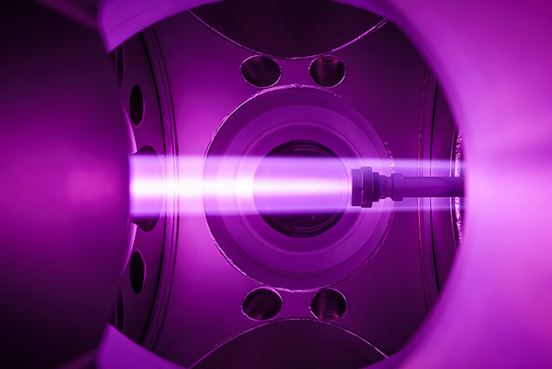
Fusion works by pressing atoms (of hydrogen, usually) together at enormous pressure—so enormous that it can overcome the mutual repulsion of these atoms and cause them to fuse and form a bigger atom (helium), while “sweating” a photon or two in the process.
This photon sweat is the bounty of the fusion energy, and it’s YUGE. Unfortunately, the process of squeezing a hydrogen plasma into a tight enough space for a long enough period of time at millions of degrees Celsius, without it leaking out the side or, worse, squirting off into the walls of your reactor and melting everything, is damned hard. You remember those prank spring snakes that pop out of a can when you open a lid? Imagine cramming a billion of those snakes into a can the size of a thimble and you’ll have some idea of the challenge.
Taming a fusion plasma is so hard, in fact, that it well be one of those hyper-intensive tasks mere human beings—with our leaden reflexes, sluggishly throwing switches and pushing buttons—might not be able to manage.
For an analogy, I often think of the F-117 Nighthawk, the first true “stealth” bomber produced back in the 1980s. The Nighthawk didn’t look like a regular airplane because it wasn’t a regular airplane. Rather, the distinctive, saw-tooth pattern of its wings and fuselage, which was the essence of its radar-evading design, made it look ungainly. And, indeed, it was ungainly, so much so that no human pilot could fly it unaided. Instead, an on-board computer was required to make constant corrections, microsecond by microsecond, to keep the plane in the air and on target.
Controlling a nuclear plasma is, I suspect, a lot like flying a stealth-bomber; constant corrections are needed to keep the fluid stable. And they need to happen much faster than a human being can comprehend, no less attend to.
Enter AI.
As we all should know by now, you can teach an AI how to do almost anything—including (we hope) how to maintain a fusion plasma. As the article I mentioned above explains, a partnership has been created between the private company Commonwealth Fusion Systems (CFS) and AI research company Google DeepMind to do just that. One of the more notable achievements of this partnership so far is the creation of a fusion plasma simulator called TORAX, which could be used to train an AI.
Of course, I have no idea if this partnership will turn out to be fruitful. For that matter, I have no idea if we will ever, truly, crack the fusion code once and for all. But I think we will. And I’m not alone. As one expert, Jean Paul Allain, states in the article, “Fusion is real, near and ready for coordinated action.” In other words, fusion might soon be a real thing. For this reason, capitalists have caught the fusion bug and are funding dozens, if not hundreds, of related start-ups, including CFS.
In some ways, this fusion mania is reminiscent of the very earliest days of aviation (way earlier than the Nighthawk). Back in 1908 or so, there were literally hundreds of amateur aviators in Europe, desperately trying to master the trick of powered flight. Many of these enthusiasts were smart, self-funded, and brave. But their craft were not much better than cannonballs with wings, unable to turn or steer, or even stay in the air for very long. Sure, they had all heard rumors of a possible breakthrough that might have been achieved by those bicycle-shop boys, the Wright brothers, over in the U.S., but no one knew exactly what had happened. And they certainly hadn’t seen the proof.
At an exhibition in Le Mans, France, Wilbur flew his and Orville’s latest model over the famous racecourse, remaining in-flight for a full one minute and 45 seconds. More important than the duration, though, was the fact that he could steer the airplane, demonstrating banked turns, climbs, and dives.
Three years later, he flew a newer model over the same racecourse for 31 minutes and 25 seconds.
The world had changed.
The same kind of progression is now happening in fusion. In 2024, Korea’s KSTAR tokamak sustained plasma for 102 seconds. In February of 2025, the WEST in France sustained a plasma for 22 minutes. Each year or so, the record gets longer, and the plasma becomes more stable. And all this is happening before the ITER mega-reactor has even come on-line (as it is expected to do this year).
One of these days, fusion is going to take off and never land.
Author’s Note: There has a been a lot of really cool UFO news lately (especially this article), so I thought I would re-share an old post I wrote some years ago regarding a fine book on the subject. Enjoy!
From 1989 to 1992 I went to graduate school at the University of Arizona. This was around the same time that Fife Symington was elected governor of that fine state. I don’t remember having any opinion of Symington at the time, except that he seemed a man very much in the mold of Arizona politicians: a conservative, folksy cowboy.
So it was probably not that big of a surprise when, six years later, Symington handled an unusual political crisis in what many saw as a callous, flippant way. The crisis in question was a UFO—literally, an unidentified flying object—that was spotted by hundreds of people in the Phoenix area on the night of March 13th, 1997. The incident, which has since become known as The Phoenix Lights UFO Incident, resulted in dozens of 911 calls and hundreds of letters being written to the governor. Eventually, Symington was forced to hold a press conference about the event, in which he essentially laughed-off the whole affair. (One of his aides came to conference dressed as a green alien. Hilarity ensued.)
I recently learned that this year’s Nobel Prize in Physics went to a team of scientists who conducted experiments on quantum tunneling. Their experiments were conducted in the 1980s, which is typical of how the Nobel committees work—it takes around thirty years for a scientific consensus to build that a body of work was truly worthy of a Nobel Prize.
I was interested in this news because, like most sci-fi nerds, I have an unflagging fascination with quantum mechanics. Heck, I even have a passing understanding of the fundamentals. (No, not just from Star Trek; I’ve read a few actual books! With facts, and stuff!) A few years ago, I even tried to write a non-fiction book about Bell’s Theorem, which is a famous consent in Quantum Mechanics, albeit one that you’ve probably never heard of (unless you’re a physicist or a science teacher or a sci-fi nerd).
John Stewart Bell (copyright CERN)
To be frank, I had never heard of it either, until I read about it in a science book and then ventured to the Wikipedia page, where I learned that the theorem was written by an Anglo-Irish physicist named John Stewart Bell in the 1960s, and it hit the scientific community like a hurricane. Later, in 1975, another physicist Henry Stapp called it “the most profound discovery of science.”
When I read this quote, I thought, “Whoa, dude! If it’s really the most ‘profound discovery of science’,” I should probably learn something about it.”
And I did. Sort of.
Obviously, I will never really understand the underlying math, or even the root concepts that the math represents (which is one reason I abandoned the aforementioned book project). But the theorem itself is pretty easy to understand….
When I was a kid, my parents bought me a book called A Pictorial History of Science Fiction by David Kyle, which covers the history of science fiction illustration from Jules Verne all the way through the 1970s. (The book was printed in 1976.) I still have it. I remember being especially enthralled by covers from pulp magazines in the 1930s like Astounding Science Fiction and Amazing Stories. Many of these covers were devoted to some artist’s vision of The City of The Future—usually some towering, high-tech, hive-like metropolis.
It makes sense that sci-fi nerds of the 1930s would imagine a vertical, urban future. At the time, the most sophisticated places on earth were the great western cities of Europe and America. Paris. Berlin. And especially New York—Manhattan—with its great skyscrapers reaching ever higher. The obvious extrapolation of this trend was that someday everyone would be living in some vast, super-tall version of New York or Los Angeles, with buildings hundreds of stories high and millions of people living in close proximity. Ramps and walkways would connect these towers in the sky, allowing residents to hardly ever venture down to street-level. Airplanes, blimps, and elevated high-speed trains would speed residents from one end of the city to the next.
For most of these sci-fi artists and writers, this was going to be a good thing. A utopian vision, in fact. Future cities would be paradises of high technology, dense but egalitarian. Robots would do all the dirty work, and everyone would be rich. For others, though, the City of the Future would be a capitalist hell, with the decadent rich living high above the exploited poor. These upper-classes would hoard resources and technology, either out of fear or greed or sheer meanness. It is this dystopian vision that informs works like Fritz Lang’s Metropolis, as well as every instance of the cyberpunk genre from William Gibson’s Virtual Light to Ridley Scott’s Blade Runner.
Despite this dark side, however, the vision of an artificial, high-tech utopia has long existed in sci-fi, and it still does today. But the vision itself has changed. Relocated. These days, the City of Future is almost invariably depicted as being in outer space—”off-world,” in the lingo of movies like Blade Runner—either on a nearby planet or the moon or on a station floating in space.
Space stations, in particular, have captured the imagination of science fiction fans for the past four decades, ever since Princeton physicist Gerard K. O’Neill published The High Frontier: Human Colonies in Outer Space. In that landmark book, O’Neill explained the advantages of living on a space colony as opposed to a land-based colony like Mars or the moon. These include the fact that one could spin the colony to produce the same gravitational pull as Earth, thus avoiding any physiological problems the colonies might suffer from living on a smaller world. Unlimited solar power is another plus, as is the fact that, living outside the gravity well of a planet or moon, travel between colonies would be vastly cheaper. Trade would thrive, fueled by a steady flow of cheap, raw materials from the asteroid belt and various moons throughout the solar system.
Artist’s Depiction of Stanford Torus Interior, c. 1970s
O’Neill was the first, legit scientist to take the idea of people living in outer space seriously, and he was able to back up his ideas with hard data, including actual blueprints for working stations. Namely, he invented the O’Neill Cylinder, a tube-shaped world the size of a city with its residents living on the inner surface. Other designs were created by a diverse group of like-minded theorists. Of these, the most compelling is the Stanford torus (named for the university where the plan was cooked up). Instead of a tube, it’s a giant wheel. For whatever reason, it’s this ring-like design that has dominated most sci-fi stories of recent decades. Larry Niven’s Ringworld is basically a humongous Stanford torus (large enough to encircle a star). And the design is also represented in the wheel-worlds of the Halo videogame franchise and the fabulous Orbitals of Iain Banks’s The Culture novels.
As was the case with the high-rise super-cities that were imagined of the 1920s, the space-colony vision isn’t always utopian. In the 2013 film Elysium, for example, the titular space station is an exclusive haven for the ultra-rich, desperate to escape an Earth ravaged by global warming and end-stage capitalism. Perhaps this is why many people become uneasy when billionaire tech-bros like Jeff Bezos openly embrace the idea of building giant colonies in space. They seem to be confirming the dystopian side of the space colony coin.
I have very little in common with Jeff Bezos. But, like him, I must confess to be completely captivated by the idea of colonies in space. They are not only fun to imagine, but I believe that they probably do represent the best possible, long-term vision for the future of humanity. I don’t know if they will happen, but I hope they do.
Recent Artistic Depiction of Stanford Torus
Why do I harbor this hope? Lots of reasons. For one, space colonies offer our best chance of surviving as a species into the far future. Even if we somehow avoid the worst consequences of global-warming, there will always be some other looming disaster that threatens to exterminate life on Earth, from planet-killer asteroids to super-volcanoes to the next pandemic. With space colonies, there would soon be more people living in space than earth—perhaps trillions of people within a few centuries—thus making us a lot harder to wipe out.
For another, the quality of life on space colonies would probably be much, much higher for the average citizen than it is likely to ever be on Earth. This is due to the advantages I listed above, like abundant solar power and cheap resources for asteroids. And overpopulation would never be a problem—at least, not for long. Whenever a colony got too crowded, any citizens who craved more elbow-room would simply build a new space colony and move into it.
Of course, many people will never be disavowed of the idea that space colonies represent nothing more than a “Plan-B” for the ultra-rich. That is, after all the rich people trash the earth with their greed and unfettered capitalism, space colonies give them the ultimate chance for escape from the consequences of their actions.
This is, I think, a real possibility for why space colonies might eventually be built. But it’s not the only possibility, nor even the most likely. Rather, my guess is that space colonies will be built for the positive reasons that I mentioned—abundance, room, and quality of life. Indeed, one could imagine an era—in the three or four-hundred perhaps—when so many people choose to emigrate to space that Earth could become a giant Hawaii. That is, an ecological and historical preserve, with less than a billion people on the entire planet. People who are born on space colonies might endeavor to make a pilgrimage down to Earth at least once in their lives, the way many Irish-Americans eventually take a vacation in “the Old Country” of Ireland.
One thing Bezos and I vehemently disagree on (one of many things, actually) is the time-table for when space colonies will eventually be built. It won’t happen any time soon–not in Bezo’s lifetime (unless he has a store of some immortality drug stashed somewhere), nor in mine, nor in the next generation. But I think it will happen.
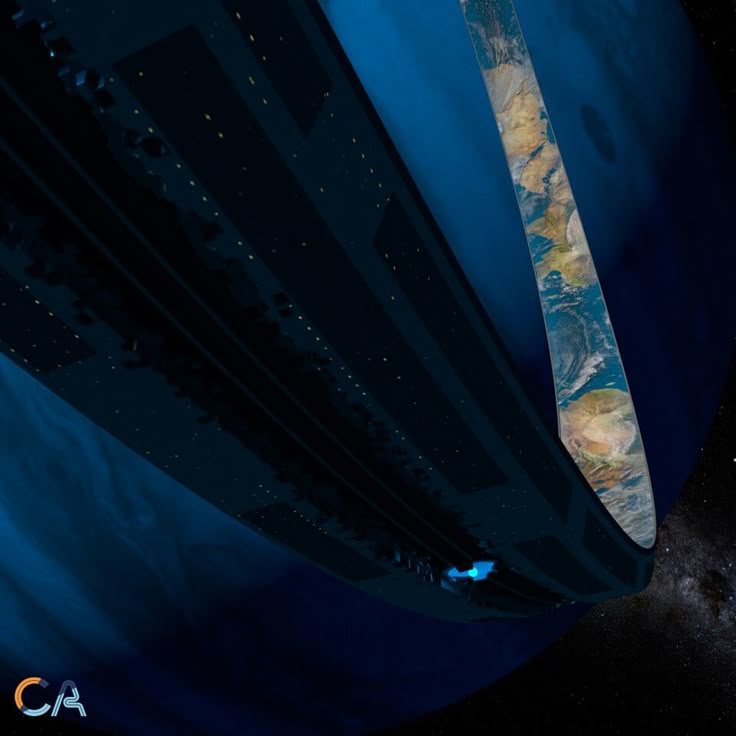
Artistic Depiction of a Roofless Bishop Ring
Which leads to the question: Will space colonies really be utopias? That depends on your definition of utopia. If a citizen of mediaeval Europe were to be magically transported to a modern, western city, they would probably perceive it as a utopia. I mean, running water? Toilets? Central heating? All the food you can eat? How much more utopian can you get? Such a person would probably dismiss any argument we might make to the contrary—that people in the 21st Century have as many problems as those in the 13th. Bullshit, they would probably say. And they’d be right. For, while modern western civilization isn’t perfect (and it seems to be getting less perfect by the day, alas), it’s still pretty freakin cool. Yes, we still have evil and stupidity and greed. And all of those human failings will find their way onto space stations.
But still, we will be making progress. It’s a worthwhile vision, and exactly the kind of dream that good sci-fi can deliver.
I can’t believe it’s been 41 years since James Cameron’s The Terminator came out. I first saw it in the movie theater and like everyone else I was completely stunned by its energy and creativity. It might well be the best B-movie action film ever made. (Its sequel, T2, is an A-movie action flick that still feels like a B-movie, in a good way.) Cameron’s spin on what is essentially the ancient hunter-vs.-the-hunted plot—mashed up with about a dozen sci-fi tropes and a heaping serving of the Frankenstein/Dr. Faust myth—results in an almost perfect piece of entertainment. There is not a dull moment or lame moment in it. Every scene either surprises, shocks, or tickles the viewer.
The sequel, T2, is even better, mainly because it’s a coming-of-age film. Rather, it’s a becoming-human film. We watch as the Terminator observes human beings, learns from them, and begins to emulate their best qualities. It’s an archetypal story, and I (almost) tire of watching it. And, in the process of watching the film so many times over the years, I’ve repeatedly asked myself: What is it like to be the Terminator?
One of my favorite movies of the last twenty years is Ridley Scott’s The Martian. It’s a science-fiction/adventure movie about an astronaut (Matt Damon) who becomes stranded on Mars after his comrades leave him for dead. Marooned on a barren, hostile world, he has to use his brains and ingenuity to survive until his friends come back to rescue him. By the end of the movie, he has survived dust storms, explosions, freezing temperatures, and starvation.
How does he overcome all these challenges?
Science.
The story is familiar, of course. It has many antecedents, including with the original stranded-on-an-island novel, Robinson Crusoe, and also (more directly) to a great B-movie Robinson Crusoe on Mars. In that classic 1964 cheese-fest, the hero survives by finding a Martian cave full of air where plants still grow, water still flows, and there’s a steady source of light (which is never explained). He even befriends an alien who is also trapped on the planet.
I learned many things from reading the excellent nonfiction book Would You Baptize an Extraterrestrial? For instance, I learned that the Vatican has its own astronomical observatory, which is run, in part, by the authors, Guy Consolmagno and Paul Mueller. Both men are also Jesuits. (The current Pope, Francis, is also a Jesuit—that’s another thing I learned).
Now, I was raised Catholic, and I thought a knew a thing or two about the religion. But not only did I learn from this book that the Vatican has its own observatory, but that it has had one for hundreds of years. In fact, I was so taken by this discovery that I Googled “Vatican observatory” and, to my amazement, found that the Vatican also runs an observatory in Tucson, Arizona.
Talk about synchronicity! When I was twenty-two years old, I went off to attend grad school at the University of Arizona, in Tucson, and I distinctly remember the first night I spent there. I impressed by the size of the city—much larger than my little hometown of Gainesville, Florida—but also by how beautiful the desert sky was. Even in the downtown area, the stars were clearly visible. This was no accident; the city, I was told, purposely kept the streets relatively dark, in deference to the many astronomical observatories that surround the valley, which could not function if too much light pollution bled from the metro area.
Apparently, the Vatican’s observatory is one of them.
One of the coolest classes I took at U.F. was Intro To Astronomy, taught by a funny old German guy named Heinrich Eichorn who, I later learned, was Chair of the Astronomy Department. (Yes, this was back in those quaint old days when top-notch professors had to actually, you know, teach class. And not just to grad students!) While Professor Eichorn’s lectures tended to meander a bit, he had a genuine enthusiasm for the subject that students, myself included, could sense and respond to. I remember one particular class when, in one of his usual, off-topic asides, he said, “We know the universe is not infinite. If it were, then every point in the sky above us would always be as bright as a star.”
For me, this was one of those mind-blowing moments when one is exposed to the wisdom of the ages. In this case, it was that of another German astronomer, Johannes Kepler, who in 1610 realized that if the universe really were infinitely large, and infinitely old, then every line-of-sight direction one looks at in the sky should eventually hit a star. Thus, the entire sky should be as bright as (and, worse still, as hot as) the surface of a star. Nevermind the fact that most of these stars would be very, very far away. Their light would still have an infinite amount of time to reach us, and there would be an infinite number of them shining down on us.









 Ash Clifton, Writer