Synchronicity for Bookworms: Harlan Ellison

Harlan Ellison in the 1970s

The great film critic Roger Ebert once noted that the people we think of as heroes are those we looked up to when we were kids. As adults, we might admire a particularly talented athlete or actor or musician, but they won’t really be “heroes” to us; they’ll just be really cool (but life-sized) people. 

I think that my middle-aged affection for Harlan Ellison might be a slight exception to this adage, however. I was a fan of his when I was growing up (he became famous in the 1970s with his revolutionary, sci-fi short-stories like “I Have No Mouth, and I Must Scream”), but he wasn’t exactly a “hero” of mine. Then, in the 1990s, Ellison began to appear on TV as a talk-show celebrity, especially on the sci-fi channel, where he essentially co-hosted a show called Sci-Fi Buzz, where he was often very funny and always insightful. Also, to my amazement, one of his stories, “The Man Who Rowed Christopher Columbus Ashore,” was included in 1993’s Best American Short Stories collection. I saw an Ellison interview around that time, in which related that the series’ editor called him to give him the good news. At the end of their brief conversation, she asked him if had written any other short stories—an unintentional slight that Ellison said felt like “a dagger to the heart.” 

But this was typical of Ellison’s relationship to the literary world, and to Hollywood. He couldn’t get no respect. Part of this life-long diss was, surely, his own fault. He was famously abrasive and out-spoken, and hated to have his work messed with. When he wrote the screenplay for the what is generally considered the best episode of the original Star Trek series, “City on the Edge of Forever,” he hated Gene Roddenbury’s changes so much that he tried to have his name taken off the credits. (Fortunately, he failed.) In fact, he was so contentious about such matters that he had a special pseudonym, Cordwainer Smith, that he would use when he felt his work had been to mangled by studio executives that he no longer wanted his real name associated with it.

Paradoxically, the more interviews I watched of Ellison in the 1990s and beyond, the more I liked him. He had a razor wit, and he did not suffer fools easily. He could also be mean as hell when he felt attacked. But these were all characteristics I had seen before in some exceptional people I have met over the years, including my great teacher, the writer Harry Crews. I never met Ellison, but I suspect that we would have gotten along just fine. 

Indeed, I came to admire even Elllison’s famously pugilistic nature. He was quick to sue anyone who he felt had stolen his ideas. Most famously, he sued Orion Pictures over 1984’s The Terminator, alleging that director/writer James Cameron had cribbed the concept from a script Ellison wrote for The Outer Limits. Orion settled the suit out of court. (Cameron later called Ellison a “blood-sucking ghoul,” which I still find hilarious.)

Clearly, Ellison knew how to defend himself and his ideas, and to get what he felt was owed to him. Much of this toughness, I imagine, came from Ellison’s early life, growing up as an diminutive Jewish kid in Ohio. Like a lot of smart, little guys, Ellison learned how to punch back, and punch hard. 

After I wrote a blog post about Ellison and Isaac Asimov last year, I found myself thinking about Ellison more and more. So much so, in fact, that a couple of weeks ago I decided to write something about him, although what form that would take. 

Then, in one of those moments of synchronicity that happen to writers when they immerse themselves in a subject, I stumbled upon a fact regarding Ellison that I had never read before, and it came from a totally unrelated source.

I was looking at some classic sci-fi book covers when I spotted one for Fritz Leiber’s The Big Time. I hadn’t thought of Leiber in decades (he was a favorite of a friend of mine in middle school), so out of pure curiosity I checked out his Wikipedia page. There, I was saddened to learn that Leiber spent the last few years of his life in poverty. As with so many writers, alcohol had taken its toll, and Leiber ended up living in a cheap motel. Apparently, Ellison came to visit him one day and was appalled by the state of his affairs, with Leiber not even able to afford a writing table. Rather, he was composing his latest work on a “manual typewriter propped up over the sink.” 
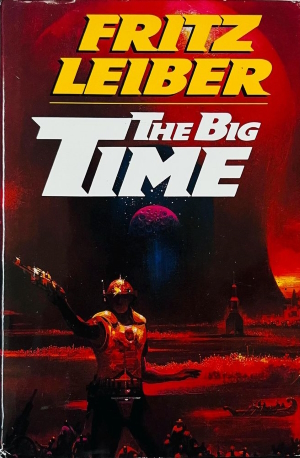
Fritz Leiber’s Sci-Fi Classic, “The Big Time”

Okay, maybe this wasn’t a good example of full-blown, Jungian synchronicity. I guess it wasn’t that unlikely that I should stumble upon a Ellison anecdote while reading about Leiber. They were both great science fiction writers, after all, and it make sense that they might have known each other. In fact, as I learned, Ellison included some of Leiber’s short stories in the Dangerous Vision anthologies that he (Ellison) edited for decades. Still, I didn’t know of any connection between the men. They were of different generations and circumstances, linked only by their genre and talent.

Unfortunately, the Wikipedia article does not cite the source of this (if anyone knows, please tell me), nor does it say what action, if any, Ellison took to improve Leiber’s circumstances. But I like to think that he did something to help. After all, he was a pugnacious, smart-ass little guy who looked after himself and other little guys. I miss him.

Here is a good interview that Ellison gave to the BBC in the 1970s.

Orlando Trip De-Brief (with a Bit of Synchonicity)

Me with Danni and Michelle of the BCAD Podcast at the Barnes & Noble on Colonial

Well, Cathy and I got back from Orlando on Thursday, and this is the first chance I’ve had to write a post about it. All in all, it was a fine trip! My book talk at Barnes and Noble went well, mostly due to Danni and Michelle, the hosts of the excellent podcast Book Club After Dark, who were nice enough to interview me. They asked great, insightful questions, and I had a lot of fun. The turn-out was modest, but the people who did show up seemed really interested. They asked some great questions, too. It was especially nice to see my old friend Norm, who came to the event to cheer me on. He also snapped the picture above. 

Afterward, Cathy and I had a great dinner and some fine beers at the Harp and Celt Pub downtown. The next day, we did a driving tour of Orlando, Noland Twice’s home turf, refamiliarizing ourselves with our old stomping grounds. As one might expect, parts of the city seem completely different from when we lived there, while other parts seemed exactly the same. Overall, O-Town still feels like two cities. There’s the lovely, old, Southern city, with its tree-shaded streets and gorgeous houses from the 1930s and ‘40s. Then, there’s the litter-on-a-stick, urban sprawl of Generica, with its strip-malls and fast-food shacks and liquor stores. And traffic. Lots of traffic. The really sad part about Orlando is that you have to drive through the nasty bits to get to the nice, old, quaint bits. But oh well. I still love the city.

Catchup by the Pool by Slim Aarons (snapped from my phone in Orlando)

When we were done exploring, Cathy and I drove down Mills Avenue and visited the Mennello Museum of American Art, which is perhaps the best small museum I’ve ever visited. I was especially taken with their current exhibit, entitled Pool Party, which had lots of amazing photos and paintings of American pool culture from all over the country. I was especially taken with this 1970 photo, above, by former combat photographer Slim Aarons. It’s titled Catchup by the Pool, and it seems to encapsulate the entire upper-class, White, suburban culture of the U.S., right on the cusp between two equally garish decades. And yet, it’s also kind of…sweet. I find myself wanting to go to this party.

Screen Grab of a Random Speechify Ad from my Youtube Account

And then, just this morning, in one of those instances of synchronicity that seem to happen fairly often to me (and which I blog about, a lot), I happened to be presented with a YouTube ad (for Speechify, of all things). Before the skip button came up, I had to leave the room, so I paused the ad so I wouldn’t miss the beginning of the actual video I was waiting for. (Just to prove I wasn’t crazy, I did a screen grab, above left.)

When I came back, I noticed that there was something weirdly familiar about the freeze-frame that I happened to pause on. If you look at the background, on the wall of whatever apartment or motel room the ad was apparently filmed in, you can see—lo-and-behold!—the same photo by Slim Aarons

What are the odds? Like, a bazillion-to-0ne! Talk about synchronicity-on-steroids!

Anyway, it seemed like a magical end to a good trip. 

Synchronicity for Bookworms: Sherlock Holmes and George Eliot

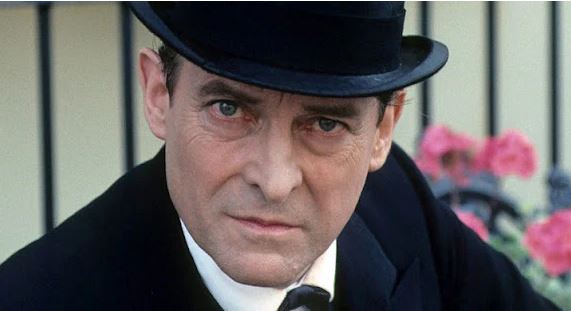
Jeremy Brett as Sherlock Holmes

It’s time for another entry in my ongoing series Synchronicity for Bookworms. In this episode, I will describe the incredibly tenuous and yet undeniable connection I found between the great stage and film actor Jeremy Brett and George Eliot’s classic Victorian novel Middlemarch

As you might recall, I recently did a blog post on Arthur Conan Doyle’s classic mystery novel, The Hound of the Baskervilles. In that post, I mentioned that my favorite actor to ever play the role of Sherlock Holmes was Jeremy Brett. While I was writing the post, I browsed various Internet pages pertaining to Brett. Brett was primarily a brilliant and prolific stage actor, appearing in everything from Shakespearean Tragedy (check out his performance as Macbeth on YouTube) to comic theater. 

Rex Harrison

On one page, I found a photo of Brett standing in front of a billboard advertising a play in which he was appearing. As I looked closer at the image, I saw that Rex Harrison was also in the play. (As I later discovered, the production was a revival of Frederick Lonsdale’s “Aren’t We All?” that ran on Broadway in 1985.) This revelation made me smile because I am also a fan of Rex Harrison, ever since I read a biography of him a decade ago.

Naturally, I immediately went to the Wikipedia page for Rex Harrison and browsed through his biography. This included his great filmography. One of the more famous films he starred in was Blithe Spirit, a supernatural comedy based on a play by Noël Coward. I clicked on the link to the Wikipedia page for Blythe Spirit (the play) and discovered that Coward took the title from a poem by the great British romantic poet Percy Bysshe Shelley

Naturally, I then clicked on the link to Shelly’s Wikipedia page and browse through his biography. Reaching the bottom of the page, I saw to my amazement that George Eliott had based the character of Will Ladislaw from her great novel Middlemarch on Shelley. 

Percy Bysshe Shelley

And there you have it, a cosmic filament connecting two of my recent topics—Sherlock Holmes and George Eliot. When my eyes settled on this last reference to Middlemarch, a little spark of amazement ran down my spine. That’s the sensation one gets when stumbling upon the sublime, hiding in the common-place.

Note that this was not some Six Degrees of Seven Bacon thing. That is, I was not looking for any connection. In fact, Middlemarch wasn’t on my mind at all when I started Googling Jeremy Brett. And yet, there the connection was.

I don’t know if it means anything or not. But it made my day.

Synchronicity for Bookworms: Martin Caidin

Iron_Annie
German Ju-52 “Iron Annie”

Some years ago, my son Connor and I were watching the movie Dunkirk on DVD. It’s a very good movie, telling the story of that fateful week from multiple points-of-view. Of course, the most compelling thread of the narrative is that of the lone RAF pilot (played by Tom Hardy) doing his heroic best to protect the stranded British troops.

These scenes inevitably led to a geek-worthy discussion between Connor and me about the relative merits of the RAF’s Spitfire versus the Luftwaffe’s Messerschmitt 109. Believe it or not, such discussions are becoming more common between fathers and sons (and mothers and daughters, for all I know), mainly because of online games like War Thunder, whose popularity has breathed new life into the study of military history by the Millennial generation.

Anyway…. At some point during the discussion, I offhandedly commented that I had once flown in Adolf Hitler’s airplane.

Continue reading “Synchronicity for Bookworms: Martin Caidin”