I love Stephen King. I watch his interviews and lectures on YouTube, and I re-read his book, On Writing, once or twice a year, finding it one of the best meditations on the craft around, not to mention a very fine memoir. I follow him on Twitter (er…X), and you should, too (he’s @StephenKing, if you’re interested).
And yet, in one of the stranger ironies of my adult life, I went over twenty years without reading a King novel. Sure, I once devoured books like The Stand and Firestarter in high school, but then I became an English major and, for a multitude of reasons, I stopped.
(Author’s Note: The recent tragedy in Maui got me thinking about one of my favorite novels of the past twenty years, The Descendants, which is set nearby. I am reposting this essay about it as a kind of semi-tribute.)
Even though I fancy myself a literary fiction writer (even when I’m writing detective or sci-fi novels), I don’t read that much literary fiction. I read a ton when I was young, especially in college, and lately I’ve found it difficult to find novels that don’t seem derivative or poorly imagined or just downright silly. And for those rare books I do find engaging, I often arrive at them in circuitous ways.
Take Kaui Hart Hemmings’ celebrated novel, The Descendants. Like a lot of books I read, it became known to me from a movie adaptation, although, strangely enough, I didn’t actually see the movie. I was on a flight to Europe some years ago, on an older model jet that still had drop-down movie screen, and the in-flight movie was The Descendants. I didn’t pay for the earphones, but even as a silent film it looked interesting, with George Clooney skulking about some lush tropical landscape that I somehow knew was Hawaii. I looked the movie up on Imdb.com and found that it was based on a novel, so I looked that up. It was a debut novel and looked the kind of book I might like: a literary story, told from a single point-of-view, with relatively few characters, a vivid setting, a compressed time-span, and an intriguing premise.
So, I checked it out on Overdrive. And, man, was I lucky I did.
Down here in Florida, we know a thing or two about hurricane preparation. So, for all my friends out on the west coast about to face down their first-ever hurricane, I thought I’d offer my personal short list of things to do and have on-hand before the storm hits.
Water (obviously). Bottles. Buy a big (like a disperser sized) bottle if you can’t find any smaller ones.
Bleach. You can use this to treat water if you know what you’re doing and don’t poison yourself. You can also use it to help wash dishes.
Flashlights/Lanterns/Candles. Duh.
Charge everything. Cell phones, laptops, tablets. If you have an external or backup battery (I like camping batteries), change those, too.
Gas up your car. I don’t care if you aren’t planning on bugging out. Gas will be short for a week or two. Plus, you can use your car to recharge your phones, etc.
A radio. Yes, an honest-to-God, battery powered radio. If you don’t have one, download an app to turn your cell phone into an FM receiver. (You’ll need wired-headphones, however.)
Canned food. Beans are great. Soup is great. Anything you can cook on a grill is great. Also, sardines, tuna, etc are good to eat cold (buy crackers!).
A barbeque grill. You can use this to make coffee if nothing else.
Charcoal.
A coffee pot you can use on the grill.
A deck of playing cards. (Trust me.)
Board games.
While you have power, freeze as many water bottles/jugs as can in your freezer. The more your freezer resembles a solid block of ice, the longer your food will stay good.
Freeze a cup of water and leave it in the freezer. Once it’s frozen, drop a quarter on top. This will let you see how much your freezer has thawed after the fact.
I started binge-reading science fiction when I was in 8th grade. That was the year that the local school board rezoned the kids from my White, suburban neighborhood to attend the largely Black, urban middle school, Lincoln, across town. This was a miraculous development for me because I had already attended Lincoln (back when my parents and I still lived in the ‘hood, or thereabouts), and I already loved it. But there was a downside—I had a really, really long ride on the school bus. Like almost an hour each way.
So, I started reading seriously, and as with a lot of boys at that age, my go-to genre was sci-fi. I read a lot of Arthur C. Clarke and Ray Bradbury and John Christopher. But perhaps the most revelatory, amazing book I had read up to that time was Larry Niven’s Ringworld. Never had a novel held such wonder for me, such a Tolkienesque landscape of adventure and possibility. The fact that Niven was able to pull this off in a book which is, even today, a prime example of so-called “Hard SF,” in which every story element must be grounded in, or acknowledge the effect of, some scientific principle.
The fact that Niven’s novel (the first of a tetralogy) has never been adapted to film is perhaps testament to this fact, the book’s off-the-chart nerd factor. Set in the 29th century, the story concerns an Earth-man, Louis Wu, who goes on adventure with two aliens and a human woman to visit a distant, recently discovered artifact called the Ringworld. It’s basically a giant, taurus-shaped space colony, so big that it wraps completely around its sun-like star. The entire ring spins to simulate 1G of gravity, and thousand-kilometer high mountains along the rim keep the air from leaking out. An inner ring of smaller, checker-box squares creates a shadow pattern on the inside of the big ring, creating a day/night cycle.
And there you have it, a plausible sci-fi world with normal gravity and a recognizable biosphere, including oceans, forests, deserts, mountains, and so on, but with an unbroken surface area equivalent to three million earths.
Oh, how this idea fired my thirteen-year-old imagination. Forget Shangri-La or Cathay or Edgar Rice Burroughs’s Mars or Middle Earth or any of the other fantasy lands of pre-1970s literature. Here was an endless realm that you could explore for a million years and never reach the end of. And, sure enough, as Louis and his alien comrades (one is a humanoid, Tiger-like creature called a Kzin, the other a two-headed cowardly alien called a Puppeteer) wander across the Ringworld, they encounter many of the tropes of 19th century adventure lit, including castles, galleons, savage tribes (including sexy native girls), shamans, sword-wielding heroes, etc. Niven accomplishes all this by establishing that the once high-tech inhabitants of the Ringworld have long since fallen into a pre-industrial state, leaving open the mystery of how this apocalypse happened and what remnants of the original civilization might remain, if any.
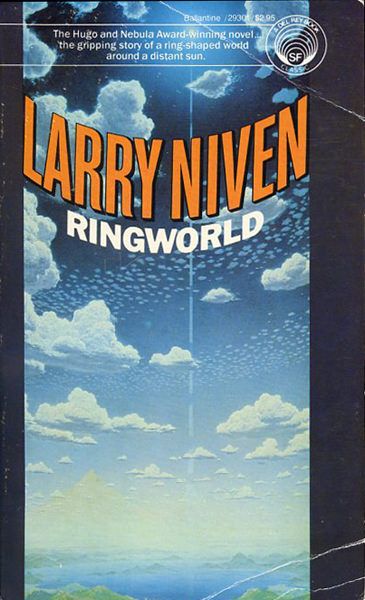
It’s a great, great adventure book, and it has inspired a number of fine covers. My favorite is the one above by Don Davis. Davis was in some ways an inspired choice since he was best known as a “space artist,” doing representations of proposed space colonies for NASA. (And, as I said above, the Ringworld is basically a giant space colony.) Davis’s cover captures the sense of wonder and endless possibility that novel creates, depicting a typical (summer-like) day on the Ringworld. In the distance, you can see the arc of the ring itself (the primitive inhabitants think it is an “arch”), complete with light-and-dark sections from the shadow squares.
It’s a fine cover, and I have no doubt that it and the book itself probably inspired the current obsession on the part of certain high-tech billionaires with the idea of space colonies, a possibility for a kind of endless utopia in outer space. And why not? Deep down, we’re all still thirteen-year-olds. Right?
Okay, this one is kind of a no-brainer. Seven Nation Army by The White Stripes contains one of the most iconic guitar riffs since The Rolling Stones’ Satisfaction. (And, as with that song, the riff supposedly came to the artist, Jack White, in a dream).
Yeah, it’s got a great riff, but I mainly like it because it feels kind of demented, the way it moves between fast and slow, loud and soft. Also, in keeping with the demented motif, the video is great. I can’t prove it, but it seems to be channeling the original poster for Stanley Kubrick’s A Clockwork Orange, which is possibly the most demented movie ever made.
Anyway, enjoy. And rock on…
Here is the Kubrick poster…
And here is The White Stripes video. You be the judge:
Recently I was enjoying a long-distance phone chat with an old friend of mine, and the conversation turned, as it inevitably does, to the weather. She lives in Ohio, I live in Florida, and yet our answers to our respective inquiries about “How’s the weather where you are” were identical: Hot AF.
Fortunately, scientists like David Keith have been telling us for years that we are not helpless in the battle against climate change. If worse comes to worst, for a few billion dollars we could deploy specialized aircraft to release particles of sulfur (or some more exotic material) into the upper atmosphere, thus reflecting enough sunlight back into space to cool the planet very quickly. Of course, as professor David warns, we have a poor grasp of what possible, global side-effects such a radical course of action might have (although one one wonders if these side-effects could be any worse than a Canada-sized wildfire or a continent-wide heat-wave in India). It is precisely because of these unknown side-effects, he explains, that we need to start thinking about the problem now, with a clear head.
Along these lines, one of the strangest—and yet most encouraging—options to the “solar dimming” set of possible mitigation strategies is the idea that we might blast moondust into outer space. Yeah. For real. This dust, if aimed properly, would linger in one of the Lagrange points between the earth and the sun and, for a time, reduce solar radiation falling on the earth’s surface. The effect would be short-lived due to solar wind blowing the dust away into interplanetary space, but this is a good thing in that the technique would thus be throttleable. We could blast as much as or little dust as needed to cool the planet without plunging it inadvertently into a new ice age. (Have you seen that movie SnowPiercer?) Also, unlike the sulfur-in-the-sky option, the lunar dust wouldn’t contribute to air pollution or acid rain here on earth.
Obviously, the notion that we might somehow shoot lunar dust into space on a routine, industrial scale seems like science fiction. But is it? The space agencies of many nations such as the U.S., China, and Japan have planned future missions to the moon. One can imagine a gradual infrastructure of settlements, supplies, and equipment gathering on the moon over time, much as one formed in the American West in the 19th Century. One could presumably build some kind of mass-driver or rail-gun that could shoot the dust into space, and power it with solar energy. (Extra power could be stored during the two-week long lunar “day” to keep the gun shooting during the “night”).
How much would such a setup cost? Billions? Trillions? On the other hand, how much would it cost to rescue two-hundred million people from Europe if the Atlantic thermohaline circulation is disrupted, as some scientists predict it will? Or to build sea-walls around New York and Miami and San Diego and every other major coastal city? Or to feed South America if the crops there dry up during the next heat wave?
It’s time to think outside-the-box, people.
If worse comes to worst, we shouldn’t rule out going back to the moon. And building a huge cannon there. Or anything else we have to do to cool off the planet.
Here is the original article on SingularityHub where I learned about this idea:
Fifteen years ago I read Mark Harris’s excellent non-fiction book Pictures at a Revolution: Five Movies and the Birth of New Hollywood. It recounts five movies that came out in 1968, a kind of annus mirabilis of American film, a pivot point in both cinema and culture when Hollywood reinvented itself for the better.
I was reminded of Mr. Harris’s book last night as I sat in a crowded IMAX theater watching Christopher Nolan’s vaunted new film, Oppenheimer. It is, of course, a terrific movie on almost every level: technically, visually, dramatically, and, yes, historically. Moreover, it marks the second very good movie I’ve seen in the last month (Wes Anderson’s Asteroid City was the other), and both films struck me as indications of turning-point in American movies, similar to the one Harris describes so beautifully. Both Asteroid City and Oppenheimer are gorgeous, inventive, and lyrica films—a dark, nostalgic kind of lyricism in the former, and a dark, horrific kind in the latter. Coming just a few years after the movie industry was declared dead during the COVID pandemic, this new wave of excellent films (I’m guessing Greta Gerwig’s Barbie will continue it) makes me hopeful that a new revolution is afoot.
Regarding Oppenheimer, I sat next to my son, Connor, who is also a film and history buff, and we were both mesmerized by the power of the film, but even more so by its cleverness. For a film based on a non-fiction source (Kai Bird’s fine biography of Oppenheimer, American Prometheus), Oppenheimer the movie feels like a fiction film. Unrelentingly tense and dramatic, it is almost free of exposition. Noland trusts the viewer to figure out what is going on in each scene, whether or not you’re familiar with the actual history.
I am, actually, familiar with it. I read Kai Bird’s book years ago and loved it. So, at one moment in the film when Oppenheimer reads from a sanskrit book and intones the words: “I am become death, the destroyer of worlds,” I knew that he is reading from the Hindu epic The Bhagavad Gita, and that these are the same words that would come to mind later as he witnesses the first nuclear test in the New Mexico desert. Part of Nolan’s genius, however, is to reframe this quote into a dramatic (um…actually erotic) scene, in which the character is having sweaty sex with his lover (the tormented Jean Tatlow, played with intelligence and verve by Florence Pugh). This is history done right. If you’re going to insert a famous quote by a famous man in a famous moment in history, you’re better off sneaking it into a steamy sex scene.
I don’t mean to brag—oh, who am I kidding; I totally mean to brag—but not only have I read Kai Bird’s book, I’ve read The Bhagavad Gita, too. And while I only read an English translation (unlike Oppenheimer), I gleaned enough meaning from it to know that it’s a story about a man who finds himself caught between duty and humanity, action and paralysis. Which strikes me as the central theme of Oppenheimer, too, both the man and the movie. Like Arjuna, the super-warrior hero of the Bhagavad Gita, who doesn’t want to go into battle against his friends, Oppenheimer was naturally reluctant to use his talents to create a bomb. But, from a moral and existential point-of-view, he finds himself trapped in a cosmic dilemma. As he explains to a friend at one point in the film, giving the Allies an atomic weapon would be dangerous, but giving the Nazis one would be apocalyptic.
But did he make the right choice? The question becomes even thornier when focused on the specific issue of how the bomb was first used, against Japan, an enemy that never had an atomic weapons program of its own and which was pretty much on the ropes by 1945. Personally, I have always found the question of whether or not America was right to drop the bomb on Japan to be mildly ridiculous. If we were fighting a war today in which hundreds of thousands of our soldiers had been killed fighting an implacable enemy, and if someone then told us, “We’ve got a bomb that will insert a colony of mutant spiders into country X, and those spiders will eat the face off everyone there, soldiers included,” I’d probably say, “Drop the friggin spiders.” This was essentially the decision Oppenheimer himself reached when advocating for the use of the bomb on Japan (an event he eventually celebrated, as is shown in the film’s most chilling scene).
But the best thing about Nolan’s film is that it never descends to this level of after-the-fact, arm-chair quarterbacking. Indeed, through Oppenheimer’s own hallucinations and fever dreams about a potential World War III, it makes clear that the decisions made in 1945—like the cosmic forces they unleashed—surpass ordinary human judgment, if not human understanding. Was Oppenheimer right to lobby for dropping the bomb? God knows. Perhaps not even Him.
I’ve read many fine coming-of-age novels in my time, but never one about a 62-year-old protagonist. Yet, in Under the Wave at Waimea, that is exactly what Paul Theroux delivers. And it’s a thing of beauty.
Joe Sharkey is a champion big wave surfer in Hawaii. Past his prime but still a hero to younger surfers, Sharkey lives off corporate sponsorships in a beautiful beach-side house, spending his free time on the water and hanging out with his much younger girlfriend, Olive. He lives pretty much as he always has: in the moment.
But his life turns dark when he accidentally hits and kills a homeless man on the road. Sharkey initially dismisses the incident (the man was “just a homeless guy,” after all, biking in the rain). But Sharkey soon finds himself cursed by mysterious maladies and a sudden, inexplicable fear of the water, culminating in a moment when he almost drowns while surfing on of his trademark big-waves.
Fortunately, he is rescued—both physically and spiritually—by Olive, who senses that Sharkey’s misfortunes can only be turned around if he performs some kind of penance. This takes the form of a search for the homeless man’s identity. They discover that his name was Max Mulgrave, a one-time Silicon Valley millionaire who somehow found his way to Hawaii and ended up living in a tent. In exploring Max’s life-story—which turns out to have many parallels to Sharkey’s own—Sharkey must confront some of the darker aspects of his own past, and the fraught trajectory of his future.
Theroux is one of those writers whose style always inspires me to try to improve my own. I’ve written before about how much I admire his novels, and this one is no exception. Endlessly smart and brutally honest, Under the Wave at Waimea is both a brilliant character study as well as a fine whodunit (in the best, psychological sense). Check it out.
It’s hot as hell in Gainesville, as one would expect of Florida in July. But I mean, it’s really, really hot as hell.
All over the country, people are feeling the effects of the climate change. Even the most hard-core deniers (some of which are people in my own extended family, whom I love) are starting to sense the truth about what we’re facing as a civilization.
Unlike many, however, I think we can innovate our way out of the mess before it’s too late. But we need a World War II level mobilization of effort and resources to tackle it. In keeping with that idea, here is a cool video explaining one of the best weapons we have in the battle against global warming: carbon capture. No, it’s not a silver bullet, but it is part of the solution.
It’s a well known fact of life that the older you get, the more you find yourself drawn to old things. This has always been true for me. I find myself particularly entertained by the classic pop culture of the twentieth century.
A few years ago, for instance, I was working my way through the works of two great pop writers: the James Bond thrillers by Ian Fleming, and the Nero Wolfe mysteries of Rex Stout. I would alternate between them, tearing through each series in no particular order. Each of them offered a different kind of thrill, and also a window into the past.
Young people today are familiar with the Bond stories thanks to the great and continuing set of movies based on them, the latest incarnation being the fine English character actor Daniel Craig. The Nero Wolfe novels are, of course, less well-known. To sum them up briefly, they recount the adventures of a reclusive, brilliant, and enormously fat detective who seldom leaves his Manhattan brownstone, preferring to solve his cases remotely. To do the actual legwork of investigation, he sends out his much younger, hipper assistant, Archie Goodwin (who narrates the novels). It is Goodwin who does most of that sleuthing required (as well as some frequent romancing of the numerous femme fatales). He brings the information back to Wolfe, who then solves the case by virtue of his sheer intellect.
I regard both series—the Bond novels as well as the Wolfe novels—as gems of pop literature: clever, witty, sexy, and (most importantly) sharply written. And so you can imagine my delight when, in the early chapters of Fleming’s On Her Majesty’s Secret Service, I came upon the following exchange between Bond and his craggy, avuncular boss, M.
Bond automatically took his traditional place across the desk from his Chief.
M began to fill a pipe. “What the devil’s the name of that fat American detective who’s always fiddling about with orchids, those obscene hybrids from Venezuela and so forth. Then he comes sweating out of his orchid house, eats a gigantic meal of some foreign muck and solve the murder. What’s he called?”
“Nero Wolfe, sir. They’re written by a chap called Rex Stout. I like them.”
“They’re readable,” condescended M.
This was the literary equivalent of having two good friends from separate areas of your life and inviting them both over for dinner, only to discover that they already know each other. More to the point, I found my love of Rex Stout vindicated by Fleming’s obvious approval. Had I looked, I could have found lots of other sources of vindication: Kingsley Amis also loved Stout, as did Isaac Asimov. (Asimov, in fact, was a life-long member of Stout’s fan club, The Wolfe Pack.)
Maury Chaykin as Wolfe
But the more I thought about it, the more Fleming’s Rex-Stout-shout-out made perfect sense. The character of James Bond bears more than a passing resemblance to Archie Goodwin. Both are tough guys—street-smart and wise-cracking anti-heroes—who would rather deal with a shot of a whisky than a shot from a gun. Like Bond, Archie is a brilliant operator, not to mention a rampant womanizer (although without Fleming’s darker, misogynistic overtones).
In retrospect, Bond seems like a more British, post-modern version of Goodwin—meaner, hornier, and drunker. Both characters lend a vicarious thrill to nerds like myself (and, I would bet, to Amis and Asimov). They represent versions of the tough guys we would like to be.
If there are strong echoes of Archie Goodwin in James Bond, then there are somewhat fainter echoes of Nero Wolfe in M. Like M, Wolfe is a mastermind who seldom leaves his office, preferring to send Archie to do the actual leg-work. Also like M, Wolfe is a bit of a cipher. We know he is of Eastern European descent, and that his youth was both violent and tragic, but nothing more. Beyond this, he exists only in the present-time of the stories, the genius with no intimate connection his fellow man—except perhaps in his dependence on (and grudging friendship with) Archie himself.
In suggesting that Fleming may have been influenced by Stout, I mean no slur against the great spy novelist, nor to British popular literature in general. Indeed, a sharp student of British lit would be quick to point out that Stout, in turn, seemed to borrow heavily from that earlier colossus of the mystery genre, Arthur Conan Doyle. No less a figure than Edmund Wilson first pointed out the similarity between Wolfe and Sherlock Holmes; both are hyper-intelligent misanthropes whose stories are told by lesser men. Just as Watson’s narration humanizes Holmes, Goodwin’s voice filters Wolfe’s genius and makes him accessible to the reader.
In fact, I’ve often thought of the Nero Wolfe novels as a kind of fusion of the Sherlock Holmes with the grittier, wholly American sensibilities of Philip Marlowe and Sam Spade. If Wolfe is the inheritor of Holmes’ deductive powers, then Archie is the reincarnation of the hard-boiled American private eye.
Archie is also genuinely funny…
What Wolfe tells me, and what he doesn’t tell me, never depends, as far as I can make out, on the relevant circumstances. It depends on what he had to eat at the last meal, what he is going to eat at the next meal, the kind of shirt and tie I am wearing, how well my shoes are shined, and so forth. He does not like purple. Once Lily Rowan gave me a dozen Sulka shirts, with stripes of assorted colors and shades. I happened to put on the purple one the day we started on the Chesterton-Best case, the guy that burgled his own house and shot a week-end guest in the belly. Wolfe took one look at the shirt and clammed up on me. Just for spite I wore the shirt a week, and I never did know what was going on, or who was which, until Wolfe had it all wrapped up, and even then I had to get most of the details from the newspapers and Dora Chesterton, with whom I had struck an acquaintance. Dora had a way of—no, I’ll save that for my autobiography.
Rex Stout
But while the works of Raymond Chandler and Dashiell Hammett often approached the level of high art, Stout’s novels remain happily in the realm of great genre fiction—beautifully written and with a sharp edge. Most of them involve snobbish, greedy rich people who need Wolfe to bail them out of some sort of trouble—a missing CEO, a murdered secretary, a looming scandal. If the true villain of Chandler’s work is the city of Los Angeles and all its soul-destroying corruption, then Stout’s is the corporate America of the 40s and 50s (the period when he wrote his best novels).
As with any pop classic, the Wolfe novels render of a deeply imagined world, peopled with distinct and vividly drawn characters: the cigar chomping Inspector Cramer; Wolfe’s fastidious Swiss chef, Fritz Brenner; Lon Cohen, the delightfully corrupt magazine editor who supplies Wolfe and Archie with much of their information. And, of course, there is Saul Panzer, the expert freelancer who represents a more cautious (not to mention Jewish) version of Archie himself.
But the real achievement of the novels comes from the sheer amusement of watching Wolfe demolish another fat-cat rich guy. It’s easy to detect a deep vein of progressivism running through all the Wolfe novels. Two of the main characters are Jewish, and Wolfe’s roster of clients often includes women, blacks, poor people, and (in one notable case), a victim of FBI harassment.
Like all good detective stories, the Nero Wolfe novels are not primarily about their settings, or even their plots. They are conversation pieces, witty studies in human character…less mystery stories than domestic comedies, the continuing saga of two iron-willed codependents engaged in an endless game of oneupmanship. Archie may be Wolfe’s hired hand, but he is also an undefinable combination of servant, goad, court jester, and trusted confidant. His relationship with Wolfe is by definition uneasy, intimate but never affectionate—it’s plain to see that he loves Wolfe like a father, but inconceivable that he would ever admit such a thing—and so the intimacy is transformed into a daily contest for dominance. At least half the fun of the Wolfe books comes from the way in which Stout plays this struggle for laughs.
The Wolfe novels have enjoyed a resurgence in the last twenty years or so, largely thanks to an excellent A&E television series from the 90s starring Maury Chaykin and Timothy Hutton. The books underwent a really fine reprint from Bantam books, with great cover art (a campy combination of art deco and pulp luridness). The price of these paperbacks is inflating faster than BitCoins, but fortunately Bantam has released most of them as Kindle editions for under ten bucks. The penny-pinching Wolfe would be proud.





 Ash Clifton, Writer